SmarterEd

Aussie Maths & Science Teachers: Save your time with SmarterEd

  • Login
  • Get Help
  • About

PHYSICS, M7 2024 HSC 32

Many scientists have performed experiments to explore the interaction of light and matter.

Analyse how evidence from at least THREE such experiments has contributed to our understanding of physics.   (8 marks)

--- 16 WORK AREA LINES (style=lined) ---
Show Answers Only

Students could include any of the following experiments:

  • Black body radiation experiments (M7 Quantum Nature of Light)
  • Photoelectric experiments (M7 Quantum Nature of Light)
  • Spectroscopy experiments (M8 Origins of Elements)
  • Polarisation experiments (M7 Wave Nature of Light)
  • Interference and diffraction (M7 Wave Nature of Light)
  • Cosmic gamma rays (M7 Special Relativity and/or M8 Deep Inside the Atom and standard model).

Young’s Double-Slit Experiment:

  • Young’s 1801 double slit experiment aimed to determine light’s wave-particle nature.
  • He passed coherent light through two slits and observed the pattern on a screen.
  • Instead of Newton’s predicted two bright bands, Young observed alternating bright and dark bands.
  • This interference pattern occurred due to light diffraction and interference, which  re wave properties.
  • The experiment provided strong evidence for light behaving as a wave at macroscopic scales. 

Planck and the Blackbody Radiation Crisis:

  • Late 19th century scientists studied the relationship between black body radiation’s wavelength and intensity.
  • Experimental observations showed intensity peaked at a specific wavelength, contradicting classical physics predictions.
  • Classical physics led to the “ultraviolet catastrophe,” which violated energy conservation.
  • Planck’s thought experiment resolved this by proposing energy was transferred in discrete packets (quanta) where  \(E=hf\).
  • This revolutionary idea marked a shift from classical physics to quantum theory. 

Einstein and the Photoelectric Effect:

  • In 1905, Einstein built upon Plank’s idea of quantised energy to propose that light was made up of quantised photons where \(E=hf\).
  • Einstein proposition explained why electrons are ejected from metal surfaces only when light exceeds a minimum frequency.
  • Previous to Einstein’s explanation of the photoelectric effect a high intensity of light corresponds to a high energy.
  • Einstein proposed that the KE of the emitted electrons was proportion to the frequency of the light rather than the intensity of the light. 
  • This development in the understanding of the interaction of light and matter at the atomic level shifted our understanding of light to a wave-particle duality model.

Cosmic Ray Experiments and the development of the Standard Model:

  • In 1912, Victor Hess discovered cosmic rays through high-altitude balloon experiments, finding that radiation increased with altitude rather than decreased as expected.
  • The study of cosmic rays led to the unexpected discovery of new particles, including the positron and muon, which couldn’t be explained by the known models of matter.
  • These discoveries from cosmic rays helped inspire the development of modern particle accelerators and contributed to the formulation of the quark model in the 1960s.
  • Eventually further studies on these newly discovered particles led to the development of the Standard Model of particle physics, which organises all known elementary particles and their interactions.

Show Worked Solution

Students could include any of the following experiments:

  • Black body radiation experiments (M7 Quantum Nature of Light)
  • Photoelectric experiments (M7 Quantum Nature of Light)
  • Spectroscopy experiments (M8 Origins of Elements)
  • Polarisation experiments (M7 Wave Nature of Light)
  • Interference and diffraction (M7 Wave Nature of Light)
  • Cosmic gamma rays (M7 Special Relativity and/or M8 Deep Inside the Atom and standard model).

Young’s Double-Slit Experiment:

  • Young’s 1801 double slit experiment aimed to determine light’s wave-particle nature.
  • He passed coherent light through two slits and observed the pattern on a screen.
  • Instead of Newton’s predicted two bright bands, Young observed alternating bright and dark bands.
  • This interference pattern occurred due to light diffraction and interference, which  re wave properties.
  • The experiment provided strong evidence for light behaving as a wave at macroscopic scales. 

Planck and the Blackbody Radiation Crisis:

  • Late 19th century scientists studied the relationship between black body radiation’s wavelength and intensity.
  • Experimental observations showed intensity peaked at a specific wavelength, contradicting classical physics predictions.
  • Classical physics led to the “ultraviolet catastrophe,” which violated energy conservation.
  • Planck’s thought experiment resolved this by proposing energy was transferred in discrete packets (quanta) where  \(E=hf\).
  • This revolutionary idea marked a shift from classical physics to quantum theory. 

Einstein and the Photoelectric Effect:

  • In 1905, Einstein built upon Plank’s idea of quantised energy to propose that light was made up of quantised photons where \(E=hf\).
  • Einstein proposition explained why electrons are ejected from metal surfaces only when light exceeds a minimum frequency.
  • Previous to Einstein’s explanation of the photoelectric effect a high intensity of light corresponds to a high energy.
  • Einstein proposed that the KE of the emitted electrons was proportion to the frequency of the light rather than the intensity of the light. 
  • This development in the understanding of the interaction of light and matter at the atomic level shifted our understanding of light to a wave-particle duality model.

Cosmic Ray Experiments and the development of the Standard Model:

  • In 1912, Victor Hess discovered cosmic rays through high-altitude balloon experiments, finding that radiation increased with altitude rather than decreased as expected.
  • The study of cosmic rays led to the unexpected discovery of new particles, including the positron and muon, which couldn’t be explained by the known models of matter.
  • These discoveries from cosmic rays helped inspire the development of modern particle accelerators and contributed to the formulation of the quark model in the 1960s.
  • Eventually further studies on these newly discovered particles led to the development of the Standard Model of particle physics, which organises all known elementary particles and their interactions.
♦ Mean mark 50%.

Filed Under: Deep Inside the Atom, Light and Special Relativity, Light: Quantum Model, Light: Wave Model Tagged With: Band 5, Band 6, smc-3697-20-Young, smc-3698-10-Photoelectric Effect, smc-3698-60-Experiments, smc-3698-70-Planck, smc-3704-10-Standard Model

PHYSICS, M8 2024 HSC 24

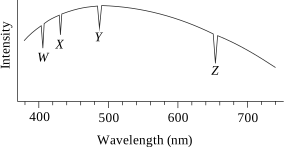
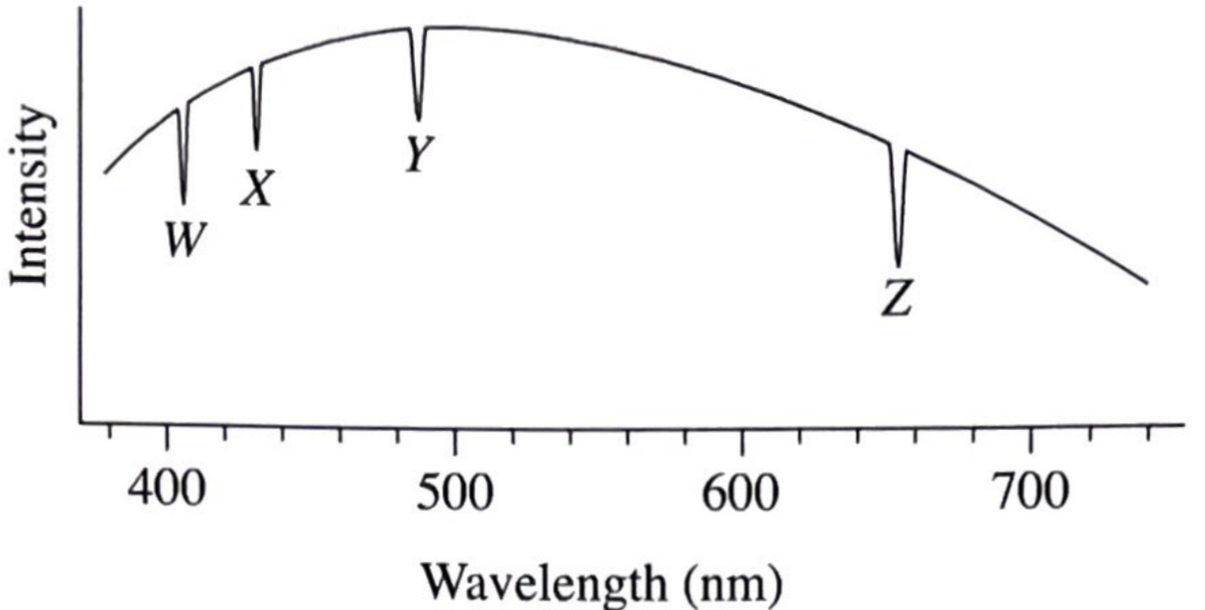
An absorption spectrum resulting from the passage of visible light from a star's surface through its hydrogen atmosphere is shown. Absorption lines are labelled \(W\) to \(Z\) in the diagram.
 

  1. Determine the surface temperature of the star.   (2 marks)

    --- 4 WORK AREA LINES (style=lined) ---
  2. Absorption line \(W\) originates from an electron transition between the second and sixth energy levels. Use  \(\dfrac{1}{\lambda}=R\left(\dfrac{1}{n_{ f }^2}-\dfrac{1}{n_{ i }^2}\right)\)  to calculate the frequency of light absorbed to produce absorption line \(W\).   (3 marks)

    --- 8 WORK AREA LINES (style=lined) ---
  3. Explain the physical processes that produce an absorption spectrum.   (3 marks)

    --- 8 WORK AREA LINES (style=lined) ---
Show Answers Only

a.    \(5796\ \text{K}\)

b.    \(7.31 \times 10^{14}\ \text{Hz}\)

c.    An absorption spectra is produced when:

  • A continuous spectrum of light  from a black body such as a star passes through cooler and lower density gas in the outer atmosphere of the star.
  • As the light passes through the gas, electrons in the atoms that make up the cooler gas clouds absorb distinct wavelengths/energy levels of light equal to the difference in energy levels between the electron shells where \(E_i-E_f=hf=\dfrac{hc}{\lambda}\). 
  • As the electrons in the atoms fall back into their ground state, they emit the photon of light that they absorb and the photon is then scattered out of the continuous spectrum.
  • The light that remains is then passed through a prism to separate the wavelengths and record the intensities. The black or darkened lines in the absorption spectra is the result of the scattered wavelengths of light. 
Show Worked Solution

a.    Determined temperature using the peak wavelength:

\(T=\dfrac{b}{\lambda_{\text{max}}}=\dfrac{2.898 \times 10^{-3}}{500 \times 10^{-9}}=5796\ \text{K}\)
 

b.     \(\dfrac{1}{\lambda}\) \(=R\left(\dfrac{1}{n_f^2}-\dfrac{1}{n_i^2}\right)\)
    \(=1.097 \times 10^7 \times \left(\dfrac{1}{2^2}-\dfrac{1}{6^2}\right)\)
    \(=2.438 \times 10^6\ \text{m}^{-1}\)
  \(\lambda\) \(=\dfrac{1}{2.438 \times 10^6}=410.2\ \text{nm}\)


\(\therefore f=\dfrac{c}{\lambda} = \dfrac{3 \times 10^8}{410.2 \times 10^{-9}} = 7.31 \times 10^{14}\ \text{Hz}\)
 

c.    Absorption spectra:

  • Produced when a continuous spectrum of light  from a black body such as a star passes through cooler and lower density gas in the outer atmosphere of the star.
  • As the light passes through the gas, electrons in the atoms that make up the cooler gas clouds absorb distinct wavelengths/energy levels of light equal to the difference in energy levels between the electron shells where \(E_i-E_f=hf=\dfrac{hc}{\lambda}\). 
  • As the electrons in the atoms fall back into their ground state, they emit the photon of light that they absorb and the photon is then scattered out of the continuous spectrum.
  • The light that remains is then passed through a prism to separate the wavelengths and record the intensities. The black or darkened lines in the absorption spectra is the result of the scattered wavelengths of light. 
♦ Mean mark (c) 51%.

Filed Under: Light: Quantum Model, Origins of Elements, Quantum Mechanical Nature of the Atom Tagged With: Band 4, Band 5, smc-3698-50-Blackbodies, smc-3698-70-Planck, smc-3700-20-Spectra, smc-3702-20-Electron Transitions

PHYSICS, M7 2019 VCE 16

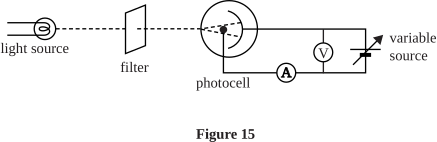
Students are studying the photoelectric effect using the apparatus shown in Figure 1.


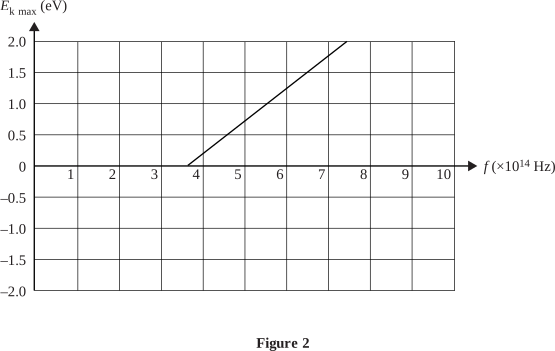
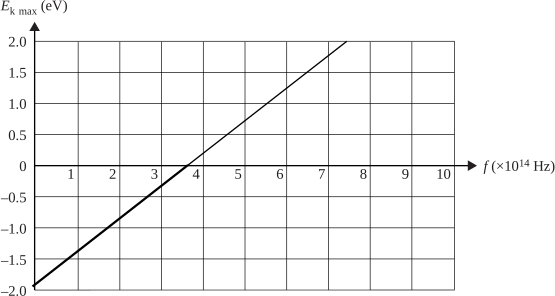
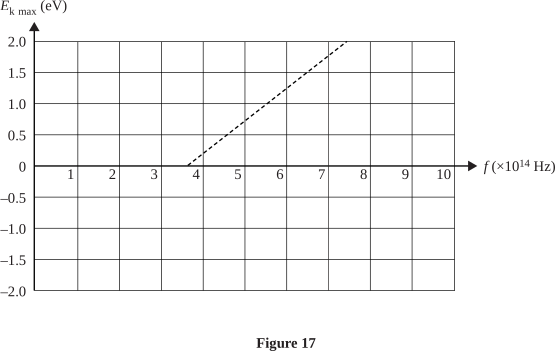
Figure 2 shows the results the students obtained for the maximum kinetic energy \((E_{\text{k max }})\) of the emitted photoelectrons versus the frequency of the incoming light.
 

  1. Using only data from the graph, determine the values the students would have obtained for
    1. Planck's constant, \(h\). Include a unit in your answer.  (2 marks)

--- 2 WORK AREA LINES (style=lined) ---
    1. the maximum wavelength of light that would cause the emission of photoelectrons.   (1 mark)

--- 2 WORK AREA LINES (style=lined) ---

    1. the work function of the metal of the photocell.   (1 mark)

--- 2 WORK AREA LINES (style=lined) ---

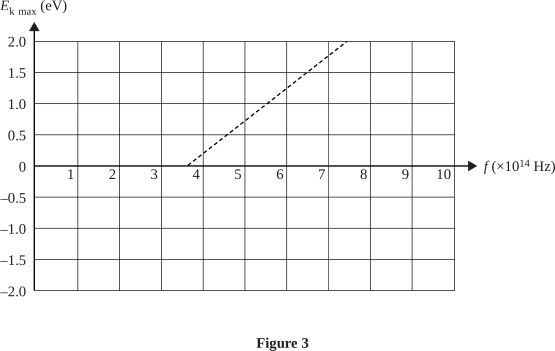
  1. The work function for the original metal used in the photocell is \(\phi\).
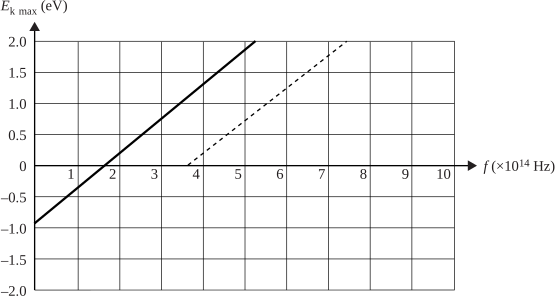
    On Figure 3, draw the line that would be obtained if a different metal, with a work function of \(\dfrac{1}{2} \phi\), were used in the photocell. The original graph is shown as a dashed line.   (2 marks)
     

--- 0 WORK AREA LINES (style=blank) ---

Show Answers Only

a.i.  \(5.4 \times 10^{-15}\ \text{eV s}\)

   ii.  \(811\ \text{nm}\)

  iii.  \(1.9\ \text{eV}\).

b.  

Show Worked Solution

a.i.  Planck’s constant \((h)\):

  • Equal to the gradient of the line when \(E_{\text{k max}}\) is graphed against frequency.

\(\therefore h=\dfrac{\text{rise}}{\text{run}}=\dfrac{1.25-0}{6 \times 10^{14}-3.7\times 10^{-14}}=5.4 \times 10^{-15}\ \text{eV s}\)
 

a.ii.  Max wavelength = minimum frequency of emitted photoelectron.

\(\lambda=\dfrac{c}{f}=\dfrac{3 \times 10^8}{3.7 \times 10^{14}}=811\ \text{nm}\)
 

♦ Mean mark (a)(ii) 44%.

a.iii.  


  • The work function is the y-intercept of the graph, so by extending the graph as shown above, the work function is \(1.9\ \text{eV}\).
     

b.   Constructing the new graph:

  • The new \(y\)-intercept for the graph will be \(-0.95\ \text{eV}\)
  • The gradient of the graph will remain the same (Planck’s constant)
     

Filed Under: Light: Quantum Model Tagged With: Band 4, Band 5, smc-3698-10-Photoelectric Effect, smc-3698-40-Find freq/lambda, smc-3698-70-Planck

PHYSICS, M7 2023 HSC 9 MC

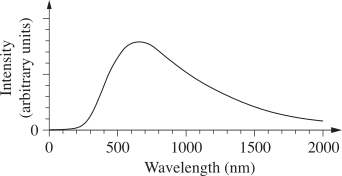
The graph shows the relationship between radiation intensity and wavelength for a black body at 4500 K.
 

Which statement describes the expected difference in the graph for a black body at 4000 K?

  1. Intensity at all wavelengths will be less.
  2. Intensity at all wavelengths will be greater.
  3. The peak intensity will occur at a higher frequency.
  4. The peak intensity will occur at a shorter wavelength.
Show Answers Only

\(A\)

Show Worked Solution
  • The total power output of a black body diminishes with decreasing temperature, resulting in lower intensity across all wavelengths for the 4000 K curve.

\(\Rightarrow A\)

Filed Under: Light: Quantum Model Tagged With: Band 4, smc-3698-50-Blackbodies, smc-3698-70-Planck

Copyright © 2014–2025 SmarterEd.com.au · Log in