SmarterEd

Aussie Maths & Science Teachers: Save your time with SmarterEd

  • Login
  • Get Help
  • About

PHYSICS, M7 2025 HSC 32

Analyse the consequences of the theory of special relativity in relation to length, time and motion. Support your answer with reference to experimental evidence.   (8 marks)

--- 22 WORK AREA LINES (style=lined) ---

Show Answers Only

Overview Statement

  • Special relativity predicts that time dilation, length contraction and relativistic momentum arise from the principle that the speed of light is constant for all observers.
  • These effects change how time, distance and motion are measured and each consequence is supported by experimental evidence.

Time–Length Relationship in Muon Observations

  • Muon-decay experiments show how time dilation and length contraction depend on relative motion.
  • Muons created high in the atmosphere have such short lifetimes that, in classical physics, they should decay long before reaching Earth’s surface. Yet far more muons are detected at ground level than predicted.
  • In Earth’s frame of reference, the muons experience time dilation, so they “live longer” and travel further.
  • In the muon’s frame of reference, the atmosphere is length-contracted according to the equation  \(l=l_0 \sqrt{\left(1-\dfrac{v^{2}}{c^{2}}\right)}\), so the distance they travel is much shorter.
  • Both viewpoints are valid within their own reference frames, showing that time and length are not absolute but depend on relative motion.

Momentum–Energy Relationship in Particle Accelerators

  • Relativistic momentum explains how objects behave as they approach light speed.
  • Particle accelerators show that enormous increases in energy produce only small increases in speed at high velocities.
  • Particles act as though their mass increases, so each additional acceleration requires disproportionately more energy.
  • This makes it impossible for any object with mass to reach the speed of light, since doing so requires infinite energy.
  • Thus, relativistic momentum preserves light speed as a universal limit.

Implications and Synthesis

  • The consequences of these observations reveal that space and time form a single, interconnected framework rather than separate absolute quantities.
  • At high velocities, motion fundamentally alters measurements of time, distance and momentum.
  • Together, these consequences confirm that classical physics fails at relativistic speeds and that special relativity accurately describes the behaviour of fast-moving objects.
Show Worked Solution

Overview Statement

  • Special relativity predicts that time dilation, length contraction and relativistic momentum arise from the principle that the speed of light is constant for all observers.
  • These effects change how time, distance and motion are measured and each consequence is supported by experimental evidence.

Time–Length Relationship in Muon Observations

  • Muon-decay experiments show how time dilation and length contraction depend on relative motion.
  • Muons created high in the atmosphere have such short lifetimes that, in classical physics, they should decay long before reaching Earth’s surface. Yet far more muons are detected at ground level than predicted.
  • In Earth’s frame of reference, the muons experience time dilation, so they “live longer” and travel further.
  • In the muon’s frame of reference, the atmosphere is length-contracted according to the equation  \(l=l_0 \sqrt{\left(1-\dfrac{v^{2}}{c^{2}}\right)}\), so the distance they travel is much shorter.
  • Both viewpoints are valid within their own reference frames, showing that time and length are not absolute but depend on relative motion.

Momentum–Energy Relationship in Particle Accelerators

  • Relativistic momentum explains how objects behave as they approach light speed.
  • Particle accelerators show that enormous increases in energy produce only small increases in speed at high velocities.
  • Particles act as though their mass increases, so each additional acceleration requires disproportionately more energy.
  • This makes it impossible for any object with mass to reach the speed of light, since doing so requires infinite energy.
  • Thus, relativistic momentum preserves light speed as a universal limit.

Implications and Synthesis

  • The consequences of these observations reveal that space and time form a single, interconnected framework rather than separate absolute quantities.
  • At high velocities, motion fundamentally alters measurements of time, distance and momentum.
  • Together, these consequences confirm that classical physics fails at relativistic speeds and that special relativity accurately describes the behaviour of fast-moving objects.

Filed Under: Light and Special Relativity Tagged With: Band 4, Band 5, Band 6, smc-3699-10-Time Dilation, smc-3699-20-Length Contraction, smc-3699-30-Momentum Dilation and calcs, smc-3699-50-Scientific Theories

PHYSICS, M7 2024 HSC 26

Muons are unstable particles produced when cosmic rays strike atoms high in the atmosphere. The muons travel downward, perpendicular to Earth's surface, at almost the speed of light.

Classical physics predicts that these muons will decay before they have time to reach Earth's surface.

Explain qualitatively why these muons can reach Earth's surface, regardless of whether their motion is considered from either the muon's frame of reference or the Earth's frame of reference.   (3 marks)

--- 8 WORK AREA LINES (style=lined) ---

Show Answers Only

  • The muon’s are able to reach the Earth’s surface due to Einstein’s special theory of relativity in relation to length contraction and time dilation.

Muon’s frame of reference:

  • The distance to the Earth’s surface is contracted according to  \(l=l_o\sqrt{1-\frac{v^2}{c^2}}\). Muons see the Earth’s surface move towards them at speeds close to \(c\).
  • Since the muons have to travel a shorter distance than the proper length, they will have time to reach the Earth’s surface before they decay. 

Earth’s frame of reference:

  • The time that it takes the muon to decay will be dilated according to  \(t=\dfrac{t_o}{\sqrt{1-\frac{v^2}{c^2}}}\)  as the muon’s are moving close to the speed of light.
  • Therefore, the muons have a longer half-life and lifespan than predicted by classical physics and will be able to reach the Earth’s surface before they decay.
  • In this way, muons can reach the surface of the Earth from either frame of reference. 

Show Worked Solution

  • The muon’s are able to reach the Earth’s surface due to Einstein’s special theory of relativity in relation to length contraction and time dilation.

Muon’s frame of reference:

  • The distance to the Earth’s surface is contracted according to  \(l=l_o\sqrt{1-\frac{v^2}{c^2}}\). Muons see the Earth’s surface move towards them at speeds close to \(c\).
  • Since the muons have to travel a shorter distance than the proper length, they will have time to reach the Earth’s surface before they decay.

Earth’s frame of reference:

  • The time that it takes the muon to decay will be dilated according to  \(t=\dfrac{t_o}{\sqrt{1-\frac{v^2}{c^2}}}\)  as the muon’s are moving close to the speed of light.
  • Therefore, the muons have a longer half-life and lifespan than predicted by classical physics and will be able to reach the Earth’s surface before they decay.
  • In this way, muons can reach the surface of the Earth from either frame of reference. 
♦ Mean mark 46%.

Filed Under: Light and Special Relativity Tagged With: Band 5, smc-3699-10-Time Dilation, smc-3699-20-Length Contraction, smc-3699-40-Einstein's Postulates

PHYSICS, M7 2024 HSC 12 MC

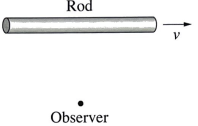
A rod has a length, \(\mathrm{L}_0\), when measured in its own frame of reference.

The rod travels past a stationary observer at speed, \(v\), as shown in the diagram.
 

Which option represents the relationship between the speed of the rod, \(v\), and the length of the rod as measured by the stationary observer?
 

  1. \( W \)
  2. \( X \)
  3. \( Y \)
  4. \( Z \)
Show Answers Only

\(B\)

Show Worked Solution
  • Length contraction occurs when objects travelling at high speeds are observed from a stationary observer.
  •    \(L=L_o\sqrt{1-\frac{v^2}{c^2}}\)
  • At low speeds, e.g. \((0.4c)\), the contraction factor is only small, \(\sqrt{1-\frac{v^2}{c^2}} = \sqrt{1-\frac{(0.4c)^2}{c^2}} = 0.92\)
  • As the speed of the rod increases, the contraction factor increases exponentially, e.g. \((0.9c)\), \(\sqrt{1-\frac{v^2}{c^2}} = \sqrt{1-\frac{(0.9c)^2}{c^2}} = 0.44\)
  • This exponential increase in the length contraction of an object as the object approaches \(c\) is demonstrated by the curve \(X\). 

\(\Rightarrow B\)

Filed Under: Light and Special Relativity Tagged With: Band 4, smc-3699-20-Length Contraction

PHYSICS, M7 2019 VCE 13 MC

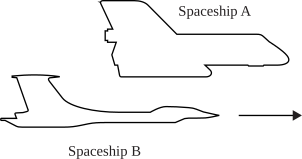
Joanna is an observer in Spaceship \(\text{A}\), watching Spaceship \(\text{B}\) fly past at a relative speed of 0.943\(c\). She measures the length of Spaceship \(\text{B}\) from her frame of reference to be 150 m.
 

Which one of the following is closest to the proper length of Spaceship \(\text{B}\)?

  1. 50 m
  2. 150 m
  3. 450 m
  4. 900 m
Show Answers Only

\(C\)

Show Worked Solution
\(l\) \(=l_0\sqrt{1-\frac{v^2}{c^2}}\)  
\(l_0\) \(=\dfrac{l}{\sqrt{1-\frac{v^2}{c^2}}}=\dfrac{150}{\sqrt{1-0.943^2}}=450\ \text{m}\)  


\(\Rightarrow C\)

Filed Under: Light and Special Relativity Tagged With: Band 4, smc-3699-20-Length Contraction

PHYSICS, M7 2021 VCE 10

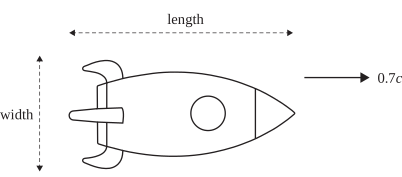
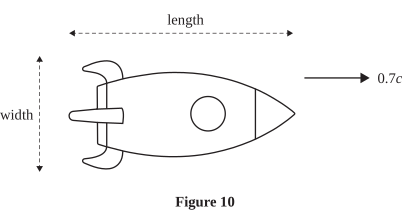
A new spaceship that can travel at 0.7\(c\) has been constructed on Earth. A technician is observing the spaceship travelling past in space at 0.7\(c\), as shown in the diagram. The technician notices that the length of the spaceship does not match the measurement taken when the spaceship was stationary in a laboratory, but its width matches the measurement taken in the laboratory.

  1. Explain, in terms of special relativity, why the technician notices there is a different measurement for the length of the spaceship, but not for the width of the spaceship.   (2 marks)

--- 4 WORK AREA LINES (style=lined) ---

  1. If the technician measures the spaceship to be 135 m long while travelling at a constant 0.7\(c\), what was the length of the spaceship when it was stationary on Earth? Show your working.   (2 marks)

--- 4 WORK AREA LINES (style=lined) ---

Show Answers Only

a.    By Einstein’s theory of special relativity:

  • When travelling at high speeds, length contraction occurs.
  • Length contraction only occurs in the direction of motion thus the technician measures a different measurement for the length but not the width of the spaceship.

b.    \(l_o=189\ \text{m}\)

Show Worked Solution

a.    By Einstein’s theory of special relativity:

  • When travelling at high speeds, length contraction occurs.
  • Length contraction only occurs in the direction of motion thus the technician measures a different measurement for the length but not the width of the spaceship.
b.     \(l\) \(=l_0\sqrt{1-\frac{v^2}{c^2}}\)
  \(l_0\) \(=\dfrac{l}{\sqrt{1-\frac{v^2}{c^2}}}\)
    \(=\dfrac{135}{\sqrt{1-\frac{(0.7c)^2}{c^2}}}\)
    \(=\dfrac{135}{\sqrt{1-0.7^2}}\)
    \(=189\ \text{m}\)

Filed Under: Light and Special Relativity Tagged With: Band 4, smc-3699-20-Length Contraction

PHYSICS, M7 2022 VCE 11

Explain why muons formed in the outer atmosphere can reach the surface of Earth even though their half-lives indicate that they should decay well before reaching Earth's surface.    (2 marks)

--- 4 WORK AREA LINES (style=lined) ---

Show Answers Only

Using the special relativity principal of time dilation:

  • The average lifespans of muons are 2.2 μs, but when they are observed from the Earth’s frame of reference this becomes significantly dilated.
  • Thus, they are able to travel from the outer atmosphere and reach the surface of the Earth before they decay.
  • Other answers could have also referred to length contraction from the perspective of the muons.
Show Worked Solution

Answer 1: Using the special relativity principal of time dilation:

  • The average lifespans of muons are 2.2 μs, but when they are observed from the Earth’s frame of reference this becomes significantly dilated.
  • Thus, they are able to travel from the outer atmosphere and reach the surface of the Earth before they decay.
  • Other answers could have also referred to length contraction from the perspective of the muons.

Answer 2: Using the special relativity principal of length contraction:

  • A muon’s frame of reference measures the distance to the Earth as shorter than that measured from the Earth’s frame of reference.
  • This shorter distance allows the muons to reach the Earth before they decay.
♦ Mean mark 41%.

Filed Under: Light and Special Relativity Tagged With: Band 5, smc-3699-10-Time Dilation, smc-3699-20-Length Contraction

PHYSICS, M7 2023 VCE 10

A proton in an accelerator beamline of proper length 4.80 km has a Lorentz factor, \(\gamma\), of 2.00.

  1. Calculate the speed of the proton relative to the beamline in terms of \(c\), the speed of light in a vacuum. Give your answer to three significant figures.  (3 marks)

--- 6 WORK AREA LINES (style=lined) ---

  1. Calculate the length of the beamline in the reference frame of the proton.  (1 mark)

--- 3 WORK AREA LINES (style=lined) ---

Show Answers Only

a.    \(0.866c\)

b.    \(2.4\ \text{km}\)

Show Worked Solution
a.   \(\dfrac{1}{\sqrt{1-\frac{v^2}{c^2}}}\) \(=2\)  
\(\sqrt{1-\dfrac{v^2}{c^2}}\) \(=\dfrac{1}{2}\)  
\(1-\dfrac{v^2}{c^2}\) \(=\dfrac{1}{4}\)  
\(\dfrac{v^2}{c^2}\) \(=\dfrac{3}{4}\)  
\(v^2\) \(=\dfrac{3}{4}c^2\)  
\(v\) \(=0.866c\)  


b.     \(l\) \(=l_0\sqrt{1-\dfrac{v^2}{c^2}}\)
    \(=4.8 \times \sqrt{1-\dfrac{(0.886c)^2}{c^2}}\)
    \(=4.8 \times 0.5\)
    \(=2.4\ \text{km}\)

Filed Under: Light and Special Relativity Tagged With: Band 4, smc-3699-20-Length Contraction

PHYSICS, M7 2023 HSC 19 MC

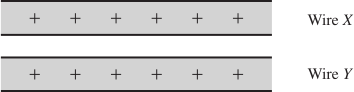
The diagram represents the distribution of positive charges in identical wires when no current is flowing.


Equal currents then flow in each wire, but in opposite directions. These currents are considered conventionally as the flow of positive charge.

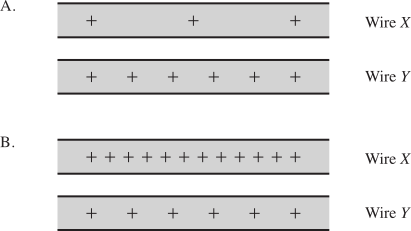
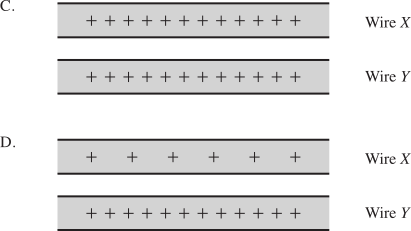
Which diagram represents the charge distribution in the wires, from the frame of reference of a positive charge in wire \(Y\) ?


Show Answers Only

\(B\)

Show Worked Solution
  • The currents flowing through Wire \(Y\) are all travelling in the same direction and at the same speed, thus they are all within the same inertial frame of reference and will not experience any relativistic effects when viewed from the frame of reference of a positive charge in \(Y\).
  • Therefore, the separation of the charges in \(Y\) from the frame of reference of \(Y\) will not change.
  • As the positive charges in \(X\) are moving in the opposite direction to the positive charges in \(Y\), from the frame of reference of a positive charge in \(Y\), length contraction will be observed in \(X\).
  • Therefore, the separation of the positive charges in \(X\) from the frame of reference of \(Y\) will be shorter so the charges appear closer together.

\(\Rightarrow B\)

♦ Mean mark 44%.

Filed Under: Light and Special Relativity Tagged With: Band 5, smc-3699-20-Length Contraction, smc-3699-40-Einstein's Postulates

PHYSICS, M7 EQ-Bank 3 MC

A spaceship sitting on its launch pad is measured to have a length \(L\). This spaceship passes an outer planet at a speed of 0.95\(c\).

Which observations of the length of the spaceship are correct?
 

\begin{align*}
\begin{array}{l}
\rule{0pt}{2.5ex} \ \rule[-1ex]{0pt}{0pt}& \\
\rule{0pt}{2.5ex}\textbf{A.}\rule[-1ex]{0pt}{0pt}\\
\rule{0pt}{2.5ex}\textbf{B.}\rule[-1ex]{0pt}{0pt}\\
\rule{0pt}{2.5ex}\textbf{C.}\rule[-1ex]{0pt}{0pt}\\
\rule{0pt}{2.5ex}\textbf{D.}\rule[-1ex]{0pt}{0pt}\\
\end{array}
\begin{array}{|l|l|}
\hline
\rule{0pt}{2.5ex}\textit{Observer on the spaceship}\rule[-1ex]{0pt}{0pt}& \ \ \textit{Observer on the planet} \\
\hline
\rule{0pt}{2.5ex}\text{No change}\rule[-1ex]{0pt}{0pt}&\text{Shorter than \(L\)}\\
\hline
\rule{0pt}{2.5ex}\text{No change}\rule[-1ex]{0pt}{0pt}& \text{Greater than \(L\)}\\
\hline
\rule{0pt}{2.5ex}\text{Shorter than \(L\)}\rule[-1ex]{0pt}{0pt}& \text{No change} \\
\hline
\rule{0pt}{2.5ex}\text{Greater than \(L\)}\rule[-1ex]{0pt}{0pt}& \text{No change} \\
\hline
\end{array}
\end{align*}

Show Answers Only

\(A\)

Show Worked Solution
  • An observer in the frame of reference of the spaceship will measure the proper length of the spaceship.
  • An observer on the planet will observe relativistic length contraction and will observe the length to be shorter than \(L\).

\(\Rightarrow A\)

Filed Under: Light and Special Relativity Tagged With: Band 3, smc-3699-20-Length Contraction

PHYSICS, M7 2015 HSC 16 MC

Astronauts travel at a velocity of 0.9 `c` to Alpha Centauri. Newtonian physics predicts that this journey would take 4.86 years.

How many years will the journey take in the frame of reference of the astronauts?

  1. 0.923
  2. 1.54
  3. 2.12
  4. 11.1
Show Answers Only

`C`

Show Worked Solution
  • The Newtonian distance to Alpha Centauri: `4.86 xx0.9 = 4.373` light years.
  • Finding the relativistic distance due to length contraction:
`l` `=l_(0)sqrt(1-(v^2)/c^2)`  
  `=4.373xx sqrt(1-((0.9c)^2)/c^2)`  
  `=4.373 xxsqrt(1-0.9^2)`  
  `=1.906\ text{ly}`  

 
This will take `(1.906)/(0.9) = 2.12` years.

`=>C`


Mean mark 59%.

Filed Under: Light and Special Relativity Tagged With: Band 4, smc-3699-20-Length Contraction

PHYSICS, M7 2017 HSC 20 MC

The length of a spaceship is measured by an observer to be 3.57 m as the spaceship passes with a velocity of 0.7`c`.

At what velocity would the spaceship be moving relative to the observer if its measured length was 2.5 m?

  1. 0.490`c`
  2. 0.707`c`
  3. 0.714`c`
  4. 0.866`c`
Show Answers Only

`D`

Show Worked Solution
`l` `=l_(0)sqrt((1-(v^(2))/(c^(2))))`  
`3.57` `=l_(0)sqrt((1-((0.7c)^(2))/(c^(2))))`  
`3.57` `=l_(0)sqrt(1-0.7^2)`  
`l_(0)` `=(3.57)/(sqrt(1-0.7^2))=5.0  text{m}`  


If the measured length were to be 2.5 m:

`2.5` `=(5.0)sqrt((1-(v^(2))/(c^(2))))`  
`(1)/(2)` `=sqrt(1-(v^(2))/(c^(2)))`  
`1-(v^(2))/(c^(2))` `=(1)/(4)`  
`(v^(2))/(c^(2))` `=(3)/(4)`  
`v^2` `=(3)/(4)c^2`  
`v` `=0.866c`  

 
`=>D`

Filed Under: Light and Special Relativity Tagged With: Band 4, smc-3699-20-Length Contraction

PHYSICS, M7 2018 HSC 16 MC

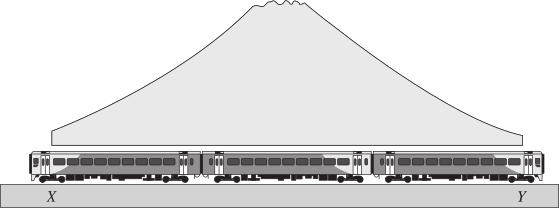
When a train is at rest in a tunnel, the train is slightly longer than the tunnel.
 

In a thought experiment, the train is travelling from left to right fast enough relative to the tunnel that its length contracts and it fits inside the tunnel.

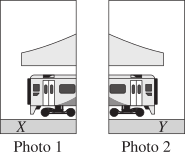
An observer on the ground sets up two cameras, at `X` and `Y`, to take photos at exactly the same time. The photos show that both ends of the train are inside the tunnel.
 

A passenger travelling on the train at its centre can see both ends of the tunnel and is later shown the photos.

From the point of view of the passenger, what is observed and what can be deduced about the photos?

  1. The tunnel's length contracts so the train does not fit, and photo 2 is taken before photo 1.
  2. The tunnel's length contracts so the train does not fit, and photos 1 and 2 are taken at the same time.
  3. The tunnel appears to expand due to length contraction of the train, allowing it to fit in the tunnel, and photo 1 is taken before photo 2 .
  4. The tunnel appears to expand due to length contraction of the train, allowing it to fit in the tunnel, and photos 1 and 2 are taken at the same time.
Show Answers Only

`A`

Show Worked Solution
  • From the frame of reference of an observer on the train, the tunnel’s length will contract (all objects outside the train will appear length contracted).
  • Due to the relativity of simultaneity, the photo that the observer on the train sees as taken first is the photo taken at the end of the tunnel that the train was moving towards at that moment.

`=>A`


♦♦♦ Mean mark 36%.

Filed Under: Light and Special Relativity Tagged With: Band 6, smc-3699-20-Length Contraction, smc-3699-60-Simultaneity

PHYSICS, M7 2018 HSC 9 MC

A hypothetical journey to a distant star might be accomplished in an astronaut's life span by travelling at relativistic speeds.

What is the key concept which underpins such a hypothetical journey?

  1. From the frame of reference of the spacecraft making the journey, the distance to the star is less.
  2. Clocks on the spacecraft run slower and hence the rate at which fuel is used for the journey is decreased.
  3. Relativistic effects on the spacecraft reduce its mass, making it possible to accelerate to the speeds needed for such a journey.
  4. The relativistic increase in the mass of the fuel on board makes it possible to complete a longer journey with less fuel.
Show Answers Only

`A`

Show Worked Solution
  • Due to the relativistic effect of length contraction, the distance required to travel will decrease.
  • This reduces the travel time.

`=>A`

Filed Under: Light and Special Relativity Tagged With: Band 4, smc-3699-20-Length Contraction

PHYSICS M7 2022 HSC 20 MC

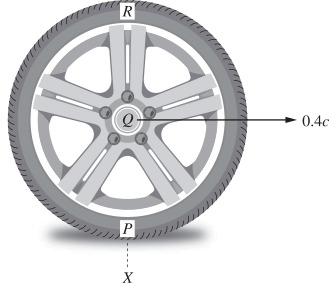
In a thought experiment, a car is travelling at a uniform velocity of `0.4 c`. The diagram shows one of the car's wheels as it rolls past a stationary observer at `X`.
 

Consider the instantaneous velocity of different points on the car's wheel relative to the ground. Assume that there is no slippage of the tyre on the road.

At the instant the centre of the wheel, `Q`, passes `X`, how would the observer describe the relativistic length contraction at points `P, Q` and `R` ?

  1. It is the same at `P, Q` and `R`.
  2. It is zero at `P` and greatest at `R`.
  3. It is equal at `P` and `R`, and least at `Q`.
  4. It is zero at `P` and the same value at `Q` and `R`.
Show Answers Only

`B`

Show Worked Solution

Consider Point `P`:

  • Point `P` is moving at 0.4`c` left relative to point `Q`.
  • Point `P` has zero instantaneous velocity relative to the ground.
  • Zero relativistic length contraction will be observed at `P`.

Consider Point `R`:

  • Point `R` is moving at 0.4`c` right relative to point `Q`.
  • Point `R` has an instantaneous velocity of 0.8`c` relative to the ground.
  • Maximum relativistic length contraction will be observed at `R`.

`=>B`


♦♦♦ Mean mark 30%.

Filed Under: Light and Special Relativity Tagged With: Band 5, smc-3699-20-Length Contraction

PHYSICS, M7 2020 HSC 17 MC

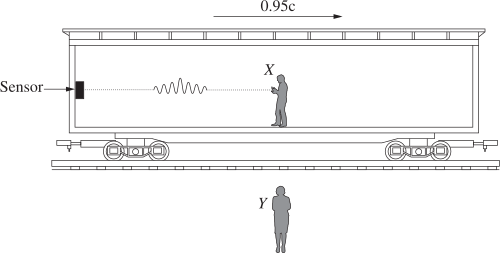
In a thought experiment, observer `X` is on a train travelling at a constant velocity of 0.95c relative to the ground. Observer `Y` is standing on the ground outside the train. As observer `X` passes observer `Y`, observer `X` sends a short light pulse towards the sensor.
 

Which statement about the light pulse is correct as observed by `X` or `Y` in their respective frames of reference?

  1. Its velocity observed by `Y` is 0.05c.
  2. `X` sees it travel a shorter distance to the sensor than `Y`.
  3. `X` sees it take a longer time to reach the sensor than `Y`.
  4. Both `X` and `Y` see it travel the same distance in the same amount of time.
Show Answers Only

`C`

Show Worked Solution
  • `Y` observes the length of the carriage to be shorter than `X`  does due to length contraction.
  • As the speed of light is equal for both observers, `X`  sees the light pulse take a longer time to reach the sensor.

`=>C` 

Filed Under: Light and Special Relativity Tagged With: Band 4, smc-3699-20-Length Contraction

Copyright © 2014–2025 SmarterEd.com.au · Log in