SmarterEd

Aussie Maths & Science Teachers: Save your time with SmarterEd

  • Login
  • Get Help
  • About

PHYSICS, M8 2025 HSC 30

A beam of electrons travelling at \(4 \times 10^3 \ \text{m s}^{-1}\) exits an electron gun and is directed toward two narrow slits with a separation, \(d\), of 1 \(\mu\text{m}\). The resulting interference pattern is detected on a screen 50 cm from the slits.

  1. Show that the wavelength of the electrons in this experiment is 182 nm.   (2 marks)

    --- 4 WORK AREA LINES (style=lined) ---

  2. An interference fringe occurs on the screen where constructive interference takes place.
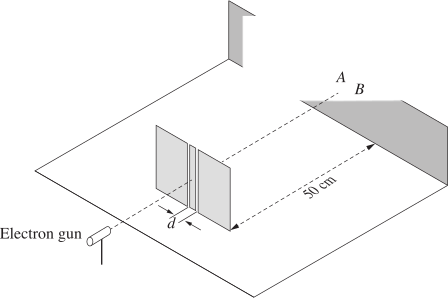
     

  1. Determine the distance between the central interference fringe \(A\) and the centre of the next bright fringe \(B\).   (2 marks)

    --- 4 WORK AREA LINES (style=lined) ---

  2. Determine the potential difference acting in the electron gun to accelerate the electrons in the beam from rest to \(4 \times 10^3 \ \text{m s}^{-1}\).   (2 marks)

    --- 4 WORK AREA LINES (style=lined) ---
Show Answers Only

a.    \(\text {Using} \ \ \lambda=\dfrac{h}{m v}:\)

\(\lambda=\dfrac{6.626 \times 10^{-34}}{9.109 \times 10^{-31} \times 4 \times 10^3}=1.82 \times 10^{-7} \ \text{m}=182 \ \text{nm}\)

b.    \(x=9.1 \ \text{cm}\)

c.    \(V=4.5 \times 10^{-5} \ \text{V}\)

Show Worked Solution

a.    \(\text {Using} \ \ \lambda=\dfrac{h}{m v}:\)

\(\lambda=\dfrac{6.626 \times 10^{-34}}{9.109 \times 10^{-31} \times 4 \times 10^3}=1.82 \times 10^{-7} \ \text{m}=182 \ \text{nm}\)
 

b.    \(\text {Using}\ \ x=\dfrac{\lambda m L}{d}\)

\(\text{where} \ \ x=\text{distance between middle of adjacent bright spots}\)

\(x=\dfrac{182 \times 10^{-9} \times 1 \times 0.5}{1 \times 10^{-6}}=0.091 \ \text{m}=9.1 \ \text{cm}\)
 

c.    \(\text{Work done by field}=\Delta K=K_f-K_i\)

\(qV\) \(=\dfrac{1}{2} m v^2-0\)
\(V\) \(=\dfrac{m v^2}{2 q}=\dfrac{9.109 \times 10^{-31} \times\left(4 \times 10^3\right)^2}{2 \times 1.602 \times 10^{-19}}=4.5 \times 10^{-5} \ \text{V}\)

Filed Under: Charged Particles, Conductors and Electric/Magnetic Fields, Light: Wave Model, Quantum Mechanical Nature of the Atom Tagged With: Band 4, Band 5, smc-3693-35-Kinematic/Work Calcs, smc-3697-30-Double Slit Calcs, smc-3702-40-De Broglie

PHYSICS, M8 2025 HSC 4 MC

Which row in the table identifies the particle with the shortest de Broglie wavelength?

\begin{align*}
\begin{array}{l}
\rule{0pt}{2.5ex} \ \rule[-1ex]{0pt}{0pt}& \\
\rule{0pt}{2.5ex}\textbf{A.}\rule[-1ex]{0pt}{0pt}\\
\rule{0pt}{2.5ex}\textbf{B.}\rule[-1ex]{0pt}{0pt}\\
\rule{0pt}{2.5ex}\textbf{C.}\rule[-1ex]{0pt}{0pt}\\
\rule{0pt}{2.5ex}\textbf{D.}\rule[-1ex]{0pt}{0pt}\\
\end{array}
\begin{array}{|c|c|}
\hline
\rule{0pt}{2.5ex}\quad \textit{Particle}\quad\rule[-1ex]{0pt}{0pt}& \quad\textit{Velocity}\quad \\
\hline
\rule{0pt}{2.5ex}\text{Electron}\rule[-1ex]{0pt}{0pt}&0.1 c\\
\hline
\rule{0pt}{2.5ex}\text{Electron}\rule[-1ex]{0pt}{0pt}& 0.9 c\\
\hline
\rule{0pt}{2.5ex}\text{Proton}\rule[-1ex]{0pt}{0pt}& 0.1 c \\
\hline
\rule{0pt}{2.5ex}\text{Proton}\rule[-1ex]{0pt}{0pt}& 0.9 c \\
\hline
\end{array}
\end{align*}

Show Answers Only

\(D\)

Show Worked Solution
  • Using  \(\lambda = \dfrac{h}{p}\), the large momentum \((p = mv)\) of a fast, heavy particle makes \(\lambda\) smallest.
  • The proton at 0.9\(c\) is the heaviest and fastest option. Since this has the greatest momentum, it has the shortest de Broglie wavelength.

\(\Rightarrow D\)

Filed Under: Quantum Mechanical Nature of the Atom Tagged With: Band 4, smc-3702-40-De Broglie

PHYSICS, M8 2024 HSC 23

Development of models of the atom has resulted from both experimental investigations and hypotheses based on theoretical considerations.

  1. A key piece of experimental evidence supporting the nuclear model of the atom was a discovery by Chadwick in 1932.
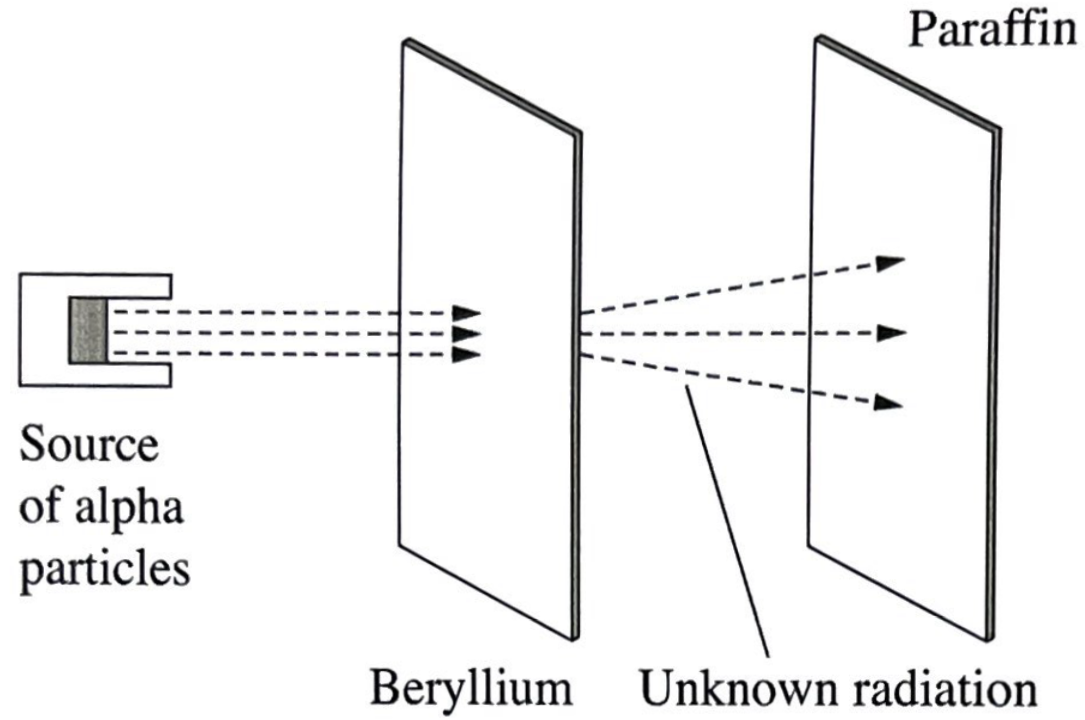
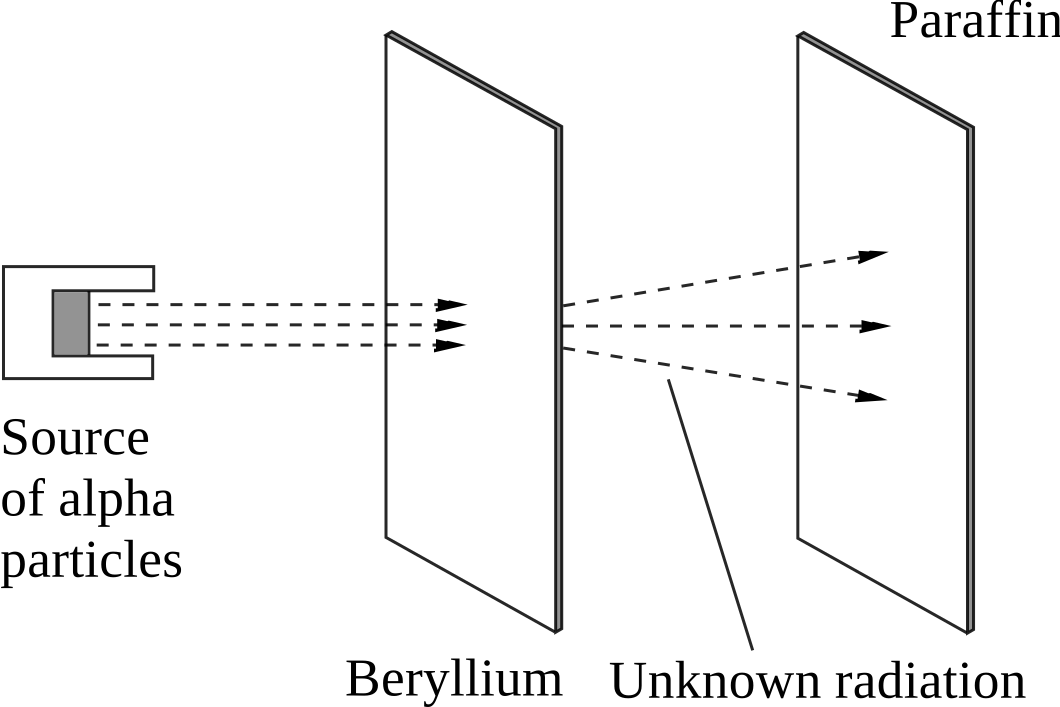
  2. An aspect of the experimental design is shown.
     

    1. What was the role of paraffin in Chadwick's experiment?   (2 marks)

      --- 4 WORK AREA LINES (style=lined) ---
    2. How did Chadwick's experiment change the model of the atom?  (3 marks)

      --- 6 WORK AREA LINES (style=lined) ---

  1. Explain how de Broglie's hypothesis regarding the nature of electrons addressed limitations in the Bohr-Rutherford model of the atom.   (4 marks)

    --- 8 WORK AREA LINES (style=lined) ---

Show Answers Only

a.i.  Role of paraffin wax:

  • Paraffin wax is a rich source of protons.
  • When the paraffin was placed in front of the unknown radiation, the transfer of momentum from the radiation caused protons to be emitted from the paraffin wax.
  • The emitted protons could then be detected and analysed.
  • From studying the protons ejected from the paraffin wax, Chadwick proposed the existence of the neutron.
     

a.ii. Changes to the model of the atom:

  • Previous to Chadwick’s experiment, the model of the atom proposed by Rutherford consisted of a dense positive charge in the nucleus which was orbited by electrons.
  • In this model however, the protons did not account for the total mass of the nucleus.
  • Through using the conservation of momentum and energy in his experiment, Chadwick proposed the existence of the neutron particle which was slightly heavier than the proton.
  • The model of the atom was updated to include both protons and neutrons in the nucleus which then fully accounted for the mass of the nucleus.
     

b.   Limitations in the Bohr-Rutherford model:

  • Rutherford’s model of the atom stated that electrons orbited the nucleus and were electrostatically attracted to the positive nucleus. This meant that the electrons were in circular motion and were constantly under centripetal acceleration.
  • However, Maxwell predicted that an accelerating charge would emit electro-magnetic radiation and in Rutherford’s model, all atoms should have been unstable as the electrons would emit EMR, lose energy and spiral into the nucleus.
  • Bohr proposed that electrons orbited the nucleus in stationary states at fixed energies with no intermediate states possible where they would not emit EMR but provided no theoretical explanation for this.

De Broglie’s hypothesis:

  • De Broglie proposed that electrons could exhibit a wave nature and could act as matter-waves. The electrons would form standing waves around the nucleus and would no longer be an accelerating particle which addressed the limitation of all atoms being unstable.
  • Further, De Broglie proposed that the standing waves would occur at integer wavelengths where the circumference of the electron orbit would be equal to an integer electron wavelength, \(2\pi r=n\lambda\)  where  \(\lambda = \dfrac{h}{mv}\). At any other radii other than this, deconstructive interference would occur and a standing electron wave would not form. This addressed why electrons could only be present at fixed radii/energy levels in the atom.

Show Worked Solution

a.i.  Role of paraffin wax:

  • Paraffin wax is a rich source of protons.
  • When the paraffin was placed in front of the unknown radiation, the transfer of momentum from the radiation caused protons to be emitted from the paraffin wax.
  • The emitted protons could then be detected and analysed.
  • From studying the protons ejected from the paraffin wax, Chadwick proposed the existence of the neutron. 
Mean mark (a)(i) 52%.

a.ii. Changes to the model of the atom:

  • Previous to Chadwick’s experiment, the model of the atom proposed by Rutherford consisted of a dense positive charge in the nucleus which was orbited by electrons.
  • In this model however, the protons did not account for the total mass of the nucleus.
  • Through using the conservation of momentum and energy in his experiment, Chadwick proposed the existence of the neutron particle which was slightly heavier than the proton.
  • The model of the atom was updated to include both protons and neutrons in the nucleus which then fully accounted for the mass of the nucleus. 

b.   Limitations in the Bohr-Rutherford model:

  • Rutherford’s model of the atom stated that electrons orbited the nucleus and were electrostatically attracted to the positive nucleus. This meant that the electrons were in circular motion and were constantly under centripetal acceleration.
  • However, Maxwell predicted that an accelerating charge would emit electro-magnetic radiation and in Rutherford’s model, all atoms should have been unstable as the electrons would emit EMR, lose energy and spiral into the nucleus.
  • Bohr proposed that electrons orbited the nucleus in stationary states at fixed energies with no intermediate states possible where they would not emit EMR but provided no theoretical explanation for this.

De Broglie’s hypothesis:

  • De Broglie proposed that electrons could exhibit a wave nature and could act as matter-waves. The electrons would form standing waves around the nucleus and would no longer be an accelerating particle which addressed the limitation of all atoms being unstable.
  • Further, De Broglie proposed that the standing waves would occur at integer wavelengths where the circumference of the electron orbit would be equal to an integer electron wavelength, \(2\pi r=n\lambda\)  where  \(\lambda = \dfrac{h}{mv}\). At any other radii other than this, deconstructive interference would occur and a standing electron wave would not form. This addressed why electrons could only be present at fixed radii/energy levels in the atom.
♦ Mean mark (b) 44%.

Filed Under: Quantum Mechanical Nature of the Atom, Structure of the Atom Tagged With: Band 4, Band 5, smc-3701-40-Rutherford, smc-3701-60-Chadwick, smc-3702-10-Bohr's Model, smc-3702-40-De Broglie

PHYSICS, M8 2024 HSC 14 MC

The velocity of a proton \( {\displaystyle \left({ }_1^1 \text{H}\right) } \) is twice the velocity of an alpha particle \( { \displaystyle \left({ }_2^4 \text{He}\right) } \). The proton has a de Broglie wavelength of \(\lambda\).

What is the de Broglie wavelength of the alpha particle?

  1. \(\dfrac{\lambda}{8}\)
  2. \(\dfrac{\lambda}{2}\)
  3. \(2 \lambda\)
  4. \(8 \lambda\)
Show Answers Only

\(B\)

Show Worked Solution
  • Let the mass of the proton be \(m\) and the velocity of the proton be \(v\).
  • Therefore the mass of the alpha particle will be \(4m\) and the velocity will be \(\dfrac{v}{2}\).
  • The de Broglie wavelength of the proton, \(\lambda_{p} = \dfrac{h}{mv}\).
  • Therefore the de Broglie wavelength of the alpha particle:
  •    \(\lambda_{\alpha}=\dfrac{h}{4m \times \frac{v}{2}}=\dfrac{h}{2mv} = \dfrac{\lambda}{2}\)

\(\Rightarrow B\)

♦ Mean mark 49%.

Filed Under: Quantum Mechanical Nature of the Atom Tagged With: Band 5, smc-3702-40-De Broglie

PHYSICS, M8 2019 VCE 17

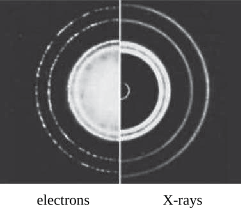
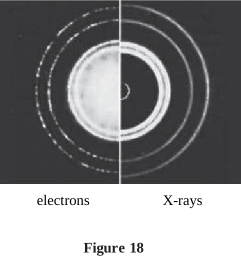
Students are comparing the diffraction patterns produced by electrons and X-rays, in which the same spacing of bands is observed in the patterns, as shown schematically in the diagram. Note that both patterns shown are to the same scale.
 

The electron diffraction pattern is produced by 3.0 × 10\(^3\) eV electrons.

  1. Explain why electrons can produce the same spacing of bands in a diffraction pattern as X-rays.   (3 marks)

    --- 4 WORK AREA LINES (style=lined) ---

  1. Calculate the frequency of X-rays that would produce the same spacing of bands in a diffraction pattern as for the electrons. Show your working.   (4 marks)

    --- 6 WORK AREA LINES (style=lined) ---

Show Answers Only

a.    Electron vs X-ray wavelength:

  • Electrons with momentum exhibit wave-like properties.
  • In this way, moving electrons produce a de Broglie wavelength.
  • As diffraction is a wave phenomenon and is dependent on wavelengths, if the de Broglie wavelength of an electron matches the wavelength of an X-ray then spacing of the bands will be the same. 

b.    \(1.34 \times 10^{19}\ \text{Hz}\)

Show Worked Solution

a.    Electron vs X-ray wavelength:

  • Electrons with momentum exhibit wave-like properties.
  • In this way, moving electrons produce a de Broglie wavelength.
  • As diffraction is a wave phenomenon and is dependent on wavelengths, if the de Broglie wavelength of an electron matches the wavelength of an X-ray then spacing of the bands will be the same. 
♦ Mean mark (a) 49%.

b.    Find velocity of the electrons using  \(E=\dfrac{1}{2}mv^2 :\)

\(3.0 \times 10^3 \times 1.602 \times 10^{-19}=\dfrac{1}{2} \times 9.109 \times 10^{-31} \times v^2\)

\(v^2\) \(=\dfrac{4.806 \times 10^{-16}}{4.5545 \times 10^{-31}}\)  
\(v\) \(=\sqrt{1.055 \times 10^{15}}\)  
  \(=3.25 \times 10^7\ \text{ms}^{-1}\)  


The de Broglie wavelength of the electron is:

\(\lambda\) \(=\dfrac{h}{mv}\)  
  \(=\dfrac{6.626 \times 10^{-34}}{3.25 \times 10^7 \times 9.109 \times 10^{-31}}\)  
  \(=2.24 \times 10^{-11}\ \text{m}\)  

 
Frequency of the X-ray:

\(f=\dfrac{c}{\lambda}=\dfrac{3 \times 10^8}{2.24 \times 10^{-11}}=1.34 \times 10^{19}\ \text{Hz}\)

♦♦♦ Mean mark (b) 27%.
COMMENT: Multi-step solutions require clear and logical working.

Filed Under: Quantum Mechanical Nature of the Atom Tagged With: Band 5, Band 6, smc-3702-40-De Broglie

PHYSICS, M8 2019 VCE 15 MC

Electrons pass through a fine metal grid, forming a diffraction pattern.

If the speed of the electrons was doubled using the same metal grid, what would be the effect on the fringe spacing?

  1. The fringe spacing would increase.
  2. The fringe spacing would decrease.
  3. The fringe spacing would not change.
  4. The fringe spacing cannot be determined from the information given.
Show Answers Only

\(B\)

Show Worked Solution
  • \(\lambda=\dfrac{h}{mv} \ \Rightarrow \  \lambda \propto \dfrac{1}{v}\)
  • If the velocity of the electron is doubled, the wavelength of the electron will halve.
  • Using Young’s double slit calculations:
  •    \(\dfrac{d\Delta x}{D}=m \lambda\ \Rightarrow\  \Delta x \propto \lambda\)
  • Therefore, if lambda decreases so will the fringe spacing \((\Delta x)\).

\(\Rightarrow B\)

♦ Mean mark 40%.
COMMENT: Formulas from different syllabus areas required here.

Filed Under: Quantum Mechanical Nature of the Atom Tagged With: Band 5, smc-3702-40-De Broglie

PHYSICS, M8 2019 VCE 14* MC

Electrons are accelerated in an electron gun to a speed of 1.0 × 10\(^7\) m s\(^{-1}\).

The best estimate of the de Broglie wavelength of these electrons is

  1. 4.5 × 10\(^{-6}\) m
  2. 7.3 × 10\(^{-8}\) m
  3. 7.3 × 10\(^{-11}\) m
  4. 4.5 × 10\(^{-12}\) m
Show Answers Only

\(C\)

Show Worked Solution

\(\lambda=\dfrac{h}{mv}=\dfrac{6.626 \times 10^{-34}}{9.109 \times 10^{-31} \times 1 \times 10^7}=7.3 \times 10^{-11}\ \text{m}\)

\(\Rightarrow C\)

Filed Under: Quantum Mechanical Nature of the Atom Tagged With: Band 3, smc-3702-40-De Broglie

PHYSICS, M8 2020 VCE 16

A beam of electrons travelling at 1.72 × 10\(^5\) m s\(^{-1}\) illuminates a crystal, producing a diffraction pattern as shown below. Ignore relativistic effects.
 

  1. Calculate the kinetic energy of one of the electrons. Show your working.   (2 marks)

    --- 5 WORK AREA LINES (style=lined) ---

  2. The electron beam is now replaced by an X-ray beam. The resulting diffraction pattern has the same spacing as that produced by the electron beam.

    Calculate the energy of one X-ray photon. Show your working.   (3 marks)

    --- 6 WORK AREA LINES (style=lined) ---

Show Answers Only

a.    \(0.084\ \text{eV}\)

b.    \(293\ \text{eV}\)

Show Worked Solution

a.     \(KE\) \(=\dfrac{1}{2}mv^2\)
    \(=\dfrac{1}{2} \times 9.109 \times 10^{-31} \times (1.72 \times 10^5)^2\)
    \(=1.3474\times 10^{-20}\ \text{J}\)
    \(=\dfrac{1.3474 \times 10^{-20}}{1.602 \times 10^{-19}}\)
    \(=0.084\ \text{eV}\)


b.     \(\lambda_e\) \(=\dfrac{h}{mv}\)
    \(=\dfrac{6.626 \times 10^{-34}}{9.109 \times 10^{-31} \times 1.72 \times 10^5}\)
    \(=4.23 \times 10^{-9}\ \text{m}\)
    \(=\lambda_{\text{x-ray}}\)


  \(E_{\text{x-ray}}\) \(=\dfrac{hc}{\lambda}\)
    \(=\dfrac{6.626 \times 10^{-34} \times 3 \times 10^8}{4.23 \times 10^{-9}}\)
    \(=4.7 \times 10^{-17}\ \text{J}\)
    \(=\dfrac{4.7 \times 10^{-17}}{1.602 \times 10^{-19}}\)
    \(=293\ \text{eV}\)
♦ Mean mark (b) 41%.

Filed Under: Quantum Mechanical Nature of the Atom Tagged With: Band 4, Band 5, smc-3702-30-Photon Energy, smc-3702-40-De Broglie

PHYSICS, M8 2020 VCE 18 MC

Quantised energy levels within atoms can best be explained by

  1. electrons behaving as individual particles with different energies.
  2. electrons behaving as waves, with each energy level representing a diffraction pattern.
  3. protons behaving as waves, with only standing waves at particular wavelengths allowed.
  4. electrons behaving as waves, with only standing waves at particular wavelengths allowed.
Show Answers Only

\(D\)

Show Worked Solution
  • This was explained by de Broglie’s work in determining electrons (all matter) can exhibit wave properties.
  • Quantised energy levels in the atom correspond to where electrons form standing waves due to there being an integer number of electron wavelengths.

\(\Rightarrow D\)

Filed Under: Quantum Mechanical Nature of the Atom Tagged With: Band 4, smc-3702-40-De Broglie

PHYSICS, M8 2021 VCE 17 MC

Which one of the following is closest to the de Broglie wavelength of a 663 kg motor car moving at 10 m s\(^{-1}\) ?

  1. \(10^{-37}\) m
  2. \(10^{-36}\) m
  3. \(10^{-35}\) m
  4. \(10^{-34}\) m
Show Answers Only

\(A\)

Show Worked Solution

\(\lambda=\dfrac{h}{mv}=\dfrac{6.626 \times 10^{-34}}{663 \times 10}=9.99 \times 10^{-38} \approx 10^{-37}\ \text{m}\)

\(\Rightarrow A\)

Filed Under: Quantum Mechanical Nature of the Atom Tagged With: Band 4, smc-3702-40-De Broglie

PHYSICS, M8 2022 VCE 17

A materials scientist is studying the diffraction of electrons through a thin metal foil. She uses electrons with an energy of 10.0 keV. The resulting diffraction pattern is shown in Figure 19.
 

  1. Calculate the de Broglie wavelength of the electrons in nanometres.  (4 marks)

--- 6 WORK AREA LINES (style=lined) ---

  1. The materials scientist then increases the energy of the electrons by a small amount and hence their speed by a small amount.

    Explain what effect this would have on the de Broglie wavelength of the electrons. Justify your answer.  (3 marks)

--- 6 WORK AREA LINES (style=lined) ---

Show Answers Only

a.    \(0.012\ \text{nm}\)

b.    Effects when speed of the electron increases by a small amount:

  • Momentum will increase by a small amount
  • As \(\lambda \propto \dfrac{1}{mv}\), if the momentum of the electron increases, its corresponding de Broglie wavelength will decrease.

Show Worked Solution

a.    Convert electron volts to joules:

\(\Rightarrow \ E=10 \times 10^3 \times 1.602 \times 10^{-19}=1.602 \times 10^{-15}\ \text{J}\)

\(E\) \(=\dfrac{1}{2}mv^2\)  
\(v\) \(=\sqrt{\dfrac{2E}{m}}\)  
  \(=\sqrt{\dfrac{2 \times 1.602 \times 10^{-15}}{9.109 \times 10^{-31}}}\)  
  \(=5.93 \times 10^7\)  


\(\therefore \lambda\) \(=\dfrac{h}{mv}\)  
  \(=\dfrac{6.626 \times 10^{-34}}{9.109 \times 10^{-27} \times 5.93 \times 10^7}\)  
  \(=1.23 \times 10^{-11}\ \text{m}\)  
  \(=0.012\ \text{nm}\)  

♦ Mean mark 42%.

b.    Effects when speed of the electron increases by a small amount:

  • Momentum will increase by a small amount
  • As \(\lambda \propto \dfrac{1}{mv}\), if the momentum of the electron increases, its corresponding de Broglie wavelength will decrease.

Filed Under: Quantum Mechanical Nature of the Atom Tagged With: Band 4, Band 5, smc-3702-40-De Broglie

PHYSICS, M8 2022 VCE 14 MC

Which one of the following best provides evidence of electrons behaving as waves?

  1. photoelectric effect
  2. atomic emission spectra
  3. atomic absorption spectra
  4. diffraction of electrons through a crystal
Show Answers Only

\(D\)

Show Worked Solution
  • Diffraction is a wave phenomenon.
  • As electrons produce a diffraction pattern after passing through a crystal, they are behaving as waves.

\(\Rightarrow D\)

Filed Under: Quantum Mechanical Nature of the Atom Tagged With: Band 4, smc-3702-40-De Broglie

PHYSICS, M8 2023 VCE 17 MC

Which one of the following statements best explains why it is possible to compare X-ray and electron diffraction patterns?

  1. X-rays can exhibit particle-like properties.
  2. Electrons can exhibit wave-like properties.
  3. Electrons are a form of high-energy X-rays.
  4. Both electrons and X-rays can ionise matter.
Show Answers Only

\(B\)

Show Worked Solution
  • de Broglie developed an equation linking an objects momentum to its wavelength. 
  • At high speeds, the wavelength of electrons is similar to that of X-rays and so they can be compared.

\(\Rightarrow B\)

Filed Under: Quantum Mechanical Nature of the Atom Tagged With: Band 4, smc-3702-40-De Broglie

PHYSICS, M8 2023 HSC 33

Consider the following statement.

The interaction of subatomic particles with fields, as well as with other types of particles and matter, has increased our understanding of processes that occur in the physical world and of the properties of the subatomic particles themselves.

Justify this statement with reference to observations that have been made and experiments that scientists have carried out.   (9 marks)

--- 22 WORK AREA LINES (style=lined) ---

Show Answers Only

Thomson’s Experiment:

  • Thomson’s experiment tested the interaction of cathode rays (which he discovered were negatively charged subatomic particles and named them electrons) with electric and magnetic fields to determine the charge to mass ratio (\(\dfrac{q}{m}\)) of the electrons.
  • Using both the electric and magnetic fields, Thomson balanced the forces to ensure the cathode rays travelled through undeflected. Thus:
  •    \(F_E = F_B \ \ \Rightarrow \ \ qE=qvB \ \ \Rightarrow \ \ v=\dfrac{E}{B}\)
  • Using the magnetic field and known velocity, the cathode rays travelled in a circular path due to their negative charges interacting with the magnetic field. Thus:
  •    \(F_c=F_B\ \ \Rightarrow \ \ \dfrac{mv^2}{r}=qvB \ \ \Rightarrow \ \ \dfrac{q}{m}=\dfrac{v}{Br}\)
  • The charge to mass ratio was determined to be 0.77 \(\times\) 10\(^{11}\) Ckg\(^{-1}\) and was \(\dfrac{1}{1800}\) times smaller than the charge to mass ratio of the proton. The number was also the same regardless of the metal cathode used, thus Thomson determined this particle was a fundamental constitute of all matter. 
  • Therefore, the statement is true as the observations and experiment undertaken by Thomson using the interactions of particles and fields led to a greater understanding of the electrons. 

Chadwick’s Experiment:

  • In Chadwick’s experiment, he irradiated beryllium with alpha particles which emitted a deeply penetrating radiation with neutral charge. When this particle was directed into paraffin wax, protons were emitted and detected on a screen. 
  • Using the Laws of conservation of energy and momentum, Chadwick proposed the idea of a neutral particle and named it the neutron. He determined that the mass of this particle must be slightly greater than the mass of the proton.
  • Therefore, Chadwick’s observations of the neutrons led to a greater understanding of the properties of the particle, thus justifying the statement above.  

Observations using particle accelerators:

  • Particle accelerators have led to many new scientific discoveries as a result of the interaction of particles with fields and particle-particle interactions.
  • Scientists have come to a greater understanding of quarks and other subatomic particles within the standard model of matter and processes of the physical world including decay trails and momentum dilation.
  • The Large Hadron Collider (LHC) can accelerate particles close to the speed of light using electric and magnetic fields. When particles collide, the kinetic energy is converted into mass using Einstein’s equation  \(E=mc^2\).
  • The new particles formed as a result of these collisions led to the development of the standard model and increased scientific understanding of subatomic particles including up and down quarks, W/Z bosons and the Higgs Boson.
  • These subatomic particles have very short lifetimes before decaying into more stable particles. Our knowledge of them is primarily from studying their decay properties which has led to a greater understanding of particle decay trails.
  • Observations of interactions within particles accelerators has also increased the scientific understanding of momentum dilation. As particles reach relativistic speeds, a greater force is required to accelerate them than classical physics predicts which is due to mass and momentum dilation. 

Other Answers could include:

  • Millikan’s Oil drop experiment.
  • The photoelectric effect.
  • Geiger Marsden experiment.
  • Davisson Germer experiment.
  • Observations of Muons.
Show Worked Solution

One (of many) exemplar responses.

Thomson’s Experiment:

  • Thomson’s experiment tested the interaction of cathode rays (which he discovered were negatively charged subatomic particles and named them electrons) with electric and magnetic fields to determine the charge to mass ratio (\(\dfrac{q}{m}\)) of the electrons.
  • Using both the electric and magnetic fields, Thomson balanced the forces to ensure the cathode rays travelled through undeflected. Thus:
  •    \(F_E = F_B \ \ \Rightarrow \ \ qE=qvB \ \ \Rightarrow \ \ v=\dfrac{E}{B}\)
  • Using the magnetic field and known velocity, the cathode rays travelled in a circular path due to their negative charges interacting with the magnetic field. Thus:
  •    \(F_c=F_B\ \ \Rightarrow \ \ \dfrac{mv^2}{r}=qvB \ \ \Rightarrow \ \ \dfrac{q}{m}=\dfrac{v}{Br}\)
  • The charge to mass ratio was determined to be 0.77 \(\times\) 10\(^{11}\) Ckg\(^{-1}\) and was \(\dfrac{1}{1800}\) times smaller than the charge to mass ratio of the proton. The number was also the same regardless of the metal cathode used, thus Thomson determined this particle was a fundamental constitute of all matter. 
  • Therefore, the statement is true as the observations and experiment undertaken by Thomson using the interactions of particles and fields led to a greater understanding of the electrons.

Chadwick’s Experiment:

  • In Chadwick’s experiment, he irradiated beryllium with alpha particles which emitted a deeply penetrating radiation with neutral charge. When this particle was directed into paraffin wax, protons were emitted and detected on a screen. 
  • Using the Laws of conservation of energy and momentum, Chadwick proposed the idea of a neutral particle and named it the neutron. He determined that the mass of this particle must be slightly greater than the mass of the proton.
  • Therefore, Chadwick’s observations of the neutrons led to a greater understanding of the properties of the particle, thus justifying the statement above.  

Observations using particle accelerators:

  • Particle accelerators have led to many new scientific discoveries as a result of the interaction of particles with fields and particle-particle interactions.
  • Scientists have come to a greater understanding of quarks and other subatomic particles within the standard model of matter and processes of the physical world including decay trails and momentum dilation.
  • The Large Hadron Collider (LHC) can accelerate particles close to the speed of light using electric and magnetic fields. When particles collide, the kinetic energy is converted into mass using Einstein’s equation  \(E=mc^2\).
  • The new particles formed as a result of these collisions led to the development of the standard model and increased scientific understanding of subatomic particles including up and down quarks, W/Z bosons and the Higgs Boson.
  • These subatomic particles have very short lifetimes before decaying into more stable particles. Our knowledge of them is primarily from studying their decay properties which has led to a greater understanding of particle decay trails.
  • Observations of interactions within particles accelerators has also increased the scientific understanding of momentum dilation. As particles reach relativistic speeds, a greater force is required to accelerate them than classical physics predicts which is due to mass and momentum dilation. 

Other Answers could include:

  • Millikan’s Oil drop experiment.
  • The photoelectric effect.
  • Geiger Marsden experiment.
  • Davisson Germer experiment.
  • Observations of Muons.
♦♦ Mean mark 45%.

Filed Under: Deep Inside the Atom, Quantum Mechanical Nature of the Atom, Structure of the Atom Tagged With: Band 5, Band 6, smc-3701-10-Cathode Rays and Thomson, smc-3701-20-Millikan, smc-3701-60-Chadwick, smc-3702-40-De Broglie, smc-3704-10-Standard Model, smc-3704-25-Linear Accelerator

PHYSICS, M8 2023 HSC 7 MC

A proton and a neutron travel at the same speed.

Which statement correctly explains the difference between their de Broglie wavelengths?

  1. The proton has a longer wavelength because its mass is greater.
  2. The proton has a shorter wavelength because its mass is smaller.
  3. The neutron has a shorter wavelength because its mass is greater.
  4. The neutron has a longer wavelength because its mass is smaller.
Show Answers Only

\(C\)

Show Worked Solution
  • de Broglie wavelength equation  \( \lambda = \dfrac{h}{mv}\ \ \Rightarrow\ \ \lambda \propto \dfrac{1}{m} \)
  • Since the mass of a neutron is slightly greater than the mass of a proton, the neutron will have a shorter wavelength.

\(\Rightarrow C\)

Filed Under: Quantum Mechanical Nature of the Atom Tagged With: Band 4, smc-3702-40-De Broglie

PHYSICS, M8 EQ-Bank 26

Observations and mathematical ideas are critical to the improvement of scientific models.

Discuss this statement with reference to scientific discoveries that have contributed to our understanding of the atom.   (8 marks)

--- 22 WORK AREA LINES (style=lined) ---

Show Answers Only
  • [P] Observations have been critical in advancing atomic models.
  • [E] When experiments reveal unexpected results, scientists must revise their models to match reality.
  • [Ev] The Geiger-Marsden experiment showed alpha particles bouncing back from gold foil, contradicting the plum pudding model. This led Rutherford to propose a dense nucleus.
  • [L] This demonstrates how observations drive scientific progress in understanding atoms.
     
  • [P] Mathematical ideas provide essential frameworks for atomic models.
  • [E] Mathematics allows scientists to make precise predictions and test theories quantitatively.
  • [Ev] Bohr developed a mathematical model explaining the specific wavelengths emitted which relies on Rydberg’s equation: `(1)/(lambda)=R((1)/(n_(f)^2)-(1)/(n_(i)^2))`.
  • [Ev] This model was limited as it was only able to explain the hydrogen atom. De Broglie built upon it by postulating that electrons behaved as a wave, eventually describing the equation `\lambda=h/{mv}` which helped explain electron wave behaviour.
  • [L] These mathematical models transformed vague ideas into testable predictions about atomic structure.
     
  • [P] However, observations and mathematics alone have limitations.
  • [E] Models based purely on observations can miss underlying principles without theoretical insight.
  • [Ev] Bohr’s model perfectly matched hydrogen spectra but failed for other atoms because it lacked deeper quantum understanding.
  • [L] This shows that observation and mathematics need theoretical frameworks to truly advance atomic understanding.
     
  • [P] Nevertheless, observations and mathematical ideas remain fundamental to atomic theory development.
  • [E] Despite limitations, these tools work together to progressively refine scientific understanding.
  • [Ev] The progression from Rutherford to Bohr to de Broglie shows each model building on previous observations and mathematical frameworks, creating increasingly accurate atomic models.
  • [L] Therefore, the statement is valid as both elements are critical for advancing our understanding of the atom.

Answers could also reference:

  • Thomson’s discovery of the electron.
  • Further contributions from Davisson-Germer as well as Schrodinger and Heisenberg.
Show Worked Solution
  • [P] Observations have been critical in advancing atomic models.
  • [E] When experiments reveal unexpected results, scientists must revise their models to match reality.
  • [Ev] The Geiger-Marsden experiment showed alpha particles bouncing back from gold foil, contradicting the plum pudding model. This led Rutherford to propose a dense nucleus.
  • [L] This demonstrates how observations drive scientific progress in understanding atoms.
     
  • [P] Mathematical ideas provide essential frameworks for atomic models.
  • [E] Mathematics allows scientists to make precise predictions and test theories quantitatively.
  • [Ev] Bohr developed a mathematical model explaining the specific wavelengths emitted which relies on Rydberg’s equation: `(1)/(lambda)=R((1)/(n_(f)^2)-(1)/(n_(i)^2))`.
  • [Ev] This model was limited as it was only able to explain the hydrogen atom. De Broglie built upon it by postulating that electrons behaved as a wave, eventually describing the equation `\lambda=h/{mv}` which helped explain electron wave behaviour.
  • [L] These mathematical models transformed vague ideas into testable predictions about atomic structure.
     
  • [P] However, observations and mathematics alone have limitations.
  • [E] Models based purely on observations can miss underlying principles without theoretical insight.
  • [Ev] Bohr’s model perfectly matched hydrogen spectra but failed for other atoms because it lacked deeper quantum understanding.
  • [L] This shows that observation and mathematics need theoretical frameworks to truly advance atomic understanding.
     
  • [P] Nevertheless, observations and mathematical ideas remain fundamental to atomic theory development.
  • [E] Despite limitations, these tools work together to progressively refine scientific understanding.
  • [Ev] The progression from Rutherford to Bohr to de Broglie shows each model building on previous observations and mathematical frameworks, creating increasingly accurate atomic models.
  • [L] Therefore, the statement is valid as both elements are critical for advancing our understanding of the atom.

Answers could also reference:

  • Thomson’s discovery of the electron.
  • Further contributions from Davisson-Germer as well as Schrodinger and Heisenberg.

Filed Under: Quantum Mechanical Nature of the Atom, Structure of the Atom Tagged With: Band 4, Band 5, smc-3701-40-Rutherford, smc-3702-10-Bohr's Model, smc-3702-40-De Broglie

PHYSICS, M8 2015 HSC 34d

In 1927, Davisson and Germer reported the results of an experiment in which they fired electrons at a crystal of nickel and observed how the electrons were scattered.

  1. State their conclusion, with reference to the results they obtained.   (2 marks)

--- 5 WORK AREA LINES (style=lined) ---

  1. Explain the significance of this experiment to the Rutherford-Bohr model of the atom.   (3 marks)

--- 6 WORK AREA LINES (style=lined) ---

Show Answers Only

i.    Experiment Results:

  • Davisson and Germer found that the electrons were not scattered in a random pattern, but formed an interference pattern after passage through the crystal.
  • This pattern is formed by constructive and destructive wave interference.
  • Conclusion:
  • Since interference is a phenomenon only observed with waves they concluded that electrons were also waves.
     

ii.   The Rutherford-Bohr model:

  • Postulated that electrons existed in fixed orbits. The model however, was unable to explain why only these orbits were stable.
  • The knowledge that electrons are waves provides a plausible explanation for this stability.
  • If electrons act as waves, as indicated by de Broglie, the electron can only exist in orbits where it experiences constructive interference.
Show Worked Solution

i.    Experiment Results:

  • Davisson and Germer found that the electrons were not scattered in a random pattern, but formed an interference pattern after passage through the crystal.
  • This pattern is formed by constructive and destructive wave interference.
  • Conclusion:
  • Since interference is a phenomenon only observed with waves they concluded that electrons were also waves. 

ii.   The Rutherford-Bohr model:

  • Postulated that electrons existed in fixed orbits. The model however, was unable to explain why only these orbits were stable.
  • The knowledge that electrons are waves provides a plausible explanation for this stability.
  • If electrons act as waves, as indicated by de Broglie, the electron can only exist in orbits where it experiences constructive interference.

Mean mark (ii) 54%.

Filed Under: Quantum Mechanical Nature of the Atom Tagged With: Band 4, Band 5, smc-3702-10-Bohr's Model, smc-3702-40-De Broglie

PHYSICS, M8 2017 HSC 34dii

How did de Broglie, and Davisson and Germer contribute to the modification of the Bohr model of the atom?   (3 marks)

--- 07 WORK AREA LINES (style=lined) ---

Show Answers Only
  • Bohr’s model posed serious challenges for classical physicists who could not explain the stable electron orbits which were integral to this model.
  • de Broglie modified Bohr’s model by postulating that electrons exist as standing waves about an atom’s nucleus with each of Bohr’s stationary states (energy levels) being associated with various wavelengths.
  • An important feature of de Broglie’s model was that only integer multiples of the fundamental wavelength were possible.
  • This idea was then tested experimentally by Davisson and Germer, whose electron scattering experiments provided evidence that electrons were waves.
Show Worked Solution
  • Bohr’s model posed serious challenges for classical physicists who could not explain the stable electron orbits which were integral to this model.
  • de Broglie modified Bohr’s model by postulating that electrons exist as standing waves about an atom’s nucleus with each of Bohr’s stationary states (energy levels) being associated with various wavelengths.
  • An important feature of de Broglie’s model was that only integer multiples of the fundamental wavelength were possible.
  • This idea was then tested experimentally by Davisson and Germer, whose electron scattering experiments provided evidence that electrons were waves.

Mean mark 55%.

Filed Under: Quantum Mechanical Nature of the Atom Tagged With: Band 5, smc-3702-40-De Broglie

PHYSICS, M8 2019 HSC 21

Outline de Broglie's contribution to quantum mechanics. Support your answer with a relevant equation.   (2 marks)

--- 4 WORK AREA LINES (style=lined) ---
Show Answers Only
  • de Broglie proposed the dual wave-particle model of matter which postulated that particles, such as electrons possessed wave properties.
  • The equation to predict the wavelength of such particles is:
  •    `lambda=(h)/(mv)`
Show Worked Solution
  • de Broglie proposed the dual wave-particle model of matter which postulated that particles, such as electrons possessed wave properties.
  • The equation to predict the wavelength of such particles is:
  •    `lambda=(h)/(mv)`

Filed Under: Quantum Mechanical Nature of the Atom Tagged With: Band 4, smc-3702-40-De Broglie

PHYSICS, M7 2020 HSC 30b

  1. Calculate the wavelength of a proton travelling at 0.1\(c\).   (2 marks)

--- 5 WORK AREA LINES (style=lined) ---
  1. Explain the relativistic effect on the wavelength of a proton travelling at 0.95\(c\).   (2 marks)

--- 5 WORK AREA LINES (style=lined) ---

Show Answers Only

i.   `lambda=1xx10^(-14)` m

ii.  See Worked Solutions

Show Worked Solution
i.     `lambda` `=(h)/(mv)`
    `=(6.626 xx10^(-34))/(1.673 xx10^(-27)xx0.1 xx3xx10^(8))`
    `=1xx10^(-14)\ text{m}`

ii.    Due to momentum dilation:

  • The momentum of the proton is greater than that predicted by classical mechanics. 
  • Since  `lambda=(h)/(mv)\ \ =>\ \ lambda prop 1/(mv)`
  • The wavelength of the proton is shorter than would be predicted by classical mechanics.

♦ Mean mark (ii) 45%.

Filed Under: Light and Special Relativity, Quantum Mechanical Nature of the Atom Tagged With: Band 3, Band 5, smc-3699-30-Momentum Dilation and calcs, smc-3702-40-De Broglie

PHYSICS, M8 2021 HSC 29

Bohr, de Broglie and Schrödinger EACH proposed a model for the structure of the atom.

How does the nature of the electron proposed in each of the three models differ?   (5 marks)

--- 12 WORK AREA LINES (style=lined) ---

Show Answers Only
  • Bohr’s model of the atom proposed that the electron was a negatively charged particle which orbits the nucleus in a circular path at discrete, quantised energy levels.
  • De Broglie’s model proposed that electrons had a dual wave/particle nature existing as stable standing waves around the nucleus.
  • Schrödinger’s quantum mechanical model described electrons as having a wave nature and existing as orbitals. His equation described a cloud surrounding the nucleus in which electrons had a high probability to be found.
Show Worked Solution

  • Bohr’s model of the atom proposed that the electron was a negatively charged particle which orbits the nucleus in a circular path at discrete, quantised energy levels.
  • De Broglie’s model proposed that electrons had a dual wave-particle nature existing as stable standing waves around the nucleus.
  • Schrödinger’s quantum mechanical model described electrons as having a wave nature and existing as orbitals. His equation described a cloud surrounding the nucleus in which electrons had a high probability to be found.


♦ Mean mark 49%.

Filed Under: Quantum Mechanical Nature of the Atom Tagged With: Band 5, smc-3702-10-Bohr's Model, smc-3702-40-De Broglie, smc-3702-50-Schrödinger

Copyright © 2014–2025 SmarterEd.com.au · Log in