SmarterEd

Aussie Maths & Science Teachers: Save your time with SmarterEd

  • Login
  • Get Help
  • About

PHYSICS, M6 2024 HSC 33

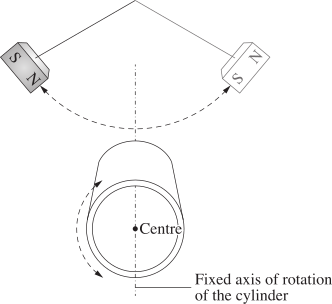
A magnet is swinging as a pendulum. Close below it is an aluminium (non-ferromagnetic) can. The can is free to spin around a fixed axis as shown.
 

Analyse the motion and energy transformations of both the can and the magnet.   (7 marks)

--- 18 WORK AREA LINES (style=lined) ---

Show Answers Only

  • When the magnet swings down from its high position toward the can, its gravitational potential energy transforms into kinetic energy.
  • As the magnet moves, it creates changing magnetic flux through the aluminium can. This flux change is strongest when there’s the fastest relative motion between the magnet and can.
  • The induced emf is described in the equation  \({\large{\varepsilon}} = -N \dfrac{\Delta \phi}{\Delta t} \).
  • This emf creates eddy currents in the can, which produce both heat and a magnetic field. Following Lenz’s law, this magnetic field opposes the magnet’s motion.
  • The magnetic fields from both the magnet and the eddy currents interact, causing the can to initially rotate clockwise.
  • Eventually, this interaction dampens the magnet’s swing. The magnetic interaction between the eddy currents and the magnet causes the can to rotate back and forth with decreasing amplitude, as the system’s energy gradually converts to heat.

Show Worked Solution

  • When the magnet swings down from its high position toward the can, its gravitational potential energy transforms into kinetic energy.
  • As the magnet moves, it creates changing magnetic flux through the aluminium can. This flux change is strongest when there’s the fastest relative motion between the magnet and can.
  • The induced emf is described in the equation  \({\large{\varepsilon}} = -N \dfrac{\Delta \phi}{\Delta t} \).
  • This emf creates eddy currents in the can, which produce both heat and a magnetic field. Following Lenz’s law, this magnetic field opposes the magnet’s motion.
  • The magnetic fields from both the magnet and the eddy currents interact, causing the can to initially rotate clockwise.
  • Eventually, this interaction dampens the magnet’s swing. The magnetic interaction between the eddy currents and the magnet causes the can to rotate back and forth with decreasing amplitude, as the system’s energy gradually converts to heat.
♦♦ Mean mark 47%.

Filed Under: Electromagnetic Induction Tagged With: Band 5, Band 6, smc-3705-20-Induced emf, smc-3705-30-Magnetic Flux, smc-3705-40-Lenz and Faraday

PHYSICS, M6 2024 HSC 18 MC

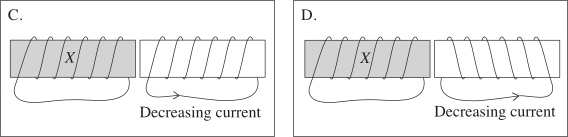
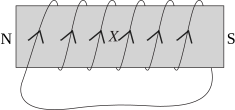
The diagram shows a magnet moving towards a coil \(X\).
 

This action causes a current to be induced in the coil.

Which situation will induce a current in coil \(X\) that is in the same direction as the current induced by the movement of the magnet?
 

Show Answers Only

\(D\)

Show Worked Solution
  • As the north pole of the magnet moves towards coil \(X\), the magnetic flux through \(X\) is increased. By Lenz’s law, a current will be generated in the coil that produces a magnetic field to oppose the increase the flux. Using Lenz’s law, the current in \(X\) will generate a north pole to the left to repel the approaching magnet. The induced current will run up the coils as viewed from the front. 

  • The current will be induced in the same direction in \(D\). Using the right hand grip rule, the current though the white coil will produce magnetic field lines gong to the left. As the current is decreasing, the change of flux through \(X\) is decreasing. Therefore by Lenz’s law, the current induced in \(X\) will strengthen the magnetic field to oppose the decreasing magnetic flux. 
  • Therefore, the magnetic field lines produced by the current in \(X\) will also be to the left, and using the right hand grip rule, the current through \(X\) will run up the coils (front view).
  • In all the other options, the current will run down the coils (front view).

\(\Rightarrow D\)

♦♦♦ Mean mark 28%.

Filed Under: Electromagnetic Induction Tagged With: Band 6, smc-3705-20-Induced emf, smc-3705-40-Lenz and Faraday

PHYSICS, M6 2020 VCE 6

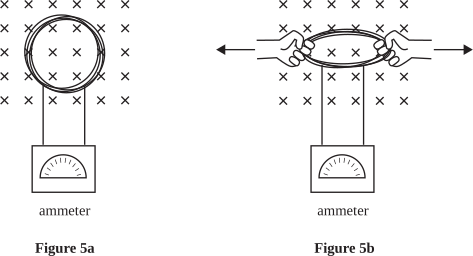
Two Physics students hold a coil of wire in a constant uniform magnetic field, as shown in Figure 5a. The ends of the wire are connected to a sensitive ammeter. The students then change the shape of the coil by pulling each side of the coil in the horizontal direction, as shown in Figure 5b. They notice a current register on the ammeter.
 

  1. Will the magnetic flux through the coil increase, decrease or stay the same as the students change the shape of the coil?   (1 mark)

    --- 2 WORK AREA LINES (style=blank) ---

  1. Explain, using physics principles, why the ammeter registered a current in the coil and determine the direction of the induced current.   (3 marks)

    --- 6 WORK AREA LINES (style=lined) ---

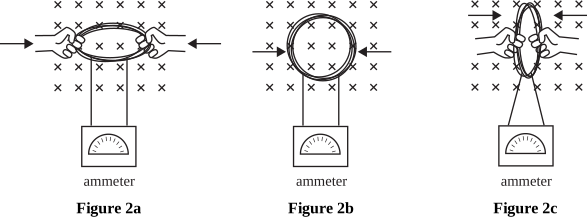
  1. The students then push each side of the coil together, as shown in Figure 6a, so that the coil returns to its original circular shape, as shown in Figure 6b, and then changes to the shape shown in Figure 6c. 
     

  1. Describe the direction of any induced currents in the coil during these changes. Give your reasoning.   (2 marks)

    --- 6 WORK AREA LINES (style=lined) ---

Show Answers Only

a.    Decrease 

b.    Ammeter registers a current:

  • By Faraday’s law of induction, a change in flux will result in an induced EMF through the coil and induced current. 
  • This induced current acts to oppose the original change in flux that created it. As the magnetic flux is decreasing, the induced current will act to strengthen the magnetic field.
  • Hence by using the right-hand grip rule, the current will run clockwise through the coil.

c.    There will be an induced current from 6a to 6b.

  • As the magnetic flux is increasing, the induced current will act to decrease the flux and oppose the magnetic field.
  • By the right-hand grip rule, the current will flow anti-clockwise around the coil.
  • There will also be an induced current from 6b to 6c.
  • The magnetic flux this time is decreasing, so the induced current will act to increase the flux and strengthen the magnetic field.
  • Using the right-hand grip rule, the current through the coil will flow clockwise.
Show Worked Solution

a.    Magnetic flux will decrease.

  • The magnetic flux is proportional to how many field lines are passing through a given area.
  • As the number of lines passing through the coil of wire decreases, the magnetic flux will also decrease.

b.    Ammeter registers a current:

  • By Faraday’s law of induction, a change in flux will result in an induced EMF through the coil and induced current. 
  • This induced current acts to oppose the original change in flux that created it. As the magnetic flux is decreasing, the induced current will act to strengthen the magnetic field.
  • Hence by using the right-hand grip rule, the current will run clockwise through the coil.
♦ Mean mark (b) 42%.

c.    There will be an induced current from 6a to 6b.

  • As the magnetic flux is increasing, the induced current will act to decrease the flux and oppose the magnetic field.
  • By the right-hand grip rule, the current will flow anti-clockwise around the coil.
  • There will also be an induced current from 6b to 6c.
  • The magnetic flux this time is decreasing, so the induced current will act to increase the flux and strengthen the magnetic field.
  • Using the right-hand grip rule, the current through the coil will flow clockwise.
♦♦♦ Mean mark (c) 28%.
COMMENT: Lenz’s law was poorly understood in this question.

Filed Under: Electromagnetic Induction Tagged With: Band 4, Band 5, Band 6, smc-3705-20-Induced emf, smc-3705-30-Magnetic Flux, smc-3705-40-Lenz and Faraday

PHYSICS, M6 2020 VCE 6*

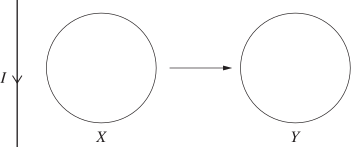
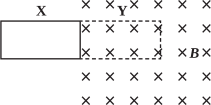
A single loop of wire moves into a uniform magnetic field \(B\) of strength 3.5 × 10\(^{-4}\) T over time \(t\) = 0.20 s from point \(\text{X}\) to point \(\text{Y}\) , as shown in the diagram below. The area \(A\) of the loop is 0.05 m\(^2\).
 

Determine the magnitude of the average induced EMF in the loop.   (2 marks)

--- 4 WORK AREA LINES (style=lined) ---

Show Answers Only

\(8.8 \times 10^{-5}\ \text{V}\)

Show Worked Solution

\(\varepsilon=\dfrac{\Delta \Phi}{\Delta t}=\dfrac{B \Delta A}{\Delta t}=\dfrac{3.5 \times 10^{-4} \times 0.05}{0.2}=8.8 \times 10^{-5}\ \text{V}\)

Filed Under: Electromagnetic Induction Tagged With: Band 3, smc-3705-20-Induced emf

PHYSICS, M6 2021 VCE 6 MC

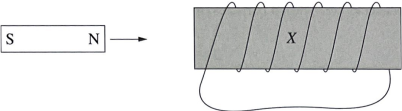
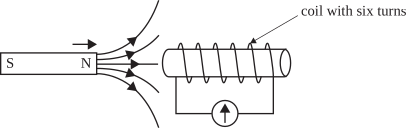
A magnet approaches a coil with six turns, as shown in the diagram below. During time interval \(\Delta t\), the magnetic flux changes by 0.05 Wb and the average induced EMF is 1.2 V.
 

Which one of the following is closest to the time interval \(\Delta t\) ?

  1. 0.04 s
  2. 0.01 s
  3. 0.25 s
  4. 0.50 s
Show Answers Only

\(C\)

Show Worked Solution
\(\varepsilon\) \(=N\dfrac{\Delta \Phi}{\Delta t}\)  
\(\Delta t\) \(=N \dfrac{\Delta \Phi}{\varepsilon}=6 \times \dfrac{0.05}{1.2}=0.25\ \text{s}\)  


\(\Rightarrow C\)

Filed Under: Electromagnetic Induction Tagged With: Band 4, smc-3705-20-Induced emf, smc-3705-30-Magnetic Flux

PHYSICS, M6 2022 VCE 6

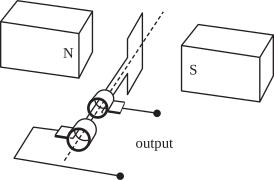
The diagram shows a simple alternator consisting of a rectangular coil of area 0.060 m\(^{2}\) and 200 turns, rotating in a uniform magnetic field. The magnetic flux through the coil in the vertical position shown in the diagram is 1.2 × 10\(^{-3}\) Wb.
 

  1. Calculate the strength of the magnetic field. Show your working.  (2 marks)

--- 4 WORK AREA LINES (style=lined) ---

  1. The rectangular coil rotates at a frequency of 2.5 Hz.
  2. Calculate the average induced EMF produced in the first quarter of a turn. Begin the quarter with the coil in the vertical position shown in the diagram.  (3 marks)

--- 6 WORK AREA LINES (style=lined) ---

Show Answers Only

a.    \(0.02\ \text{T}\)

b.    \(2.4\ \text{V}\)

Show Worked Solution
a.     \(\Phi\) \(=BA\)
  \(B\) \(=\dfrac{\Phi}{A}=\dfrac{1.2 \times 10^{-3}}{0.060}=0.02\ \text{T}\)

 
b.   
\(\text{The time for 1 complete rotation:}\)

\(T=\dfrac{1}{f}=\dfrac{1}{2.5}=0.4\ \text{s}\)

\(\Rightarrow \text{Time for a quarter turn}\ =0.1\ \text{s}\)

\(\varepsilon=N\dfrac{\Delta \Phi}{t}=200 \times  \dfrac{1.2 \times 10^{-3}}{0.1}=2.4\ \text{V}\)

Filed Under: Electromagnetic Induction Tagged With: Band 3, Band 4, smc-3705-20-Induced emf, smc-3705-30-Magnetic Flux

PHYSICS, M6 2022 VCE 4

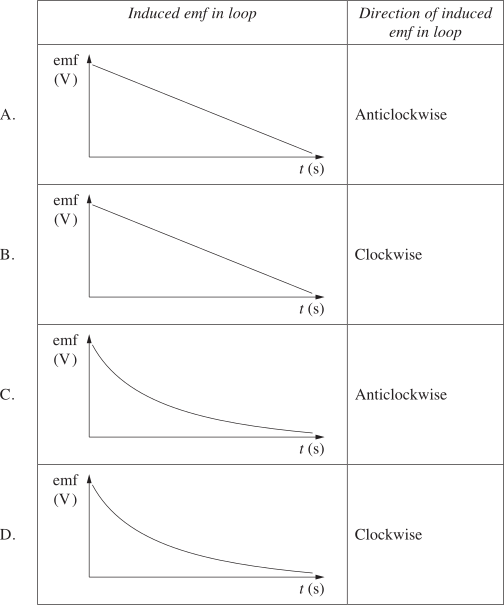
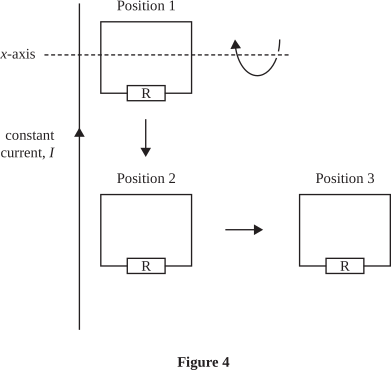
A square loop of wire connected to a resistor, \(\text{R}\), is placed close to a long wire carrying a constant current, \(I\), in the direction shown in the diagram.

The square loop is moved three times in the following order:

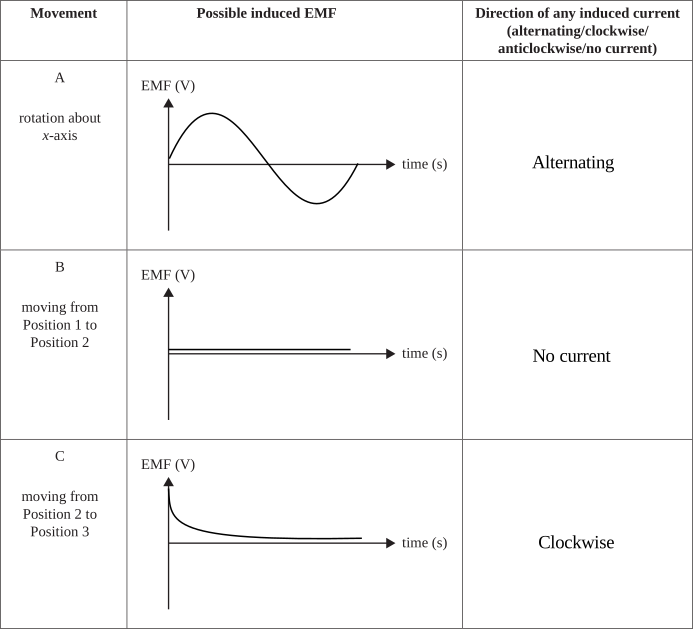
  • Movement A – Starting at Position 1 in the diagram, the square loop rotates one full rotation at a steady speed about the \(x\)-axis. The rotation causes the resistor, \(\text{R}\), to first move out of the page.
  • Movement B – The square loop is then moved at a constant speed, parallel to the current carrying wire, from Position 1 to Position 2.
  • Movement C – The square loop is moved at a constant speed, perpendicular to the current carrying wire, from Position 2 to Position 3.
     

Complete the table below to show the effects of each of the three movements by:

  • sketching any EMF generated in the square loop during the motion on the axes provided (scales and values are not required)
  • stating whether any induced current in the square loop is 'alternating', 'clockwise', 'anticlockwise' or has 'no current'.

--- 0 WORK AREA LINES (style=blank) ---

Show Answers Only

Show Worked Solution
  • The magnetic field strength around a current carrying conductor, \(B \propto \dfrac{1}{r}\). Hence, for the movement in C, the change in magnetic field strength and therefore magnetic flux is one of inverse proportionality as depicted in the graph below.
♦ Mean mark 43%.

Filed Under: Electromagnetic Induction Tagged With: Band 5, smc-3705-20-Induced emf

PHYSICS, M6 2023 VCE 5

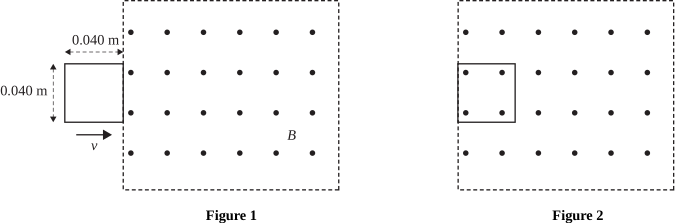
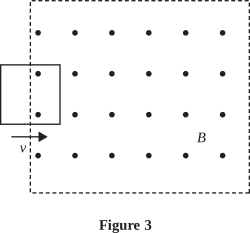
Figure 1 shows a single square loop of conducting wire placed just outside a constant uniform magnetic field, \(B\). The length of each side of the loop is 0.040 m. The magnetic field has a magnitude of 0.30 T and is directed out of the page.

Over a time period of 0.50 s, the loop is moved at a constant speed, \(v\), from completely outside the magnetic field, Figure 1, to completely inside the magnetic field, Figure 2.
 

  1. Calculate the average EMF produced in the loop as it moves from the position just outside the region of the field, Figure 1, to the position completely within the area of the magnetic field, Figure 2.
  2. Show your working.   (2 marks)

--- 5 WORK AREA LINES (style=lined) ---

  1. On the small square loop in Figure 3, show the direction of the induced current as the loop moves into the area of the magnetic field.   (1 mark)
     

--- 5 WORK AREA LINES (style=blank) ---

Show Answers Only

a.    \(9.6 \times 10^{-4}\ \text{V}\)

b.    
       

Show Worked Solution
a.     \(\varepsilon\) \(=\dfrac{\Delta \phi}{\Delta t}\)
    \(=\dfrac{\Delta B A}{\Delta t}\)
    \(=\dfrac{0.3 \times 0.04^2}{0.5}\)
    \(=9.6 \times 10^{-4}\ \text{V}\)


b.  
         

♦ Mean mark (b) 45%.

Filed Under: Electromagnetic Induction Tagged With: Band 4, Band 5, smc-3705-20-Induced emf, smc-3705-40-Lenz and Faraday

PHYSICS, M6 2023 HSC 30

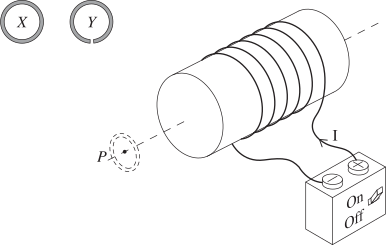
The diagram shows apparatus that is used to investigate the interaction between the magnetic field produced by a coil and two copper rings \(X\) and \(Y\), when each is placed at position \(P\), as shown.


Ring \(X\) is a complete circular ring, and a small gap has been cut in ring \(Y\). Each of the rings has a cross-sectional area of  4 × 10\(^{-4}\) m².

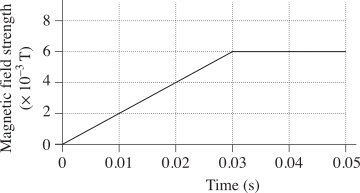
The power supply connected to the coil produces an increasing current through the coil in the direction shown, when the switch is turned on. This produces a magnetic field at \(P\) that varies as shown in the graph.
 

  1. In the first part of the investigation, ring \(X\) is held near the end of the electromagnet at position \(P\).
  2. Account for the force acting on the ring from 0 to 0.05 seconds after the power supply is turned on.   (4 marks)

--- 7 WORK AREA LINES (style=lined) ---

  1. i.  In the second part of the investigation, ring \(Y\) is placed at \(P\), and the power supply is turned on. 
  2.     Explain the behaviour of the ring.   (2 marks)

--- 4 WORK AREA LINES (style=lined) ---

  1. ii. Calculate the maximum induced emf in ring \(Y\).   (2 marks)

--- 4 WORK AREA LINES (style=lined) ---

Show Answers Only

a.   Between 0 – 0.03 seconds:

  • The magnetic field strength at point \(P\) is increasing at a constant rate.
  • Thus, ring \(X\) experiences a change in flux, which causes an EMF to be induced across the ring (Faraday’s Law) 
  • This induced EMF causes a current to flow through ring \(X\) that will interact in the external magnetic field to reduce the change in flux that created it (Lenz’s Law).
  • Thus, a clockwise current will run through the ring, creating a north pole towards the solenoid, causing the ring to have a repulsive force away from the solenoid acting on it.

Between 0.03 – 0.05 seconds: 

  • There is no change in flux through the ring due to there being a constant magnetic field.
  • Therefore, there is no induced EMF or induced current.
  • Therefore, there is no force acting on the ring.

b.i.  Ring \(Y\) behaviour when placed at \(P\):

  • Ring \(Y\) will experience the same change in flux and hence the same induced EMF as ring \(X\) within 0 – 0.03 seconds.
  • However, due to the gap in ring \(Y\) (i.e. there is no closed circuit), no induced current will be able to flow through the ring.
  • Hence, there is no force exerted on ring \(Y\).

ii.  \(\varepsilon = 8 \times 10^{-5}\ \text{V}\)

Show Worked Solution

a.   Between 0 – 0.03 seconds:

  • The magnetic field strength at point \(P\) is increasing at a constant rate.
  • Thus, ring \(X\) experiences a change in flux, which causes an EMF to be induced across the ring (Faraday’s Law) 
  • This induced EMF causes a current to flow through ring \(X\) that will interact in the external magnetic field to reduce the change in flux that created it (Lenz’s Law).
  • Thus, a clockwise current will run through the ring, creating a north pole towards the solenoid, causing the ring to have a repulsive force away from the solenoid acting on it.

Between 0.03 – 0.05 seconds: 

  • There is no change in flux through the ring due to there being a constant magnetic field.
  • Therefore, there is no induced EMF or induced current.
  • Therefore, there is no force acting on the ring.
♦ Mean mark (a) 44%.

b.i.  Ring \(Y\) behaviour when placed at \(P\):

  • Ring \(Y\) will experience the same change in flux and hence the same induced EMF as ring \(X\) within 0 – 0.03 seconds.
  • However, due to the gap in ring \(Y\) (i.e. there is no closed circuit), no induced current will be able to flow through the ring.
  • Hence, there is no force exerted on ring \(Y\).
b.ii. \(\varepsilon\) \(=N\dfrac{\Delta \phi}{\Delta t}\)
    \(=N \dfrac{A \Delta B}{\Delta t}\)
    \(= 1 \times \dfrac{4 \times 10^{-4} \times (6 \times 10^{-3}-0)}{0.03-0}\)
    \(=8 \times 10^{-5}\ \text{V}\)
♦♦ Mean mark (b)(i) 38%.
♦ Mean mark (b)(ii) 49%.

Filed Under: Electromagnetic Induction Tagged With: Band 5, smc-3705-20-Induced emf, smc-3705-30-Magnetic Flux, smc-3705-40-Lenz and Faraday

PHYSICS, M6 2017 HSC 14 MC

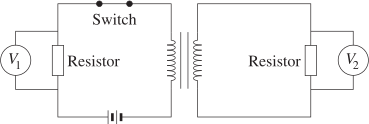
The diagram shows a DC circuit containing a transformer.
 

The potential differences `V_1` and `V_2` are measured continuously for 4 s. The switch is initially closed.

At t = 2 s, the switch is opened.

Which pair of graphs shows how the potential differences `V_1` and `V_2` vary with time over the 4-second interval?


Show Answers Only

`A`

Show Worked Solution
  • When the switch is opened at t = 2 s, the current through the primary circuit and thus `V_(1)`  drops to zero.
  • This sudden decrease in magnetic flux through the secondary coil induces a temporary voltage in the secondary circuit.

`=>A`

Filed Under: Electromagnetic Induction Tagged With: Band 4, smc-3705-20-Induced emf

PHYSICS, M6 2018 HSC 22

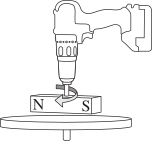
  1. A drill spins a magnet above a non-magnetic metal disc which is free to rotate.


    Explain the effect of the rotating magnet on the disc.   (3 marks)

--- 6 WORK AREA LINES (style=lined) ---

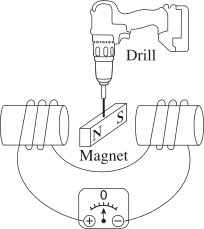
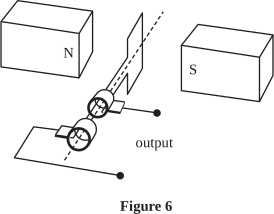
  1. The diagram shows a magnet attached to an electric drill so that it can be rotated between two coils connected to a voltmeter.


    The drill starts from rest and gradually speeds up, reaching its full speed after three revolutions.
     
    Sketch a graph showing the induced emf across the coils during the time that it takes the magnet to reach its full speed.   (3 marks)
     

--- 6 WORK AREA LINES (style=lined) ---

Show Answers Only

a.    Effect of rotating magnet:

  • The rotating magnet causes a changing magnetic flux in the metal disc.
  • This induces eddy currents (Faraday’s Law). By Lenz’s Law, these produce a magnetic field which opposes the change in flux by minimising the relative motion between the disc and the magnet.
  • This will have the effect of the disc rotating in the same direction as the magnet.

b.   


Show Worked Solution

a.    Effect of rotating magnet:

  • The rotating magnet causes a changing magnetic flux in the metal disc.
  • This induces eddy currents (Faraday’s Law). By Lenz’s Law, these produce a magnetic field which opposes the change in flux by minimising the relative motion between the disc and the magnet.
  • This will have the effect of the disc rotating in the same direction as the magnet.

b.   


♦ Mean mark (b) 50%.

Filed Under: Electromagnetic Induction Tagged With: Band 4, Band 5, smc-3705-20-Induced emf, smc-3705-40-Lenz and Faraday

PHYSICS, M6 2020 HSC 33

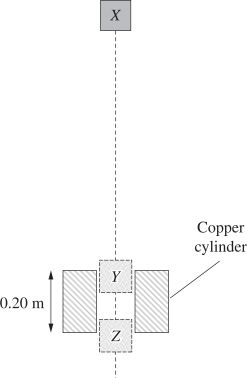
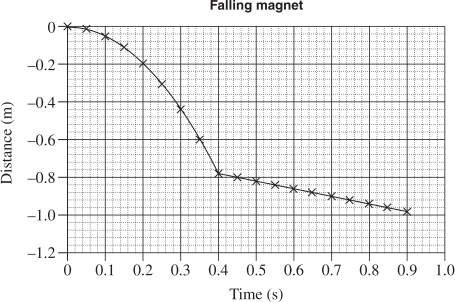
A strong magnet of mass 0.04 kg falls 0.78 m under the action of gravity from position `X` above a hollow copper cylinder. It then travels a distance of 0.20 m through the cylinder from `Y` to `Z` before falling freely again.
 

The magnet takes 0.5 seconds to pass through the cylinder. The displacement-time graph of the magnet is shown.
 

Analyse the motion of the magnet by applying the law of conservation of energy.

Your analysis should refer to gravity and the copper cylinder, and include both qualitative and quantitative information.   (9 marks)

--- 20 WORK AREA LINES (style=lined) ---

Show Answers Only

During the first 0.4 seconds:

  • The magnet is accelerating downwards at 9.8 m s–2 due to gravity.
  • The magnet’s gravitational potential energy is being converted into kinetic energy consistent with the law of conservation of energy.
  • Quantitatively:
  •   `Delta E_(k)= Delta U=mg Delta h=0.04 xx9.8 xx0.78=0.30576\ \text{J}`
  • Hence 0.30576 joules of the magnet’s gravitational potential energy is converted into kinetic energy as it falls under gravity.

As magnet reaches the copper cylinder:

  • Its downwards motion causes the formation of induced currents in the cylinder which produce a magnetic field that opposes the magnet’s motion (Lenz’s law).
  • This causes the magnet to decelerate to 0.4 m s–1 and lose kinetic energy. 
  • Finding the magnets speed before entering the copper cylinder:
`E_(k)` `=(1)/(2)mv^2`  
`0.30576` `=(1)/(2)xx 0.04xx v^2`  
`v` `=3.91\ \text{m s}^{-1}`  


  • Quantifying the kinetic energy loss:
`Delta E_(k)` `=(1)/(2)mv^2-(1)/(2)m u^2`  
  `=(1)/(2)xx 0.04xx 3.91^2-(1)/(2)xx 0.04xx 0.4^2`  
  `=0.30256\ \text{J}`  


  • Applying the law of conservation of energy shows that 0.30256 J of the magnet’s kinetic energy is being converted to heat energy within the cylinder as the magnet decelerates.
  • Finally, as the magnet passes through the copper cylinder, its gravitational potential energy decreases while its velocity remains constant.
  • Quantifying the decrease in gravitational potential energy:
  •   `Delta U=mg Delta h=0.04xx 9.8xx 0.2=0.0784`
  • Hence, 0.0784 J of the magnet’s gravitational potential energy is converted into heat energy in the cylinder, consistent with the law of conservation of energy.
Show Worked Solution

During the first 0.4 seconds:

  • The magnet is accelerating downwards at 9.8 m s–2 due to gravity.
  • The magnet’s gravitational potential energy is being converted into kinetic energy consistent with the law of conservation of energy.
  • Quantitatively:
  •   `Delta E_(k)= Delta U=mg Delta h=0.04 xx9.8 xx0.78=0.30576\ \text{J}`
  • Hence 0.30576 joules of the magnet’s gravitational potential energy is converted into kinetic energy as it falls under gravity.

As magnet reaches the copper cylinder:

  • Its downwards motion causes the formation of induced currents in the cylinder which produce a magnetic field that opposes the magnet’s motion (Lenz’s law).
  • This causes the magnet to decelerate to 0.4 m s–1 and lose kinetic energy. 
  • Finding the magnets speed before entering the copper cylinder:
`E_(k)` `=(1)/(2)mv^2`  
`0.30576` `=(1)/(2)xx 0.04xx v^2`  
`v` `=3.91\ \text{m s}^{-1}`  


  • Quantifying the kinetic energy loss:
`Delta E_(k)` `=(1)/(2)mv^2-(1)/(2)m u^2`  
  `=(1)/(2)xx 0.04xx 3.91^2-(1)/(2)xx 0.04xx 0.4^2`  
  `=0.30256\ \text{J}`  


  • Applying the law of conservation of energy shows that 0.30256 J of the magnet’s kinetic energy is being converted to heat energy within the cylinder as the magnet decelerates.
  • Finally, as the magnet passes through the copper cylinder, its gravitational potential energy decreases while its velocity remains constant.
  • Quantifying the decrease in gravitational potential energy:
  •   `Delta U=mg Delta h=0.04xx 9.8xx 0.2=0.0784`
  • Hence, 0.0784 J of the magnet’s gravitational potential energy is converted into heat energy in the cylinder, consistent with the law of conservation of energy.
♦ Mean mark 51%.

Filed Under: Electromagnetic Induction Tagged With: Band 4, Band 5, Band 6, smc-3705-20-Induced emf, smc-3705-40-Lenz and Faraday, smc-3705-90-X-topic: Gravity

PHYSICS, M6 2019 HSC 5 MC

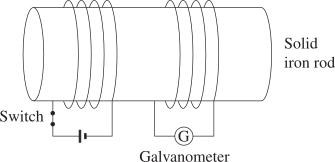
The diagram shows two coils wound around a solid iron rod. Initially the switch is closed.
 

Opening the switch will cause the galvanometer pointer to

  1. remain at a constant reading.
  2. move from a non-zero reading to a zero reading.
  3. move from a zero reading to a non-zero reading, where it remains.
  4. move from a zero reading to a non-zero reading, then back to zero.
Show Answers Only

`D`

Show Worked Solution
  • Originally, there is a constant magnetic field passing through the coil on the right due to the current through the coil on the left.
  • As there is no change in flux through the coil on the right initially the galvanometer shows a zero reading.
  • When the switch is opened, the decrease in magnetic flux through the coil on the right causes a deflection of the galvanometer to a non-zero reading.
  • The galvanometer will return to a reading of zero when the magnetic flux passing through it drops to zero. 

`=>D`

Filed Under: Electromagnetic Induction Tagged With: Band 4, smc-3705-20-Induced emf, smc-3705-40-Lenz and Faraday

PHYSICS, M6 2020 HSC 19 MC

A conductor `P Q` is in a uniform magnetic field. The conductor rotates around the end `P` at a constant angular velocity.
 

Which graph shows the induced emf between `P` and `Q` as the conductor completes one revolution from the position shown?


Show Answers Only

`C`

Show Worked Solution
  • At the starting position shown, electrons in the rod are moving to the right, parallel to the magnetic field lines. So, there is no force acting on the conductor (EMF of zero).
  • After a quarter of a rotation, electrons in the rod are moving up the page. Using the right hand palm rule, they experience a force out of the page. This will not induce an EMF between `P` and `Q.`
  • The correct graph will show an EMF of zero at both `t=0` and after a quarter of a rotation.

`=>C`


♦♦ Mean mark 10%.

Filed Under: Charged Particles, Conductors and Electric/Magnetic Fields, Electromagnetic Induction Tagged With: Band 6, smc-3693-15-Charged Particles in MF, smc-3705-20-Induced emf

PHYSICS, M6 2021 HSC 31

Two identical solenoids are mounted on carts as shown. Each solenoid is connected to a galvanometer, and the solenoid on cart 1 is also connected to an open switch and a battery. The total mass of cart 1 is twice that of cart 2.
 

Explain what would be observed when the switch on cart 1 is closed. In your answer, refer to the current in each galvanometer and the initial movement of the carts.   (7 marks)

--- 16 WORK AREA LINES (style=lined) ---

Show Answers Only
  • When the switch on cart one is closed, a direct current will flow through the cart 1 solenoid causing a deflection on `G_1.`
  • Using the right hand grip rule, this will create a magnetic field with a south pole on the right hand side of this solenoid. As this magnetic field is generated, the solenoid on cart two experiences a change in magnetic flux.
  • According to Faraday’s law, an induced emf and current will be generated in the cart 2 solenoid.
  • By Lenz’s law, this current will flow in a direction that opposes the original change in flux, causing a magnetic south pole on the left hand side of this solenoid, and a momentary deflection of `G_2` in the opposite direction to `G_1`.
  • As the two solenoids produce south poles facing each other, they will repel causing the carts to move away from each other. The law of conservation of momentum dictates that since cart 1 is double the mass of cart 2, it will have half the velocity of cart 2.
Show Worked Solution

  • When the switch on cart one is closed, a direct current will flow through the cart 1 solenoid causing a deflection on `G_1.`
  • Using the right hand grip rule, this will create a magnetic field with a south pole on the right hand side of this solenoid. As this magnetic field is generated, the solenoid on cart two experiences a change in magnetic flux.
  • According to Faraday’s law, an induced emf and current will be generated in the cart 2 solenoid.
  • By Lenz’s law, this current will flow in a direction that opposes the original change in flux, causing a magnetic south pole on the left hand side of this solenoid, and a momentary deflection of `G_2` in the opposite direction to `G_1`.
  • As the two solenoids produce south poles facing each other, they will repel causing the carts to move away from each other. The law of conservation of momentum dictates that since cart 1 is double the mass of cart 2, it will have half the velocity of cart 2.


♦ Mean mark 45%.

Filed Under: Electromagnetic Induction Tagged With: Band 5, smc-3705-20-Induced emf, smc-3705-40-Lenz and Faraday

Copyright © 2014–2025 SmarterEd.com.au · Log in