SmarterEd

Aussie Maths & Science Teachers: Save your time with SmarterEd

  • Login
  • Get Help
  • About

PHYSICS, M6 2024 HSC 33

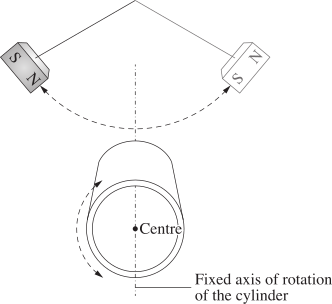
A magnet is swinging as a pendulum. Close below it is an aluminium (non-ferromagnetic) can. The can is free to spin around a fixed axis as shown.
 

Analyse the motion and energy transformations of both the can and the magnet.   (7 marks)

--- 18 WORK AREA LINES (style=lined) ---
Show Answers Only

  • When the magnet swings down from its high position toward the can, its gravitational potential energy transforms into kinetic energy.
  • As the magnet moves, it creates changing magnetic flux through the aluminium can. This flux change is strongest when there’s the fastest relative motion between the magnet and can.
  • The induced emf is described in the equation  \({\large{\varepsilon}} = -N \dfrac{\Delta \phi}{\Delta t} \).
  • This emf creates eddy currents in the can, which produce both heat and a magnetic field. Following Lenz’s law, this magnetic field opposes the magnet’s motion.
  • The magnetic fields from both the magnet and the eddy currents interact, causing the can to initially rotate clockwise.
  • Eventually, this interaction dampens the magnet’s swing. The magnetic interaction between the eddy currents and the magnet causes the can to rotate back and forth with decreasing amplitude, as the system’s energy gradually converts to heat.

Show Worked Solution

  • When the magnet swings down from its high position toward the can, its gravitational potential energy transforms into kinetic energy.
  • As the magnet moves, it creates changing magnetic flux through the aluminium can. This flux change is strongest when there’s the fastest relative motion between the magnet and can.
  • The induced emf is described in the equation  \({\large{\varepsilon}} = -N \dfrac{\Delta \phi}{\Delta t} \).
  • This emf creates eddy currents in the can, which produce both heat and a magnetic field. Following Lenz’s law, this magnetic field opposes the magnet’s motion.
  • The magnetic fields from both the magnet and the eddy currents interact, causing the can to initially rotate clockwise.
  • Eventually, this interaction dampens the magnet’s swing. The magnetic interaction between the eddy currents and the magnet causes the can to rotate back and forth with decreasing amplitude, as the system’s energy gradually converts to heat.
♦♦ Mean mark 47%.

Filed Under: Electromagnetic Induction Tagged With: Band 5, Band 6, smc-3705-20-Induced emf, smc-3705-30-Magnetic Flux, smc-3705-40-Lenz and Faraday

PHYSICS, M6 2020 VCE 6

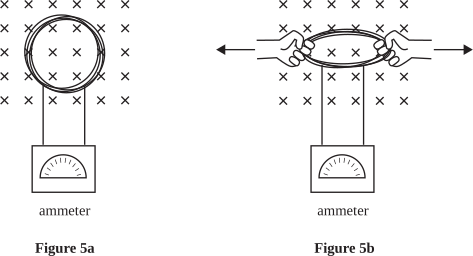
Two Physics students hold a coil of wire in a constant uniform magnetic field, as shown in Figure 5a. The ends of the wire are connected to a sensitive ammeter. The students then change the shape of the coil by pulling each side of the coil in the horizontal direction, as shown in Figure 5b. They notice a current register on the ammeter.
 

  1. Will the magnetic flux through the coil increase, decrease or stay the same as the students change the shape of the coil?   (1 mark)

    --- 2 WORK AREA LINES (style=blank) ---

  1. Explain, using physics principles, why the ammeter registered a current in the coil and determine the direction of the induced current.   (3 marks)

    --- 6 WORK AREA LINES (style=lined) ---
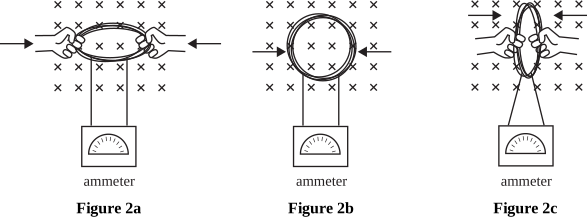
  1. The students then push each side of the coil together, as shown in Figure 6a, so that the coil returns to its original circular shape, as shown in Figure 6b, and then changes to the shape shown in Figure 6c. 
     

  1. Describe the direction of any induced currents in the coil during these changes. Give your reasoning.   (2 marks)

    --- 6 WORK AREA LINES (style=lined) ---
Show Answers Only

a.    Decrease 

b.    Ammeter registers a current:

  • By Faraday’s law of induction, a change in flux will result in an induced EMF through the coil and induced current. 
  • This induced current acts to oppose the original change in flux that created it. As the magnetic flux is decreasing, the induced current will act to strengthen the magnetic field.
  • Hence by using the right-hand grip rule, the current will run clockwise through the coil.

c.    There will be an induced current from 6a to 6b.

  • As the magnetic flux is increasing, the induced current will act to decrease the flux and oppose the magnetic field.
  • By the right-hand grip rule, the current will flow anti-clockwise around the coil.
  • There will also be an induced current from 6b to 6c.
  • The magnetic flux this time is decreasing, so the induced current will act to increase the flux and strengthen the magnetic field.
  • Using the right-hand grip rule, the current through the coil will flow clockwise.
Show Worked Solution

a.    Magnetic flux will decrease.

  • The magnetic flux is proportional to how many field lines are passing through a given area.
  • As the number of lines passing through the coil of wire decreases, the magnetic flux will also decrease.

b.    Ammeter registers a current:

  • By Faraday’s law of induction, a change in flux will result in an induced EMF through the coil and induced current. 
  • This induced current acts to oppose the original change in flux that created it. As the magnetic flux is decreasing, the induced current will act to strengthen the magnetic field.
  • Hence by using the right-hand grip rule, the current will run clockwise through the coil.
♦ Mean mark (b) 42%.

c.    There will be an induced current from 6a to 6b.

  • As the magnetic flux is increasing, the induced current will act to decrease the flux and oppose the magnetic field.
  • By the right-hand grip rule, the current will flow anti-clockwise around the coil.
  • There will also be an induced current from 6b to 6c.
  • The magnetic flux this time is decreasing, so the induced current will act to increase the flux and strengthen the magnetic field.
  • Using the right-hand grip rule, the current through the coil will flow clockwise.
♦♦♦ Mean mark (c) 28%.
COMMENT: Lenz’s law was poorly understood in this question.

Filed Under: Electromagnetic Induction Tagged With: Band 4, Band 5, Band 6, smc-3705-20-Induced emf, smc-3705-30-Magnetic Flux, smc-3705-40-Lenz and Faraday

PHYSICS, M6 2020 VCE 5 MC

A coil consisting of 20 loops with an area of 10 cm\(^2\) is placed in a uniform magnetic field \(B\) of strength 0.03 T so that the plane of the coil is perpendicular to the field direction, as shown in the diagram below.
 

The magnetic flux through the coil is closest to

  1. 0 Wb
  2. 3.0 × 10\(^{-5}\) Wb
  3. 6.0 × 10\(^{-4}\) Wb
  4. 3.0 × 10\(^{-1}\) Wb
Show Answers Only

\(B\)

Show Worked Solution
  • Convert cm\(^2\) to m\(^2\): 1 cm\(^2\) = 0.01 m × 0.01 m = 0.0001 m\(^2\)
  • 10 cm\(^2\) = 0.0010 m\(^2\)
  • \(\Phi = BA = 0.03 \times 0.0010 = 3.0 \times 10^{-5}\ \text{Wb}\)

\(\Rightarrow B\)

Filed Under: Electromagnetic Induction Tagged With: Band 4, smc-3705-30-Magnetic Flux

PHYSICS, M6 2021 VCE 6 MC

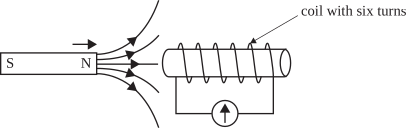
A magnet approaches a coil with six turns, as shown in the diagram below. During time interval \(\Delta t\), the magnetic flux changes by 0.05 Wb and the average induced EMF is 1.2 V.
 

Which one of the following is closest to the time interval \(\Delta t\) ?

  1. 0.04 s
  2. 0.01 s
  3. 0.25 s
  4. 0.50 s
Show Answers Only

\(C\)

Show Worked Solution
\(\varepsilon\) \(=N\dfrac{\Delta \Phi}{\Delta t}\)  
\(\Delta t\) \(=N \dfrac{\Delta \Phi}{\varepsilon}=6 \times \dfrac{0.05}{1.2}=0.25\ \text{s}\)  


\(\Rightarrow C\)

Filed Under: Electromagnetic Induction Tagged With: Band 4, smc-3705-20-Induced emf, smc-3705-30-Magnetic Flux

PHYSICS, M6 2022 VCE 6

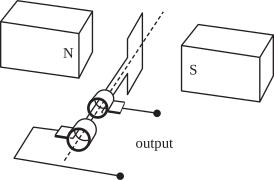
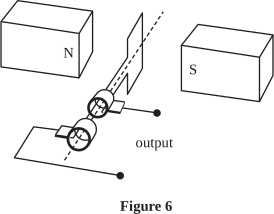
The diagram shows a simple alternator consisting of a rectangular coil of area 0.060 m\(^{2}\) and 200 turns, rotating in a uniform magnetic field. The magnetic flux through the coil in the vertical position shown in the diagram is 1.2 × 10\(^{-3}\) Wb.
 

  1. Calculate the strength of the magnetic field. Show your working.  (2 marks)

--- 4 WORK AREA LINES (style=lined) ---
  1. The rectangular coil rotates at a frequency of 2.5 Hz.
  2. Calculate the average induced EMF produced in the first quarter of a turn. Begin the quarter with the coil in the vertical position shown in the diagram.  (3 marks)

--- 6 WORK AREA LINES (style=lined) ---
Show Answers Only

a.    \(0.02\ \text{T}\)

b.    \(2.4\ \text{V}\)

Show Worked Solution
a.     \(\Phi\) \(=BA\)
  \(B\) \(=\dfrac{\Phi}{A}=\dfrac{1.2 \times 10^{-3}}{0.060}=0.02\ \text{T}\)

 
b.   
\(\text{The time for 1 complete rotation:}\)

\(T=\dfrac{1}{f}=\dfrac{1}{2.5}=0.4\ \text{s}\)

\(\Rightarrow \text{Time for a quarter turn}\ =0.1\ \text{s}\)

\(\varepsilon=N\dfrac{\Delta \Phi}{t}=200 \times  \dfrac{1.2 \times 10^{-3}}{0.1}=2.4\ \text{V}\)

Filed Under: Electromagnetic Induction Tagged With: Band 3, Band 4, smc-3705-20-Induced emf, smc-3705-30-Magnetic Flux

PHYSICS, M6 2023 VCE 5-6 MC

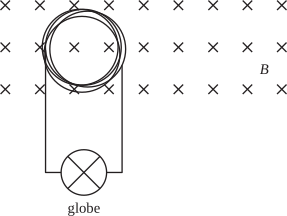
The diagram below shows a stationary circular coil of conducting wire connected to a low-resistance globe in a uniform, constant magnetic field, \(B\).


Question 5

The magnetic field is switched off.

Which one of the following best describes the globe in the circuit \( \textbf{before} \) the magnetic field is switched off, \( \textbf{during} \) the time the magnetic field is being switched off and \( \textbf{after} \) the magnetic field is switched off?

\begin{align*}
\begin{array}{l}
\rule{0pt}{2.5ex} \ \rule[-1ex]{0pt}{0pt}& \\
\rule{0pt}{2.5ex}\textbf{A.}\rule[-1ex]{0pt}{0pt}\\
\rule{0pt}{2.5ex}\textbf{B.}\rule[-1ex]{0pt}{0pt}\\
\rule{0pt}{2.5ex}\textbf{C.}\rule[-1ex]{0pt}{0pt}\\
\rule{0pt}{2.5ex}\textbf{D.}\rule[-1ex]{0pt}{0pt}\\
\end{array}
\begin{array}{|c|c|}
\hline
\rule{0pt}{2.5ex}\quad\text{Before}\quad\rule[-1ex]{0pt}{0pt}&\quad \text{During} \quad& \quad\text{After}\quad\\
\hline
\rule{0pt}{2.5ex}\text{Off}\rule[-1ex]{0pt}{0pt}&\text{On}& \text{Off}\\
\hline
\rule{0pt}{2.5ex}\text{On}\rule[-1ex]{0pt}{0pt}& \text{On}& \text{Off}\\
\hline
\rule{0pt}{2.5ex}\text{On}\rule[-1ex]{0pt}{0pt}& \text{Off} & \text{Off}\\
\hline
\rule{0pt}{2.5ex}\text{Off}\rule[-1ex]{0pt}{0pt}& \text{On} & \text{On}\\
\hline
\end{array}
\end{align*}

 
Question 6

The radius of the coil is 5 cm and the magnetic field strength is 0.2 T. The coil has 100 loops. Assume that the magnetic field is perpendicular to the area of the coil.

Which one of the following is closest to the magnitude of the magnetic flux through the coil of wire when the magnetic field is switched on?

  1.  0.0016 Wb
  2.  0.16 Wb
  3.  16 Wb
  4. 1600 Wb
Show Answers Only

\(\text{Question 5:}\ A\)

\(\text{Question 6:}\ A\)

Show Worked Solution

Question 5

  • By Faraday’s Law of Induction, an EMF and current will be induced in the coil when the coil experiences a change of flux causing the light to turn on. 
  • This occurs when the strength of the magnetic field is changing and so the light will be on during the time the magnetic field is being reduced to 0.
  • Before and after this, there is no change in flux (i.e. no EMF or current produced) so the light will be off.

\(\Rightarrow A\)


Question 6

\(\phi=BA=B \times \pi \times r^2 = 0.2 \times \pi \times (0.05)^2= 0.0016\ \text{Wb}\)

  
\(\Rightarrow A\)

Filed Under: Electromagnetic Induction Tagged With: Band 4, smc-3705-30-Magnetic Flux

PHYSICS, M6 2023 HSC 30

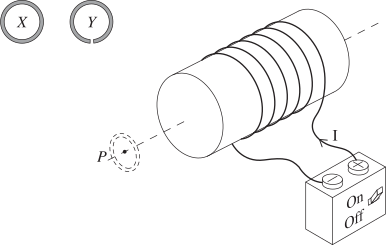
The diagram shows apparatus that is used to investigate the interaction between the magnetic field produced by a coil and two copper rings \(X\) and \(Y\), when each is placed at position \(P\), as shown.


Ring \(X\) is a complete circular ring, and a small gap has been cut in ring \(Y\). Each of the rings has a cross-sectional area of  4 × 10\(^{-4}\) m².

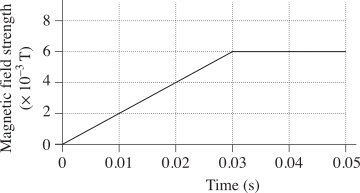
The power supply connected to the coil produces an increasing current through the coil in the direction shown, when the switch is turned on. This produces a magnetic field at \(P\) that varies as shown in the graph.
 

  1. In the first part of the investigation, ring \(X\) is held near the end of the electromagnet at position \(P\).
  2. Account for the force acting on the ring from 0 to 0.05 seconds after the power supply is turned on.   (4 marks)

--- 7 WORK AREA LINES (style=lined) ---

  1. i.  In the second part of the investigation, ring \(Y\) is placed at \(P\), and the power supply is turned on. 
  2.     Explain the behaviour of the ring.   (2 marks)

--- 4 WORK AREA LINES (style=lined) ---
  1. ii. Calculate the maximum induced emf in ring \(Y\).   (2 marks)

--- 4 WORK AREA LINES (style=lined) ---

Show Answers Only

a.   Between 0 – 0.03 seconds:

  • The magnetic field strength at point \(P\) is increasing at a constant rate.
  • Thus, ring \(X\) experiences a change in flux, which causes an EMF to be induced across the ring (Faraday’s Law) 
  • This induced EMF causes a current to flow through ring \(X\) that will interact in the external magnetic field to reduce the change in flux that created it (Lenz’s Law).
  • Thus, a clockwise current will run through the ring, creating a north pole towards the solenoid, causing the ring to have a repulsive force away from the solenoid acting on it.

Between 0.03 – 0.05 seconds: 

  • There is no change in flux through the ring due to there being a constant magnetic field.
  • Therefore, there is no induced EMF or induced current.
  • Therefore, there is no force acting on the ring.

b.i.  Ring \(Y\) behaviour when placed at \(P\):

  • Ring \(Y\) will experience the same change in flux and hence the same induced EMF as ring \(X\) within 0 – 0.03 seconds.
  • However, due to the gap in ring \(Y\) (i.e. there is no closed circuit), no induced current will be able to flow through the ring.
  • Hence, there is no force exerted on ring \(Y\).

ii.  \(\varepsilon = 8 \times 10^{-5}\ \text{V}\)

Show Worked Solution

a.   Between 0 – 0.03 seconds:

  • The magnetic field strength at point \(P\) is increasing at a constant rate.
  • Thus, ring \(X\) experiences a change in flux, which causes an EMF to be induced across the ring (Faraday’s Law) 
  • This induced EMF causes a current to flow through ring \(X\) that will interact in the external magnetic field to reduce the change in flux that created it (Lenz’s Law).
  • Thus, a clockwise current will run through the ring, creating a north pole towards the solenoid, causing the ring to have a repulsive force away from the solenoid acting on it.

Between 0.03 – 0.05 seconds: 

  • There is no change in flux through the ring due to there being a constant magnetic field.
  • Therefore, there is no induced EMF or induced current.
  • Therefore, there is no force acting on the ring.
♦ Mean mark (a) 44%.

b.i.  Ring \(Y\) behaviour when placed at \(P\):

  • Ring \(Y\) will experience the same change in flux and hence the same induced EMF as ring \(X\) within 0 – 0.03 seconds.
  • However, due to the gap in ring \(Y\) (i.e. there is no closed circuit), no induced current will be able to flow through the ring.
  • Hence, there is no force exerted on ring \(Y\).
b.ii. \(\varepsilon\) \(=N\dfrac{\Delta \phi}{\Delta t}\)
    \(=N \dfrac{A \Delta B}{\Delta t}\)
    \(= 1 \times \dfrac{4 \times 10^{-4} \times (6 \times 10^{-3}-0)}{0.03-0}\)
    \(=8 \times 10^{-5}\ \text{V}\)
♦♦ Mean mark (b)(i) 38%.
♦ Mean mark (b)(ii) 49%.

Filed Under: Electromagnetic Induction Tagged With: Band 5, smc-3705-20-Induced emf, smc-3705-30-Magnetic Flux, smc-3705-40-Lenz and Faraday

PHYSICS, M6 EQ-Bank 5 MC

The total flux in the core of an electrical machine is 30 mWb and its flux density is 0.6 T.

What is the cross-sectional area of the core?

  1. `0.018 \ text{m}^(2)`
  2. `0.05 \ text{m}^(2)`
  3. `20 \ text{m}^(2)`
  4. `50 \ text{m}^(2)`
Show Answers Only

`B`

Show Worked Solution
`Phi` `=BA`  
`A` `=(Phi)/(B)`  
  `=(30 xx10^(-3))/(0.6)`  
  `=50 xx10^(-3)\ text{m}^(2)`  
  `=0.05\ text{m}^(2)`  

 
`=>B`

Filed Under: Electromagnetic Induction Tagged With: Band 4, smc-3705-30-Magnetic Flux

PHYSICS, M6 2017 HSC 27

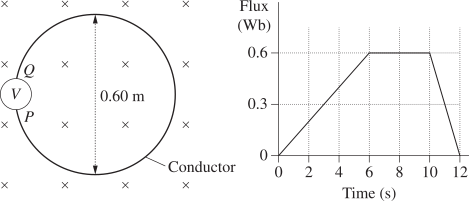
The diagram shows an electric circuit in a magnetic field directed into the page. The graph shows how the flux through the conductive loop changes over a period of 12 seconds.
 

  1. Calculate the maximum magnetic field strength within the stationary loop during the 12-second interval.   (2 marks)

--- 4 WORK AREA LINES (style=lined) ---

  1. Calculate the maximum voltage generated in the circuit by the changing flux. In your answer, indicate the polarity of the terminals `P` and `Q` when this occurs.   (3 marks)

--- 6 WORK AREA LINES (style=lined) ---

Show Answers Only

a.   `2.1\ text{T}`

b.   `0.3  text{V}`

  • Terminal `P` will be positive and terminal `Q` will be negative (Lenz’s Law).
Show Worked Solution
a.       `Phi` `=BA`
  `B` `=(Phi)/(A)=(Phi)/(pir^(2))`
  `B_max` `=(0.6)/(pi xx(0.3)^(2))=2.1\ text{T}`


♦♦ Mean mark (a) 38%.

b.   Voltage (emf) = time rate of flux

  • The induced emf is at a maximum when the rate of change of flux is a maximum.
  • From the graph, this occurs at  t = 10 – 12 s (steepest gradient).
  •   `epsilon=-(Delta Phi)/(Delta t)=-((-0.6)/(2))=0.3\ text{V}`
  • Terminal `P` will be positive and terminal `Q` will be negative (Lenz’s Law).

♦♦ Mean mark (b) 27%.

Filed Under: Electromagnetic Induction Tagged With: Band 5, Band 6, smc-3705-10-Generated emf, smc-3705-30-Magnetic Flux

PHYSICS, M6 2020 HSC 28

A metal rod sits on a pair of parallel metal rails, 20 cm apart, that are connected by a copper wire. The rails are at 30° to the horizontal.

The apparatus is in a uniform magnetic field of 1 T which is upward, perpendicular to the table.
 

A force, `F`, is applied parallel to the rails to move the rod at a constant speed along the rails. The rod is moved a distance of 30 cm in 2.5 s.

  1. Show that the change in magnetic flux through the circuit while the rod is moving is approximately `5.2 × 10^(-2)` Wb.   (2 marks)

--- 4 WORK AREA LINES (style=lined) ---

  1. Calculate the emf induced between the ends of the rod while it is moving, and state the direction of flow of the current in the circuit.   (2 marks)

--- 4 WORK AREA LINES (style=lined) ---

  1. The experiment is repeated without the magnetic field.
  2. Explain why the force required to move the rod is different without the magnetic field.   (3 marks)

--- 6 WORK AREA LINES (style=lined) ---

Show Answers Only

a.   `phi=5.2 xx10^(-2)\ \text{Wb}`

b.   `epsi=2.1 xx10^(-2)  \text{V}`

The direction of the induced current is anticlockwise as viewed from above.

c.    Repeating experiment is without the magnetic field:

  • When the magnetic field is present, the induced current results in a force acting on the rod which opposes its motion (Lenz’s Law).
  • Additionally, the force required to move the rod must also overcome the downwards gravitational force.
  • Without the magnetic field, there is no opposing force due to the induced current so the force applied only needs to overcome gravity.
  • Hence, the force required to move the rod is less without the magnetic field.
Show Worked Solution
a.
`phi` `=BA cos theta`
    `=1xx(0.3 xx0.2)xx cos 30^(@)`
    `=0.05196…`
    `~~5.2 xx10^(-2)` Wb

b.
`epsi` `=-N(Delta phi)/(t)`
    `=-1xx(5.2 xx10^(-2))/(2.5)`
    `=0.208…`
    `=2.1 xx10^(-2)\ \text{V  (V>0)`


  • The direction of the induced current is anticlockwise as viewed from above (Lenz’s Law).


♦ Mean mark (b) 51%.

c.    Repeating experiment is without the magnetic field:

  • When the magnetic field is present, the induced current results in a force acting on the rod which opposes its motion (Lenz’s Law).
  • Additionally, the force required to move the rod must also overcome the downwards gravitational force.
  • Without the magnetic field, there is no opposing force due to the induced current so the force applied only needs to overcome gravity.
  • Hence, the force required to move the rod is less without the magnetic field.

♦ Mean mark (c) 50%.

Filed Under: Electromagnetic Induction Tagged With: Band 4, Band 5, smc-3705-10-Generated emf, smc-3705-30-Magnetic Flux, smc-3705-40-Lenz and Faraday

Copyright © 2014–2025 SmarterEd.com.au · Log in