SmarterEd

Aussie Maths & Science Teachers: Save your time with SmarterEd

  • Login
  • Get Help
  • About

PHYSICS, M6 2025 HSC 2 MC

An ideal transformer converts 240 V to 2200 V.

Which row in the table best describes the transformer?

\begin{align*}
\begin{array}{l}
\rule{0pt}{2.5ex} \ & \\
 \ \rule[-1ex]{0pt}{0pt}& \\
\rule{0pt}{2.5ex}\textbf{A.}\rule[-1ex]{0pt}{0pt}\\
\rule{0pt}{2.5ex}\textbf{B.}\rule[-1ex]{0pt}{0pt}\\
\rule{0pt}{2.5ex}\textbf{C.}\rule[-1ex]{0pt}{0pt}\\
\rule{0pt}{2.5ex}\textbf{D.}\rule[-1ex]{0pt}{0pt}\\
\end{array}
\begin{array}{|c|c|}
\hline
\rule{0pt}{2.5ex}\text{Type of}& \text{Number of turns in}& \text{Number of turns in} \\
\quad \text{transformer}\quad \rule[-1ex]{0pt}{0pt}& \text{primary coil}& \text{secondary coil} \\
\hline
\rule{0pt}{2.5ex}\text{Step up}\rule[-1ex]{0pt}{0pt}&\text{120}&\text{1100}\\
\hline
\rule{0pt}{2.5ex}\text{Step up}\rule[-1ex]{0pt}{0pt}& \text{1100}&\text{120}\\
\hline
\rule{0pt}{2.5ex}\text{Step down}\rule[-1ex]{0pt}{0pt}& \text{12}&\text{1100} \\
\hline
\rule{0pt}{2.5ex}\text{Step down}\rule[-1ex]{0pt}{0pt}& \text{1100} &\text{120}\\
\hline
\end{array}
\end{align*}

Show Answers Only

\(A\)

Show Worked Solution
  • Since the voltage increases from the primary to the secondary coil, it is a step up transformer (eliminate \(C\) and \(D\)).
  • Using  \(\dfrac{V_p}{V_s}=\dfrac{N_p}{N_s}\ \ \Rightarrow\ \ \dfrac{240}{2200}=\dfrac{120}{1100}\).

\(\Rightarrow A\)

Filed Under: Electromagnetic Induction Tagged With: Band 3, smc-3705-50-Transformer Calcs

PHYSICS, M6 2024 HSC 8 MC

An ideal transformer produces an output of 6 volts when an input of 240 volts is applied.

What change would be needed to produce an output of 12 volts, using the same input voltage?

  1. Increase the number of turns on the primary coil
  2. Decrease the number of turns on the primary coil
  3. Increase the resistance connected to the secondary coil
  4. Decrease the resistance connected to the secondary coil
Show Answers Only

\(B\)

Show Worked Solution
  • Using the ideal transformer equation:
  •   \(\dfrac{V_p}{V_s}=\dfrac{N_p}{N_s}\ \ \Rightarrow\ \ V_s=V_p \times \dfrac{N_s}{N_p}\)
  • To increase the output voltage while the input voltage remains the same, the value of \(\dfrac{N_s}{N_p}\) must increase.
  • Given the options, this can only be done by decreasing the number of turns on the primary coil.

\(\Rightarrow B\)

Filed Under: Electromagnetic Induction Tagged With: Band 4, smc-3705-50-Transformer Calcs

PHYSICS, M6 2019 VCE 5-6* MC

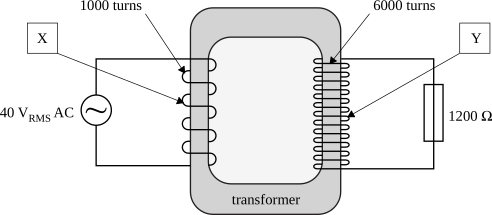
A 40 V AC generator and an ideal transformer are used to supply power. The diagram below shows the generator and the transformer supplying 240 V to a resistor with a resistance of 1200 \( \Omega \).
 

Question 5

Which of the following correctly identifies the parts labelled \(\text{X}\) and \(\text{Y}\), and the function of the transformer?

\begin{align*}
\begin{array}{l}
\rule{0pt}{2.5ex} \ \rule[-1ex]{0pt}{0pt}& \\
\rule{0pt}{2.5ex}\textbf{A.}\rule[-1ex]{0pt}{0pt}\\
\rule{0pt}{2.5ex}\textbf{B.}\rule[-1ex]{0pt}{0pt}\\
\rule{0pt}{2.5ex}\textbf{C.}\rule[-1ex]{0pt}{0pt}\\
\rule{0pt}{2.5ex}\textbf{D.}\rule[-1ex]{0pt}{0pt}\\
\end{array}
\begin{array}{|l|l|l|}
\hline
\rule{0pt}{2.5ex}\quad \ \ \ \text{Part X}\quad \rule[-1ex]{0pt}{0pt}&\ \ \  \quad \text{Part Y} \quad& \text{Function of transformer} \\
\hline
\rule{0pt}{2.5ex}\text{primary coil}\rule[-1ex]{0pt}{0pt}&\text{secondary coil} & \text{step-down}\\
\hline
\rule{0pt}{2.5ex}\text{primary coil}\rule[-1ex]{0pt}{0pt}& \text{secondary coil}&\text{step-up}\\
\hline
\rule{0pt}{2.5ex}\text{secondary coil}\rule[-1ex]{0pt}{0pt}& \text{primary coil} &\text{step-down}\\
\hline
\rule{0pt}{2.5ex}\text{secondary coil}\rule[-1ex]{0pt}{0pt}& \text{primary coil} &\text{step-up}\\
\hline
\end{array}
\end{align*}
 
Question 6

Which one of the following is closest to the current in the primary circuit?

  1. \(0.04\ \text{A}\)
  2. \(0.20\ \text{A}\)
  3. \(1.20\ \text{A}\)
  4. \(1.50\ \text{A}\)
Show Answers Only

\(\text{Question 5:}\ B\)

\(\text{Question 6:}\ C\)

Show Worked Solution

Question 5

  • The primary coil is connected to the power supply (i.e. Part \(\text{X}\)).
  • For a step-up transformer, there are more coils in the secondary coil then there are in the primary coil.

\(\Rightarrow B\)
 

Question 6

\(I_s=\dfrac{V_s}{r_s}=\dfrac{240}{1200}=0.2\ \text{A}\)

\(\dfrac{I_s}{I_p}\) \(=\dfrac{N_p}{N_s}\)  
\(I_p\) \(=\dfrac{N_s \times I_s}{N_p}=\dfrac{6000 \times 0.2}{1000}=1.2\ \text{A}\)  


\(\Rightarrow C\)

Mean mark Q6 57%.

Filed Under: Electromagnetic Induction Tagged With: Band 3, Band 4, smc-3705-50-Transformer Calcs

PHYSICS, M6 2020 VCE 7 MC

An ideal transformer has an input DC voltage of 240 V, 2000 turns in the primary coil and 80 turns in the secondary coil.

The output voltage is closest to

  1. 0 V
  2. 9.6 V
  3. 6.0 × 10\(^{3}\) V
  4. 3.8 × 10\(^{7}\) V
Show Answers Only

\(A\)

Show Worked Solution
  • Transformers require an AC current to provide the change in flux that generates an EMF in the secondary coil from the primary coil.
  • The question refers to a DC current. There will therefore be no change in flux in the transformer and no output voltage.

\(\Rightarrow A\)

♦♦♦ Mean mark 16%.
COMMENT: Attention! DC current will not work on a transformer.

Filed Under: Electromagnetic Induction Tagged With: Band 6, smc-3705-50-Transformer Calcs

PHYSICS, M6 2021 VCE 7*

A mobile phone charger uses a step-down transformer to transform 240 V AC mains voltage to 5.0 V. The mobile phone draws a current of 3.0 A while charging. Assume that the transformer is ideal and that all readings are RMS.

Calculate the current drawn from the mains during charging?   (2 marks)

--- 5 WORK AREA LINES (style=lined) ---

Show Answers Only

\(0.06\ \text{A}\)

Show Worked Solution
\(\text{Power}_{\text{in}}\) \(=\ \text{Power}_{\text{out}}\)  
\(V_p I_p\) \(=V_s I_s\)  
\(I_p\) \(=\dfrac{V_s I_s}{V_p}=\dfrac{5 \times 3}{240}=0.06\ \text{A}\)  

Filed Under: Electromagnetic Induction Tagged With: Band 4, smc-3705-50-Transformer Calcs

PHYSICS, M6 2023 VCE 4*

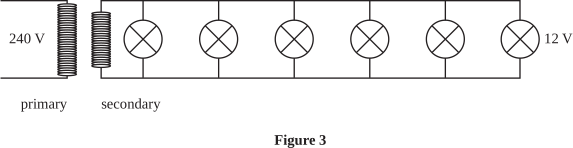
A transformer is used to provide a low-voltage supply for six outdoor garden globes. The circuit is shown in the diagram below. Assume there is no power loss in the connecting wires. 
 

The input of the transformer is connected to a power supply that provides an AC voltage of 240 V. The globes in the circuit are designed to operate with an AC voltage of 12 V. Each globe is designed to operate with a power of 20 W.

  1. Assuming that the transformer is ideal, calculate the ratio of primary turns to secondary turns of the transformer.   (1 mark)

--- 2 WORK AREA LINES (style=lined) ---

The globes are turned on.

  1. Calculate the current in the primary coil of the transformer.   (2 marks)

--- 4 WORK AREA LINES (style=lined) ---

  1. Explain why the input current to the primary coil of the transformer must be AC rather than constant DC for the globes to shine.   (2 marks)

--- 4 WORK AREA LINES (style=lined) ---

Show Answers Only

a.    \(20:1\)

b.    \(0.5\ \text{A}\)

c.    AC input current:

  • A change in flux from the primary coil induces an EMF in the secondary coil.
  • Only an AC current will provide the change in flux required for the transformer to work. 
  • DC currents provide a constant flux and therefore will not work on a transformer.

Show Worked Solution

a.    \(\dfrac{N_p}{N_s}=\dfrac{240}{12}=20:1\)
 

b.    The total power drawn on the secondary side \(=6 \times 20=120\ \text{W}\)

Total power on the primary side is \(120\ \text{W}\).

\(I=\dfrac{P}{V}=\dfrac{120}{240}=0.5\ \text{A}\)

♦ Mean mark (b) 43%.

c.    AC input current:

  • A change in flux from the primary coil induces an EMF in the secondary coil.
  • Only an AC current will provide the change in flux required for the transformer to work. 
  • DC currents provide a constant flux and therefore will not work on a transformer.
♦ Mean mark (c) 42%.

Filed Under: Electromagnetic Induction Tagged With: Band 4, Band 5, smc-3705-50-Transformer Calcs

PHYSICS, M6 2023 HSC 28

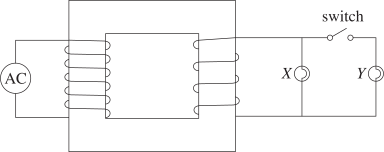
An ideal transformer is connected to a 240 V AC supply. It has 300 turns on the primary coil and 50 turns on the secondary coil.

It is connected in the circuit with two identical light globes, \(X\) and \(Y\), as shown.
 

  1. Calculate the voltage across light globe \(X\) when the switch is open. (2 marks)

    --- 4 WORK AREA LINES (style=lined) ---

  1. Explain why, after the switch has been closed, the current in the primary coil is different from when the switch is open.  (3 marks)

    --- 7 WORK AREA LINES (style=lined) ---

Show Answers Only

a.     40 V

b.    When the switch is closed:

  • Globe \(X\) and \(Y\) are connected in a parallel circuit.
  • Once closed, the total resistance through the circuit is less than when only light globe \(X\) is in the circuit. 
  • Since  \(V=IR\ \ \Rightarrow\ \ R \propto \dfrac{1}{I} \). Therefore, a decrease in resistance through the circuit leads to an increase in the current.
  • Transformer is ideal, so Power in = Power out ( \(V_{p}I_{p}=V_{s}I_{s}\) ). Hence, an increase in \(I_s\) corresponds to an increase in \(I_p\).
  • Therefore, the current in the primary coil is greater when the switch is closed.

Show Worked Solution

a.    \( \dfrac{V_p}{V_s}\) \(= \dfrac{N_p}{N_s}\)  
  \( V_s\) \(=V_p \times \dfrac{N_s}{N_p}=240 \times \dfrac{50}{300}=40\ \text{V} \)  


  • The voltage across light globe \(X\) is 40 V.

b.    When the switch is closed:

  • Globe \(X\) and \(Y\) are connected in a parallel circuit.
  • Once closed, the total resistance through the circuit is less than when only light globe \(X\) is in the circuit. 
  • Since  \(V=IR\ \ \Rightarrow\ \ R \propto \dfrac{1}{I} \). Therefore, a decrease in resistance through the circuit leads to an increase in the current.
  • Transformer is ideal, so Power in = Power out ( \(V_{p}I_{p}=V_{s}I_{s}\) ). Hence, an increase in \(I_s\) corresponds to an increase in \(I_p\).
  • Therefore, the current in the primary coil is greater when the switch is closed.
♦ Mean mark (b) 39%.

Filed Under: Electromagnetic Induction Tagged With: Band 3, Band 5, smc-3705-50-Transformer Calcs

PHYSICS, M6 EQ-Bank 23

The diagram shows a circuit containing two ideal transformers connected with an ammeter. The current through the load is 5.0 A.
 

What is the reading on the ammeter?   (3 marks)

Show Answers Only

`1.0  text{A}`

Show Worked Solution
  • The total power `(P=VI)` of the circuit is constant. This can be calculated from the data given regarding the load.
  •    `P=VI=24 xx5.0=120\ text{W}`
  • Calculating the voltage in the secondary coil of transformer 1:
`(V_(p))/(V_(s))` `=(N_(p))/(N_(s))`  
`V_(s)` `=(V_(p)N_(s))/(N_(p))=(240 xx500)/(1000)120\ text{V}`  


  • Calculating the reading on the ammeter:
`P` `=VI`  
`120` `=120 xxI`  
`I` `=1.0  text{A}`  

Filed Under: Electromagnetic Induction Tagged With: Band 5, smc-3705-50-Transformer Calcs

PHYSICS, M6 2015 HSC 25b

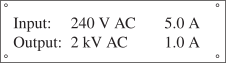
The diagram shows a label on a transformer used in an appliance.

     
Explain why the information provided on the label is not correct. Support your answer with calculations.   (3 marks)

--- 6 WORK AREA LINES (style=lined) ---

Show Answers Only

Calculating the input power:

`P=VI=240 xx5=1200\  text{W}` 

Calculating the output power:

`P=VI=2000 xx 1=2000\  text{W}`

  • The output power is greater than the input power.
  • The label is incorrect as this is inconsistent with the law of conservation of energy.
Show Worked Solution

Calculating the input power:

`P=VI=240 xx5=1200\  text{W}` 

Calculating the output power:

`P=VI=2000 xx 1=2000\  text{W}`

  • The output power is greater than the input power.
  • The label is incorrect as this is inconsistent with the law of conservation of energy.

♦ Mean mark 45%.

Filed Under: Electromagnetic Induction Tagged With: Band 5, smc-3705-50-Transformer Calcs

PHYSICS, M6 2015 HSC 18 MC

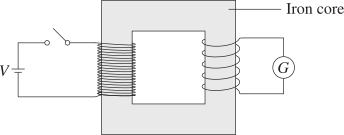
The diagram shows an ideal transformer.
 

When the switch is closed, the pointer on the galvanometer deflects.

How could the size of the deflection be increased?

  1. Decrease the number of primary coils
  2. Decrease the number of secondary coils
  3. Replace the iron core with a copper core
  4. Place a resistor in series with the galvanometer
Show Answers Only

`B`

Show Worked Solution
  • In order to increase the deflection of the galvanometer, the current through the secondary coil must increase.
  •    `(V_(s))/(V_(p))=(n_(s))/(n_(p))\ \ =>\ \ V_(s)=(V_(p)n_(s))/(n_(p))`
  •    `V_(s) prop n_(s)`
  • Decreasing the number of secondary coils will decrease `V_(s)`.
  •    `V_(s)I_(s)=V_(p)I_(p)\ \ =>\ \ V_(s) prop (1)/(I_(s))`
  • Decreasing the number of secondary coils will increase `I_(s)`.

`=>B`


♦ Mean mark 45%.

Filed Under: Electromagnetic Induction Tagged With: Band 5, smc-3705-50-Transformer Calcs

PHYSICS, M6 2017 HSC 11 MC

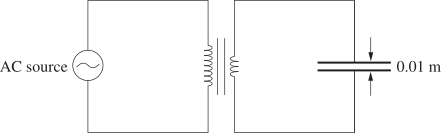
An AC source is connected to a transformer having a primary winding of 900 turns. Connected to the secondary winding of 450 turns is a pair of parallel plates 0.01 m apart.
 

The AC input is shown in the graph.
 

What is the maximum field strength (in `text{V m}^(-1)`) produced between the plates?

  1. `1.7`
  2. `6.8`
  3. `1.7 × 10^4`
  4. `6.8 × 10^4`
Show Answers Only

`C`

Show Worked Solution

Maximum voltage in primary coil = 340 `text{V}`  (see graph)

`(V_(p))/(V_(s))` `=(N_(p))/(N_(s))`  
`(340)/(V_(s))` `=(900)/(450)`  
`V_(s)` `=(450 xx 340)/900=170\ text{V}`  

 
∴ The maximum voltage in the secondary circuit is 170 `text{V}`.

  `E=(V)/(d)=(170)/(0.01)=1.7 xx10^(4)\ text{V m}^(-1)`

`=>C`

Filed Under: Charged Particles, Conductors and Electric/Magnetic Fields, Electromagnetic Induction Tagged With: Band 4, smc-3693-20-EF Strength, smc-3705-50-Transformer Calcs

PHYSICS M6 2022 HSC 1 MC

An ideal transformer has 20 turns on the primary coil and an input voltage of 100 V.

How many turns are there on the secondary coil if the output voltage is 400 V ?

  1. 4
  2. 5
  3. 80
  4. 400
Show Answers Only

`C`

Show Worked Solution
`(V_(p))/(V_(s))` `=(N_(p))/(N_(s))`  
`(100)/(400)` `=(20)/(N_(s))`  
`N_(s)` `=(20 xx400)/(100)=80`  

 
`=>C`

Filed Under: Electromagnetic Induction Tagged With: Band 3, smc-3705-50-Transformer Calcs

PHYSICS, M6 2019 HSC 24

A step-up transformer is constructed using a solid iron core. The coils are made using copper wires of different thicknesses as shown.
 

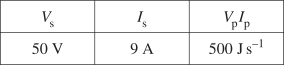
The table shows electrical data for this transformer.
 

  1. Explain how the operation of this transformer remains consistent with the law of conservation of energy. Include a relevant calculation in your answer.   (3 marks)

--- 6 WORK AREA LINES (style=lined) ---

  1. Explain how TWO modifications to this transformer would improve its efficiency.   (4 marks)

--- 8 WORK AREA LINES (style=lined) ---

Show Answers Only

a.   The energy input into this transformer is `text{500 J s}^(-1)`

  • The energy output is given by:
  •    `P=V_(s)I_(s)=50xx 9=450\ \text{J s}^(-1)`
  •  This is consistent with the law of conservation of energy as `text{500 J s}^(-1)` of energy is converted into other energy forms such as heat.

b.    Modification 1:

  • Laminating the iron core prevents large eddy currents from being induced in it.
  • This reduces energy loss in the form of heat, increasing efficiency.

Modification 2:

  • Increasing the thickness of the wire in the primary coil.
  • This reduces its resistance, increasing the transformer’s efficiency.
Show Worked Solution

a.   The energy input into this transformer is `text{500 J s}^(-1)`

  • The energy output is given by:
  •    `P=V_(s)I_(s)=50xx 9=450\ \text{J s}^(-1)`
  •  This is consistent with the law of conservation of energy as `text{500 J s}^(-1)` of energy is converted into other energy forms such as heat.

b.    Modification 1:

  • Laminating the iron core prevents large eddy currents from being induced in it.
  • This reduces energy loss in the form of heat, increasing efficiency.

Modification 2:

  • Increasing the thickness of the wire in the primary coil.
  • This reduces its resistance, increasing the transformer’s efficiency.

♦ Mean mark part 48%.

Filed Under: Electromagnetic Induction Tagged With: Band 3, Band 5, smc-3705-50-Transformer Calcs, smc-3705-70-Transformer Efficiency

PHYSICS, M6 2021 HSC 7 MC

In a certain ideal transformer, the current in the secondary coil is four times as large as the current in the primary coil.

Which row of the table correctly identifies the type of transformer and the ratio of turns?

\begin{align*}
\begin{array}{l}
\rule{0pt}{0.5ex}\textit{} & \textit{} \\
\textit{}\rule[-0.5ex]{0pt}{0pt}& \textit{} \\
\rule{0pt}{2.5ex}\textbf{A.}\rule[-1ex]{0pt}{0pt}\\
\rule{0pt}{2.5ex}\textbf{B.}\rule[-1ex]{0pt}{0pt}\\
\rule{0pt}{2.5ex}\textbf{C.}\rule[-1ex]{0pt}{0pt}\\
\rule{0pt}{2.5ex}\textbf{D.}\rule[-1ex]{0pt}{0pt}\\
\end{array}
\begin{array}{|l|c|}
\hline
\rule{0pt}{0.5ex} \quad \textit{Type of} & \textit{Ratio of turns in primary coil} \\
\textit{transformer}\rule[-0.5ex]{0pt}{0pt}& \textit{to turns in secondary coil} \\
\hline
\rule{0pt}{2.5ex}\text{Step up}\rule[-1ex]{0pt}{0pt}&4:1\\
\hline
\rule{0pt}{2.5ex}\text{Step up}\rule[-1ex]{0pt}{0pt}& 1:4\\
\hline
\rule{0pt}{2.5ex}\text{Step down}\rule[-1ex]{0pt}{0pt}& 4:1 \\
\hline
\rule{0pt}{2.5ex}\text{Step down}\rule[-1ex]{0pt}{0pt}& 1:4 \\
\hline
\end{array}
\end{align*}
Show Answers Only

\(C\)

Show Worked Solution

  • Larger current in secondary coil → Lower voltage in secondary coil
  • Step down transformer → Primary coil has more turns

\(\Rightarrow C\)


♦ Mean mark 42%.

Filed Under: Electromagnetic Induction Tagged With: Band 5, smc-3705-50-Transformer Calcs

Copyright © 2014–2025 SmarterEd.com.au · Log in