SmarterEd

Aussie Maths & Science Teachers: Save your time with SmarterEd

  • Login
  • Get Help
  • About

PHYSICS, M6 2025 HSC 22

The diagram represents the parts of the AC system used to transfer energy from a power station to people's houses.
 

Describe the energy transformations that take place in the transformers, and in the transmission line.   (4 marks)

--- 10 WORK AREA LINES (style=lined) ---
Show Answers Only
  • Transformers \(A\) and \(B\): Some electrical energy is always lost, so each transformer outputs less electrical energy than it receives.
  • Core losses in transformers: Part of the input electrical energy is transformed into heat in the iron core due to eddy currents and magnetic effects.
  • Resistive losses in transformers: Some electrical energy becomes heat in the coils because of their resistance. Small amounts may also become sound/vibration energy.
  • Transmission lines: Electrical energy is also transformed into heat in the wires due to their resistance.
Show Worked Solution
  • Transformers \(A\) and \(B\): Some electrical energy is always lost, so each transformer outputs less electrical energy than it receives.
  • Core losses in transformers: Part of the input electrical energy is transformed into heat in the iron core due to eddy currents and magnetic effects.
  • Resistive losses in transformers: Some electrical energy becomes heat in the coils because of their resistance. Small amounts may also become sound/vibration energy.
  • Transmission lines: Electrical energy is also transformed into heat in the wires due to their resistance.

Filed Under: Electromagnetic Induction Tagged With: Band 3, Band 4, smc-3705-80-Energy Distribution

PHYSICS, M6 2019 VCE 6

A home owner on a large property creates a backyard entertainment area. The entertainment area has a low-voltage lighting system. To operate correctly, the lighting system requires a voltage of 12 V. The lighting system has a resistance of 12 \(\Omega\).

  1. Calculate the power drawn by the lighting system.   (1 mark)

    --- 3 WORK AREA LINES (style=lined) ---
To operate the lighting system, the home owner installs an ideal transformer at the house to reduce the voltage from 240 V to 12 V. The home owner then runs a 200 m long heavy-duty outdoor extension lead, which has a total resistance of 3 \( \Omega\), from the transformer to the entertainment area.

  1. The lights are a little dimmer than expected in the entertainment area.
  2. Give one possible reason for this and support your answer with calculations.   (4 marks)

    --- 7 WORK AREA LINES (style=lined) ---

  3. Using the same equipment, what changes could the home owner make to improve the brightness of the lights? Explain your answer.   (2 marks)

    --- 4 WORK AREA LINES (style=lined) ---

Show Answers Only

a.    \(12\ \text{W}\)

b.   Potential cause of dimmer lights: 

  • Power loss in the extension lead.
  • The total resistance (\(R_T\)) in the circuit \(=12 + 3=15\ \Omega\)
  • The new current in the circuit \(=\dfrac{V}{R_T}=\dfrac{12}{15}=0.8\ \text{A}\)
  • The power loss across the extension lead, \(P_{\text{loss}}=I^2R_l=0.8^2 \times 3=1.92\ \text{W}\)
  • Therefore, power supplied to lights \(=12.0-1.92=10.08\ \text{W}\).

c.    Changes using the same equipment:

  • The homeowner needs to move the transformer from inside the home (start of the lead) to the outside entertainment area (end of the lead).
  • This would mean a higher voltage/lower current is running through the lead which would decrease the power loss through the lead and improve the brightness of the lights.

Show Worked Solution

a.    \(I=\dfrac{V}{R}=\dfrac{12}{12}=1\ \text{A}\)

\(P=IV=1 \times 12 = 12\ \text{W}\)
 

b.   Potential cause of dimmer lights: 

  • Power loss in the extension lead.
  • The total resistance (\(R_T\)) in the circuit \(=12 + 3=15\ \Omega\)
  • The new current in the circuit \(=\dfrac{V}{R_T}=\dfrac{12}{15}=0.8\ \text{A}\)
  • The power loss across the extension lead, \(P_{\text{loss}}=I^2R_l=0.8^2 \times 3=1.92\ \text{W}\)
  • Therefore, power supplied to lights \(=12.0-1.92=10.08\ \text{W}\).
♦♦♦ Mean mark (b) 23%.
COMMENT: Many students used 1 Amp in their calculations instead of finding the total current in the system.

c.    Changes using the same equipment:

  • The homeowner needs to move the transformer from inside the home (start of the lead) to the outside entertainment area (end of the lead).
  • This would mean a higher voltage/lower current is running through the lead which would decrease the power loss through the lead and improve the brightness of the lights.
♦♦♦ Mean mark (c) 22%.
COMMENT: Students incorrectly added or changed the equipment used in the question.

Filed Under: Electromagnetic Induction Tagged With: Band 3, Band 6, smc-3705-80-Energy Distribution

PHYSICS, M6 2021 VCE 7

The generator of an electrical power plant delivers 500 MW to external transmission lines when operating at 25 kV. The generator's voltage is stepped up to 500 kV for transmission and stepped down to 240 V 100 km away (for domestic use). The overhead transmission lines have a total resistance of 30.0 \(\Omega\). Assume that all transformers are ideal.

  1. Explain why the voltage is stepped up for transmission along the overhead transmission lines.   (2 marks)

--- 5 WORK AREA LINES (style=lined) ---

  1. Calculate the current in the overhead transmission lines. Show your working.   (2 marks)

--- 5 WORK AREA LINES (style=lined) ---

  1. Determine the maximum power available for domestic use at 240 V. Show all your working.   (3 marks)

--- 7 WORK AREA LINES (style=lined) ---

Show Answers Only

a.    Since  `P=IV:`

  • The voltage is stepped up for transmission in overhead transmission lines to reduce the current while maintaining a constant power output.
  • Since  \(P_{\text{loss}}=I^2R\), if the current is reduced, the power loss will is reduced significantly.

b.    \(I=1000\ \text{A}\)

c.    \(P_{\text{avail}}=470\ \text{MW}\)

Show Worked Solution

a.    Since  `P=IV:`

  • The voltage is stepped up for transmission in overhead transmission lines to reduce the current while maintaining a constant power output.
  • Since  \(P_{\text{loss}}=I^2R\), if the current is reduced, the power loss will is reduced significantly.
♦♦ Mean mark (a) 30%.
COMMENT: Students must state that the power is constant when stepping up the voltage to decrease the current.

b.    The power in the lines is 500 MW.

Voltage through the transmission lines is 500 kV.

Using \(P=IV:\)

   \(I=\dfrac{P}{V}=\dfrac{500 \times 10^6}{500 \times 10^3}=1000\ \text{A}\)
 

♦ Mean mark (b) 43%.

c.    \(P_{\text{loss}}=I^2R=(1000)^2 \times 30=30\ \text{MW}\)

\(\text{Power (delivered)}\ =500\ \text{MW}-30\ \text{MW}=470\ \text{MW}\)

♦♦ Mean mark (c) 38%.

Filed Under: Electromagnetic Induction Tagged With: Band 5, smc-3705-80-Energy Distribution

PHYSICS, M6 2022 VCE 5*

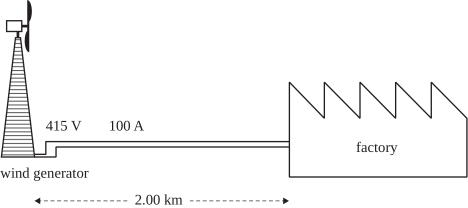
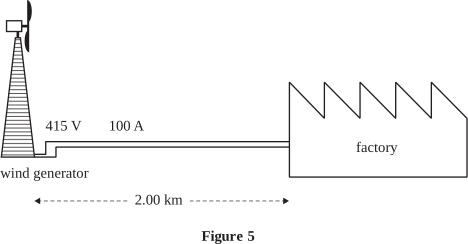
A wind generator provides power to a factory located 2.00 km away, as shown in the diagram.

When there is a moderate wind blowing steadily, the generator produces a voltage of 415 V and a current of 100 A.

The total resistance of the transmission wires between the wind generator and the factory is 2.00 \(\Omega\).
 

  1. Calculate the power, in kilowatts, produced by the wind generator when there is a moderate wind blowing steadily.   (1 mark)

--- 2 WORK AREA LINES (style=lined) ---

To operate correctly, the factory's machinery requires a power supply of 40 kW.

  1. Determine whether the energy supply system, as shown, will be able to supply power to the factory when the moderate wind is blowing steadily. Justify your answer with calculations.   (3 marks)

--- 6 WORK AREA LINES (style=lined) ---

  1. The factory's owner decides to limit transmission energy loss by installing two transformers: a step-up transformer with a turns ratio of 1:10 at the wind generator and a step-down transformer with a turns ratio of 10:1 at the factory. Each transformer can be considered ideal.

    With the installation of the transformers, determine the power, in kilowatts, now supplied to the factory.   (3 marks)

--- 8 WORK AREA LINES (style=lined) ---

Show Answers Only

a.    \(41.5\ \text{kW}\)

b.    \(P_{\text{loss}}=I^2R=100^2 \times 2=20000\ \text{W}=20\ \text{kW}\)

\(\Rightarrow\ \text{Net power supplied}\ =41.5-20=21.5\ \text{kW}\ < 40\ \text{kW}\)

\(\therefore \ \text{The power supply will not be enough to power the factory.}\)

c.    \(41.3\ \text{kW}\)

Show Worked Solution

a.    \(P=VI=415 \times 100 = 41\ 500\ \text{W}=41.5\ \text{kW}\)
 

b.    \(P_{\text{loss}}=I^2R=100^2 \times 2=20000\ \text{W}=20\ \text{kW}\)

\(\Rightarrow\ \text{Net power supplied}\ =41.5-20=21.5\ \text{kW}\ < 40\ \text{kW}\)

\(\therefore \ \text{The power supply will not be enough to power the factory.}\)
 

c.     \(\dfrac{I_s}{I_p}\) \(=\dfrac{N_p}{N_s}\)
  \(I_s\) \(=\dfrac{N_p}{N_s} \times I_p=\dfrac{1}{10} \times 100=10\ \text{A}\)


\(P_{\text{loss}} \text{(new)} =I^2R=10^2 \times 2=200\ \text{W}=0.2\ \text{kW}\)

\(\therefore\ \text{Net power supplied}\ =41.5-0.2=41.3\ \text{kW}\)

Filed Under: Electromagnetic Induction Tagged With: Band 3, Band 4, smc-3705-80-Energy Distribution

PHYSICS, M6 2023 VCE 7*

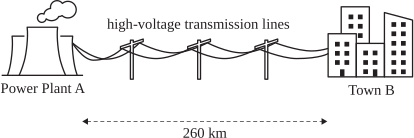
Two high-voltage transmission lines span a distance of 260 km between Power Plant A and Town B, as shown in the diagram. Power Plant A provides 350 MW of power. The potential difference at Power Plant A is 500 kV. The current in the transmission lines has a value of 700 A and the power loss in the transmission lines is 20 MW.


  1. Show, using calculations, that the total resistance of the two transmission lines is 41 \(\Omega\).   (2 marks)

--- 8 WORK AREA LINES (style=lined) ---

  1. Town B needs a minimum of 480 kV.
  2. Determine whether 480 kV will be available to Town B. Show your working.   (3 marks)

--- 8 WORK AREA LINES (style=lined) ---

  1. Explain what would happen if the electricity between Power Plant A and Town B were to be transmitted at 50 kV instead of 500 kV. Assume that the resistance of the transmission lines is still 41 \(\Omega\).   (2 marks)

--- 6 WORK AREA LINES (style=lined) ---

Show Answers Only

a.    \(41\ \Omega\)

b.    The power generated in the power plant is 500 kV.

\(V_{\text{drop}}=IR=700 \times 41 =28.7\ \text{kV} \)

\(V_{\text{remaining}} = 500-28.7 = 471.3\ \text{kV} \)

\(\therefore\) 480V will not be available to Town B.
 

c.    If the voltage was decreased by a factor of 10 to 50 kV:

  • Power remains constant \((P=VI)\)
  • The current through the power lines would increase by a factor of 10.
  • As \(P_{\text{loss}}=I^2r\), this would dramatically increase the power loss and significantly less power would be transmitted to the town.
Show Worked Solution
a.     \(P_{\text{loss}}\) \(=I^2R\)
  \(R\) \(=\dfrac{P_{\text{loss}}}{I^2}=\dfrac{20 \times 10^6}{700^2}=41\ \Omega\)


b.    The power generated in the power plant is 500 kV.

\(V_{\text{drop}}=IR=700 \times 41 =28.7\ \text{kV} \)

\(V_{\text{remaining}} = 500-28.7 = 471.3\ \text{kV} \)

\(\therefore\) 480V will not be available to Town B.
 

c.    If the voltage was decreased by a factor of 10 to 50 kV:

  • Power remains constant \((P=VI)\)
  • The current through the power lines would increase by a factor of 10.
  • As \(P_{\text{loss}}=I^2r\), this would dramatically increase the power loss and significantly less power would be transmitted to the town.

Filed Under: Electromagnetic Induction Tagged With: Band 3, Band 4, smc-3705-80-Energy Distribution

PHYSICS, M6 2023 HSC 2 MC

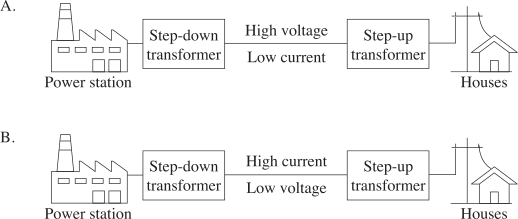
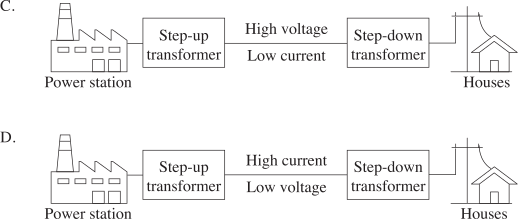
Which diagram best represents the transmission of energy from a power station to people's houses?


Show Answers Only

\(C\)

Show Worked Solution
  • Energy from power stations passes through a step-up transformer to increase the voltage and decrease the current.
  • This energy then passes through a step-down transformer to be used in homes.

 \(\Rightarrow C\)

Filed Under: Electromagnetic Induction Tagged With: Band 3, smc-3705-80-Energy Distribution

PHYSICS, M6 EQ-Bank 2 MC

What is the role of a transformer at a power station?

  1. To reduce heating in the transmission lines by stepping up the current
  2. To reduce heating in the transmission lines by stepping up the voltage
  3. To increase heating in the transmission lines by stepping up the current
  4. To increase heating in the transmission lines by stepping up the voltage
Show Answers Only

`B`

Show Worked Solution
  • At a power station, heating is reduced to decrease power loss.
  • This is done by stepping up the voltage, which decreases transmission current and lowers heating loss consistent with  `P_(loss)=I^2R`

`=>B`

Filed Under: Electromagnetic Induction Tagged With: Band 3, smc-3705-80-Energy Distribution

PHYSICS, M6 2016 HSC 1 MC

Some mobile phones are recharged at a power point using a charger that contains a transformer.

What is the purpose of the transformer?

  1. To convert AC at the power point to DC
  2. To convert DC at the power point to AC
  3. To increase the AC voltage at the power point
  4. To decrease the AC voltage at the power point
Show Answers Only

`D`

Show Worked Solution
  • Transformers cannot convert AC to DC or vice versa, they only change the voltage.
  • As transmission voltages are incredibly high in order to decrease power loss, transformers in the home decrease voltages to a level safe for devices to use.

`=>D`

Filed Under: Electromagnetic Induction Tagged With: Band 3, smc-3705-80-Energy Distribution

PHYSICS, M6 2018 HSC 30

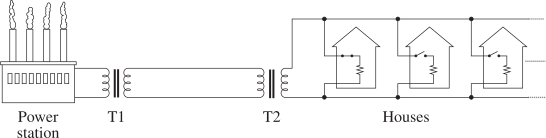
The diagram shows a model of a system used to distribute energy from a power station through transmission lines and transformers to houses.
 

During the evening peak period there is an increase in the number of electrical appliances being turned on in houses.

Explain the effects of this increased demand on the components of the system, with reference to voltage, current and energy.   (6 marks)

--- 18 WORK AREA LINES (style=lined) ---

Show Answers Only

Current and voltage:

  • An increase in the number of electrical appliances causes an increase in energy demand, and a greater power requirement.
  • As `P=VI`, and `V` is constant at approximately 240`V` at the secondary coil of the step down transformer (T2), a greater current is drawn.
  • Similarly, this increases the current in the transmission lines as well as the power station.
  • As the voltage of T2 is approximately fixed at 240`V` and the ratio of coils in each transformer stays constant, the output voltage from the power station, the transmission line voltage and the supply voltage to houses will also remain approximately constant.

Energy losses:

  • As the current increases, the heat produced by resistance in the wires increases leading to losses in energy according to `P_(loss)=I^2R`.
  • Energy loss is also caused by the formation of eddy currents in the transformer cores, and this increases as current increases.
  • This power loss will cause slight voltage drops along the transmission lines leading to slight decreases in voltage inputs and outputs at each of the transformers.
Show Worked Solution

Current and voltage:

  • An increase in the number of electrical appliances causes an increase in energy demand, and a greater power requirement.
  • As `P=VI`, and `V` is constant at approximately 240`V` at the secondary coil of the step down transformer (T2), a greater current is drawn.
  • Similarly, this increases the current in the transmission lines as well as the power station.
  • As the voltage of T2 is approximately fixed at 240`V` and the ratio of coils in each transformer stays constant, the output voltage from the power station, the transmission line voltage and the supply voltage to houses will also remain approximately constant.

Energy losses:

  • As the current increases, the heat produced by resistance in the wires increases leading to losses in energy according to `P_(loss)=I^2R`.
  • Energy loss is also caused by the formation of eddy currents in the transformer cores, and this increases as current increases.
  • This power loss will cause slight voltage drops along the transmission lines leading to slight decreases in voltage inputs and outputs at each of the transformers.

♦♦ Mean mark 42%.

Filed Under: Electromagnetic Induction Tagged With: Band 5, Band 6, smc-3705-80-Energy Distribution

Copyright © 2014–2025 SmarterEd.com.au · Log in