SmarterEd

Aussie Maths & Science Teachers: Save your time with SmarterEd

  • Login
  • Get Help
  • About

ENGINEERING, CS 2026 HSC 14 MC

The galvanic table provided shows the relative corrosion potential of a metal when it is in contact with another metal in an aqueous environment.
 

\begin{align*}
\begin{array}{|l|l|}
\hline
\rule{0pt}{2.5ex} \qquad \qquad \quad \text{GALVANIC SERIES} \rule[-1ex]{0pt}{0pt}& \\
\hline
\rule{0pt}{2.5ex}\textit{Anodic} \qquad \qquad \rule[-1ex]{0pt}{0pt}& \text{Magnesium} \qquad \qquad \\
\hline
\rule{0pt}{2.5ex} \rule[-1ex]{0pt}{0pt}& \text{Zinc} \\
\hline
\rule{0pt}{2.5ex} \rule[-1ex]{0pt}{0pt}& \text{Aluminium} \\
\hline
\rule{0pt}{2.5ex} \rule[-1ex]{0pt}{0pt}& \text{Cadmium} \\
\hline
\rule{0pt}{2.5ex} \rule[-1ex]{0pt}{0pt}& \text{Iron} \\
\hline
\rule{0pt}{2.5ex} \rule[-1ex]{0pt}{0pt}& \text{Lead} \\
\hline
\rule{0pt}{2.5ex} \rule[-1ex]{0pt}{0pt}& \text{Tin} \\
\hline
\rule{0pt}{2.5ex} \rule[-1ex]{0pt}{0pt}& \text{Nickel} \\
\hline
\rule{0pt}{2.5ex} \rule[-1ex]{0pt}{0pt}& \text{Brass} \\
\hline
\rule{0pt}{2.5ex} \rule[-1ex]{0pt}{0pt}& \text{Copper} \\
\hline
\rule{0pt}{2.5ex}\textit{Cathodic} \rule[-1ex]{0pt}{0pt}& \text{Bronze} \\
\hline
\end{array}
\end{align*}

Sheet metal is used to clad the exterior of a building.

Which row of the table shows the most suitable sheet metal and fastener combination for the building to maximise durability and minimise corrosion?

\begin{align*}
\begin{array}{l}
\rule{0pt}{2.5ex} \ \rule[-1ex]{0pt}{0pt}& \\
\rule{0pt}{2.5ex}\textbf{A.}\rule[-1ex]{0pt}{0pt}\\
\rule{0pt}{2.5ex}\textbf{B.}\rule[-1ex]{0pt}{0pt}\\
\rule{0pt}{2.5ex}\textbf{C.}\rule[-1ex]{0pt}{0pt}\\
\rule{0pt}{2.5ex}\textbf{D.}\rule[-1ex]{0pt}{0pt}\\
\end{array}
\begin{array}{|l|l|}
\hline
\rule{0pt}{2.5ex}\quad \textit{Sheet metal cladding}\quad \rule[-1ex]{0pt}{0pt}& \quad \ \ \textit{Fastener (screw)}\quad \ \ \\
\hline
\rule{0pt}{2.5ex}\text{Aluminium}\rule[-1ex]{0pt}{0pt}&\text{Aluminium}\\
\hline
\rule{0pt}{2.5ex}\text{Aluminium}\rule[-1ex]{0pt}{0pt}& \text{Galvanised steel}\\
\hline
\rule{0pt}{2.5ex}\text{High tensile steel}\rule[-1ex]{0pt}{0pt}& \text{Aluminium} \\
\hline
\rule{0pt}{2.5ex}\text{High tensile steel}\rule[-1ex]{0pt}{0pt}& \text{Galvanised steel} \\
\hline
\end{array}
\end{align*}
Show Answers Only

\(A\ \text{or}\ D\)

Show Worked Solution
  • A is correct. Galvanic corrosion occurs when two different metals are in electrical contact in the presence of an electrolyte (e.g. rainwater), and the more anodic metal corrodes. Using aluminium for both the cladding and the fastener means there is no potential difference, so no galvanic corrosion occurs. Aluminium also forms a protective oxide layer, giving good durability.

Other options:

  • B is incorrect. Galvanised steel fasteners have a zinc coating. Zinc is anodic to aluminium, so the small fastener becomes the anode and corrodes rapidly.
  • C is incorrect. Aluminium is anodic to steel, so the aluminium fasteners would corrode. Uncoated high tensile steel cladding would also rust.
  • D was also accepted by NESA. On the galvanic table alone, the zinc-coated fastener is anodic to the steel cladding and would corrode. However, steel cladding is normally zinc-coated in practice (e.g. Zincalume, Colorbond), and galvanised fasteners are the standard match for it. With similar coatings on both, the combination is durable.

\(\Rightarrow A\ \text{or}\ D\)

Filed Under: Engineering Materials Tagged With: Band 4, smc-3715-70-Corrosion

ENGINEERING, CS 2025 HSC 11 MC

Which of the following is true of cathodic protection?

  1. It uses high temperatures to preserve metals.
  2. It uses a polymer coating to prevent corrosion.
  3. It uses heat treatment to improve the tensile strength.
  4. It uses an electric current to prevent corrosion of metals.
Show Answers Only

\(D\)

Show Worked Solution
  • Cathodic protection works by supplying an electric current that makes the metal structure the cathode, preventing oxidation (corrosion).
  • \(\text{A}\) is incorrect — high temperatures accelerate corrosion rather than prevent it.
  • \(\text{B}\) describes paint/polymer coating — a separate corrosion prevention method, not cathodic protection.
  • \(\text{C}\) describes heat treatment — a process that changes mechanical properties, unrelated to corrosion prevention.

\(\Rightarrow D\)

Filed Under: Engineering Materials Tagged With: Band 4, smc-3715-70-Corrosion

ENGINEERING, CS 2024 HSC 27a

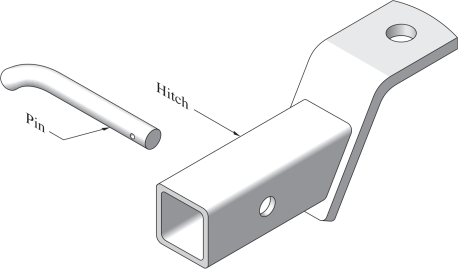
A towbar hitch and shear pin is shown.

The hitch is exposed to various environmental conditions.

Outline a method to protect against corrosion.   (2 marks)

--- 5 WORK AREA LINES (style=lined) ---

Show Answers Only

  • Applying protective finishes like paint or powder coating provides a barrier that shields the component from corrosive elements.
  • This resistance is a result of preventing the hitch from exposure to oxygen, moisture, and environmental contaminants.

Show Worked Solution

  • Applying protective finishes like paint or powder coating provides a barrier that shields the component from corrosive elements.
  • This resistance is a result of preventing the hitch from exposure to oxygen, moisture, and environmental contaminants.

Filed Under: Engineering Materials Tagged With: Band 3, smc-3715-70-Corrosion

ENGINEERING, CS 2020 HSC 26a

Describe methods used to protect civil structures against corrosion. Support your answer with examples.   (3 marks)

--- 7 WORK AREA LINES (style=lined) ---

Show Answers Only
  • The use of sacrificial anodes. For example a block of zinc can be connected to a civil structure so any corrosion occurs at this anode.
  • Surface coating such as organic based paints or salt films can protect the surface of the metal structure.

Other examples could include:

  • Galvanic protection.
  • Ceramic coating or oxide films.
Show Worked Solution
  • The use of sacrificial anodes. For example a block of zinc can be connected to a civil structure so any corrosion occurs at this anode.
  • Surface coating such as organic based paints or salt films can protect the surface of the metal structure.

Other examples could include:

  • Galvanic protection.
  • Ceramic coating or oxide films.

Filed Under: Engineering Materials Tagged With: Band 4, smc-3715-70-Corrosion

ENGINEERING, CS 2021 HSC 20 MC

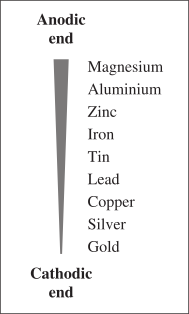
The galvanic table below shows the relative corrosion potential of a metal when it is in contact with another metal in an aqueous environment.
 

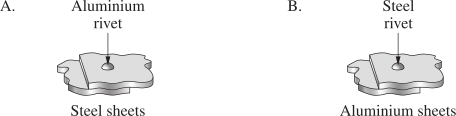
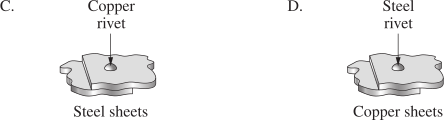
In which of the following situations is the steel component likely to corrode in the shortest amount of time?


Show Answers Only

`D`

Show Worked Solution

Two key factors affecting the rate of corrosion:

  • First is the difference in reactivity. Since the difference between steel and copper is greater than the difference between steel and aluminium, the answer must be `C` or `D`.
  • Secondly, the reaction is faster if the anode is smaller than the cathode. Therefore the steel must be the rivet, not the sheet.

`=>D`

♦ Mean mark 38%.

Filed Under: Engineering Materials Tagged With: Band 5, smc-3715-70-Corrosion

Copyright © 2014–2026 SmarterEd.com.au · Log in