SmarterEd

Aussie Maths & Science Teachers: Save your time with SmarterEd

  • Login
  • Get Help
  • About

ENGINEERING, PPT 2016 HSC 27b

The table compares the \(\ce{CO2}\) emissions of three transport systems - car, train and aircraft.
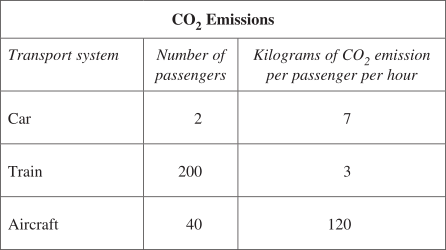
 

For each transport system shown in the \(\ce{CO2}\) emissions table, explain how an engineering innovation in that transport system has affected the environment.   (7 marks)

--- 16 WORK AREA LINES (style=lined) ---

Show Answers Only

Innovations in car transport include:

  • Fuel injection, turbo engines, power to weight ratio, tyre variants, engine management systems, ABS breaks, regenerative braking and reduction in drive train losses.

Environmental Impacts

  • Improved power to weight ratios have led to greater fuel efficiency (less consumption).
  • This has resulted from innovations in the strength of aluminium alloys and the use of carbon fibre composite components both of which make the car lighter.
  • Cars with more aerodynamic shapes are also being routinely produced, which reduces drag.
  • Therefore, modern cars that are more aerodynamically designed and built with lighter materials, have considerably less drag, and thus \(\ce{CO2}\) emissions are reduced.

Innovations in rail transport include:

  • Turbo driven diesel engines, magnetic levitation braking, disc brakes, electric trains with AC versus DC motors and efficient track alignment.

Environmental Impacts

  • The use of AC motors in the drive train, rather than DC, has been the most positive modern innovation in rail transport.
  • VVVF (variable voltage variable frequency) drives, control the voltage and torque on modern AC machines, creating greater efficiencies, as DC machines lose electricity as heat.
  • Regenerative braking can be employed by AC machines as a train descends or slows down.
  • These improved efficiencies result in less diesel fuel on country trains and less electricity on city trains, leading to a reduction in \(\ce{CO2}\) emissions.

Innovations in air transport include:

  • The use of composites to create more aerodynamic shapes and reduced weight, improved efficiency in turbofans, reduced drag and the removal of rivet-induced turbulence through the use of adhesives.

Environmental Impacts

  • Fuel efficiency is greatly improved through the use of modern turbofan engines that optimise the entrainment of by bypass air, which produces 90% of the total thrust of the engine.
  • The use of flow control devices and winglets on wings, minimise wing tip vortices, improving lift and reducing drag.
  • Efficiency is therefore improved leading to reduced fuel consumption and a consequent reductions in \(\ce{CO2}\) emissions.
Show Worked Solution

Innovations in car transport could include:

  • Fuel injection, turbo engines, power to weight ratio, tyre variants, engine management systems, ABS breaks, regenerative braking and reduction in drive train losses.

Environmental Impacts

  • Improved power to weight ratios have led to greater fuel efficiency (less consumption).
  • This has resulted from innovations in the strength of aluminium alloys and the use of carbon fibre composite components both of which make the car lighter.
  • Cars with more aerodynamic shapes are also being routinely produced, which reduces drag.
  • Therefore, modern cars that are more aerodynamically designed and built with lighter materials, have considerably less drag, and thus \(\ce{CO2}\) emissions are reduced.

Innovations in rail transport could include:

  • Turbo driven diesel engines, magnetic levitation braking, disc brakes, electric trains with AC versus DC motors and efficient track alignment.

Environmental Impacts

  • The use of AC motors in the drive train, rather than DC, has been the most positive modern innovation in rail transport.
  • VVVF (variable voltage variable frequency) drives, control the voltage and torque on modern AC machines, creating greater efficiencies, as DC machines lose electricity as heat.
  • Regenerative braking can be employed by AC machines as a train descends or slows down.
  • These improved efficiencies result in less diesel fuel on country trains and less electricity on city trains, leading to a reduction in \(\ce{CO2}\) emissions.

Innovations in air transport could include:

  • The use of composites to create more aerodynamic shapes and reduced weight, improved efficiency in turbofans, reduced drag and the removal of rivet-induced turbulence through the use of adhesives.

Environmental Impacts

  • Fuel efficiency is greatly improved through the use of modern turbofan engines that optimise the entrainment of by bypass air, which produces 90% of the total thrust of the engine.
  • The use of flow control devices and winglets on wings, minimise wing tip vortices, improving lift and reducing drag.
  • Efficiency is therefore improved leading to reduced fuel consumption and a consequent reductions in \(\ce{CO2}\) emissions.

♦ Mean mark 51%.
Filed Under: Historical and Societal Influences Tagged With: Band 5, Band 6, smc-3717-20-Innovation, smc-3717-40-Environment

ENGINEERING, PPT 2017 HSC 22a

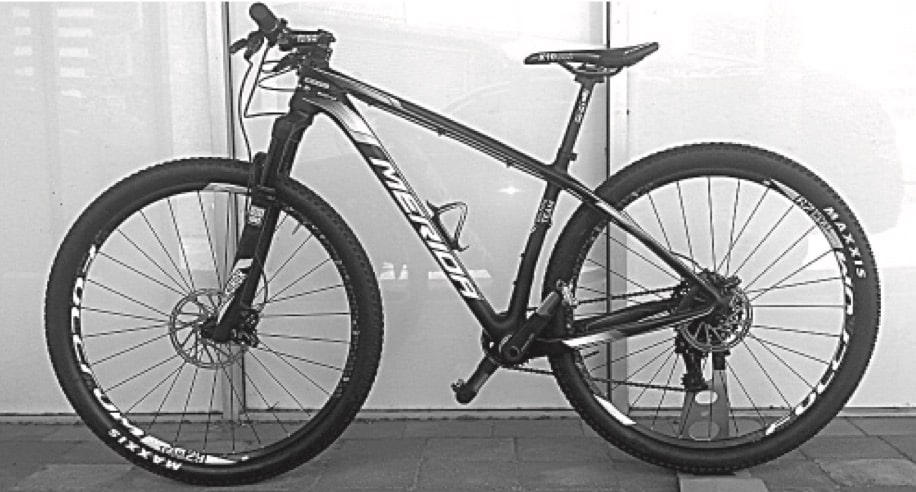
Carbon fibre was originally developed to produce aircraft bodies and high performance vehicles. Carbon fibre is now used in a wide range of applications, including the manufacture of the type of bicycle frame shown.
 

Outline the advantages of carbon fibre bicycle frames over steel bicycle frames.   (3 marks)

--- 6 WORK AREA LINES (style=lined) ---

Show Answers Only

Advantages of carbon fibre bicycle frames

  • Excellent strength to weight ratio, which is a preferred feature and is superior to that of steel.
  • More intricate shapes can be moulded with carbon fibre than steel.
  • Rigid and resistant to corrosion.
  • Wide colour selection available.
Show Worked Solution

Advantages of carbon fibre bicycle frames

  • Excellent strength to weight ratio, which is a preferred feature and is superior to that of steel.
  • More intricate shapes can be moulded with carbon fibre than steel.
  • Rigid and resistant to corrosion.
  • Wide colour selection available.

Filed Under: Historical and Societal Influences, Materials Tagged With: Band 4, smc-3717-20-Innovation, smc-3725-20-Metal alloys, smc-3725-40-Composites, smc-3725-50-Property comparison

ENGINEERING, PPT 2022 HSC 26b

Different modes of transport emit different amounts of carbon dioxide `(\text{CO}_2)`. For example, petrol cars emit more `\text{CO}_2` than electric cars while in motion.

Describe engineering innovations that have led to lower carbon dioxide emissions from electric transportation.   (3 marks)

--- 9 WORK AREA LINES (style=lined) ---

Show Answers Only

Answers should discuss one of the following:

Electric powered cars

  • Electric powered cars do not need heavy engine components to propel them as their energy comes from an electric source. There are also fewer moving parts resulting in a net decrease in weight.
  • Lighter engineering materials further contribute to the decreased weight, which improves fuel efficiency and lowers `\text{CO}_2` emissions.
  • Furthermore, combustion engines themselves produce large volumes of `\text{CO}_2`, hence their removal greatly decreases emissions.

Electric powered bikes

  • Place lower energy demands on a rider, which decreases the `\text{CO}_2` emissions from the cyclist.
  • Battery technology increases the bike’s range and decreases its emissions, enabling long distance travel without negative environmental impacts.
Show Worked Solution

Answers should discuss one of the following:

Electric powered cars

  • Do not need heavy engine components to propel them as their energy comes from an electric source. There are also fewer moving parts resulting in a net decrease in weight.
  • Lighter engineering materials further contribute to the decreased weight, which improves fuel efficiency and lowers `\text{CO}_2` emissions.
  • Furthermore, combustion engines themselves produce large volumes of `\text{CO}_2`, hence their removal greatly decreases emissions.

Electric powered bikes

  • Place lower energy demands on a rider, which decreases the `\text{CO}_2` emissions from the cyclist.
  • Battery technology increases the bike’s range and decreases its emissions, enabling long distance travel without negative environmental impacts.

Filed Under: Historical and Societal Influences Tagged With: Band 4, smc-3717-20-Innovation, smc-3717-40-Environment

ENGINEERING, PPT 2020 HSC 23a

The diagrams show two bicycles, one from 1900 and one from 2020.


The basic components of the bicycle frame have not changed for 120 years. However, manufacturing and materials technologies have evolved significantly during this period.

Compare TWO technologies used in the production of modern bicycle frames to those used in earlier times.

--- 6 WORK AREA LINES (style=lined) ---

Show Answers Only

Successful answers should include two of the following:

  • Lightweight composite materials (such as carbon fibre) have replaced heavy steel tubing in modern bike frames due to their high strength to weight ratio.
  • Seamless tubing is now used instead of rolling a flat sheet into a circular shape and welding it together.
  • Advanced understanding of aerodynamics has led to bike frames being designed to better reduce wind resistance.
Show Worked Solution

Successful answers should include two of the following:

  • Lightweight composite materials (such as carbon fibre) have replaced heavy steel tubing in modern bike frames due to their high strength to weight ratio.
  • Seamless tubing is now used instead of rolling a flat sheet into a circular shape and welding it together.
  • Advanced understanding of aerodynamics has led to bike frames being designed to better reduce wind resistance.

Filed Under: Historical and Societal Influences Tagged With: Band 4, smc-3717-10-Transport systems, smc-3717-20-Innovation

ENGINEERING, PPT 2021 HSC 26a

Outline a change in technology that has led to improved fuel efficiency in cars.   (2 marks)

--- 4 WORK AREA LINES (style=lined) ---

Show Answers Only

Successful answers should discuss one of the following:

  • Lighter/more streamlined cars are generally more fuel efficient. This has been achieved through improved manufacturing methods and improved materials (ie replacing steel bumpers with lighter polymers).
  • Improved materials technology used to produce aluminium engine blocks instead of cast iron to decrease weight.
  • Mathematical modelling to increase aerodynamics of a car.
  • Hybrid cars and regenerative braking.
  • Shift towards fuel injection and higher compression ratio.
  • Cruise control maintains better average fuel economy.
  • Improved efficient gearboxes and differentials with low friction and torque.
  • Improvements to lubrication technology to reduce internal friction.
Show Worked Solution

Successful answers should discuss one of the following:

  • Lighter/more streamlined cars are generally more fuel efficient. This has been achieved through improved manufacturing methods and improved materials (ie replacing steel bumpers with lighter polymers).
  • Improved materials technology used to produce aluminium engine blocks instead of cast iron to decrease weight.
  • Mathematical modelling to increase aerodynamics of a car.
  • Hybrid cars and regenerative braking.
  • Shift towards fuel injection and higher compression ratio.
  • Cruise control maintains better average fuel economy.
  • Improved efficient gearboxes and differentials with low friction and torque.
  • Improvements to lubrication technology to reduce internal friction.

Filed Under: Historical and Societal Influences Tagged With: Band 2, smc-3717-20-Innovation, smc-3717-40-Environment

Copyright © 2014–2025 SmarterEd.com.au · Log in