SmarterEd

Aussie Maths & Science Teachers: Save your time with SmarterEd

  • Login
  • Get Help
  • About

ENGINEERING, TE 2024 HSC 13 MC

What is the primary function of GPS satellites?

  1. Receiving magnetic field data for accuracy of location
  2. Receiving signals from GPS devices to determine distance
  3. Transmitting signals that provide accurate timing and positioning data
  4. Transmitting weather system data to ground-based stations for tracking
Show Answers Only

\(C\)

Show Worked Solution
  • GPS satellites continuously broadcast precisely timed radio signals containing their exact orbital position data, which GPS receivers use to calculate their location through trilateration.

\(\Rightarrow C\)

Filed Under: Electricity/Electronics Tagged With: Band 3, smc-3730-40-Satellites/GPS

ENGINEERING, TE 2023 HSC 15 MC

What is the primary benefit of placing a satellite in a low earth orbit rather than a higher earth orbit?

  1. Longer lifespan
  2. Less atmospheric drag
  3. Faster data transmission
  4. Cover larger areas on Earth
Show Answers Only

\(  C \)

Show Worked Solution
  • Low earth orbit (LEO) satellites’ primary benefit is faster data transmission (low communication latency).
  • Another major benefit of LEO satellites is accessibility for servicing, although this was not given as an option.

\(\Rightarrow  C \)

Filed Under: Electricity/Electronics Tagged With: Band 3, smc-3730-40-Satellites/GPS

ENGINEERING, TE 2023 HSC 25c

Outline how GPS satellites determine a position on the planet.   (2 marks)

--- 4 WORK AREA LINES (style=lined) ---


Show Answers Only

  • Position is determined when a GPS satellites triangulate signals.
  • Triangulation depends on the accurate measurement of the time differences between signals traveling from satellites to GPS receivers.

Show Worked Solution

  • Position is determined when a GPS satellites triangulate signals.
  • Triangulation depends on the accurate measurement of the time differences between signals traveling from satellites to GPS receivers.
♦ Mean mark 44%.

Filed Under: Electricity/Electronics Tagged With: Band 5, smc-3730-40-Satellites/GPS

ENGINEERING, TE 2016 HSC 9 MC

Which type of satellite is commonly used to broadcast TV signals?

  1. Low Earth-orbit satellite that orbits over the poles
  2. High Earth-orbit satellite that orbits over the poles
  3. Geostationary satellite that orbits above the equator
  4. Geosynchronous satellite that orbits above the Tropic of Capricorn
Show Answers Only

`D`

Show Worked Solution

`=>D`

Filed Under: Electricity/Electronics Tagged With: Band 4, smc-3730-15-Television, smc-3730-40-Satellites/GPS

ENGINEERING, TE 2022 HSC 13 MC

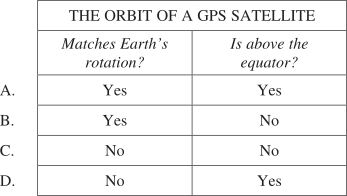
Four students (A, B, C, D) completed a table regarding the orbit of a GPS satellite.

Which student is correct?
 

Show Answers Only

`C`

Show Worked Solution

By Elimination:

  • GPS satellites need to cover most of earths surface, not just the equator, therefore not `A` or `D`.
  • GPS satellites are in medium earth orbit and therefore are not geostationary (do not match earths rotation), so not `A` or `B`.

`=>C`


♦♦♦ Mean mark 24%.

Filed Under: Electricity/Electronics Tagged With: Band 6, smc-3730-40-Satellites/GPS

ENGINEERING, TE 2020 HSC 12 MC

A geostationary satellite is positioned above the equator.

How many times does the satellite go around Earth's axis in a 24-hour period?

  1. 0
  2. 1
  3. 2
  4. 3
Show Answers Only

`B`

Show Worked Solution
  • Geostationary satellites orbit at a fixed spot above earths surface.
  • Therefore, a satellite above the equator takes the same time to rotate 360° around the earth’s axis as it takes the earth to do the same.

`=>B`


Mean mark 59%.

Filed Under: Electricity/Electronics Tagged With: Band 4, smc-3730-40-Satellites/GPS

ENGINEERING, TE 2021 HSC 24c

Describe the basic principles of low orbit satellite telecommunication systems.   (3 marks)

--- 9 WORK AREA LINES (style=lined) ---

Show Answers Only

Successful answers would cover one of the following:

Low orbit Satellites

  • Low orbit satellites orbit the earth at altitudes below 2000 km.
  • Low orbit telecommunication systems have many satellites that pass overhead as these satellites are not geostationary and move in and out of range of the handset.
  • These satellites take around 90 minutes to orbit earth and are only in range for 5 minutes maximum.
  • When one satellite is about to disappear from the reception range, another comes into range and takes over communication.  

Satellite telephones

  • Satellite telephones broadcast their individual ID numbers to satellites to identify which are in range.
  • Once a satellite receives the signal it is passed onto a base station, then its destination.
  • The phone signal is passed between satellites until one in contact with the base station is in range.
  • The phone signal is modulated using phase shift keying due to long transmission distances.
Show Worked Solution

Successful answers would cover one of the following:

Low orbit Satellites

  • Low orbit satellites orbit the earth at altitudes below 2000 km.
  • Low orbit telecommunication systems have many satellites that pass overhead as these satellites are not geostationary and move in and out of range of the handset.
  • These satellites take around 90 minutes to orbit earth and are only in range for 5 minutes maximum.
  • When one satellite is about to disappear from the reception range, another comes into range and takes over communication.  

Satellite telephones

  • Satellite telephones broadcast their individual ID numbers to satellites to identify which are in range.
  • Once a satellite receives the signal it is passed onto a base station, then its destination.
  • The phone signal is passed between satellites until one in contact with the base station is in range.
  • The phone signal is modulated using phase shift keying due to long transmission distances.

♦ Mean mark 49%.

Filed Under: Electricity/Electronics Tagged With: Band 5, smc-3730-20-Telephony, smc-3730-40-Satellites/GPS

Copyright © 2014–2025 SmarterEd.com.au · Log in