SmarterEd

Aussie Maths & Science Teachers: Save your time with SmarterEd

  • Login
  • Get Help
  • About

Data Analysis, SM-Bank 056 MC

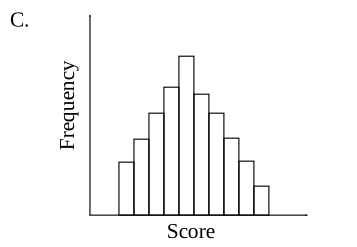
The dot plot below shows the times, in seconds, of 40 runners in the qualifying heats of their 800 m club championship.
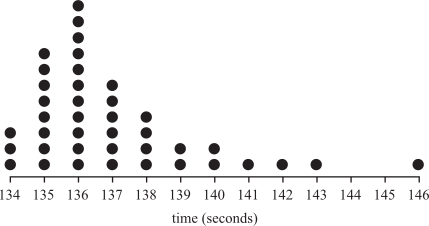
 

The shape of this distribution is best described as

  1. positively skewed with one outlier.
  2. approximately symmetric with one outlier.
  3. approximately symmetric with no outliers.
  4. negatively skewed with one outlier.

Show Answers Only

\(A\)

Show Worked Solution

\(\text{Distribution is positively skewed (tail stretches to the right)} \)

\(\text{and 146 is a possible outlier}\)

\(\Rightarrow A\)

Filed Under: Data Analysis Tagged With: num-title-ct-core, smc-4224-35-Describing datasets

Data Analysis, SM-Bank 054

The following ordered stem plot shows the areas, in square kilometres, of 27 suburbs of a large city.

\begin{array} {r|lll}
\textbf{Stem} & \textbf{Leaf} \\
\hline 1 & 5\ 6\ 7\ 8  \\
2 & 1\ 2\ 4\ 5 \ 6\ 8\ 9\ 9 \\
3 & 0\ 1\ 1\ 2\ 2\ 8\ 9 \\
4 & 0\ 4\ 7 \\
5 & 0\ 1 \\
6 & 1\ 9 \\
7 &  \\
8 & 4 \\
\end{array}
\(\text{key:  }1|6=1.6\ \text{km}^2\)
  1. For these suburbs
    i.     What is the median, in square kilometres?  (1 mark)

    --- 1 WORK AREA LINES (style=lined) ---

    ii.    What is the range, in square kilometres?  (1 mark)

    --- 1 WORK AREA LINES (style=lined) ---

  2. What is the possible outlier?  (1 mark)

    --- 1 WORK AREA LINES (style=lined) ---

  3. Briefly describe the skewness of the data.  (1 mark)

    --- 1 WORK AREA LINES (style=lined) ---

Show Answers Only

a.    i.    \(3.1\ \text{km}^2\)

ii.   \(6.9\)

b.    \(8.4\ \text{km}^2\)

c.    \(\text{Positively skewed.}\)

Show Worked Solution
a.    i.     \(\text{Median}\) \(=\dfrac{27+1}{2}\)
      \(=\ \text{14 th score}\)
    \(\therefore\ \text{Median}\) \(=3.1\ \text{km}^2\)
       
  ii. \(\text{Range}\) \(=8.4-1.5\)
      \(=6.9\)

 
b.    \(8.4\ \text{km}^2\ \text{is a possible outlier}\)

c.    \(\text{The data is positively skewed as the tail is to the right.}\)

Filed Under: Data Analysis Tagged With: num-title-ct-core, smc-4224-35-Describing datasets, smc-4224-40-Stem and Leaf, smc-4224-45-Mean/median/mode/range

Data Analysis, SM-Bank 052 MC

The stem plot below displays the average number of decayed teeth in 12-year-old children from `31` countries.

\begin{array} {r|lll}
\textbf{Stem} & \textbf{Leaf} \\
\hline 0 & 2 \\
0 & 5\ 6\ 7\ 7 \ 8\ 9\  \\
1 & 0\ 0\ 0\ 0\ 1\ 4\ 4\ 4\\
1 & 5\ 6\ 7 \\
2 & 3\ 3\ 4 \\
2 & 7\ 7\ 8\ 8 \\
3 & 0\ 4 \\
3 & 5\ 6 \\
4 & 1 \\
4 & 7 \\
\end{array}
\(\text{key:  }0|2=0.2\)

Based on this stem plot, the distribution of the average number of decayed teeth for these countries is best described as

  1. positively skewed with a median of 15 decayed teeth and a range of 45
  2. approximately symmetric with a median of 1.5 decayed teeth and a range of 4.5
  3. negatively skewed with a median of 1.5 decayed teeth and a range of 4.5
  4. positively skewed with a median of 1.5 decayed teeth and a range of 4.5
Show Answers Only

\(D\)

Show Worked Solution

\(\text{Median = 16th value} = 1.5\)

\(\text{Range} = 4.7-0.2=4.5\)

\(\text{The clear tail to the upper end of values shows that the}\)

\(\text{data is positively skewed.}\)

\(\Rightarrow D\)

Filed Under: Data Analysis Tagged With: num-title-ct-core, smc-4224-35-Describing datasets, smc-4224-40-Stem and Leaf

Data Analysis, SM-Bank 042

The following data represents the ages of people on a riverboat cruise in Europe.
 

28,  35,  39,  39,  28,  34,  40,  43,  51,  34,  35,  39,  40,  46,  60


  1. Organise the data into an ordered stem-and-leaf plot.  (2 marks)

    --- 7 WORK AREA LINES (style=lined) ---

  2. What is the median of the ages?  (1 mark)

    --- 1 WORK AREA LINES (style=lined) ---

  3. What is the modal age of the travellers?  (1 mark)

    --- 1 WORK AREA LINES (style=lined) ---

  4. Is this age data skewed or symmetrical?  (1 mark)

    --- 1 WORK AREA LINES (style=lined) ---

Show Answers Only

a.   

\begin{array} {r|lll} \textbf{Stem} & \textbf{Leaf}  \\ \hline  2 & 8\   8 \\  3 & 4\ 4\ 5\ 5 \ 9\ 9\ 9\  \\  4 & 0\ 0\ 3\ 6 \\ 5 & 1 \\ 6 & 0 \\ \end{array}

b.    `39`

c.    `39`

d.    `text(Skewed)`

Show Worked Solution

a.    `text(Ordered data:) \ 28,  28,  34,  34,  35,  35,  39,  39,  39,  40,  40,  43,  46,  51,  60`

\begin{array} {r|lll} \textbf{Stem} & \textbf{Leaf}  \\ \hline  2 & 8\   8 \\  3 & 4\ 4\ 5\ 5 \ 9\ 9\ 9\  \\  4 & 0\ 0\ 3\ 6 \\ 5 & 1 \\ 6 & 0 \\ \end{array}

b.    `text(Median)\ = \text(8th score)\ =\ 39`

c.    `text(Mode)\ = \ 39`

d.    `text(The data is skewed.)`


Filed Under: Data Analysis Tagged With: num-title-ct-core, smc-4224-15-Mode, smc-4224-20-Median, smc-4224-35-Describing datasets, smc-4224-40-Stem and Leaf

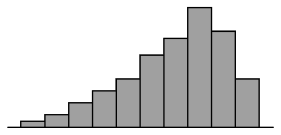
Data Analysis, SM-Bank 041 MC

Which of the following terms best describes this distribution?
  

  1. Positively skewed
  2. Negatively skewed
  3. Symmetrical
  4. None of the above
Show Answers Only

`B`

Show Worked Solution

`text(The distribution has mean < median < mode.)`

`text(Therefore, the distribution is best described as negatively skewed.)`

`=>B`

Filed Under: Data Analysis Tagged With: num-title-ct-core, smc-4224-35-Describing datasets

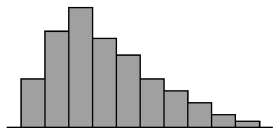
Data Analysis, SM-Bank 040 MC

Which of the following terms best describes this distribution?
  

  1. Positively skewed
  2. Negatively skewed
  3. Symmetrical
  4. None of the above
Show Answers Only

`A`

Show Worked Solution

`text(The distribution has mode < median < mean, therefore, the distribution is best described as positively skewed.`

`=>A`

Filed Under: Data Analysis Tagged With: num-title-ct-core, smc-4224-35-Describing datasets

Data Analysis, SM-Bank 039 MC

Which of the following terms best describes this distribution?
  

  1. Positively skewed
  2. Negatively skewed
  3. Symmetrical
  4. None of the above
Show Answers Only

`C`

Show Worked Solution

`text(The distribution has mean = mode = median, therefore, the distribution is best described as symmetrical.`

`=>C`

Filed Under: Data Analysis Tagged With: num-title-ct-core, smc-4224-35-Describing datasets

Data Analysis SM-Bank 033 MC

Which of the following terms best describes this distribution?
  

  1. Uniform
  2. Multimodal
  3. Unimodal
  4. Bimodal
Show Answers Only

`C`

Show Worked Solution

`text(There one mode, therefore, the distribution is best described as unimodal.`

`=>C`

Filed Under: Data Analysis Tagged With: num-title-ct-core, smc-4224-15-Mode, smc-4224-35-Describing datasets

Data Analysis, SM-Bank 032 MC

Which of the following terms best describes this distribution?
  

  1. Unimodal
  2. Multimodal
  3. Bimodal
  4. Uniform
Show Answers Only

`B`

Show Worked Solution

`text(There are many modes, therefore, the distribution is best described as multimodal.`

`=>B`

Filed Under: Data Analysis Tagged With: num-title-ct-core, smc-4224-15-Mode, smc-4224-35-Describing datasets

Data Analysis, SM-Bank 031 MC

Which of the following terms best describes this distribution?
  

  1. Unimodal
  2. Multimodal
  3. Bimodal
  4. Uniform
Show Answers Only

`C`

Show Worked Solution

`text(There are 2 modes, therefore, the distribution is best described as bimodal.`

`=>C`

Filed Under: Data Analysis Tagged With: num-title-ct-core, smc-4224-15-Mode, smc-4224-35-Describing datasets

Data Analysis SM-Bank 030 MC

Which of the following terms best describes this distribution?

  1. Unimodal
  2. Multimodal
  3. Bimodal
  4. Uniform
     
Show Answers Only

`D`

Show Worked Solution

`text(There is no distinct mode, therefore, the distribution is best described as uniform.`

`=>D`

Filed Under: Data Analysis Tagged With: num-title-ct-core, smc-4224-15-Mode, smc-4224-35-Describing datasets

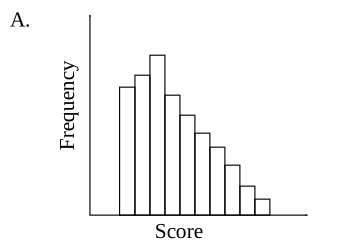
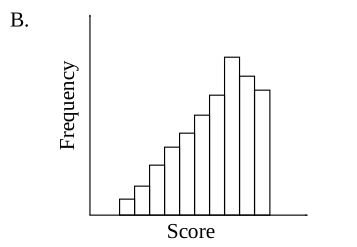
Statistics, STD2 S1 2020 HSC 7 MC

Which histogram best represents a dataset that is positively skewed?


Show Answers Only

`A`

Show Worked Solution

♦♦ Mean mark 32%.

`text(Positive skew occurs when the tail on the)`

`text{histogram is longer on the right-hand}`

`text{(positive) side.}`

`=> \ A`

Filed Under: Bar Charts and Histograms (Std 2), Bar Charts and Histograms (Std2-2027), Bar Charts and Histograms (Y12), Bar Charts, Histograms and Other Graphs (Std 1), Data Analysis Tagged With: Band 5, common-content, num-title-ct-core, num-title-qs-hsc, smc-1128-15-Histograms, smc-4224-35-Describing datasets, smc-6310-20-Histograms, smc-821-15-Histograms, smc-997-15-Histograms

Statistics, STD2 S1 2008 HSC 26d

The graph shows the predicted population age distribution in Australia in 2008.


  1. How many females are in the 0–4 age group?  (1 mark)

    --- 1 WORK AREA LINES (style=lined) ---

  2. What is the modal age group?   (1 mark)

    --- 1 WORK AREA LINES (style=lined) ---

  3. How many people are in the 15–19 age group?   (2 marks)

    --- 4 WORK AREA LINES (style=lined) ---

  4. Give ONE reason why there are more people in the 80+ age group than in the 75–79 age group.   (1 mark)

    --- 2 WORK AREA LINES (style=lined) ---

Show Answers Only
  1. `600\ 000`
  2. `35-39`
  3. `1\ 450\ 000`
  4. `text(The 80+ group includes all people over 80)`
  5.  

    `text(and is not restricted by a 5-year limit.)`

Show Worked Solution
i.    `text{# Females (0-4)}` `= 0.6 xx 1\ 000\ 000`
    `= 600\ 000`


ii.    `text(Modal age group)\ =` `text(35 – 39)`


iii.   `text{# Males (15-19)}` `= 0.75 xx 1\ 000\ 000`
    `= 750\ 000`


`text{# Females (15-19)}` `= 0.7 xx 1\ 000\ 000`
  `= 700\ 000`


`:.\ text{Total People (15-19)}` `= 750\ 000 + 700\ 000`
  `= 1\ 450\ 000`


iv.   `text(The 80+ group includes all people over 80)`
  `text(and is not restricted by a 5-year limit.)`

Filed Under: Bar Charts and Histograms, Bar Charts and Histograms (Std 2), Bar Charts and Histograms (Std2-2027), Bar Charts and Histograms (Y12), Bar Charts, Histograms and Other Graphs (Std 1), Data Analysis Tagged With: Band 3, Band 4, Band 5, common-content, num-title-ct-core, num-title-qs-hsc, smc-1128-15-Histograms, smc-4224-15-Mode, smc-4224-35-Describing datasets, smc-6310-20-Histograms, smc-821-15-Histograms, smc-997-15-Histograms

Statistics, STD2 S1 2013 HSC 26f

Jason travels to work by car on all five days of his working week, leaving home at 7 am each day. He compares his travel times using roads without tolls and roads with tolls over a period of 12 working weeks.

He records his travel times (in minutes) in a back-to-back stem-and-leaf plot.
 

2013 26f
 

  1. What is the modal travel time when he uses roads without tolls?  (1 mark)

    --- 1 WORK AREA LINES (style=lined) ---

  2. What is the median travel time when he uses roads without tolls?   (1 mark)

    --- 1 WORK AREA LINES (style=lined) ---

  3. Describe how the two data sets differ in terms of the spread and skewness of their distributions.   (2 marks)

    --- 5 WORK AREA LINES (style=lined) ---

Show Answers Only
  1. `52\ text(minutes)`
  2. `50.5\ text(minutes)`
  3. `text(Spread)`
  4. `text{Times without tolls have a tighter spread (range = 22)}`
  5. `text{than times with tolls (range = 55).}`
  6.  

    `text(Skewness)`

  7. `text(Times without tolls shows virtually no skewness while`
  8. `text(times with tolls are positively skewed.)`
Show Worked Solution

i.  `text(Modal time) = 52\ text(minutes)`

♦ Mean mark 36%
MARKER’S COMMENT: Finding a median proved challenging for many students. Take note!


ii.  `text(30 times with no tolls)`

`text(Median)` `=\ text(Average of 15th and 16th)`
  `=(50 + 51)/2`
  `= 50.5\ text(minutes)`


♦ Mean mark 39%


 iii.  `text(Spread)`

`text{Times without tolls have a much tighter}`

`text{spread (range = 22) than times with tolls}`

`text{(range = 55).}`

`text(Skewness)`

`text(Times without tolls shows virtually no skewness)`

`text(while times with tolls are positively skewed.)`

Filed Under: Bar Charts, Histograms and Other Graphs (Std 1), Data Analysis, Other Chart Types (Y12), Other Charts (Std 2), Other Charts (Std2-2027), Stem & Leaf, Box & Whisker Tagged With: Band 4, Band 5, num-title-ct-core, num-title-qs-hsc, smc-1128-24-Stem and Leaf, smc-4224-15-Mode, smc-4224-20-Median, smc-4224-35-Describing datasets, smc-4224-40-Stem and Leaf, smc-6311-20-Back-to-Back Stem-and-Leaf, smc-822-30-Back-to-Back Stem and Leaf, smc-998-30-Back-to-Back Stem and Leaf

Copyright © 2014–2025 SmarterEd.com.au · Log in