SmarterEd

Aussie Maths & Science Teachers: Save your time with SmarterEd

  • Login
  • Get Help
  • About

Probability, SM-Bank 085

Jordan and Degas play a board game with the spinner shown.


Jordan spins the arrow.

  1. What is the probability that Jordan spins an even number?  (1 mark)

    --- 3 WORK AREA LINES (style=lined) ---
  2. To win the game you must spin an odd number.
    What is the probability that Jordan will win the game on the next spin?  (1 mark)

    --- 3 WORK AREA LINES (style=lined) ---

Show Answers Only

a.    \(\dfrac{1}{3}\)

b.    \(\dfrac{2}{3}\)

Show Worked Solution
a.    \(P\text{(Even)}\) \(=\dfrac{\text{# even numbers}}{\text{Total numbers}}\)
    \(=\dfrac{3}{9}\)
    \(=\dfrac{1}{3}\)


b.    \(P\text{(Odd)}\) \(=1-P\text{(Even)}\)
    \(=1-\dfrac{1}{3}\)
    \(=\dfrac{2}{3}\)

Filed Under: Probability Tagged With: num-title-ct-core, smc-4225-15-Single-stage events, smc-4225-20-Complementary events

Probability, SM-Bank 069

Wendy has a number of different types of flowers as shown in the table below. 
 

\begin{array} {|c|c|}
\hline
\rule{0pt}{2.5ex} \textbf{Type of Flower} \rule[-1ex]{0pt}{0pt} & \textbf{Number of Flowers} \\
\hline
\rule{0pt}{2.5ex} \text{Carnation} \rule[-1ex]{0pt}{0pt} & 8 \\
\hline
\rule{0pt}{2.5ex} \text{Tulip} \rule[-1ex]{0pt}{0pt} & 6 \\
\hline
\rule{0pt}{2.5ex} \text{Dandelion} \rule[-1ex]{0pt}{0pt} & 10 \\
\hline
\rule{0pt}{2.5ex} \text{Rose} \rule[-1ex]{0pt}{0pt} & 8 \\
\hline
\end{array}

  1. What is the probability that a randomly selected flower will be either a carnation or a tulip?  (2 marks)

    --- 3 WORK AREA LINES (style=lined) ---

  2. What is the probability that a randomly selected flower will not be a rose?  (2 marks)

    --- 5 WORK AREA LINES (style=lined) ---

Show Answers Only

a.    \(\dfrac{7}{16}\)

b.    \(\dfrac{3}{4}\)

Show Worked Solution
a.    \(P\text{(carnation or tulip)}\) \(=\dfrac{\text{number carnations + number tulips}}{\text{total number of flowers}}\)
    \(=\dfrac{8+6}{32}\)
    \(=\dfrac{14}{32}=\dfrac{7}{16}\)


b.    \(P\text{(not a rose)}\) \(=1-P\text{(is a rose)}\)
    \(=1-\dfrac{\text{number roses}}{\text{total number of flowers}}\)
    \(=1-\dfrac{8}{32}\)
    \(=1-\dfrac{1}{4}\)
    \(=\dfrac{3}{4}\)

Filed Under: Probability Tagged With: num-title-ct-core, smc-4225-15-Single-stage events, smc-4225-20-Complementary events

Probability, SM-Bank 066

A bag contains different coloured balls.

It contains 4 red balls, 8 green balls, 3 pink balls, 6 grey balls and 11 yellow balls.

Nathalie picks a ball from the bag without looking.

  1. What is the chance that she draws a grey ball?  (1 mark)

    --- 3 WORK AREA LINES (style=lined) ---
  2. What is the chance that the ball she draws in not pink?  (2 marks)

    --- 4 WORK AREA LINES (style=lined) ---

Show Answers Only

a.    \(\dfrac{3}{16}\)

b.    \(\dfrac{29}{32}\)

Show Worked Solution
a.    \(P\text{(Grey ball)}\) \(=\dfrac{\text{Number of grey balls}}{\text{Total number of balls}}\)
    \(=\dfrac{6}{4+8+3+6+11}\)
    \(=\dfrac{6}{32}\)
    \(=\dfrac{3}{16}\)


b.    \(P\text{(not pink ball)}\) \(=1-P\text{(pink ball)}\)
    \(=1-\dfrac{\text{Number of pink balls}}{\text{Total number of balls}}\)
    \(=1-\dfrac{3}{32}\)
    \(=\dfrac{29}{32}\)

Filed Under: Probability Tagged With: num-title-ct-core, smc-4225-15-Single-stage events, smc-4225-20-Complementary events

Probability, SM-Bank 064

A biased die is rolled.

The probability of rolling an even number is 56%.

What is the probability of rolling an odd number?  (1 mark)

--- 3 WORK AREA LINES (style=lined) ---
Show Answers Only

\(44\%\)

Show Worked Solution

\(P\text{(odd number)}\)

  \(=1-P\text{(even number)}\)
  \(=1-0.56\)
  \(=0.44\)
  \(=44\%\)

Filed Under: Probability Tagged With: num-title-ct-core, smc-4225-20-Complementary events

Probability, SM-Bank 063

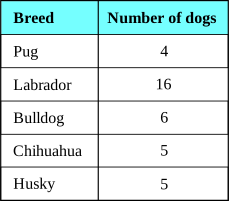
Victoria runs a pet store that sells pure breed dogs.

She has several dogs in the shop from different breeds.


  1. If one of Victoria's dogs is chosen at random, what is the probability it will be either a labrador or a pug?  (1 mark)

    --- 3 WORK AREA LINES (style=lined) ---

  2. If one of the dogs is chosen at random, what is the probability that the dog is not a bulldog?  (2 marks)

    --- 3 WORK AREA LINES (style=lined) ---

Show Answers Only

a.    \(\dfrac{5}{9}\)

b.    \(\dfrac{5}{6}\)

Show Worked Solution
a.    \(P\text{(Labrador or Pug)}\) \(=\dfrac{\text{Number of Labrador and Pug}}{\text{Total dogs}}\)
    \(=\dfrac{16 + 4}{4+16+6+5+5}\)
    \(=\dfrac{20}{36}=\dfrac{5}{9}\)


b.    \(P\text{(Dog not a bulldog)}\) \(=1-P\text{(Dog is a bulldog)}\)
    \(=1-\dfrac{6}{36}\)
    \(=\dfrac{30}{36}=\dfrac{5}{6}\)

Filed Under: Probability Tagged With: num-title-ct-core, smc-4225-15-Single-stage events, smc-4225-20-Complementary events

Probability, SM-Bank 062

Tristan's laundromat has a lost clothing basket that contains only black and white socks.

The probability of randomly picking a black sock from the basket is 35%.

What is the probability of randomly picking a white sock?  (1 mark)

--- 3 WORK AREA LINES (style=lined) ---

Show Answers Only

\(65\%\)

Show Worked Solution

\(P\text{(white)}+P\text{(Black)}=100\%\)

\(\therefore\ P\text{(white)}\) \(=100-P\text{(black)}\)
  \(=100-35\)
  \(=65\%\)

Filed Under: Probability Tagged With: num-title-ct-core, smc-4225-20-Complementary events

Probability, SM-Bank 020

Jenny and Sam play a board game with the spinner shown.
 

 Jenny spins the arrow.

  1. On which number is the arrow most likely to stop?  (1 mark)

    --- 1 WORK AREA LINES (style=lined) ---

  2. What is the probability that Jenny spins a 3?  (1 mark)

    --- 2 WORK AREA LINES (style=lined) ---

  3. What is the probability that Jenny does NOT spin a 3?  (1 mark)

    --- 3 WORK AREA LINES (style=lined) ---

Show Answers Only

a.    \(3\)

b.    \(\dfrac{4}{9}\)

c.    \(\dfrac{5}{9}\)

Show Worked Solution

a.    \(\text{There are more 3’s than any other number.}\)

\(\therefore\ \text{Most likely to land on 3.}\)

b.    \(P\text{(3)}\) \(=\dfrac{\text{Number of 3’s}}{\text{Total divisions on spinner}}\)
    \(=\dfrac{4}{9}\)


c.    \(P\text{(not 3)}\) \(=1-P\text{(3)}\)
    \(=1-\dfrac{4}{9}\)
    \(=\dfrac{5}{9}\)

Filed Under: Probability Tagged With: num-title-ct-core, smc-4225-05-Core concepts, smc-4225-15-Single-stage events, smc-4225-20-Complementary events

Probability, STD1 S2 2022 HSC 17

Each number from 1 to 30 is written on a separate card. The 30 cards are shuffled. A game is played where one of these cards is selected at random. Each card is equally likely to be selected.

Ezra is playing the game, and wins if the card selected shows an odd number between 20 and 30.

  1. List the numbers which would result in Ezra winning the game.  (1 mark)

    --- 1 WORK AREA LINES (style=lined) ---

  2. What is the probability that Ezra does NOT win the game?  (2 marks)

    --- 4 WORK AREA LINES (style=lined) ---

Show Answers Only
  1. `21, 23, 25, 27, 29`
  2. `Ptext{(not win)} = 5/6`
Show Worked Solution

a.   `21, 23, 25, 27, 29`
 

b.    `Ptext{(not win)}` `=1-Ptext{(win)}`
    `=1-5/30`
    `=25/30`
    `=5/6`


♦ Mean mark 51%.

Filed Under: Probability, Single and Multi-Stage Events (Std 1) Tagged With: Band 3, Band 5, num-title-ct-core, num-title-qs-hsc, smc-1135-05-Simple Probability, smc-1135-30-P(E) = 1 - P(not E), smc-4225-15-Single-stage events, smc-4225-20-Complementary events

Probability, STD1 S2 2021 HSC 20

In a bag, there are six playing cards, 2, 4, 6, 8, Queen and King. The Queen and King are known as picture cards.

Two of these cards are chosen randomly. All the possible outcomes are shown.


  1. What is the probability that the two cards chosen include one or both picture cards?  (1 mark)

    --- 2 WORK AREA LINES (style=lined) ---

  2. What is the probability that the two cards chosen do NOT include any picture cards?  (1 mark)

    --- 2 WORK AREA LINES (style=lined) ---

Show Answers Only
  1. `9/15`
  2. `6/15`
Show Worked Solution

a.   `P text{(at least 1 picture card)} = 9/15`


b.    `P text{(no picture card)}` `= 1 – 9/15`
    `= 6/15`

Filed Under: Probability, Single and Multi-Stage Events (Std 1) Tagged With: Band 4, num-title-ct-core, num-title-qs-hsc, smc-1135-20-Other Multi-Stage Events, smc-1135-30-P(E) = 1 - P(not E), smc-4225-15-Single-stage events, smc-4225-20-Complementary events

Probability, STD1 S2 2020 HSC 26

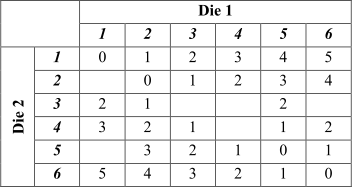
Barbara plays a game of chance, in which two unbiased six-sided dice are rolled. The score for the game is obtained by finding the difference between the two numbers rolled. For example, if Barbara rolls a 2 and a 5, the score is 3.

The table shows some of the scores.


  1. Complete the six missing values in the table to show all possible scores for the game.   (1 mark)
  2. What is the probability that the score for a game is NOT 0?  (2 marks)

    --- 3 WORK AREA LINES (style=lined) ---

Show Answers Only
  1.  

     
  2. `frac{5}{6}`
Show Worked Solution

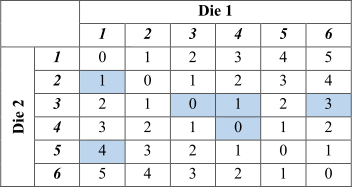
a.     

♦ Mean mark part (b) 47%.
b.       `Ptext{(not zero)}` `= frac{text(numbers) ≠ 0}{text(total numbers)}`
    `= frac{30}{36}`
    `= frac{5}{6}`

 
\(\text{Alternate solution (b)}\)

b.       `Ptext{(not zero)}` `= 1 – Ptext{(zero)}`
    `= 1 – frac{6}{36}`
    `= frac{5}{6}`

Filed Under: Probability, Single and Multi-Stage Events (Std 1) Tagged With: Band 4, Band 5, num-title-ct-core, num-title-qs-hsc, smc-1135-20-Other Multi-Stage Events, smc-1135-40-Arrays, smc-4225-20-Complementary events, smc-4225-45-Multi-stage events

Probability, STD2 S2 2015 HSC 26e

The table shows the relative frequency of selecting each of the different coloured jelly beans from packets containing green, yellow, black, red and white jelly beans.

\begin{array} {|c|c|}
\hline
\rule{0pt}{2.5ex} \textit{Colour} \rule[-1ex]{0pt}{0pt} & \textit{Relative frequency} \\
\hline
\rule{0pt}{2.5ex} \text{Green} \rule[-1ex]{0pt}{0pt} & 0.32 \\
\hline
\rule{0pt}{2.5ex} \text{Yellow} \rule[-1ex]{0pt}{0pt} & 0.13 \\
\hline
\rule{0pt}{2.5ex} \text{Black} \rule[-1ex]{0pt}{0pt} & 0.14 \\
\hline
\rule{0pt}{2.5ex} \text{Red} \rule[-1ex]{0pt}{0pt} &  \\
\hline
\rule{0pt}{2.5ex} \text{White} \rule[-1ex]{0pt}{0pt} & 0.24 \\
\hline
\end{array}

  1. What is the relative frequency of selecting a red jelly bean?  (1 mark)

    --- 2 WORK AREA LINES (style=lined) ---

  2. Based on this table of relative frequencies, what is the probability of NOT selecting a black jelly bean?  (1 mark)

    --- 2 WORK AREA LINES (style=lined) ---

Show Answers Only
  1. \(0.17\)
  2. \(0.86\)
Show Worked Solution

i.  \(\text{Relative frequency of red}\)

\(= 1-(0.32 + 0.13 + 0.14 + 0.24)\)

\(= 1-0.83\)

\(= 0.17\)


ii.  \(P\text{(not selecting black)}\)

\(= 1-P\text{(selecting black)}\)

\(= 1-0.14\)

\(= 0.86\)

Filed Under: Combinations and Single Stage Events (Std 2), Probability, Relative Frequency, Relative Frequency (Std 1), Relative Frequency (Std 2), Relative Frequency (Y11), Single and Multi-Stage Events (Std 1), Single stage events Tagged With: Band 3, Band 4, common-content, num-title-ct-core, num-title-qs-hsc, smc-1133-20-Games of Chance, smc-1135-05-Simple Probability, smc-4225-20-Complementary events, smc-4225-35-Relative frequency, smc-827-20-Games of Chance, smc-828-10-Simple Probability, smc-990-20-Games of Chance

Copyright © 2014–2025 SmarterEd.com.au · Log in