SmarterEd

Aussie Maths & Science Teachers: Save your time with SmarterEd

  • Login
  • Get Help
  • About

CHEMISTRY, M1 EQ-Bank 19

Silicon \(\ce{(Si)}\) is in Group 14 and Period 3 of the periodic table. Sodium \(\ce{(Na)}\) is in Group 1 and Period 3.   (6 marks)

Compare the properties of silicon and sodium with reference to their:

    • Metallic character
    • Electrical conductivity
    • Ion formation

--- 15 WORK AREA LINES (style=lined) ---

Show Answers Only

Metallic character:

  • Sodium has much greater metallic character than silicon. Sodium is an alkali metal (Group 1) with typical metallic properties such as being shiny, malleable, and ductile.
  • Silicon is a metalloid with properties intermediate between metals and non-metals.

Electrical conductivity:

  • Sodium is an excellent electrical conductor, while silicon is a semiconductor. As a Group 1 metal, sodium has one valence electron that is delocalised in a metallic lattice, allowing it to move freely and conduct electricity very effectively.
  • Silicon, as a metalloid, has moderate electrical conductivity that increases with temperature – its conductivity is much lower than sodium’s but higher than non-metals.

Ion formation:

  • Sodium readily forms positive ions (cations) with a 1+ charge (\(\ce{Na^+}\)) by losing its single valence electron to achieve a stable electron configuration similar to neon. Silicon typically does not form simple ions due to its position as a metalloid.
  • Instead, silicon forms covalent bonds by sharing its four valence electrons with other atoms. While silicon can theoretically form \(\ce{Si^4+}\) or \(\ce{Si^4-}\) ions, the energy required to remove or add four electrons is too high.
Show Worked Solution

Metallic character:

  • Sodium has much greater metallic character than silicon. Sodium is an alkali metal (Group 1) with typical metallic properties such as being shiny, malleable, and ductile.
  • Silicon is a metalloid with properties intermediate between metals and non-metals.

Electrical conductivity:

  • Sodium is an excellent electrical conductor, while silicon is a semiconductor. As a Group 1 metal, sodium has one valence electron that is delocalised in a metallic lattice, allowing it to move freely and conduct electricity very effectively.
  • Silicon, as a metalloid, has moderate electrical conductivity that increases with temperature – its conductivity is much lower than sodium’s but higher than non-metals.

Ion formation:

  • Sodium readily forms positive ions (cations) with a 1+ charge (\(\ce{Na^+}\)) by losing its single valence electron to achieve a stable electron configuration similar to neon. Silicon typically does not form simple ions due to its position as a metalloid.
  • Instead, silicon forms covalent bonds by sharing its four valence electrons with other atoms. While silicon can theoretically form \(\ce{Si^4+}\) or \(\ce{Si^4-}\) ions, the energy required to remove or add four electrons is too high.

Filed Under: Properties of Matter Tagged With: Band 5, Band 6, smc-4255-20-Periodic Table

CHEMISTRY, M1 EQ-Bank 17

Element \(\ce{X}\) is a shiny solid at room temperature that conducts electricity well. It forms a compound with oxygen with the formula \(\ce{X2O3}\).

Identify the group in the periodic table to which element \(\ce{X}\) most likely belongs. Justify your answer.   (2 marks)

--- 5 WORK AREA LINES (style=lined) ---

Show Answers Only
  • Element \(\ce{X}\) most likely belongs to Group 13 of the periodic table.
  • The formula \(\ce{X2O3}\) indicates that element \(\ce{X}\) forms ions with a \(+3\) charge (\(\ce{X^3+}\)), since oxygen forms \(\ce{O^2-}\) ions.
  • To balance the charges in a neutral compound, two \(\ce{X^3+}\) ions (total charge: 6+) combine with three \(\ce{O^2-}\) ions (total charge: 6–).
  • Elements in Group 13, such as aluminium, form \(+3\) ions and are metals with the described properties of being shiny solids that conduct electricity well.
Show Worked Solution
  • Element \(\ce{X}\) most likely belongs to Group 13 of the periodic table.
  • The formula \(\ce{X2O3}\) indicates that element \(\ce{X}\) forms ions with a \(+3\) charge (\(\ce{X^3+}\)), since oxygen forms \(\ce{O^2-}\) ions.
  • To balance the charges in a neutral compound, two \(\ce{X^3+}\) ions (total charge: 6+) combine with three \(\ce{O^2-}\) ions (total charge: 6–).
  • Elements in Group 13, such as aluminium, form \(+3\) ions and are metals with the described properties of being shiny solids that conduct electricity well.

Filed Under: Properties of Matter Tagged With: Band 5, smc-4255-20-Periodic Table

CHEMISTRY, M1 EQ-Bank 11 MC

Which statement about the periodic table is correct?

  1. Non-metals are found on the left side of the periodic table and are generally good conductors of electricity.
  2. Metalloids have properties intermediate between metals and non-metals and are found along the staircase line.
  3. Metals generally have high electronegativity and form negative ions.
  4. Noble gases are highly reactive due to their incomplete valence shells.
Show Answers Only

\(B\)

Show Worked Solution
  • Metalloids (such as silicon, germanium, and arsenic) are located along the staircase line separating metals and non-metals on the periodic table.
  • They exhibit properties of both metals and non-metals, such as being semiconductors of electricity.

\(\Rightarrow B\)

Filed Under: Properties of Matter Tagged With: Band 3, smc-4255-20-Periodic Table

CHEMISTRY, M1 EQ-Bank 7 MC

Which row of the table correctly identifies a typical physical property of a metal element and a typical physical property of a non-metal element?

\begin{align*}
\begin{array}{l}
\rule{0pt}{2.5ex} \ \rule[-1ex]{0pt}{0pt}& \\
\rule{0pt}{2.5ex}\textbf{A.}\rule[-1ex]{0pt}{0pt}\\
\rule{0pt}{2.5ex}\textbf{B.}\rule[-1ex]{0pt}{0pt}\\
\rule{0pt}{2.5ex}\textbf{C.}\rule[-1ex]{0pt}{0pt}\\
\rule{0pt}{2.5ex}\textbf{D.}\rule[-1ex]{0pt}{0pt}\\
\end{array}
\begin{array}{|c|c|}
\hline
\rule{0pt}{2.5ex}\text{Physical property of metal}\rule[-1ex]{0pt}{0pt}& \text{Physical property of non-metal} \\
\hline
\rule{0pt}{2.5ex}\text{Good conductor of electricity}\rule[-1ex]{0pt}{0pt}&\text{Brittle}\\
\hline
\rule{0pt}{2.5ex}\text{Poor conductor of electricity}\rule[-1ex]{0pt}{0pt}& \text{Malleable}\\
\hline
\rule{0pt}{2.5ex}\text{Dull appearance}\rule[-1ex]{0pt}{0pt}& \text{High density} \\
\hline
\rule{0pt}{2.5ex}\text{Low melting point}\rule[-1ex]{0pt}{0pt}& \text{Lustrous} \\
\hline
\end{array}
\end{align*}

Show Answers Only

\(A\)

Show Worked Solution
  • Metals: conduct heat and electricity well, are malleable and ductile, and often have high densities.
  • Non-metals: poor conductors (insulators), brittle when solid, and often dull in appearance.
  • Only option A shows a correct pairing of metal and non-metal physical properties.

\(\Rightarrow A\)

Filed Under: Properties of Matter Tagged With: Band 3, smc-4255-20-Periodic Table

CHEMISTRY, M1 EQ-Bank 6 MC

Elements \(\ce{A}\) and \(\ce{B}\) are in the same period of the Periodic Table. Element \(\ce{A}\) has 1 electron in its outer shell, and element \(\ce{B}\) has 6 electrons in its outer shell.

What is the likely formula of the compound they form together?

  1. \(\ce{A2B}\)
  2. \(\ce{AB2}\)
  3. \(\ce{A2B6}\)
  4. \(\ce{A6B2}\)
Show Answers Only

\(A\)

Show Worked Solution
  • \(\ce{A}\) (1 valence electron) → Group 1 → forms \(\ce{A^+}\).
  • \(\ce{B}\) (6 valence electrons) → Group 16 → forms \(\ce{B^2-}\) ions.
  • Hence they will form the compound with the formula \(\ce{A2B}\).

\(\Rightarrow A\)

Filed Under: Properties of Matter Tagged With: Band 4, smc-4255-20-Periodic Table, smc-4255-45-Inorganic compounds

CHEMISTRY, M1 2012 HSC 15 MC

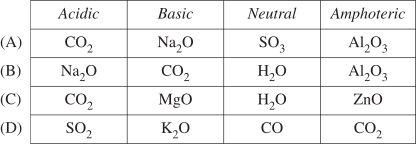
In which row of the following table are the listed oxides correctly classified?

Show Answers Only

`C`

Show Worked Solution
  • Acidic Oxides: are often the oxides of non-metals and form acidic solutions.
  • Basic Oxides: are usually formed by reacting oxygen with metals and participate with acids in neutralisation reactions.
  • Neutral Oxides: react with neither acids or bases and do not lead to either acidic or basic solutions.
  • Amphoteric Oxides: exhibit both acidic and basic properties and can chemically react as either an acid or base.

`=>C`

Filed Under: Properties of Matter Tagged With: Band 4, smc-4255-20-Periodic Table

CHEMISTRY, M1 2013 HSC 5 MC

When placed in the Periodic Table, the recently discovered element 116 would be found in the same group as

  1. element 16.
  2. element 43.
  3. element 87.
  4. element 102 .
Show Answers Only

`A`

Show Worked Solution
  • Elements in the same column are in the same Periodic Table groups.

`=>A`

Filed Under: Properties of Matter Tagged With: Band 3, smc-4255-20-Periodic Table

Copyright © 2014–2025 SmarterEd.com.au · Log in