SmarterEd

Aussie Maths & Science Teachers: Save your time with SmarterEd

  • Login
  • Get Help
  • About

CHEMISTRY, M1 EQ-Bank 8 MC

Which mixture is best separated into its component parts by fractional distillation?

  1. Iron filings and sulfur powder
  2. Ethanol and water
  3. Oil and vinegar
  4. Ethane \(\ce{C2H6}\) and octane \(\ce{C8H18}\)
Show Answers Only

\(D\)

Show Worked Solution
  • Fractional distillation is a separation technique used to separate miscible liquids that have different boiling points. It is most effective when separating components of a homogeneous liquid mixture.
  • Ethane and octane are both hydrocarbons that mix completely and have sufficiently different boiling points to be separated by this technique.

\(\Rightarrow D\)

Filed Under: Properties of Matter Tagged With: Band 5, smc-4255-35-Separation techniques

CHEMISTRY, M1 EQ-Bank 16

Hexane and water are liquids that are immiscible with each other. Some of their properties are shown in the table.

\begin{array} {|c|c|c|}
\hline  & \text{Boiling point } (^{\circ}\text{C}) & \text{Density } (\text{g mL}^{-1})\\
\hline \text{Hexane} & 68.7 & 0.66 \\
\hline \text{Water} & 100 & 1.00 \\
\hline \end{array}

A chemist finds a bottle containing hexane and water and needs to determine whether she should use a separating funnel or distillation to separate the liquids.

Assess the effectiveness of each technique when separating hexane and water.   (4 marks)

--- 10 WORK AREA LINES (style=lined) ---

Show Answers Only
  • Hexane and water are immiscible, so they do not mix and, instead, form separate layers.
  • As a result, they can be separated effectively with a separating funnel. The density of hexane is lower than the density of water, so the hexane will be the upper layer and the water will be the lower layer.
  • The liquids could also be separated effectively through distillation.
  • They have a large difference in boiling points. Hexane has a lower boiling point than water (68.7°C). As such, it will be the first fraction to be collected during distillation.
Show Worked Solution
  • Hexane and water are immiscible, so they do not mix and, instead, form separate layers.
  • As a result, they can be separated effectively with a separating funnel. The density of hexane is lower than the density of water, so the hexane will be the upper layer and the water will be the lower layer.
  • The liquids could also be separated effectively through distillation.
  • They have a large difference in boiling points. Hexane has a lower boiling point than water (68.7°C). As such, it will be the first fraction to be collected during distillation.

Filed Under: Properties of Matter Tagged With: Band 5, Band 6, smc-4255-35-Separation techniques

CHEMISTRY, M1 EQ-Bank 5 MC

Which of the following techniques would be used to separate a mixture of oil and water?

  1. Filtration
  2. Chromatography
  3. Using a separating funnel
  4. Evaporation
Show Answers Only

\(C\)

Show Worked Solution
  • Oil and water are immiscible — they form two distinct layers due to different densities.
  • A separating funnel allows the denser liquid (water) to be drained off first, leaving the oil layer behind.
  • Filtration only separates solids from liquids.
  • Chromatography separates substances based on solubility and adsorption, not density.
  • Evaporation removes a solvent, not separate two immiscible liquids.

\(\Rightarrow C\)

Filed Under: Properties of Matter Tagged With: Band 3, smc-4255-35-Separation techniques

CHEMISTRY, M1 EQ-Bank 15

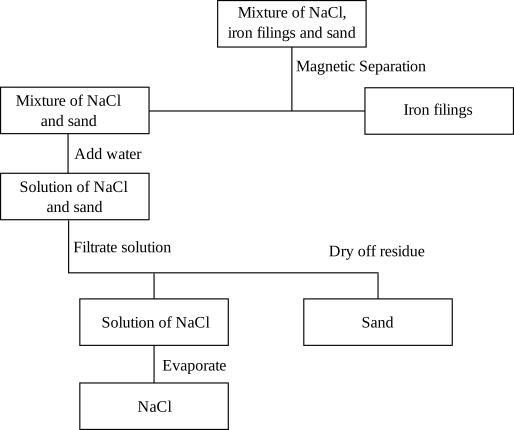
A student is given a mixture containing sodium chloride crystals, sand, and iron filings.

The table below shows some physical properties of these substances.

\begin{array} {|c|c|c|}
\hline \text{Substance} &\text{Formula} & \text{Melting point }(^{\circ}C) & \text{Solubility in water} & \text{Magnetic} & \text{Density (g cm}^{-3})\\
\hline \text{Sodium chloride} & \ce{NaCl} & 801 & \text{Soluble} & \text{No} & 2.2 \\
\hline \text{Sand (silicon dioxide)} & \ce{SiO2} & 1710 & \text{Insoluble} & \text{No} & 2.6 \\
\hline \text{Iron filings} & \ce{Fe} & 1538 & \text{Insoluble} & \text{Yes} & 7.9 \\
\hline \end{array}

  1. Explain whether you would expect this mixture to be homogeneous or heterogeneous, and explain your reasoning.   (3 marks)

--- 5 WORK AREA LINES (style=lined) ---

  1. Draw a flow diagram that shows how this mixture could be separated into pure samples of each substance.   (3 marks)

--- 8 WORK AREA LINES (style=blank) ---

Show Answers Only

a.    The mixture is a heterogeneous mixture.

  • This is because the components retain their individual physical properties and can be seen as separate phases (solid particles with different appearances).
  • They do not form a uniform composition.

b.    
       

Show Worked Solution

a.    The mixture is a heterogeneous mixture.

  • This is because the components retain their individual physical properties and can be seen as separate phases (solid particles with different appearances).
  • They do not form a uniform composition.

b.    
       

  • The flow chart should outline steps that can be completed in a school science lab.

Filed Under: Properties of Matter Tagged With: Band 4, smc-4255-35-Separation techniques

CHEMISTRY, M1 EQ-Bank 14

A mixture of sand and salt was provided to a group of students for them to determine its percentage composition by mass.

They added water to the sample before using filtration and evaporation to separate the components.

During the evaporation step, the students noticed white powder ‘spitting’ out of the basin onto the bench, so they turned off the Bunsen burner and allowed the remaining water to evaporate overnight.

After filtering, they allowed the filter paper to dry overnight before weighing. An electronic balance was used to measure the mass of each component to two decimal places.

The results were recorded as shown:

    • Mass of the original sand and salt mixture = 15.73 g
    • Mass of the filter paper = 0.80 g
    • Mass of the dried filter paper after filtering = 11.95 g
    • Mass of the empty evaporating basin = 33.50 g
    • Mass of the evaporating basin after evaporation = 36.60 g
  1. Calculate the percentage composition by mass of sand AND salt in the mixture.   (3 marks)

    --- 6 WORK AREA LINES (style=lined) ---

  2. Consider the following definition of validity
  3. Validity is the degree to which tests measure what was intended, or the accuracy of actions, data and inferences produced from tests and other processes.
  4. Use this definition of to assess the validity of the experiment.   (2 marks)

    --- 5 WORK AREA LINES (style=lined) ---

Show Answers Only

a.    % Sand = 70.88%, % Salt = 19.71%

b.   Experiment validity:

  • The calculations show that the percentages do not add up to 100.
  • Some mass (salt) was observed to be lost during the experiment, and thus the mass of salt determined is lower than the true value and the results are not accurate.
  • Hence, experiment is not valid.
Show Worked Solution
a.     \(\text{Sand mass}\ \) \(\text{ = Mass of dried filter paper – Mass of filter paper}\)
    \(= 11.95-0.80 = 11.15\ \text{g}\)
\(\text{Salt mass}\) \(\text{ = Mass of dried filter paper – Mass of filter paper}\)  
  \(= 36.60-33.50 = 3.10\ \text{g}\)  


\(\text{% sand} = \left(\dfrac{\text{Mass of sand}}{\text{Mass of original mixture}}\right) \times 100= \left(\dfrac{11.15 \ \text{g}}{15.73 \ \text{g}}\right) \times 100 = 70.88\%\)

\(\text{% salt} = \left(\dfrac{\text{Mass of salt}}{\text{Mass of original mixture}}\right) \times 100 = \left(\dfrac{3.10 \ \text{g}}{15.73 \ \text{g}}\right) \times 100 = 19.71\%\)
 

b.   Experiment validity:

  • The calculations show that the percentages do not add up to 100.
  • Some mass (salt) was observed to be lost during the experiment, and thus the mass of salt determined is lower than the true value and the results are not accurate.
  • Hence, experiment is not valid.

Filed Under: Properties of Matter Tagged With: Band 4, Band 5, smc-4255-30-Percentage composition, smc-4255-35-Separation techniques

CHEMISTRY, M1 EQ-Bank 13

You are given the task to separate the components of two mixtures: a saltwater solution and a mixture of sand and iron filings.

  1.  Suggest a suitable separation technique to extract the salt from the saltwater solution. Explain your reasoning based on the physical property involved.  (2 marks)

    --- 4 WORK AREA LINES (style=blank) ---

  2.  Identify the physical property that allow the mixture of sand and iron fillings to be separated and whether it is a homogeneous or heterogeneous mixture.  (1 marks)

    --- 2 WORK AREA LINES (style=blank) ---

  3. Describe one safety precaution that should be followed during the separation of the saltwater solution.  (2 marks)

    --- 4 WORK AREA LINES (style=blank) ---

Show Answers Only

a.   Separation technique:

  • Evaporation is a suitable technique because water has a much lower boiling point than salt.
  • By heating the solution, the water evaporates, leaving salt crystals behind.
  • Further distillation could be used to collect and condense the evaporated water.

b.   Physical property:

  • Iron fillings are magnetic and hence can be separated using a magnet.
  • The mixture is heterogeneous.

c.   Safety precaution:

  • For evaporation, wear heat-resistant gloves when handling hot equipment like the tripod or beaker to avoid burns to the hands.
Show Worked Solution

a.   Separation technique:

  • Evaporation is a suitable technique because water has a much lower boiling point than salt.
  • By heating the solution, the water evaporates, leaving salt crystals behind.
  • Further distillation could be used to collect and condense the evaporated water.

b.   Physical property:

  • Iron fillings are magnetic and hence can be separated using a magnet.
  • The mixture is heterogeneous.

c.   Safety precaution:

  • For evaporation, wear heat-resistant gloves when handling hot equipment like the tripod or beaker to avoid burns to the hands.

Filed Under: Properties of Matter Tagged With: Band 3, Band 4, smc-4255-35-Separation techniques

CHEMISTRY, M1 EQ-Bank 9

How can the physical properties of components within a mixture be utilised to separate a heterogeneous mixture of sand, salt, and iron filings?   (3 marks)

--- 7 WORK AREA LINES (style=lined) ---

Show Answers Only
  • Magnetism can be used to separate iron filings from the mixture. Iron filings are magnetic, so you can easily separate them from the non-magnetic sand and salt by moving a magnet over the surface of the mixture.
  • Filtration can be used to separate the sand from the salt. Add water to the remaining mixture of sand and salt, and stir well to dissolve the salt. Since sand is insoluble in water, you can separate it by pouring the mixture through a filter paper placed in a funnel.
  • Evaporation can be used to recover the salt. Finally, to separate the salt from the water, heat the saltwater solution until the water evaporates. The salt will be left behind as a solid residue.
Show Worked Solution
  • Magnetism can be used to separate iron filings from the mixture. Iron filings are magnetic, so you can easily separate them from the non-magnetic sand and salt by moving a magnet over the surface of the mixture.
  • Filtration can be used to separate the sand from the salt. Add water to the remaining mixture of sand and salt, and stir well to dissolve the salt. Since sand is insoluble in water, you can separate it by pouring the mixture through a filter paper placed in a funnel.
  • Evaporation can be used to recover the salt. Finally, to separate the salt from the water, heat the saltwater solution until the water evaporates. The salt will be left behind as a solid residue.

Filed Under: Properties of Matter Tagged With: Band 4, smc-4255-35-Separation techniques

CHEMISTRY, M1 EQ-Bank 2

A student is given a known mixture that contains methanol, water, salt and sand.

Describe a process where the student can separate each component of the mixture.  (3 marks)

--- 6 WORK AREA LINES (style=lined) ---

Show Answers Only
  • Each of the components in the mixture have their own unique physical properties which can be exploited to separate them.

Mixture separation process:

  1. A sieve can be used to separate the sand from the mixture.
  2. Following this, a distillation set up can be used to remove the methanol from the mixture (as methanol has a lower boiling point than water).
  3. An evaporating basin can then be used to evaporate the water, leaving salt behind.
Show Worked Solution
  • Each of the components in the mixture have their own unique physical properties which can be exploited to separate them.

Mixture separation process:

  1. A sieve can be used to separate the sand from the mixture.
  2. Following this, a distillation set up can be used to remove the methanol from the mixture (as methanol has a lower boiling point than water).
  3. An evaporating basin can then be used to evaporate the water, leaving salt behind.

Filed Under: Properties of Matter Tagged With: Band 4, smc-4255-35-Separation techniques

CHEMISTRY, M1 EQ-Bank 1

Complete the following table by providing the physical properties of compounds exploited by various separation methods.  (3 marks)

\begin{array} {|l|c|}
\hline
\rule{0pt}{2.5ex} \text{Separation Method} \rule[-1ex]{0pt}{0pt} & \text{Physical Property Exploited} \\
\hline
\rule{0pt}{2.5ex} \text{Filtration:} \rule[-1ex]{0pt}{0pt} &  \\
\hline
\rule{0pt}{2.5ex} \text{Evaporation:} \rule[-1ex]{0pt}{0pt} &  \\
\hline
\rule{0pt}{2.5ex} \text{Distillation:} \rule[-1ex]{0pt}{0pt} &  \\
\hline
\end{array}

--- 0 WORK AREA LINES (style=lined) ---

Show Answers Only

\begin{array} {|l|c|}
\hline
\rule{0pt}{2.5ex} \text{Separation Method} \rule[-1ex]{0pt}{0pt} & \text{Physical Property Exploited} \\
\hline
\rule{0pt}{2.5ex} \text{Filtration:} \rule[-1ex]{0pt}{0pt} &  \text{Particle size} \\
\hline
\rule{0pt}{2.5ex} \text{Evaporation:} \rule[-1ex]{0pt}{0pt} & \text{State of matter} \\
\hline
\rule{0pt}{2.5ex} \text{Distillation:} \rule[-1ex]{0pt}{0pt} & \text{Boiling point} \\
\hline
\end{array}

Show Worked Solution

\begin{array} {|l|c|}
\hline
\rule{0pt}{2.5ex} \text{Separation Method} \rule[-1ex]{0pt}{0pt} & \text{Physical Property Exploited} \\
\hline
\rule{0pt}{2.5ex} \text{Filtration:} \rule[-1ex]{0pt}{0pt} &  \text{Particle size} \\
\hline
\rule{0pt}{2.5ex} \text{Evaporation:} \rule[-1ex]{0pt}{0pt} & \text{State of matter} \\
\hline
\rule{0pt}{2.5ex} \text{Distillation:} \rule[-1ex]{0pt}{0pt} & \text{Boiling point} \\
\hline
\end{array}

Filed Under: Properties of Matter Tagged With: Band 4, smc-4255-35-Separation techniques

Copyright © 2014–2025 SmarterEd.com.au · Log in