SmarterEd

Aussie Maths & Science Teachers: Save your time with SmarterEd

  • Login
  • Get Help
  • About

CHEMISTRY, M1 EQ-Bank 8 MC

Which of the alternatives below identifies the electron configuration of the cation and anion present in the compound magnesium oxide?

\begin{align*}
\begin{array}{l}
\rule{0pt}{2.5ex} \ \rule[-1ex]{0pt}{0pt}& \\
\rule{0pt}{2.5ex}\textbf{A.}\rule[-1ex]{0pt}{0pt}\\
\rule{0pt}{2.5ex}\textbf{B.}\rule[-1ex]{0pt}{0pt}\\
\rule{0pt}{2.5ex}\textbf{C.}\rule[-1ex]{0pt}{0pt}\\
\rule{0pt}{2.5ex}\textbf{D.}\rule[-1ex]{0pt}{0pt}\\
\end{array}
\begin{array}{|c|c|}
\hline
\rule{0pt}{2.5ex}\text{Cation}\rule[-1ex]{0pt}{0pt}& \text{Anion} \\
\hline
\rule{0pt}{2.5ex} 1s^2\,2s^2\,2p^6\,3s^1\rule[-1ex]{0pt}{0pt}& 1s^2\,2s^2\,2p^6\\
\hline
\rule{0pt}{2.5ex} 1s^2\,2s^2\,2p^6\rule[-1ex]{0pt}{0pt}& 1s^2\,2s^2\,2p^6\\
\hline
\rule{0pt}{2.5ex} 1s^2\,2s^2\,2p^6\,3s^2\rule[-1ex]{0pt}{0pt}& 1s^2\,2s^2\,2p^4 \\
\hline
\rule{0pt}{2.5ex} 1s^2\,2s^2\,2p^6\rule[-1ex]{0pt}{0pt}& 1s^2\,2s^2\,2p^6\,3s^2\,3p^6 \\
\hline
\end{array}
\end{align*}

Show Answers Only

\(B\)

Show Worked Solution
  • In its neutral state \(\ce{Mg}\) has an electron configuration of \(1s^2\,2s^2\,2p^6\,3s^2\). 
  • In \(\ce{MgO}\), magnesium forms \(\ce{Mg^2+}\) by losing its two \(3s\) electrons. Hence the magnesium ion has the electron configuration of \(1s^2\,2s^2\,2p^6\).
  • In its neutral state \(\ce{O}\) has an electron configuration of \(1s^2\,2s^2\,2p^4\). 
  • In \(\ce{MgO}\), oxygen forms \(\ce{O^2-}\) by gaining two electrons to complete the \(2p\) subshell. Hence the oxygen ion has the electron configuration of \(1s^2\,2s^2\,2p^6\).

\(\Rightarrow B\)

Filed Under: Atomic Structure and Atomic Mass Tagged With: Band 6, smc-4256-30-Electronic Configuration

CHEMISTRY, M1 EQ-Bank 7 MC

What is the electron configuration of the element with atomic number 34?

  1. \(1s^2\, 2s^2\, 2p^6\, 3s^2\, 3p^6\, 4s^2\, 3d^{10}\, 4p^4\)
  2. \(1s^2\, 2s^2\, 2p^6\, 3s^2\, 3p^6\, 4s^2\, 3d^9\, 4p^5\)
  3. \(1s^2\, 2s^2\, 2p^6\, 3s^2\, 3p^6\, 4s^2\, 3d^6\, 4p^2\)
  4. \(1s^2\, 2s^2\, 2p^6\, 3s^2\, 3p^6\, 4s^2\, 4p^{4}\, 4d^{10}\)
Show Answers Only

\(A\)

Show Worked Solution
  • Electrons occupy orbitals in increasing energy order: `1s` → `2s` → `2p` → `3s` → `3p` → `4s` → `3d` → `4p`.
  • `s` orbitals can hold two electrons, `p` can hold 6 electrons and `d` orbitals can hold 10 electrons.
  • Filling the 34 electrons into these orbitals gives, \(1s^2\, 2s^2\, 2p^6\, 3s^2\, 3p^6\, 4s^2\, 3d^{10}\, 4p^4\).

\(\Rightarrow A\)

Filed Under: Atomic Structure and Atomic Mass Tagged With: Band 6, smc-4256-30-Electronic Configuration

CHEMISTRY, M1 EQ-Bank 5 MC

A calcium ion, \(\ce{Ca^{2+}}\), has an atomic number of 20 and a mass number of 40. Which of the following statements is correct?

  1. A calcium ion has 20 protons, 20 electrons and 20 neutrons
  2. A calcium ion has 20 protons, 18 electrons and 20 neutrons
  3. A calcium ion has 18 protons, 20 electrons and 20 neutrons
  4. A calcium ion has 20 protons, 18 electrons and 18 neutrons
Show Answers Only

\(B\)

Show Worked Solution
  • Atomic number \(=\) number of protons \(= 20\).
  • Mass number \(=\) protons \(+\) neutrons \(= 40\) → neutrons \(40-20 = 20\).
  • \(\ce{Ca^{2+}}\) means it has lost 2 electrons, so electrons \(= 20-2 = 18\).

\(\Rightarrow B\)

Filed Under: Atomic Structure and Atomic Mass Tagged With: Band 5, smc-4256-30-Electronic Configuration

CHEMISTRY, M1 EQ-Bank 1 MC

Which element has the following electronic configuration.

\(1s^2\) \(2s^2\) \(2p^6\) \(3s^2\) \(3p^1\)

  1. Sodium
  2. Magnesium
  3. Aluminium
  4. Silicon
Show Answers Only

\(C\)

Show Worked Solution
  • The total number of electrons in the element \(=2+2+6+2+1 = 13\)
  • This is equal to the atomic number of the element.

\(\Rightarrow C\)

Filed Under: Atomic Structure and Atomic Mass Tagged With: Band 5, smc-4256-30-Electronic Configuration

CHEMISTRY, M1 EQ-Bank 2

Write the electronic configuration for the following substances, using spdf notation:

  1. Calcium atom   (1 mark)

--- 1 WORK AREA LINES (style=lined) ---

  1. Fluoride ion   (1 mark)

--- 1 WORK AREA LINES (style=lined) ---

Show Answers Only

a.    \(\ce{Ca}\): \(1s^2\) \(2s^2\) \(2p^6\) \(3s^2\) \(3p^6\) \(4s^2\)

b.    \(\ce{F^-}\): \(1s^2\) \(2s^2\) \(2p^6\)

Show Worked Solution

a.    \(\ce{Ca}\): \(1s^2\) \(2s^2\) \(2p^6\) \(3s^2\) \(3p^6\) \(4s^2\)
 

b.    \(\ce{F^-}\): \(1s^2\) \(2s^2\) \(2p^6\)

Filed Under: Atomic Structure and Atomic Mass Tagged With: Band 4, smc-4256-30-Electronic Configuration

CHEMISTRY, M1 2014 HSC 35ci

Three electron configurations are presented in the table. For elemental titanium, the ground state is represented by \(\text{I}\), while \(\text{II}\) and \(\text{III}\) are both invalid ground state electron configurations.
 

Write a valid electron configuration for \(\ce{Ti^3+}\).  (2 marks)

Show Answers Only

Possible answer structures include:

\(\ce{1s^2 2s^2 2p^6 3s^2 3p^6 3d^1}\)

Show Worked Solution

Possible answer structures include:

\(\ce{1s^2 2s^2 2p^6 3s^2 3p^6 3d^1}\)

Filed Under: Atomic Structure and Atomic Mass Tagged With: Band 4, smc-4256-30-Electronic Configuration

CHEMISTRY, M1 2007 HSC 31ai

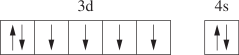
The electron spin orbital diagram represents the \(3d\) and \(4s\) electrons for an element in the first transition series.

Identify this element and explain the arrangement of electrons in these sub-shells in terms of the Pauli exclusion principle and Hund's rule.   (3 marks)

Show Answers Only
  • The electron configuration of \(3d^{6}\) \(4s^{2}\) is that of Iron (Atomic No. 26). 
  • Hund’s Rule: Every orbital within a sub shell must by singly occupied before an orbital can become doubly occupied.
    • The \(3d\) sub shell has 5 orbitals, therefore for an orbital to contain 2 electrons, there must be a minimum of 6 electrons 
  • Pauli Exclusion Principle: No more than 2 electrons can occupy the same orbital and the 2 electrons in the same orbital must have opposite spin.
    • The orbital within the \(3d\) sub shell containing 2 electrons follows this rule, as does the orbital within the \(4s\) sub shell.
Show Worked Solution
  • The electron configuration of \(3d^{6}\) \(4s^{2}\) is that of Iron (Atomic No. 26). 
  • Hund’s Rule: Every orbital within a sub shell must by singly occupied before an orbital can become doubly occupied.
    • The \(3d\) sub shell has 5 orbitals, therefore for an orbital to contain 2 electrons, there must be a minimum of 6 electrons 
  • Pauli Exclusion Principle: No more than 2 electrons can occupy the same orbital and the 2 electrons in the same orbital must have opposite spin.
    • The orbital within the \(3d\) sub shell containing 2 electrons follows this rule, as does the orbital within the \(4s\) sub shell.

Filed Under: Atomic Structure and Atomic Mass Tagged With: Band 4, smc-4256-30-Electronic Configuration

CHEMISTRY, M1 2008 HSC 32ai

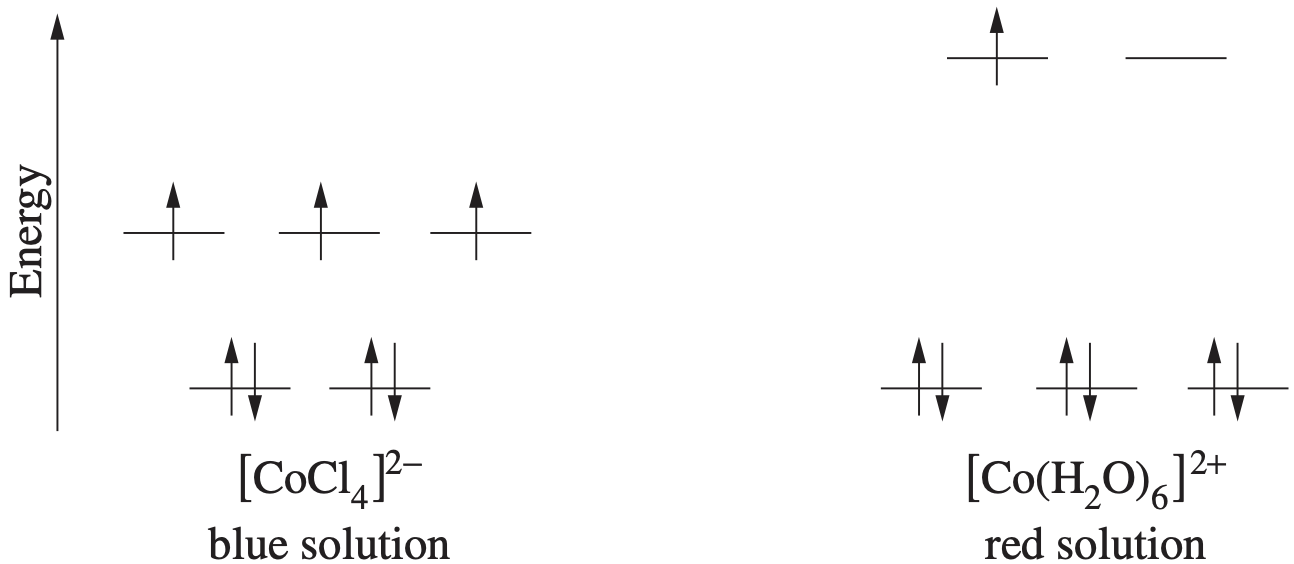
The diagram below shows the ground state electron configuration of two complexes of cobalt in aqueous solution.


Identify the block in the periodic table to which cobalt belongs and write the electron configuration of cobalt metal in its ground state.  (2 marks)

--- 4 WORK AREA LINES (style=lined) ---

Show Answers Only
  • Cobalt belongs to the D-block on the periodic table.
  • The electron configuration of Cobalt metal in its ground state is:

\(1s^{2}\)  \(2s^{2}\) \(2p^{6}\) \(3s^{2}\) \(3p^{6}\) \(4s^{2}\) \(3d^{7}\)

Show Worked Solution
  • Cobalt belongs to the D-block on the periodic table.
  • The electron configuration of Cobalt metal in its ground state is:

\(1s^{2}\)  \(2s^{2}\) \(2p^{6}\) \(3s^{2}\) \(3p^{6}\) \(4s^{2}\) \(3d^{7}\)

Filed Under: Atomic Structure and Atomic Mass Tagged With: Band 4, smc-4256-30-Electronic Configuration

CHEMISTRY, M1 2009 HSC 30bii

Write the full electron configurations for a \(\ce{Ca}\) atom in the ground state, an excited \(\ce{Ca}\) atom and a \( \ce{Ca}^{+}\) ion.  (2 marks)

Show Answers Only

\(\ce{Ca}\) atom: \(\ce{1s^2 2s^2 2p^6 3s^2 3p^6 4s^2}\)

\(\ce{Ca}\) atom (excited): \(\ce{1s^2 2s^2 2p^6 3s^2 3p^6 4s^1 4p^1}\)

\(\ce{Ca^+}\) atom: \(\ce{1s^2 2s^2 2p^6 3s^2 3p^6 4s}\)

Show Worked Solution

\(\ce{Ca}\) atom:  \(\ce{1s^2 2s^2 2p^6 3s^2 3p^6 4s^2}\)

\(\ce{Ca}\) atom (excited):  \(\ce{1s^2 2s^2 2p^6 3s^2 3p^6 4s^1 4p^1}\)

\(\ce{Ca^+}\) atom:  \(\ce{1s^2 2s^2 2p^6 3s^2 3p^6 4s}\)

Filed Under: Atomic Structure and Atomic Mass Tagged With: Band 4, smc-4256-30-Electronic Configuration

CHEMISTRY, M1 2009 HSC 30bi

What is the maximum number of electrons that a p-orbital can hold?  (1 mark)

Show Answers Only
  • The maximum number of electrons that a p-orbital can hold is two (Hunds Rule).
Show Worked Solution
  • The maximum number of electrons that a p-orbital can hold is two (Hunds Rule).

Filed Under: Atomic Structure and Atomic Mass Tagged With: Band 3, smc-4256-30-Electronic Configuration

CHEMISTRY, M1 2011 HSC 36bii

Explain the fact that Group I and Group II metal ions have one oxidation state while the transition metals often have multiple oxidation states.  (3 marks)

Show Answers Only


Show Worked Solution
  • Group I and II metals lose one or two ‘s’ valence shell electrons easily to acquire a noble gas electron configuration.
  • Removal of further electrons is difficult.
  • Thus Group I metals lose one electron and Group II metals lose two electrons to form +1 and +2 cations respectively.
  • Transitions elements lose ‘d’ shell electrons, to obtain a variety of oxidation states.

Filed Under: Atomic Structure and Atomic Mass Tagged With: Band 6, smc-4256-30-Electronic Configuration

CHEMISTRY, M1 2011 HSC 36bi

Identify ONE cation and ONE anion that can be represented by the electron configuration \( \ce{1 s^2 2 s^2 2 p^6 3 s^2 3 p^6} \).  (2 marks)

Show Answers Only

Answers could include one of the following:

\(\ce{K+, Cl-}\)

\(\ce{Ca^{2+}, S^{2-}}\)

\(\ce{Sc^{3+}, P^{3-}}\)

Show Worked Solution

Answers could include one of the following:

\(\ce{K+, Cl-}\)

\(\ce{Ca^{2+}, S^{2-}}\)

\(\ce{Sc^{3+}, P^{3-}}\)

Filed Under: Atomic Structure and Atomic Mass Tagged With: Band 4, smc-4256-30-Electronic Configuration

CHEMISTRY, M1 2013 HSC 35bii

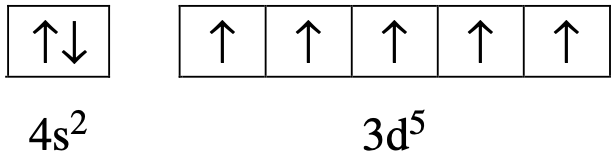
An atom has FIVE valence electrons in its \(d\) orbital. Using an orbital diagram of the valence shell of the atom, explain how Hund's rule determines the electronic configuration.   (3 marks)

Show Answers Only

  • Hund’s rule states that every orbital in a subshell is occupied with one electron before any orbital is doubly occupied.
  • In this example Hund’s rule is illustrated by the \(3d\) sub-shell having 5 electrons in 5 different orbitals.
Show Worked Solution

  • Hund’s rule states that every orbital in a subshell is occupied with one electron before any orbital is doubly occupied.
  • In this example Hund’s rule is illustrated by the \(3d\) sub-shell having 5 electrons in 5 different orbitals.

Filed Under: Atomic Structure and Atomic Mass Tagged With: Band 4, smc-4256-30-Electronic Configuration

CHEMISTRY, M1 2013 HSC 35bi

Identify in which of the \( s, p, d \) or \(f \) blocks of the Periodic Table the element \(\ce{Ra}\) is found. Justify your answer.   (2 marks)

Show Answers Only
  • \(\ce{Ra}\) (radium) is an \( s \)-block element.
  • Its valence electrons are in the \( s \) orbital.
Show Worked Solution
  • \(\ce{Ra}\) (radium) is an \( s \)-block element.
  • Its valence electrons are in the \( s \) orbital.

Filed Under: Atomic Structure and Atomic Mass Tagged With: Band 4, smc-4256-30-Electronic Configuration

Copyright © 2014–2025 SmarterEd.com.au · Log in