SmarterEd

Aussie Maths & Science Teachers: Save your time with SmarterEd

  • Login
  • Get Help
  • About

CHEMISTRY, M1 EQ-Bank 17

The following table gives some information about two covalent molecule substances

\begin{array} {|c|c|c|}
\hline \text{Compound} & \text{Molecular formula} & \text{Boiling Point } (^{\circ}C) \\
\hline \text{Water} & \ce{H2O} & 100 \\
\hline \text{Hydrogen sulfide} & \ce{H2S} & -60 \\
\hline \end{array}

  1. Draw Lewis dot diagrams for each molecule.   (2 marks)

    --- 4 WORK AREA LINES (style=blank) ---

  1. Identify the shape and polarity of each molecule.   (4 marks)

    --- 2 WORK AREA LINES (style=lined) ---

  1. Explain why there is a difference in the boiling points of these molecules.   (3 marks)

    --- 6 WORK AREA LINES (style=lined) ---

Show Answers Only

a.   
             

b.   Water: Bent and Polar

Hydrogen Sulfide: Bent and polar 

c.   Even though both molecular are polar:

  • Water has strong hydrogen bonding between molecules because \(\ce{H}\) is bonded to highly electronegative \(\ce{O}\) with lone pairs. These hydrogen bonds require large amounts of energy to break, giving water a high boiling point.
  • Hydrogen sulfide cannot form hydrogen bonds because \(\ce{S}\) is not electronegative enough. The only intermolecular forces are weak dipole–dipole and dispersion forces. Thus less energy is required to overcome the intermolecular forces and so \(\ce{H2S}\) a lower boiling point.
Show Worked Solution

a.   
             

b.   Water: Bent and Polar

Hydrogen Sulfide: Bent and polar
 

c.   Even though both molecular are polar:

  • Water has strong hydrogen bonding between molecules because \(\ce{H}\) is bonded to highly electronegative \(\ce{O}\) with lone pairs. These hydrogen bonds require large amounts of energy to break, giving water a high boiling point.
  • Hydrogen sulfide cannot form hydrogen bonds because \(\ce{S}\) is not electronegative enough. The only intermolecular forces are weak dipole–dipole and dispersion forces. Thus less energy is required to overcome the intermolecular forces and so \(\ce{H2S}\) a lower boiling point.


Filed Under: Bonding Tagged With: Band 4, Band 5, smc-4258-30-Lewis Dot, smc-4258-40-Inter/Intramolecular Bonding, smc-4258-50-Chemical structure

CHEMISTRY, M1 EQ-Bank 14

Copper and copper \(\text{(II)}\) oxide both conduct electricity in the molten state. However, copper also conducts electricity in the solid state, whereas copper \(\text{(II)}\) oxide does not.

Explain the electrical conductivity of copper and copper \(\text{(II)}\) oxide in terms of their structure and bonding.   (4 marks)

--- 8 WORK AREA LINES (style=lined) ---

Show Answers Only

Copper \(\text{(II)}\):

  • Copper is a metal with a giant metallic lattice structure. In both the solid and molten states, copper atoms are arranged in a lattice surrounded by a “sea of delocalised valence electrons”.
  • These delocalised electrons are free to move and carry charge, so copper conducts electricity in the solid state as well as when molten.

Copper \(\text{(II)}\) oxide :

  • Copper \(\text{(II)}\) oxide is an ionic compound composed of \(\ce{Cu^2+}\) cations and \(\ce{O^2-}\) anions arranged in a giant ionic lattice.
  • In the solid state, the ions are held in fixed positions by strong electrostatic forces and cannot move, so \(\ce{CuO}\) does not conduct electricity.
  • In the molten state, the ionic lattice breaks apart and the ions become mobile, allowing them to act as charge carriers, so molten \(\ce{CuO}\) does conduct electricity.
Show Worked Solution

Copper \(\text{(II)}\):

  • Copper is a metal with a giant metallic lattice structure.
  • In both the solid and molten states, copper atoms are arranged in a lattice surrounded by a “sea of delocalised valence electrons”.
  • These delocalised electrons are free to move and carry charge, so copper conducts electricity in the solid state as well as when molten.

Copper \(\text{(II)}\) oxide :

  • Copper \(\text{(II)}\) oxide is an ionic compound composed of \(\ce{Cu^2+}\) cations and \(\ce{O^2-}\) anions arranged in a giant ionic lattice.
  • In the solid state, the ions are held in fixed positions by strong electrostatic forces and cannot move, so \(\ce{CuO}\) does not conduct electricity.
  • In the molten state, the ionic lattice breaks apart and the ions become mobile, allowing them to act as charge carriers, so molten \(\ce{CuO}\) does conduct electricity.

Filed Under: Bonding Tagged With: Band 6, smc-4258-40-Inter/Intramolecular Bonding, smc-4258-50-Chemical structure

CHEMISTRY, M1 EQ-Bank 1 MC

The Lewis electron dot diagram of ammonia \(\ce{NH3}\) is shown:
 

Which of the following is correct for this molecule?

\begin{align*}
\begin{array}{l}
\rule{0pt}{2.5ex} \ \rule[-1ex]{0pt}{0pt}& \\
\rule{0pt}{2.5ex}\textbf{A.}\rule[-1ex]{0pt}{0pt}\\
\rule{0pt}{2.5ex}\textbf{B.}\rule[-1ex]{0pt}{0pt}\\
\rule{0pt}{2.5ex}\textbf{C.}\rule[-1ex]{0pt}{0pt}\\
\rule{0pt}{2.5ex}\textbf{D.}\rule[-1ex]{0pt}{0pt}\\
\end{array}
\begin{array}{|c|c|}
\hline
\rule{0pt}{2.5ex}\text{Molecule polarity}\rule[-1ex]{0pt}{0pt}& \text{Molecular shape} \\
\hline
\rule{0pt}{2.5ex}\text{Non-polar}\rule[-1ex]{0pt}{0pt}&\text{Trigonal Planar}\\
\hline
\rule{0pt}{2.5ex}\text{Non-polar}\rule[-1ex]{0pt}{0pt}& \text{Tetrahedral}\\
\hline
\rule{0pt}{2.5ex}\text{Polar}\rule[-1ex]{0pt}{0pt}& \text{Tetrahedral} \\
\hline
\rule{0pt}{2.5ex}\text{Polar}\rule[-1ex]{0pt}{0pt}& \text{Pyramidal} \\
\hline
\end{array}
\end{align*}

Show Answers Only

\(D\)

Show Worked Solution
  • \(\ce{NH3}\) has 3 bonding pairs and 1 lone pair of electrons around nitrogen.
  • According to VSEPR theory, this gives a pyramidal molecular shape (not planar or tetrahedral as a whole).
  • The bonds between nitrogen and hydrogen are polar covalent bonds. The arrangement causes the whole molecule to be polar.

\(\Rightarrow D\)

Filed Under: Bonding Tagged With: Band 5, smc-4258-30-Lewis Dot, smc-4258-50-Chemical structure

CHEMISTRY, M1 2008 HSC 18a

Draw Lewis electron dot structures for oxygen \( (\ce{O})\) and ozone \( (\ce{O3}) \).   (2 marks)

Show Answers Only

            Oxygen \((\ce{O})\)         Ozone \((\ce{O3}) \)

Show Worked Solution

            Oxygen \((\ce{O})\)         Ozone \((\ce{O3}) \)

Filed Under: Bonding Tagged With: Band 3, smc-4258-30-Lewis Dot, smc-4258-50-Chemical structure

CHEMISTRY, M1 2014 HSC 11 MC

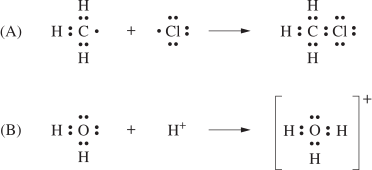
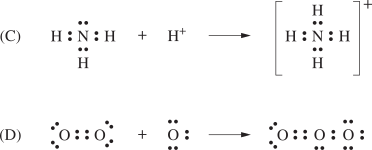
Which of the following does NOT represent the formation of a coordinate covalent bond?
 

Show Answers Only

`A`

Show Worked Solution
  • A coordinate covalent bond occurs when one atom donates a pair of electrons (both electrons) to form the covalent bond.
  • In \(A\) both atoms donate 1 electron each, therefore it is not a coordinate covalent bond.

`=>A`

Filed Under: Bonding Tagged With: Band 4, smc-4258-50-Chemical structure

CHEMISTRY, M1 2016 HSC 5 MC

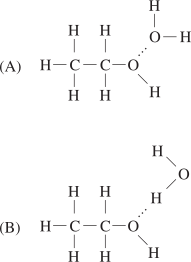
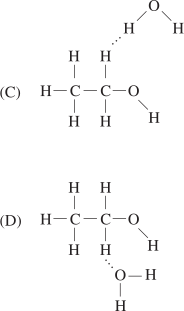
Which of the following diagrams best represents the bonding between molecules of water and ethanol?


Show Answers Only

`B`

Show Worked Solution
  • Ethanol, \(\ce{C2H5OH}\) has a polar \(\ce{OH}\) group. The partially negative oxygen atom is attracted to the partially positive hydrogen atom in the water molecule.
  • This forms a hydrogen bond.

`=>B`

Filed Under: Bonding Tagged With: Band 4, smc-4258-40-Inter/Intramolecular Bonding, smc-4258-50-Chemical structure

Copyright © 2014–2025 SmarterEd.com.au · Log in