SmarterEd

Aussie Maths & Science Teachers: Save your time with SmarterEd

  • Login
  • Get Help
  • About

PHYSICS, M1 EQ-Bank 17

Two boats begin their journey from the same dock at the same time.

- Boat A travels at \(x\) m/s due north.

- Boat B travels at \(y\) m/s due east.

Determine whether the magnitude of the velocity of Boat A relative to Boat B would change if both boats doubled their speeds but continued in their original direction. Explain your reasoning.   (2 marks)

Show Answers Only

\(v_{\text{A rel B}} = v_A-v_B = v_A + (-v_B)\)
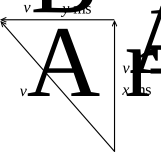
\(v_{\text{A rel B}} = \sqrt{x^2 + y^2}\)
 

Double the velocities of Boat A and Boat B – new relative velocity is:

\(\sqrt{(2x)^2+(2y)^2} = \sqrt{4(x^2+y^2)} = 2\sqrt{x^2+y^2} = 2 \times v_{\text{A rel B}}\)
 

\(\therefore\) The magnitude of the velocity of Boat A relative to Boat B is doubled when the boats double their speed.
Show Worked Solution

\(v_{\text{A rel B}} = v_A-v_B = v_A + (-v_B)\)

\(v_{\text{A rel B}} = \sqrt{x^2 + y^2}\)
 

Double the velocities of Boat A and Boat B – new relative velocity is:

\(\sqrt{(2x)^2+(2y)^2} = \sqrt{4(x^2+y^2)} = 2\sqrt{x^2+y^2} = 2 \times v_{\text{A rel B}}\)
 

\(\therefore\) The magnitude of the velocity of Boat A relative to Boat B is doubled when the boats double their speed.
Filed Under: Motion on a Plane Tagged With: Band 5, smc-4274-40-Relative motion

PHYSICS, M1 EQ-Bank 3 MC

Two birds take off from the same point at the same time.

    • Bird A flies due north at a speed of 12 m/s.

    • Bird B flies due east at a speed of 16 m/s.

What is the magnitude of the velocity of Bird A relative to Bird B?

  1. 20 m/s
  2. 12.8 m/s
  3. 8 m/s
  4. 28 m/s
Show Answers Only

\(A\)

Show Worked Solution

\(v_{\text{a rel b}} = v_a-v_b\)
 

Magnitude of \(v_{\text{a rel b}} = \sqrt{16^2 + 12^2} = 20\ \text{ms}^{-1}\)

\(\Rightarrow A\)

Filed Under: Motion on a Plane Tagged With: Band 3, smc-4274-40-Relative motion

PHYSICS, M1 EQ-Bank 14

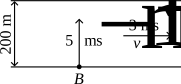
A boat is trying to cross a river that is 200 meters wide. The boat’s speed in still water is 5 m/s. The river flows eastward with a current of 3 m/s.

  1. If the boat heads straight north (perpendicular to the current), using a vector diagram. determine the magnitude and direction of its velocity relative to the ground?   (3 marks)

    --- 6 WORK AREA LINES (style=lined) ---

  1. How far downstream (east) will the boat have drifted by the time it reaches the opposite bank?   (1 mark)

    --- 2 WORK AREA LINES (style=lined) ---

  1. At what angle should the boat be aimed (relative to north) so that it reaches directly across from its starting point?   (2 marks)

    --- 4 WORK AREA LINES (style=lined) ---

Show Answers Only

a.    The velocity of the boat relative to the ground is 5.83 m/s N31\(^{\circ}\)E.

b.    \(120\ \text{m}\)

c.    The boat should head N36.9\(^{\circ}\)W.

Show Worked Solution

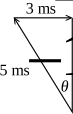
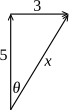
a.    Using the vector diagrams below

\(x=\sqrt{3^2+5^2} = 5.83\ \text{ms}^{-1}\)

\(\tan \theta= \dfrac{3}{5}\ \ \Rightarrow\ \ \theta=\tan^{-1}\left(\dfrac{3}{5}\right)=31^{\circ}\)

 \(\therefore\) The velocity of the boat relative to the ground is 5.83 m/s N31\(^{\circ}\)E.
 

b.    
         

\(\tan 31^{\circ}\) \(=\dfrac{d}{200}\)  
\(d\) \(=200 \times \tan\,31^{\circ}=120\ \text{m}\)  

 
c.    
         

\(\sin \theta=\dfrac{3}{5}\ \ \Rightarrow\ \ \theta=\sin^{-1}\left(\dfrac{3}{5}\right)=36.9^{\circ}\)

 \(\therefore\) The boat should head N36.9\(^{\circ}\)W.

Filed Under: Motion on a Plane Tagged With: Band 3, Band 4, smc-4274-10-Vector addition, smc-4274-40-Relative motion

PHYSICS, M1 EQ-Bank 2

A boy on a bike is travelling at 8 ms\(^{-1}\) north when he sees a girl on a scooter travelling at 6 ms\(^{-1}\) west, relative to the ground. 

  1. Draw a vector diagram to represent the velocity of the girl relative to the boy.   (2 marks)

    --- 4 WORK AREA LINES (style=blank) ---

  2. Use the vector diagram to calculate the velocity of the girl relative to the boy.   (2 marks)

    --- 4 WORK AREA LINES (style=blank) ---

Show Answers Only

10 ms\(^{-1}\), S36.9\(^{\circ}\)W

Show Worked Solution

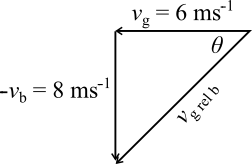
a.    \(v_{\text{g}} = 6\ \text{ms}^{-1}\ \text{west} \)

\(-v_{\text{b}} = 8\ \text{ms}^{-1}\ \text{south} \)

\(v_{\text{g rel b}} = v_\text{g} + (-v_\text{b}) \)


b.    \(v_{\text{g rel b}}=\sqrt{6^2+8^2} =10\ \text{ms}^{-1}\)

  \(\tan \theta\) \(=\dfrac{8}{6}\)
  \(\theta\) \(=\tan^{-1}\Big(\dfrac{8}{6}\Big)=53.1^{\circ}\)

 
\(\therefore\) Velocity of the girl relative to the boy is 10 ms\(^{-1}\), S36.9°W.

Filed Under: Motion on a Plane Tagged With: Band 3, Band 4, smc-4274-40-Relative motion

PHYSICS, M1 EQ-Bank 11

Car A is travelling north at 40 ms\(^{-1}\) and Car B is travelling at 30 ms\(^{-1}\) east.

Determine the velocity of Car A relative to Car B.   (3 mark)

--- 6 WORK AREA LINES (style=blank) ---

Show Answers Only

50 ms\(^{-1}\), N36.9\(^{\circ}\)W

Show Worked Solution

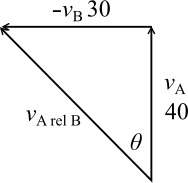
\(v_{\text{A rel B}}=v_A-v_B =v_A + (-v_B)\) 

\(v_A = 40\ \text{ms}^{-1}\ \text{north}, \ -v_B = 30\ \text{ms}^{-1}\ \text{west} \)

\(v_{\text{A rel B}}=\sqrt{40^2+30^2}=50\ \text{ms}^{-1}\)

\(\tan \theta\) \(=\dfrac{30}{40}\)  
\(\theta\) \(=\tan^{-1}\Big(\dfrac{30}{40}\Big)=36.9^{\circ}\)  


\(\therefore\) Velocity of Car A relative to Car B is 50 ms\(^{-1}\), N36.9°W.

Filed Under: Motion on a Plane Tagged With: Band 4, smc-4274-40-Relative motion

PHYSICS, M1 EQ-Bank 5

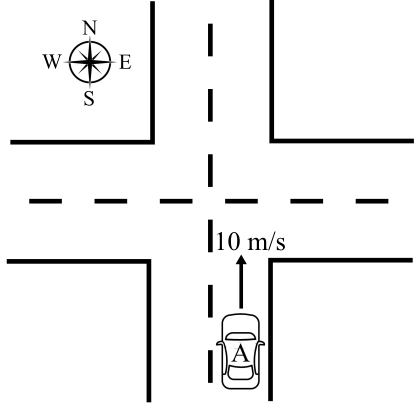
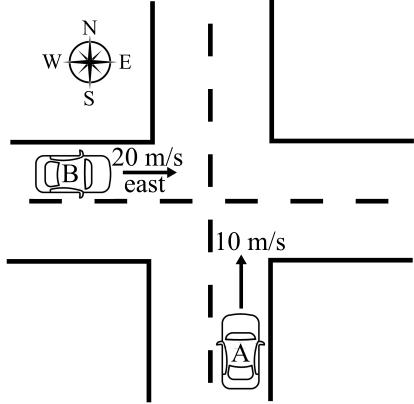
Car A approaches an intersection at 10 ms\(^{-1}\) from the South as shown. As Car B approaches the intersection, it measures the velocity of Car A to be 22.36 ms\(^{-1}\) NW.
 

Draw Car B on the diagram showing its direction and speed. Show all working.   (3 marks)

--- 8 WORK AREA LINES (style=lined) ---

Show Answers Only

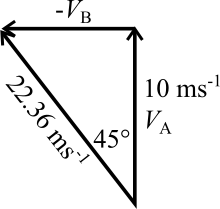
  • Velocity of A relative to B = \(v_A-v_B=v_A+-v_B\)

  • The direction of \(-v_B\) must be west, and therefore the direction of \(v_B\) is east.
  • Using Pythagoras theorem, the magnitude of \(-v_B\) is:
\(-v_B\) \(=\sqrt{22.36^2-10^2}\)  
  \(=20\ \text{ms}^{-1}\)  


  • Therefore the vector \(v_B\) is \(20\ \text{ms}^{-1}\) east.

Show Worked Solution

  • Velocity of A relative to B = \(v_A-v_B=v_A+-v_B\)

  • The direction of \(-v_B\) must be west, and therefore the direction of \(v_B\) is east.
  • Using Pythagoras theorem, the magnitude of \(-v_B\) is:
  •    \(-v_B=\sqrt{22.36^2-10^2}=20\ \text{ms}^{-1}\)
  • Thus the vector \(v_B\) is \(20\ \text{ms}^{-1}\) east.

Filed Under: Motion on a Plane Tagged With: Band 6, smc-4274-40-Relative motion, smc-4274-50-Vector diagrams

PHYSICS, M1 EQ-Bank 4

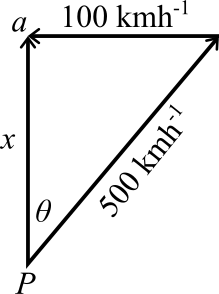
A plane that can fly at 500 kmh\(^{-1}\) with no wind, encounters a strong cross wind of 100 kmh\(^{-1}\) from the east. The plane needs to travel directly north to an airstrip

  1. Calculate the angle, correct to one decimal place, at which the pilot should steer for the plane to fly directly to the airstrip?   (3 marks)

    --- 6 WORK AREA LINES (style=lined) ---

  2. If the airstrip is 100 km from the planes current position, how long, to the nearest minute, will it take for the plane to complete the journey?   (2 marks)
  3. --- 4 WORK AREA LINES (style=lined) ---

Show Answers Only

a.    \(\text{N11.5°E}\)

b.    \(\text{12 minutes}\)

Show Worked Solution

a.    
       

\(\sin\theta\) \(=\dfrac{100}{500}\)  
\(\theta\) \(=\sin^{-1}\Big{(}\dfrac{100}{500}\Big{)}\)  
  \(=11.5^{\circ}\)  

 
\(\text{Plane direction should be N11.5°E}\)
 

b.    \(\text{Using the diagram in part (i):}\)

\(\tan(11.5°)\) \(=\dfrac{100}{x}\)  
\(x\) \(=\dfrac{100}{\tan(11.5°)}\)  
  \(=491.5\ \text{kmh}^{-1}\)  


\(t\) \(=\dfrac{\text{distance}}{\text{speed}}\)  
  \(=\dfrac{100}{491.5}\)  
  \(=0.203\ \text{h}\)  
  \(=12\ \text{m (nearest minute)}\)  

Filed Under: Motion on a Plane Tagged With: Band 4, Band 5, smc-4274-40-Relative motion, smc-4274-50-Vector diagrams

Copyright © 2014–2025 SmarterEd.com.au · Log in