SmarterEd

Aussie Maths & Science Teachers: Save your time with SmarterEd

  • Login
  • Get Help
  • About

PHYSICS, M1 EQ-Bank 16

A small plane is flying due south at 80 m/s. It makes a smooth 90° turn over 20 seconds and ends up flying due east at 60 m/s.

  1. Draw a vector diagram showing the change in velocity vector of the small plane.   (2 marks) 

    --- 4 WORK AREA LINES (style=blank) ---

  1. Calculate the average acceleration (magnitude and direction) during the turn.   (2 marks) 

    --- 4 WORK AREA LINES (style=lined) ---

Show Answers Only

a.    
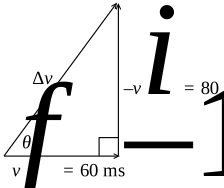
             

b.    \(5\ \text{ms}^{-2}\text{, N}37^{\circ}\text{E}\).

Show Worked Solution

a.    \(\Delta v = v_f-v_i = v_f + (-v_i)\)
 

b.   \(a=\dfrac{\Delta v}{t}=\dfrac{\sqrt{60^2+80^2}}{20}=5\ \text{ms}^{-2}\)

\(\tan \theta\) \(=\dfrac{80}{60}\)  
\(\theta\) \(=\tan^{-1}\left(\dfrac{80}{60}\right)=53^{\circ}\)  

 
\(\therefore\) The average acceleration of the plane is \(5\ \text{ms}^{-2}\text{, N}37^{\circ}\text{E}\).
Filed Under: Motion on a Plane Tagged With: Band 3, Band 4, smc-4274-50-Vector diagrams

PHYSICS, M1 EQ-Bank 15

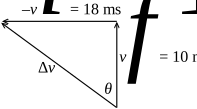
A drone is flying east at 18 m/s and begins a smooth turn that lasts 8 seconds. After completing the turn, it is flying north at 10 m/s.

  1. Represent the drone’s change in velocity using a labelled vector diagram.   (2 marks)

    --- 4 WORK AREA LINES (style=blank) ---

  1. Calculate the magnitude and direction of the drone’s change in velocity.   (2 marks)

    --- 4 WORK AREA LINES (style=lined) ---

Show Answers Only

a.    
         

b.    Change in velocity = 20.59 m/s, N60.9\(^{\circ}\)W.  

Show Worked Solution

a.    \(\Delta v = v_f-v_i = v_f + (-v_i)\)


b.    Using Pythagoras’s theorem:

\(\Delta v = \sqrt{10^2+18^2} = \sqrt{424} = 20.59\ \text{ms}^{-1}\)

\(\tan \theta\) \(=\dfrac{18}{10}\)  
\(\theta\) \(= \tan^{-1}\left(\dfrac{18}{10}\right)=60.9^{\circ}\)  

 
\(\therefore\) Change in velocity = 20.59 m/s, N60.9\(^{\circ}\)W.  

Filed Under: Motion on a Plane Tagged With: Band 4, smc-4274-50-Vector diagrams

PHYSICS, M1 EQ-Bank 1 MC

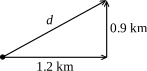
A hiker starts at Camp A and walks 1.2 km east. She then turns to face north and walks a further 0.9 km to arrive at Camp B.

The magnitude of the hiker’s overall displacement \((d)\) can be determined using which of the following expressions?

  1. \(\tan d = \dfrac{0.9\ \text{km}}{1.2\ \text{km}}\)
  2. \(d = 1.2\ \text{km} + 0.9\ \text{km}\)
  3. \(d = (1.2)^2\ \text{km} + (0.9)^2\ \text{km}\)
  4. \(d^2 = (1.2)^2\ \text{km} + (0.9)^2\ \text{km}\)
Show Answers Only

\(D\)

Show Worked Solution
  • By Pythagorean theorem:

\(d^2 = (1.2)^2\ \text{km} + (0.9)^2\ \text{km}\)

\(\Rightarrow D\)

Filed Under: Motion on a Plane Tagged With: Band 3, smc-4274-10-Vector addition, smc-4274-50-Vector diagrams

PHYSICS, M1 EQ-Bank 1

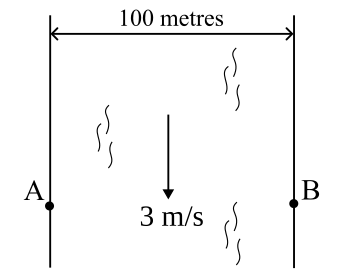
A physics student comes across a river which runs north to south and has a current of 3 ms\(^{-1}\) running south.

The student starts on the west side of the river at point A and paddles a kayak at 5 ms\(^{-1}\) directly across the river to finish at point B.

  1. Calculate the angle which he must position the boat to travel in a straight line across the river.   (2 mark)

    --- 5 WORK AREA LINES (style=blank) ---

  2. If the river is 100 metres wide, determine the time it takes for the student to cross the river.   (2 mark)

    --- 4 WORK AREA LINES (style=blank) ---

Show Answers Only

a.    \(36.9^{\circ}\)

b.    \(\text{25 seconds}\)

Show Worked Solution

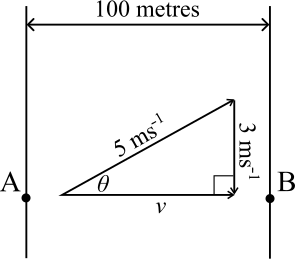
a.   
       

\(\sin \theta\) \(=\dfrac{3}{5}\)  
\(\theta\) \(=\sin^{-1}\Big(\dfrac{3}{5}\Big)=36.9^{\circ}\)  

 
The student must turn 36.9\(^{\circ}\) into the current as shown on the diagram.

 
b. 
   Using Pythagoras:

\(v=\sqrt{5^2-3^2}=4\ \text{ms}^{-1}\)

\(t=\dfrac{d}{s}=\dfrac{100}{4}=25\ \text{s}\)
 

\(\therefore\) It will take the student 25 seconds to travel from A to B.

Filed Under: Motion on a Plane Tagged With: Band 4, Band 5, smc-4274-10-Vector addition, smc-4274-50-Vector diagrams

PHYSICS, M1 EQ-Bank 9

A car is travelling north and approaching an intersection at 50 kmh\(^{-1}\).

While maintaining a constant speed, the car turns left and continues east at 50 kmh\(^{-1}\). 

Using a vector diagram, calculate the change in velocity of the car.   (3 marks)

--- 7 WORK AREA LINES (style=lined) ---

Show Answers Only

\(\text{70.7 kmh}^{-1}, \text{S45°E} \)

Show Worked Solution

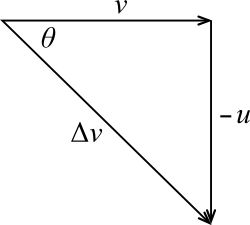
\(v= 50\ \text{kmh}^{-1}\ \text{east},\ \ u= 50\ \text{kmh}^{-1}\ \text{north.}\)

\(\Delta v= v-u = v+(-u),\ \ \text{where}\ -u= 50\ \text{kmh}^{-1}\ \text{south}\)
  

\(\Delta v=\sqrt{50^2 + 50^2}=\sqrt{5000}=70.7\ \text{kmh}^{-1}\)

\(\tan \theta \) \(=\dfrac{50}{50}\)  
\(\theta\) \(=\tan^{-1}\Big(\dfrac{50}{50}\Big)=45^{\circ}\)  


Change in velocity of the car = 70.7 \(\text{kmh}^{-1}\), S45\(^{\circ}\)E.

Filed Under: Motion on a Plane Tagged With: Band 4, smc-4274-10-Vector addition, smc-4274-50-Vector diagrams

PHYSICS, M1 EQ-Bank 7

Below is a description of the motion of a runner. The motion can be divided into three stages.

Stage 1: Runner travels 120 metres south taking 20 seconds.

Stage 2: Runner turns west and travels at 5 ms\(^{-1}\) for half a minute.

Stage 3: Runner travels directly back to their starting position.

  1. Determine the distance that the runner ran during Stage 2 of their journey.   (1 mark)

    --- 2 WORK AREA LINES (style=blank) ---

  2. Find the displacement of the start point from the runner Stage 2 is completed.   (3 marks)

    --- 6 WORK AREA LINES (style=blank) ---

Show Answers Only

a.    \(\text{150 m}\)

b.    \(\text{192.1 m, N51.3°E.}\)

Show Worked Solution

a.   \(d=v \times t=5 \times 30=150\ \text{m}\)
 

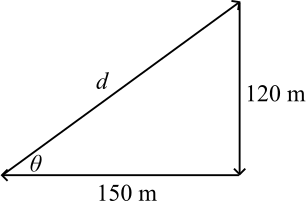
b.    Stage 1 and Stage 2 displacement diagram:
 

Using Pythagoras:

\(d=\sqrt{150^2 + 120^2}=\sqrt{36900}=192.1\ \text{m}\)
 

\(\tan\,\theta\) \(=\dfrac{120}{150} \)  
\(\theta\) \(=\tan^{-1}\Big(\dfrac{120}{150}\Big)=38.7^{\circ}\)  

 
\(\therefore\) Displacement of the start point from the runner is 192.1 m, N51.3°E.

Filed Under: Motion on a Plane Tagged With: Band 3, Band 5, smc-4274-15-Vector analysis, smc-4274-50-Vector diagrams

PHYSICS, M1 EQ-Bank 6

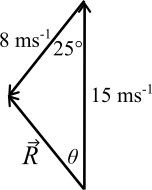
A boat is being rowed due north at a constant speed of 15 ms\(^{-1}\) when it encounters a current of 8 ms\(^{-1}\) going in the direction of S25°W.

Using vectors, determine the resultant velocity of the boat.   (3 marks)

--- 8 WORK AREA LINES (style=lined) ---

Show Answers Only

\(\overset{\rightarrow}R=8.455\ \text{ms}^{-1}\ \text{N}23.6^{\circ}\text{W}\)

Show Worked Solution

  • Using the cosine rule, the magnitude of \(\overset{\rightarrow}R\) is:
  •    \(\overset{\rightarrow}R=\sqrt{15^2+8^2-2 \times 15 \times 8 \times \cos25°}=8.455\ \text{ms}^{-1}\)
  • Using the sine rule, the direction of \(\overset{\rightarrow}R\) is:
\(\dfrac{\sin\theta}{8}\) \(=\dfrac{\sin25°}{8.455}\)  
\(\sin\theta\) \(=\dfrac{8\sin25°}{8.455}\)  
\(\theta\) \(=\sin^{-1}\Big{(}\dfrac{8\sin25°}{8.455}\Big{)}=23.6^{\circ}\)  

 
\(\therefore \overset{\rightarrow}R =8.455\ \text{ms}^{-1}\ \text{N}23.6^{\circ}\text{W}\)

Filed Under: Motion on a Plane Tagged With: Band 5, smc-4274-10-Vector addition, smc-4274-50-Vector diagrams

PHYSICS, M1 EQ-Bank 5

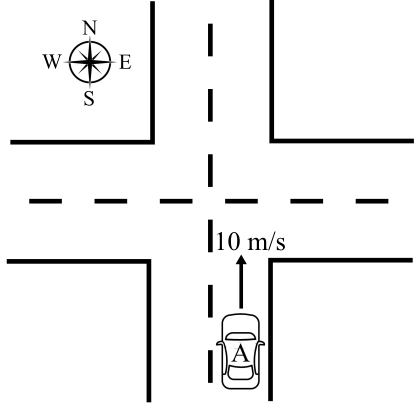
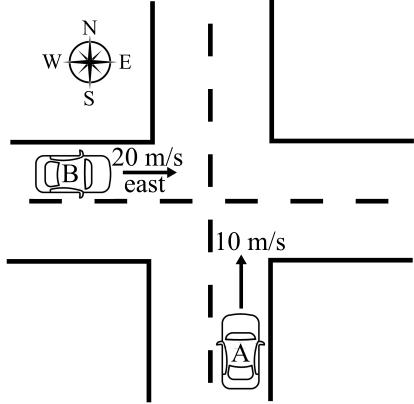
Car A approaches an intersection at 10 ms\(^{-1}\) from the South as shown. As Car B approaches the intersection, it measures the velocity of Car A to be 22.36 ms\(^{-1}\) NW.
 

Draw Car B on the diagram showing its direction and speed. Show all working.   (3 marks)

--- 8 WORK AREA LINES (style=lined) ---

Show Answers Only

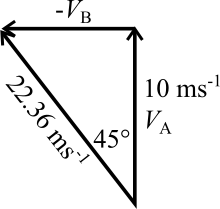
  • Velocity of A relative to B = \(v_A-v_B=v_A+-v_B\)

  • The direction of \(-v_B\) must be west, and therefore the direction of \(v_B\) is east.
  • Using Pythagoras theorem, the magnitude of \(-v_B\) is:
\(-v_B\) \(=\sqrt{22.36^2-10^2}\)  
  \(=20\ \text{ms}^{-1}\)  


  • Therefore the vector \(v_B\) is \(20\ \text{ms}^{-1}\) east.

Show Worked Solution

  • Velocity of A relative to B = \(v_A-v_B=v_A+-v_B\)

  • The direction of \(-v_B\) must be west, and therefore the direction of \(v_B\) is east.
  • Using Pythagoras theorem, the magnitude of \(-v_B\) is:
  •    \(-v_B=\sqrt{22.36^2-10^2}=20\ \text{ms}^{-1}\)
  • Thus the vector \(v_B\) is \(20\ \text{ms}^{-1}\) east.

Filed Under: Motion on a Plane Tagged With: Band 6, smc-4274-40-Relative motion, smc-4274-50-Vector diagrams

PHYSICS, M1 EQ-Bank 4

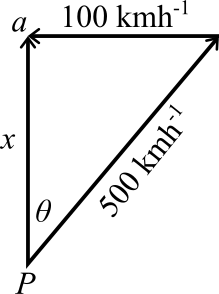
A plane that can fly at 500 kmh\(^{-1}\) with no wind, encounters a strong cross wind of 100 kmh\(^{-1}\) from the east. The plane needs to travel directly north to an airstrip

  1. Calculate the angle, correct to one decimal place, at which the pilot should steer for the plane to fly directly to the airstrip?   (3 marks)

    --- 6 WORK AREA LINES (style=lined) ---

  2. If the airstrip is 100 km from the planes current position, how long, to the nearest minute, will it take for the plane to complete the journey?   (2 marks)
  3. --- 4 WORK AREA LINES (style=lined) ---

Show Answers Only

a.    \(\text{N11.5°E}\)

b.    \(\text{12 minutes}\)

Show Worked Solution

a.    
       

\(\sin\theta\) \(=\dfrac{100}{500}\)  
\(\theta\) \(=\sin^{-1}\Big{(}\dfrac{100}{500}\Big{)}\)  
  \(=11.5^{\circ}\)  

 
\(\text{Plane direction should be N11.5°E}\)
 

b.    \(\text{Using the diagram in part (i):}\)

\(\tan(11.5°)\) \(=\dfrac{100}{x}\)  
\(x\) \(=\dfrac{100}{\tan(11.5°)}\)  
  \(=491.5\ \text{kmh}^{-1}\)  


\(t\) \(=\dfrac{\text{distance}}{\text{speed}}\)  
  \(=\dfrac{100}{491.5}\)  
  \(=0.203\ \text{h}\)  
  \(=12\ \text{m (nearest minute)}\)  

Filed Under: Motion on a Plane Tagged With: Band 4, Band 5, smc-4274-40-Relative motion, smc-4274-50-Vector diagrams

Copyright © 2014–2025 SmarterEd.com.au · Log in