SmarterEd

Aussie Maths & Science Teachers: Save your time with SmarterEd

  • Login
  • Get Help
  • About

PHYSICS, M2 EQ-Bank 5

Liam is carrying two boxes stacked on top of each other to a customer. The lighter 2.8 kg box is placed on top of the heavier 4.2 kg box.

Liam lifts the stack by applying an upward force of 40 N with each hand to the bottom of the heavier box, as shown below.
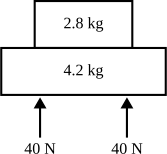
 

  1. Calculate the magnitude of the acceleration of the boxes as Liam lifts them.   (2 marks)

--- 4 WORK AREA LINES (style=lined) ---

  1. Explain why the force that the 4.2 kg box applies to the 2.8 kg box is greater while the boxes are being accelerated than when they are stationary.   (2 marks)

--- 5 WORK AREA LINES (style=lined) ---
Show Answers Only

a.    \(1.63\ \text{ms}^{-2}\)

b.    When the boxes are at rest:

  • The force that the 4.2 kg box applies to the 2.8 kg box is equal and opposite weight force of the 2.8 kg box.

When the boxes are accelerating:

  • The net force of the system is positive as the system is accelerating.
  • The 4.2 kg box must be applying extra force to the 2.8 kg box to cause it to accelerate at 1.63 ms\(^{-2}\).
Show Worked Solution
a.     \(F_{\text{net}}\) \(=\) total applied force upwards \(-\) weight force of the two boxes
    \(= (2 \times 40)-(7 \times 9.8)\)
    \(=11.4\ \text{N}\)

 
\(a=\dfrac{F_{\text{net}}}{m}=\dfrac{11.4}{7.0}=1.63\ \text{ms}^{-2}\)
  

b.    When the boxes are at rest:

  • The force that the 4.2 kg box applies to the 2.8 kg box is equal and opposite weight force of the 2.8 kg box.

When the boxes are accelerating:

  • The net force of the system is positive as the system is accelerating.
  • The 4.2 kg box must be applying extra force to the 2.8 kg box to cause it to accelerate at 1.63 ms\(^{-2}\).

Filed Under: Forces, Acceleration and Energy Tagged With: Band 4, Band 5, smc-4276-30-Gravity, smc-4276-50-F=ma

PHYSICS, M2 EQ-Bank 10 MC

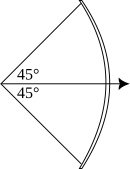
An archer pulls back the string of a bow so that it makes an angle of 45° with the arrow. At this moment, the tension in the string is 100 N.


If the archer releases a 0.2 kg arrow from this position, what would be the arrow’s initial acceleration? (Assume no friction or air resistance.)

  1. \(250\ \text{ms}^{-2}\)
  2. \(354\ \text{ms}^{-2}\)
  3. \(500\ \text{ms}^{-2}\)
  4. \(707\ \text{ms}^{-2}\)
Show Answers Only

\(D\)

Show Worked Solution
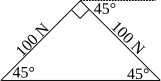
  • A force diagram for the situation can be drawn as seen below:
     
  •    
  • The resulting diagram is a right-angled triangle.
  • The net force \(F_{\text{net}}\) can be calculated by Pythagoras:
  •    \(F_{\text{net}} = \sqrt{100^2+100^2} = 141.4\ \text{N}\).
  •    \(a=\dfrac{F_{\text{net}}}{m} = \dfrac{141.4}{0.2} = 707\ \text{N}\).

\(\Rightarrow D\)

Filed Under: Forces, Acceleration and Energy Tagged With: Band 4, smc-4276-50-F=ma

PHYSICS, M2 EQ-Bank 3

A horizontal Atwood machine begins accelerating from rest along a horizontal track of length, \(L=4.00\ \text{m}\).

A block with a mass of 500 g takes 2.7 seconds to travel the full length of the track. A constant frictional force acts on the block, described by the equation \(F_f = \mu_k mg\)
  

  1. Determine the coefficient of kinetic friction between the 500 g block and the track.   (4 marks)

--- 8 WORK AREA LINES (style=lined) ---

  1. Find the kinetic energy of the 500 g block when it reaches the end of the track.   (2 marks)

--- 4 WORK AREA LINES (style=lined) ---

Show Answers Only

a.    \(0.154\)

b.    \(2.194\ \text{J}\)

Show Worked Solution

a.     Find system acceleration using  \(s=ut + \dfrac{1}{2}at^2\):

\(s\) \(=ut +\dfrac{1}{2}at^2\)  
\(4.00\) \(=0 + \dfrac{1}{2} \times a \times 2.7^2\)  
\(a\) \(=\dfrac{2 \times 4.00}{2.7^2}=1.097\ \text{ms}^{-2}\)  

 
\(\therefore\) Total system mass \((m_T)\) = 500 + 150=650\ \text{g} = 0.65\ \text{kg} \)
 

Find frictional force acting on the block:

\(F_{\text{net}}\) \(=F_{\text{applied}}-F_f\)  
\(0.65 \times 1.097\) \(= 0.15 \times 9.8-F_f\)  
\(F_f\) \(=1.47-0.713=0.757\ \text{N}\)  

 
\(\therefore \mu_k = \dfrac{F_f}{mg} = \dfrac{0.757}{9.8 \times 0.5} = 0.154\)
  

b.    Using  \(v^2=u^2 +2as:\)

\(v^2=u^2+2as = 0^2+2 \times 1.097 \times 4.00 = 8.776\ \text{ms}^{-1}\)

\(KE = \dfrac{1}{2}mv^2 = \dfrac{1}{2} \times 0.5 \times 8.776 = 2.194\ \text{J}\)

Filed Under: Forces, Acceleration and Energy Tagged With: Band 4, Band 6, smc-4276-20-Friction, smc-4276-30-Gravity, smc-4276-50-F=ma, smc-4276-60-Kinetic Energy

PHYSICS, M2 EQ-Bank 2

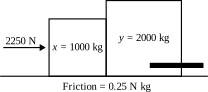
Consider the information in the diagram below.
  
  1. Calculate the acceleration of the blocks as a result of the applied forces acting on them.   (2 marks)

--- 5 WORK AREA LINES (style=lined) ---
  1. What forces does block \(Y\) apply to block \(X\).   (2 marks)

--- 4 WORK AREA LINES (style=lined) ---
Show Answers Only

a.    \(0.5\ \text{ms}^{-2}\)

b.    \(1500\ \text{N}\)

Show Worked Solution

a.    Total system mass \(= 1000 + 2000 = 3000\ \text{kg}\)

Applied force on system \(= 2250\ \text{N}\)

Frictional force on system \(= 0.25 \times 3000 = 750\ \text{N}\)

Net force \(=\) the applied force \(-\) the frictional force \(=2250-750 =1500\ \text{N}\)

Find acceleration using \(F_{\text{net}}= ma\):

\(a=\dfrac{F_{\text{net}}}{m} =\dfrac{1500}{3000} = 0.5\ \text{ms}^{-2}\)


b.    Net force on \(X = ma = 1000 \times 0.5 = 500\ \text{N}\) 

Net force on \(X\)  \(=\)  applied force on \(X -\) force of \(Y\) on \(X -\) the frictional force on \(X\).  
\(500\) \(=2250-F_{Y → X}-(1000 \times 0.25)\)  
\(F_{Y → X}\) \(=2250-500-250=1500\ \text{N}\)  

Filed Under: Forces, Acceleration and Energy Tagged With: Band 4, Band 5, smc-4276-20-Friction, smc-4276-50-F=ma

PHYSICS, M2 EQ-Bank 4 MC

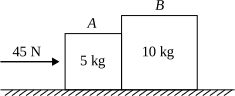
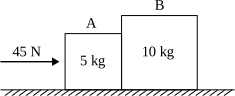
Two blocks, \(A\) and \(B\), are in contact on a horizontal frictionless surface. A 45 \(\text{N}\) constant force is applied to Block \(A\) as shown.
  

What is the magnitude of the force of Block \(B\) on Block \(A\)?

  1. \(0\ \text{N}\)
  2. \(15\ \text{N}\)
  3. \(30\ \text{N}\)
  4. \(45\ \text{N}\)
Show Answers Only

\(C\)

Show Worked Solution
  • Since both blocks are on a frictionless surface and are in contact, they will move together with the same acceleration.
  • Total mass of system \((m_T) = 5 + 10 = 15\ \text{kg}\)
  • Acceleration \(a\) of system \(=\dfrac{F}{m_T} = \dfrac{45}{15} = 3\ \text{ms}^{-2}\)
  • Block \(A\) has a mass of \(5\ \text{kg}\) and is accelerating at \(3\ \text{ms}^{-2}\).
  • It has two horizontal forces acting upon it, the \(45\ \text{N}\) force forwards and the contact force from Block \(B\) pushing back on it \((F_{B → A})\). These forces must sum to the net force acting on Block \(A\).
\(45-F_{B → A}\) \(=5 \times 3\)  
\(F_{B → A}\) \(=45-15=30\ \text{N}\)  

 
\(\Rightarrow C\)

Filed Under: Forces, Acceleration and Energy Tagged With: Band 5, smc-4276-50-F=ma

PHYSICS, M2 EQ-Bank 3 MC

A cyclist is moving with a velocity of \(u\) m/s and comes to a complete stop over a distance of \(s\) meters.

If the cyclist’s initial speed was increased to four times the original speed, what would be the new stopping distance (in metres), assuming the braking force remains the same?

  1. \(2s\)
  2. \(4s\)
  3. \(16s\)
  4. \(\dfrac{1}{4}s\)
Show Answers Only

\(C\)

Show Worked Solution
  • Stopping force remains the same  \(\Rightarrow\)  deceleration remains the same \((F=ma)\).
\(v^2\) \(=u^2 + 2as\)  
\(0\) \(=u^2-2as\)  (acceleration is negative)  
\(s\) \(=\dfrac{u^2}{2a}\)  
     
  •  Given \(u \Rightarrow 4u :\)
  • \(s_{\text{new}} =\dfrac{(4u)^2}{2a}=\dfrac{16u^2}{2a}=16 \times \dfrac{u^2}{2a}=16s\)

\(\Rightarrow C\)

Filed Under: Forces, Acceleration and Energy Tagged With: Band 5, smc-4276-50-F=ma

PHYSICS, M2 EQ-Bank 2 MC

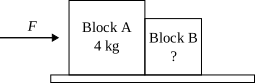
In a laboratory experiment, students are examining the motion of two blocks, Block \(A\) and Block \(B\). A force of 30 N is applied to move the blocks, while the floor exerts a frictional force of 6 N opposing their motion. Measurements show that both blocks accelerate at a rate of 4 m/s\(^{2}\).
  

What is the mass of Block \(B\)?

  1. \(1\ \text{kg}\)
  2. \(2\ \text{kg}\)
  3. \(3\ \text{kg}\)
  4. \(4\ \text{kg}\)
Show Answers Only

\(B\)

Show Worked Solution
  • Net force on system: \(F_{\text{net}}= 30-6=24\ \text{N}\)
  • The total mass of the system can be calculated using \(F_{\text{net}}=ma\):
  •    \(m=\dfrac{F_{\text{net}}}{a}=\dfrac{24}{4}=6\ \text{kg}\)
  • Mass of Block \(B = 6-4=2\) kg

\(\Rightarrow B\)

Filed Under: Forces, Acceleration and Energy Tagged With: Band 5, smc-4276-50-F=ma

PHYSICS, M2 2023 VCE 8 MC

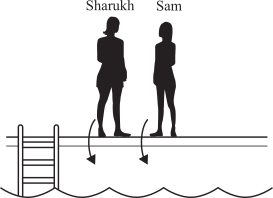
At a swimming pool, Sharukh and Sam, shown below, step off the low diving board at the same time. Over the small distance they fall, air resistance may be ignored. Sharukh and Sam have masses of 80 kg and 60 kg respectively.
 

Which one of the following best explains what happens to Sharukh and Sam as they drop straight down into the water?

  1. Sharukh reaches the surface first because she has a larger mass.
  2. The net force on Sharukh is larger than that on Sam, so Sharukh reaches the surface first.
  3. They both reach the surface together because they both experience the same downward force.
  4. They both reach the surface together because they both experience the same downward acceleration.
Show Answers Only

\(D\)

Show Worked Solution
  • Both Sharukh and Sam fall under the acceleration of gravity which is 9.8 ms\(^{-2}\).
  • They will fall at the same speed and therefore hit the surface at the same time.

\(\Rightarrow D\)

Filed Under: Forces, Acceleration and Energy Tagged With: Band 4, smc-4276-30-Gravity, smc-4276-50-F=ma

PHYSICS, M2 2017 VCE 7 MC

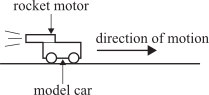
A model car of mass 2.0 kg is propelled from rest by a rocket motor that applies a constant horizontal force of 4.0 N, as shown below. Assume that friction is negligible.
 

Which one of the following best gives the magnitude of the acceleration of the model car?

  1. \(0.50 \text{ m s} ^{-2}\)
  2. \(1.0 \text{ m s}^{-2}\)
  3. \(2.0 \text{ m s} ^{-2}\)
  4. \( 4.0\text{ m s} ^{-2}\)
Show Answers Only

\(C\)

Show Worked Solution

\(a=\dfrac{F}{m}=\dfrac{4.0}{2.0}=2\ \text{ms}^{-2}\) 

\(\Rightarrow C\)

Filed Under: Forces, Acceleration and Energy Tagged With: Band 2, smc-4276-50-F=ma

PHYSICS, M2 2018 VCE 6 MC

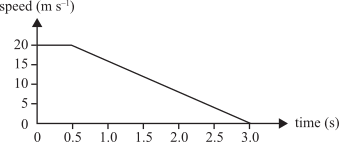
Lisa is driving a car of mass 1000 kg at 20 ms\( ^{-1}\) when she sees a dog in the middle of the road ahead of her. She takes 0.50 s to react and then brakes to a stop with a constant braking force. Her speed is shown in the graph below. Lisa stops before she hits the dog.
 

Which one of the following is closest to the magnitude of the braking force acting on Lisa's car during her braking time?

  1. \(6.7 \text{ N}\)
  2. \(6.7 \text{ kN}\)
  3. \(8.0 \text{ kN}\)
  4. \(20.0 \text{ kN}\)
Show Answers Only

\(C\)

Show Worked Solution
  • The deceleration of the car from \(0.5\ \text{s}\) to \(3.0\ \text{s}\) is:
  •    \(a=\dfrac{\Delta v}{\Delta t}= \dfrac{20}{2.5}=8\ \text{ms}^{-2}\) 
  • Thus the braking force on the car can be calculated:
  •    \(F = ma = 1000 \times 8 = 8000\ \text{N} = 8.0\ \text{kN} \)

\(\Rightarrow C\)

Filed Under: Forces, Acceleration and Energy Tagged With: Band 4, smc-4276-50-F=ma

Copyright © 2014–2025 SmarterEd.com.au · Log in