SmarterEd

Aussie Maths & Science Teachers: Save your time with SmarterEd

  • Login
  • Get Help
  • About

PHYSICS, M2 EQ-Bank 3

The diagram below shows a top view of two objects moving across a frictionless surface. Object \(X\) has a mass of 3.5 kg, and object \(Y\) has a mass of 2.5 kg. Their initial velocities are indicated in the diagram.


The two objects collide and stick together after the collision.

  1. Calculate the velocity of the combined mass after the collision.   (4 marks)

--- 8 WORK AREA LINES (style=lined) ---

  1. Determine the amount of kinetic energy lost due to the collision.   (2 marks)

--- 4 WORK AREA LINES (style=lined) ---

Show Answers Only

a.    \(2.91\ \text{ms}^{-1}, \ \text{S}57.8^{\circ}\text{E}\).

b.    \(16.21\ \text{J}\).

Show Worked Solution

a.    The momentum of each object can be seen in the diagrams below:
 

  • By letting east and south be the positive directions we can sum the vectors by their horizontal and vertical components:

\(p_h = 14\cos 60 + 8.25\cos 20 = 14.75\ \text{Ns}\)

\(p_v = 14\sin 60-8.25\sin 20 = 9.30\ \text{Ns}\)
 

  • The total momentum of the system after the collision can be represented in the diagram below:
     

\(p_T^2=9.30^2 + 14.75^2=\sqrt{304.0525} = 17.44\ \text{Ns}\)
 

  • Total mass of the system after the collision = 6 kg
  • The speed after the collision \(=\dfrac{p_T}{m} = \dfrac{17.44}{6} = 2.91\ \text{ms}^{-1}\).
\(\tan \theta \) \(=\dfrac{9.30}{14.75}\)  
\(\theta\) \(=\tan^{-1}\left(\dfrac{9.30}{14.75}\right)=32.2^{\circ}\)  

  
\(\therefore\) The velocity of the combined mass after the collision is \(2.91\ \text{ms}^{-1}\), \(\text{S}57.8^{\circ}\text{E}\).

 
b.    
The kinetic energy before the collision:

\(KE_i = \dfrac{1}{2} \times 3.5 \times 4^2 + \dfrac{1}{2} \times 2.5 \times 3.3^2 = 41.6125\ \text{J}\)

The kinetic energy after the collision:

\(KE_f = \dfrac{1}{2} \times 6 \times 2.91^2 = 25.4043\ \text{J}\)

\(\Delta KE = 25.4043-41.6125 = -16.21\ \text{J}\)

\(\therefore\) The kinetic energy lost in the collision was \(16.21\ \text{J}\).

Filed Under: Momentum, Energy and Simple Systems Tagged With: Band 4, Band 5, smc-4277-20-Momentum conservation, smc-4277-30-Energy conservation

PHYSICS, M2 EQ-Bank 4 MC

A white ice hockey puck of mass \(m\) with an initial speed \(u\) collides with a stationary black ice hockey puck also of mass \(m\). After the collision, the black puck moves off with speed \(v\).
 

The collision is elastic.

What is the speed of the white puck after the collision?

  1. \(0\)
  2. \(u\)
  3. \(v\)
  4. \(\dfrac{v}{2}\)
Show Answers Only

\(A\)

Show Worked Solution
  • Let the speed of the white puck after the collision be \(x\).
  • By the law of conservation of momentum: 
\(mu\) \(=mv + mx\)  
\(mu\) \(=m(v+x)\)  
\(u\) \(=v + x\ …\ (1)\)  
     
  •  As the collision is elastic, the kinetic energy of the system will be conserved during the collision:
\(\dfrac{1}{2}mu^2\) \(=\dfrac{1}{2}mv^2 + \dfrac{1}{2}mx^2\)  
\(\dfrac{1}{2}mu^2\) \(=\dfrac{1}{2}m(v^2 + u^2)\)  
\(u^2\) \(=v^2 + x^2\ …\ (2)\)  

  
Substitute equation (1) into equation (2):

\((v+x)^2\) \(=v^2+x^2\)  
\(v^2 +2vx +x^2\) \(=v^2 + x^2\)  
\(2vx\) \(=0\)  
     
  • The speed of the white puck after the collision \((x)\) must be \(0\) as \(v \neq 0\).

\(\Rightarrow A\)

Filed Under: Momentum, Energy and Simple Systems Tagged With: Band 6, smc-4277-20-Momentum conservation, smc-4277-30-Energy conservation, smc-4277-40-Elastic/inelastic collisions

PHYSICS, M2 2023 VCE 8

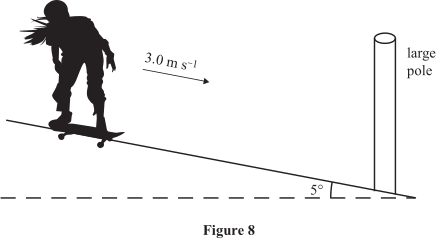
Maia is at a skatepark. She stands on her skateboard as it rolls in a straight line down a gentle slope at a constant speed of 3.0 m s\(^{-1}\), as shown in the figure below. The slope is 5° to the horizontal.

The combined mass of Maia and the skateboard is 65 kg.
  

  1. The combined system of Maia and the skateboard is modelled as a small box with point \(\text{M}\) at the centre of mass, as shown below.
  2. Draw and label arrows to represent each of the forces acting on the system - that is, Maia and skateboard as they roll down the slope.   (3 marks)


--- 0 WORK AREA LINES (style=lined) ---

  1. Calculate the magnitude of the total frictional forces acting on Maia and the skateboard.  (2 marks)

    --- 5 WORK AREA LINES (style=lined) ---

Near the bottom of the ramp, Maia takes hold of a large pole and comes to a complete rest while still standing on the skateboard. Maia and the skateboard now have no momentum or kinetic energy.

  1. Explain what happened to both the momentum and the kinetic energy of Maia and the skateboard. No calculations are required.  (2 marks)

    --- 3 WORK AREA LINES (style=lined) ---

Show Answers Only

a.
         

b.     55.5 N

c.    Momentum:

  • Maia and the skateboards momentum was transferred into the pole and hence into the Earth. Due to the Earth’s very large mass, the effect on its velocity is negligible.

Kinetic energy:

  • The kinetic energy of Maia and the skateboard would have been transformed into heat energy between the contact of Maia and the pole and/or transferred into the work done by Maia’s muscles in slowing herself down.

Show Worked Solution

a.
        

b.     Total frictional forces:

  • Constant speed means that the force down the slope of the incline is equal to the sum of the frictional forces acting on Maia and the skateboard.
\(F_{\text{down slope}}\) \(=F_f\) \(=mg\, \sin\, \theta\)
    \(=65 \times 9.8 \times \sin\,5^{\circ}\)
    \(=55.5\ \text{N}\)
♦ Mean mark (b) 50%.

c.    Momentum:

  • Maia and the skateboards momentum was transferred into the pole and hence into the Earth. Due to the Earth’s very large mass, the effect on its velocity is negligible.

Kinetic energy:

  • The kinetic energy of Maia and the skateboard would have been transformed into heat energy between the contact of Maia and the pole and/or transferred into the work done by Maia’s muscles in slowing herself down.
♦♦♦ Mean mark (c) 26%.

Filed Under: Forces, Acceleration and Energy, Momentum, Energy and Simple Systems Tagged With: Band 4, Band 5, Band 6, smc-4276-20-Friction, smc-4277-20-Momentum conservation, smc-4277-30-Energy conservation

PHYSICS, M2 2018 VCE 8-9 MC

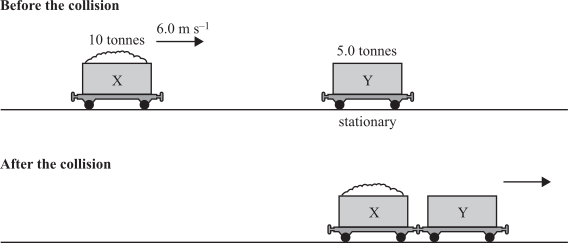
A railway truck \(\text{X}\) of mass 10 tonnes, moving at 6.0 m s\(^{-1}\), collides with a stationary railway truck \(\text{Y}\) of mass 5.0 tonnes. After the collision the trucks are joined together and move off as one. The situation is shown below.


Question 8

The final speed of the joined railway trucks after the collision is closest to

  1. \( 2.0 \text{ m s}^{-1}\)
  2. \( 3.0 \text{ m s} ^{-1}\)
  3. \( 4.0 \text{ m s} ^{-1}\)
  4. \( 6.0 \text{ m s} ^{-1}\)
     

Question 9

The collision of the railway trucks is best described as one where

  1. kinetic energy is conserved but momentum is not conserved.
  2. kinetic energy is not conserved but momentum is conserved.
  3. neither kinetic energy nor momentum is conserved.
  4. both kinetic energy and momentum are conserved.
Show Answers Only

\(\text{Question 8:}\ C\)

\(\text{Question 9:}\ B\)

Show Worked Solution

Question 8

  • By the law of conservation of momentum:
\(m_Xu_X+m_Yu_Y\) \(=m_Xv_X+m_Yv_Y\)  
  \(=v(m_X + m_Y)\ \ \ (v_X=v_Y) \)  
\(10\ 000 \times 6 +0\) \(= v(10\ 000 + 5000)\)  
\(60\ 000\) \(=15\ 000v\)  
\(v\) \(=4\ \text{ms}^{-1}\)   

 
\( \Rightarrow C\)
 

Question 9

  • By the law of conservation of momentum, momentum in the collision is conserved.
  • Kinetic energy conservation:
       \(KE_{\text{init}}\) \(=\dfrac{1}{2}m_Xu_X^2+\dfrac{1}{2}m_Yu_Y^2\)
   

\(=\dfrac{1}{2} \times 10\ 000 \times 6^2 + \dfrac{1}{2} \times 5000 \times 0^2\)

    \(=180\ 000\ \text{J}\)


\(KE_{\text{final}}\) \(=\dfrac{1}{2}(m_X+m_Y)v^2\)  
  \(=\dfrac{1}{2} \times 15\ 000 \times 4^2\)   
  \(=120\ 000\ \text{J}\)  

  
\(\therefore\) The kinetic energy of the system decreases after the collision and so is not conserved.

\(\Rightarrow B\)

Filed Under: Momentum, Energy and Simple Systems Tagged With: Band 3, Band 4, smc-4277-20-Momentum conservation, smc-4277-30-Energy conservation

PHYSICS, M2 2019 VCE 20 MC

As part of their Physics course, Anna, Bianca, Chris and Danshirou investigate the physics of car crashes. On an internet site that describes what happens during car crashes, they find the following statement.

"It happens in a flash: your car goes from driving to impacting ... As the vehicle crashes into something, it stops or slows very abruptly, and at the point of impact the car's structure will bend or break. That crumpling action works to absorb some of the initial crash forces, protecting the passenger compartment to some degree." 

The students disagree about the use of the word 'forces' in the statement, 'That crumpling action works to absorb some of the initial crash forces, protecting the passenger compartment to some degree',

Which one of the following students best identifies the physics of how the crumpling action protects the passengers?

A.   Anna '... to absorb some of the initial crash speed, protecting ...'
B. Bianca '... to absorb some of the initial crash kinetic energy, protecting ...'
C. Chris '... to absorb some of the initial crash momentum, protecting ...'
D. Danshirou '... to absorb some of the initial crash forces, protecting ...'
Show Answers Only

\(B\)

Show Worked Solution
  • It is the kinetic energy of the car which is transferred as the car hits the wall.
  • Part of the car’s kinetic energy goes into crumpling the front of the vehicle to protect the driver.

\(\Rightarrow B\) 

♦♦ Mean mark 36%.

Filed Under: Momentum, Energy and Simple Systems Tagged With: Band 5, smc-4277-30-Energy conservation

PHYSICS, M2 2017 HSC 29a

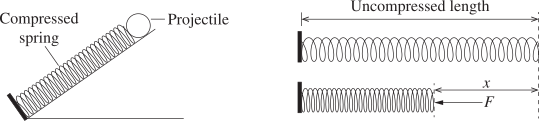
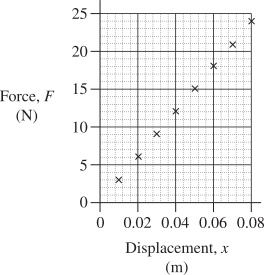
A spring is used to construct a device to launch a projectile. The force `(F)` required to compress the spring is measured as a function of the displacement `(x)` by which the spring is compressed.
 

The potential energy stored in the compressed spring can be calculated from  `E_p=(1)/(2) kx^(2)`, where `k` is the gradient of the force-displacement graph shown.
 

A projectile of mass 0.04 kg is launched using this device with the spring compressed by 0.08 m. Calculate the launch velocity.   (4 marks)

--- 12 WORK AREA LINES (style=lined) ---

Show Answers Only

\(v=6.9\) ms\(^{-1}\)

Show Worked Solution
\(k\)  \(=\) \(\text{gradient}\)  
  \(=\dfrac{24-6}{0.08-0.02}\)  
  \(=300\)  


Finding the potential energy stored in the compressed spring:

\(E_p=\dfrac{1}{2}kx^2=\dfrac{1}{2} \times 300 \times 0.08^2=0.96\) \(\text{J}\)
 

As this potential energy is converted into kinetic energy when the projectile is launched:

\(E_k\) \(=0.96\) \(\text{J}\)  
\(\dfrac{1}{2}mv^2\) \(=0.96\)  
\(v^2\) \(=\dfrac{2 \times 0.96}{0.04}\)  
\(v\) \(=6.9\) ms\(^{-1}\)  

Filed Under: Momentum, Energy and Simple Systems Tagged With: Band 5, smc-4277-30-Energy conservation

Copyright © 2014–2025 SmarterEd.com.au · Log in