SmarterEd

Aussie Maths & Science Teachers: Save your time with SmarterEd

  • Login
  • Get Help
  • About

PHYSICS, M2 EQ-Bank 5

Two identical 1200 kg cars travelling at 72 kmh\(^{-1}\) in opposite directions collide head-on and then rebound with exactly half of their original speeds.

  1. Is this collision elastic or inelastic? Give your reasons.   (2 marks)

--- 4 WORK AREA LINES (style=lined) ---

  1. Given that the cars were in contact with each other for a total of 0.5 seconds, calculate the average force that acts on each car whilst they are in contact.   (2 marks)

--- 4 WORK AREA LINES (style=lined) ---
Show Answers Only

a.    A collision will be elastic if kinetic energy is conserved in the reaction.

  \(KE_i = \dfrac{1}{2} \times 1200 \times 20^2 + \dfrac{1}{2} \times 1200 \times 20^2 = 480\ \text{kJ}\)

  \(KE_f = \dfrac{1}{2} \times 1200 \times 10^2 + \dfrac{1}{2} \times 1200 \times 10^2 = 120\ \text{kJ}\)

  • As kinetic energy is not conserved in the collision, the collision is inelastic.
     

b.    There is 72 kN acting on each car in the direction of their change in motion.

Show Worked Solution

a.    A collision will be elastic if kinetic energy is conserved in the reaction.

  \(KE_i = \dfrac{1}{2} \times 1200 \times 20^2 + \dfrac{1}{2} \times 1200 \times 20^2 = 480\ \text{kJ}\)

  \(KE_f = \dfrac{1}{2} \times 1200 \times 10^2 + \dfrac{1}{2} \times 1200 \times 10^2 = 120\ \text{kJ}\)

  • As kinetic energy is not conserved in the collision, the collision is inelastic.
     

b.    Using the impulse equation, \(I= \Delta p = F \Delta t\):

\(F\) \(=\dfrac{\Delta p}{\Delta t}\)  
  \(=\dfrac{m \Delta v}{\Delta t}\)  
  \(=\dfrac{1200 \times (10-(-20))}{0.5}\)  
  \(=-72\,000\ \text{N}\)  
     
  • There is 72 kN acting on each car in the direction of their change in motion.

Filed Under: Momentum, Energy and Simple Systems Tagged With: Band 4, Band 5, smc-4277-40-Elastic/inelastic collisions, smc-4277-50-Impulse

PHYSICS, M2 EQ-Bank 4

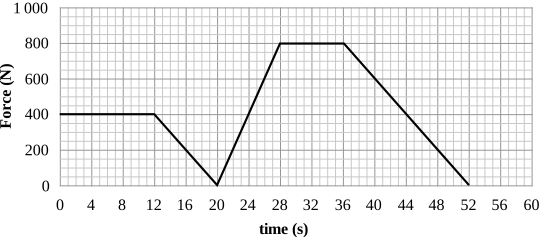
The graph below represents the net force applied to a 1600 kg vehicle.
 

  1. Calculate the total impulse exerted on the vehicle over the 52 second interval.   (2 marks)

--- 4 WORK AREA LINES (style=lined) ---
  1. If the vehicle begins at rest, determine its speed at the end of the 52 seconds.   (2 marks)

--- 4 WORK AREA LINES (style=lined) ---
Show Answers Only

a.    The total impulse exerted on the vehicle is \(22\,400\ \text{Ns}\).

b.    The final speed of the vehicle is \(14\ \text{ms}^{-1}\).

Show Worked Solution

a.    Total impulse is given by the area under the force-time graph:

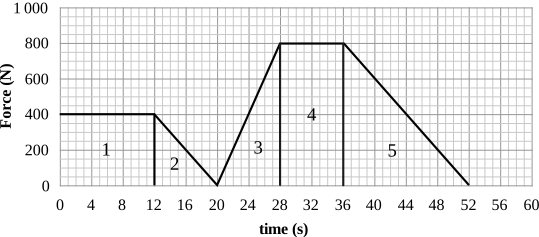
The area under the graph can be split up as seen below:
 

  \(\text{Area 1}\ =400 \times 12 = 4800\ \text{Ns}\).

  \(\text{Area 2}\ = \dfrac{1}{2} \times 400 \times 8 = 1600\ \text{Ns}\)

  \(\text{Area 3}\ = \dfrac{1}{2} \times 800 \times 8 = 3200\ \text{Ns}\)

  \(\text{Area 4}\ = 800 \times 8 = 6400\ \text{Ns}\)

  \(\text{Area 5}\ = \dfrac{1}{2} \times 800 \times 16 = 6400\ \text{Ns}\)

\(\therefore\) The total impulse exerted on the vehicle is \(22\,400\ \text{Ns}\).


b.     \(I\) \(=\Delta p\)
  \(I\) \(=mv-mu\)
  \(22\,400\) \(=1600v-1600 \times 0\)
  \(v\) \(=\dfrac{22\,400}{1600}\)
    \(=14\ \text{ms}^{-1}\)

 
\(\therefore\) The final speed of the vehicle is \(14\ \text{ms}^{-1}\).

Filed Under: Momentum, Energy and Simple Systems Tagged With: Band 3, Band 4, smc-4277-50-Impulse, smc-4277-60-Force-time graphs

PHYSICS, M2 EQ-Bank 5 MC

A stationary tennis ball of mass 0.058 kg experiences a net force of 4800 \(\text{N}\) for a time of \(4.2 \times 10^{-4}\ \text{s}\).

What is the magnitude of the impulse on the tennis ball?

  1. \(2.02\ \text{kg m s}^{-1}\)
  2. \(0.0244\ \text{kg m s}^{-1}\)
  3. \(0.000122\ \text{kg m s}^{-1}\)
  4. \(11.4\ \text{kg m s}^{-1}\)
Show Answers Only

\(A\)

Show Worked Solution

\(I = \Delta p = F_{\text{net}} \Delta t\)

\(I = 4800 \times 4.2 \times 10^{-4} = 2.02\ \text{kg m s}^{-1}\)

\(\Rightarrow A\)

Filed Under: Momentum, Energy and Simple Systems Tagged With: Band 3, smc-4277-50-Impulse

PHYSICS, M2 EQ-Bank 2

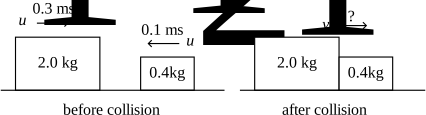
A 2.00 kg block is moving right at 0.30 m/s. A second 0.40 kg block is moving in the opposite direction at 0.10 m/s, resulting in a collision.

After the collision, both blocks stick together and move to the right.
 

  1. Calculate the speed of the two blocks after the collision.   (2 marks)

--- 5 WORK AREA LINES (style=lined) ---

  1. Determine the impulse that the smaller block applies to the larger block.   (2 marks)

--- 5 WORK AREA LINES (style=lined) ---

Show Answers Only

a.    \(0.233\ \text{ms}^{-1}\)

b.    \(0.134\ \text{kg m s}^{-1}\) to the left.

Show Worked Solution

a.    Using the conservation of energy:

\(m_1u_1 + m_2u_2\) \(=v(m_1 + m_2)\)  
\(2 \times 0.3 + 0.4 \times -0.1\) \(=v \times (2 + 0.4)\)  
\(2.4v\) \(=0.56\)  
\(v\) \(=0.233\ \text{ms}^{-1}\)  


b.   Impulse can be calculated using: \(I = \Delta p = m_1v-m_1u_1\):

  •    \(I =2 \times 0.233- \times 0.3 = -0.134\ \text{kgms}^{-1}\)
  • The smaller block applies an impulse of \(0.134\ \text{kg m s}^{-1}\) on the larger block to the left.

Filed Under: Momentum, Energy and Simple Systems Tagged With: Band 4, smc-4277-20-Momentum conservation, smc-4277-50-Impulse

PHYSICS, M2 EQ-Bank 1

Jordan is trying to push a heavy filing cabinet across the office floor, but it’s not budging. The cabinet has been used by physics students, and someone has stuck a post-it note on it with a “reminder” that reads:

“According to Newton’s third law, the cabinet pushes back with the same force you apply — so you’ll never move it!”

Jordan sighs and tries harder. Another note on the cabinet reads:

“Don’t bother! The law of conservation of momentum says that if the cabinet is at rest, its momentum must stay at zero forever.”

Identify and explain the two misunderstandings about Newton’s third law and the law of conservation of momentum. Use correct physics principles to explain how Jordan can, in fact, move the filing cabinet.    (5 marks)

--- 16 WORK AREA LINES (style=lined) ---

Show Answers Only

Newton’s third law misconception:

  • Newton’s third law states that every action has an equal and opposite reaction, but these force pairs act on different objects.
  • Jordan pushes the cabinet, and the cabinet pushes back on him with equal force. These forces do not cancel because they act on separate objects.
  • The motion of the cabinet depends on the net force acting on it, according to Newton’s second law:  \(F_{\text{net}} = ma\).

 Conservation of momentum misconception:

  • Momentum is conserved only in a closed system with no external net forces.
  • Since Jordan exerts an external force on the cabinet and the floor provides friction, the cabinet is not a closed system.
  • Therefore, momentum conservation does not prevent Jordan from moving the cabinet.

 How Jordan can move the cabinet:

  • By bracing his feet, Jordan increases backward friction against the floor, allowing him to exert a greater forward force.
  • If this force exceeds static friction, the cabinet accelerates and its momentum changes:  \(\Delta p = F \Delta t\).
Show Worked Solution

Newton’s third law misconception:

  • Newton’s third law states that every action has an equal and opposite reaction, but these force pairs act on different objects.
  • Jordan pushes the cabinet, and the cabinet pushes back on him with equal force. These forces do not cancel because they act on separate objects.
  • The motion of the cabinet depends on the net force acting on it, according to Newton’s second law:  \(F_{\text{net}} = ma\).

 Conservation of momentum misconception:

  • Momentum is conserved only in a closed system with no external net forces.
  • Since Jordan exerts an external force on the cabinet and the floor provides friction, the cabinet is not a closed system.
  • Therefore, momentum conservation does not prevent Jordan from moving the cabinet.

 How Jordan can move the cabinet:

  • By bracing his feet, Jordan increases backward friction against the floor, allowing him to exert a greater forward force.
  • If this force exceeds static friction, the cabinet accelerates and its momentum changes:  \(\Delta p = F \Delta t\).

Filed Under: Momentum, Energy and Simple Systems Tagged With: Band 4, Band 5, Band 6, smc-4277-20-Momentum conservation, smc-4277-25-Newton's 2nd Law, smc-4277-50-Impulse

PHYSICS, M2 EQ-Bank 1 MC

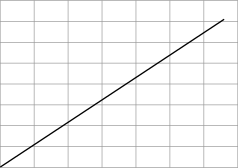
The graph displays how a car’s momentum changes over time as it accelerates.
 

What physical quantity is represented by the gradient of the momentum–time graph?

  1. Force
  2. Impulse
  3. Velocity
  4. Acceleration
Show Answers Only

\(A\)

Show Worked Solution
  • The change in momentum is given by the formula, \(\Delta p = F \Delta t\).
  • The equation can be rearranged to \(F=\dfrac{\Delta p}{\Delta t}\) and this is also the gradient of the graph above.
  • Therefore the gradient represents the force applied to the car.

\(\Rightarrow A\)

Filed Under: Momentum, Energy and Simple Systems Tagged With: Band 4, smc-4277-50-Impulse

PHYSICS, M2 2023 VCE 4 MC

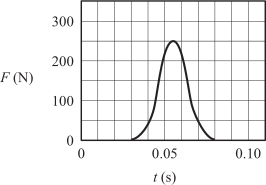
The diagram below shows the force versus time graph of the force on a tennis ball when it is hit by a tennis racquet. The tennis ball is stationary when the tennis racquet first comes into contact with the ball.
 

Which one of the following is closest to the impulse experienced by the tennis ball as it is hit by the tennis racquet?

  1. \(0.50 \text{ N s}\)
  2. \(5.0 \text{ N s}\)
  3. \(10 \text{ N s}\)
  4. \(50 \text{ N s}\)
Show Answers Only

\(B\)

Show Worked Solution
  • The impulse is equal to the area under the curve \((I=Ft)\).
  • By splitting the areas into whole number of squares, there are about 10 squares.
  • Each square is \(50\ \text{N} \times 0.01\ \text{s}=0.5\ \text{N s}\)
  • Hence the impulse experienced by the tennis ball \(\approx 5.0\ \text{N s}\).

\(\Rightarrow B\)

♦ Mean mark 49%.

Filed Under: Momentum, Energy and Simple Systems Tagged With: Band 5, smc-4277-50-Impulse

PHYSICS, M2 2017 VCE 8 MC

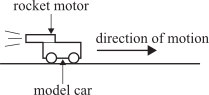
A model car of mass 2.0 kg is propelled from rest by a rocket motor that applies a constant horizontal force of 4.0 N, as shown below. Assume that friction is negligible.
 

Which one of the following best gives the magnitude of the impulse given to the car by the rocket motor in the first 5.0 seconds?

  1. \(4.0 \text{ N s}\)
  2. \(8.0 \text{ N s}\)
  3. \(20 \text{ N s}\)
  4. \(40 \text{ N s}\)
Show Answers Only

\(C\)

Show Worked Solution

\(I=Ft=4 \times 5=20 \text{ N s}\) 

\(\Rightarrow C\)

Filed Under: Momentum, Energy and Simple Systems Tagged With: Band 3, smc-4277-50-Impulse

PHYSICS, M2 2020 VCE 10

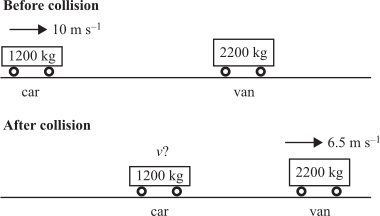
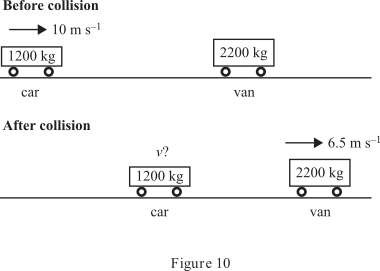
Jacinda designs a computer simulation program as part of her practical investigation into the physics of vehicle collisions. She simulates colliding a car of mass 1200 kg, moving at 10 ms\(^{-1}\), into a stationary van of mass 2200 kg. After the collision, the van moves to the right at 6.5 ms\(^{-1}\). This situation is shown in the diagrams below.
 

  1. Calculate the speed of the car after the collision and indicate the direction it would be travelling in. Show your working.  (4 marks)

    --- 7 WORK AREA LINES (style=lined) ---

  2. Explain, using appropriate physics, why this collision represents an example of either an elastic or an inelastic collision.  (3 marks)

    --- 8 WORK AREA LINES (style=lined) ---

  3. The collision between the car and the van takes 40 × 10\(^{-3}\) seconds.
    1. Calculate the magnitude and indicate the direction of the average force on the van by the car.  (3 marks)

      --- 6 WORK AREA LINES (style=lined) ---

    2. Calculate the magnitude and indicate the direction of the average force on the car by the van.  (2 marks)

      --- 4 WORK AREA LINES (style=lined) ---
Show Answers Only

a.    \(v_{\text{car}} =1.92\ \text{ms}^{-1}\) to the left.

b.    The collision is an inelastic collision as the kinetic energy decreases after the collision.

c.i   The average force of \(358\ \text{kN}\) is to right as the change in the momentum is also to the right.

c.ii    The average force of \(358\ \text{kN}\) is to the left as the change in momentum is also to the left.

Show Worked Solution

a.    Using the Conservation of Momentum:

\(m_{\text{car}}u_{\text{car}}+m_{\text{van}}u_{\text{van}}\) \(=m_{\text{car}}v_{\text{car}}+m_{\text{van}}v_{\text{van}}\)  
\(1200 \times 10 + 2200 \times 0\) \(=1200 \times v_{\text{car}} + 2200 \times 6.5\)  
\(1200v_{\text{car}}\) \(=12\ 000-14\ 300\)  
  \(=-2300\)  
\(v_{\text{car}}\) \(=-1.92\ \text{ms}^{-1}\)  
  \(=1.92\ \text{ms}^{-1}\ \text{to the left}\)  


b.     \(KE_{\text{init}}\) \(=\dfrac{1}{2}m_{\text{car}}u_{\text{car}}^2+\dfrac{1}{2}m_{\text{van}}u_{\text{van}}^2\)
   

\(=\dfrac{1}{2} \times 1200 \times 10^2 + \dfrac{1}{2} \times 2200 \times 0^2\)

    \(=60\ 000\ \text{J}\)

\(KE_{\text{final}}\) \(=\dfrac{1}{2}m_{\text{car}}v_{\text{car}}^2+\dfrac{1}{2}m_{\text{van}}v_{\text{van}}^2\)  
  \(=\dfrac{1}{2} \times 1200 \times 1.92^2 + \dfrac{1}{2} \times 2200 \times 6.5^2\)  
  \(=48\ 687\ \text{J}\)  


  • As the kinetic energy of the system decreases after the collision, the collision is inelastic.
     
c.i.   \(\Delta p\) \(=F_{net}\Delta t\)  
\(F_{net}\) \(=\dfrac{\Delta p}{ \Delta t}\)  
  \(= \dfrac{m\Delta v}{\Delta t}\)  
  \(= \dfrac{2200 \times (6.5-0)}{40 \times 10^{-3}}\)  
  \(=357\ 500\ \text{N}\)  
  \(=358\ \text{kN to the right}\)  
 
The average force of \(358\ \text{kN}\) is to right as Δmomentum is to the right.
  
c.ii.   \(F_{net}\) \(=\dfrac{\Delta p}{ \Delta t}\)
  \(= \dfrac{m\Delta v}{\Delta t}\)
  \(= \dfrac{1200 \times (-1.92-10)}{40 \times 10^{-3}}\)
  \(=-357\ 600\ \text{N}\)
  \(=-358\ \text{kN}\)


  • The average force of \(358\ \text{kN}\) is to the left as the change in momentum is also to the left.
  • Note: no calculation was required for this question as it is an example of Newton’s third law of motion. Simply stating that the force would be equal in magnitude but opposite in direction earned full marks.

Filed Under: Momentum, Energy and Simple Systems Tagged With: Band 4, smc-4277-20-Momentum conservation, smc-4277-40-Elastic/inelastic collisions, smc-4277-50-Impulse

Copyright © 2014–2025 SmarterEd.com.au · Log in