SmarterEd

Aussie Maths & Science Teachers: Save your time with SmarterEd

  • Login
  • Get Help
  • About

PHYSICS, M3 EQ-Bank 7

A group of students conducted an investigation of waves using a slinky. They generated a transverse wave pulse with an amplitude of 10 cm in a slinky under tension \(T_1\). They measured the time taken for the pulse to travel the 3.0 m length of the slinky as 0.75 seconds.

They then increased the tension to \(T_2\) where  \(T_2 = 2.25T_1\) and found that the same amplitude pulse took 0.5 seconds to travel the same distance.

  1. Calculate the wave speed for both tension values \(T_1\) and \(T_2\).   (2 marks)

--- 4 WORK AREA LINES (style=lined) ---

  1. Determine the proportionality between wave speed and tension in the slinky. Use your calculations to support your answer.   (2 marks)

--- 4 WORK AREA LINES (style=lined) ---
Show Answers Only

a.    The speed of \(T_1 = \dfrac{3}{0.75} = 4\ \text{ms}^{-1}\).

The speed of \(T_2 = \dfrac{3}{0.5} = 6\ \text{ms}^{-1}\).

b.     \(v \propto \sqrt{T}\).

Show Worked Solution

a.    The speed of the wave can be calculated using \(v=\dfrac{d}{t}\).

  • The speed of \(T_1 = \dfrac{3}{0.75} = 4\ \text{ms}^{-1}\).
  • The speed of \(T_2 = \dfrac{3}{0.5} = 6\ \text{ms}^{-1}\).

b.    \(\dfrac{v_2}{v_1}= \dfrac{6}{4} = 1.5\).

\(\dfrac{T_2}{T_1} = \dfrac{2.25T_1}{T_1} = 2.25\).

  • Noting, \(\sqrt{\dfrac{T_2}{T_1}} = \sqrt{2.25} = 1.5 \ \Rightarrow \ \dfrac{v_2}{v_1} = \sqrt{\dfrac{T_2}{T_1}}\).
  • Hence  \(v \propto \sqrt{T}\).

Filed Under: Wave Properties and Behaviour Tagged With: Band 3, Band 6, smc-4278-20-Wave calculations, smc-4278-35-Mechanical Waves

PHYSICS, M3 EQ-Bank 5

A group of physics students conducted an experiment using a spring-like apparatus to study wave properties. They generated a single pulse that travelled 2.8 m in 0.70 seconds.

  1. Calculate the speed of the pulse.   (1 marks)

--- 4 WORK AREA LINES (style=lined) ---
  1. The students then created a continuous wave using the same apparatus, generating 4 complete cycles in 2.0 seconds. Calculate the frequency of this wave.   (2 marks)

--- 4 WORK AREA LINES (style=lined) ---
  1. Determine the wavelength of the continuous wave.   (1 mark)

--- 2 WORK AREA LINES (style=lined) ---

Show Answers Only

a.    \(4.0\ \text{ms}^{-1}\)

b.    \(2\ \text{Hz}\)

c.    \(2\ \text{m}\)

Show Worked Solution

a.    \(v=\dfrac{s}{t} = \dfrac{2.8}{0.7} = 4.0\ \text{ms}^{-1}\).
 

b.     Wave frequency \(\Rightarrow\) completed wave cycles per second.

  • If four complete wave cycles are generated in two seconds then there are two complete wave cycles per second.
  • Wave frequency = 2 Hz.

c.    The wave velocity formula can be rearranged to \(\lambda = \dfrac{v}{f}\).

   \(\lambda = \dfrac{4}{2} = 2\ \text{m}\).

Filed Under: Wave Properties and Behaviour Tagged With: Band 3, smc-4278-20-Wave calculations

PHYSICS, M3 EQ-Bank 10 MC

Which of the following waves has the shortest wavelength?

  1. A microwave with a frequency of \(3.0 \times 10^{11}\ \text{Hz}\).
  2. A sound wave with a frequency of \(15\ \text{kHz}\).
  3. A water wave travelling at \(4.0\ \text{ms}^{-1}\) with a frequency of \(0.25\ \text{Hz}\).
  4. A radio wave with a frequency of \(90\ \text{MHz}\).
Show Answers Only

\(A\)

Show Worked Solution

\(v=f\lambda\) \(\Rightarrow\) \(\lambda = \dfrac{v}{f}\).

  Microwave: \(\lambda = \dfrac{3.0 \times 10^8}{3.0 \times 10^{11}} = 1 \times 10^{-3}\ \text{m}\).

  Sound wave: \(\lambda = \dfrac{340}{15 \times 10^3} = 0.023\ \text{m}\).

  Water wave: \(\lambda = \dfrac{4.0}{0.25} = 1\ \text{m}\).

  Radio wave: \(\lambda = \dfrac{3.0 \times 10^8}{90 \times 10^6} = 3.33\ \text{m}\).
 

  • The microwave has the smallest wavelength.

\(\Rightarrow A\)

Filed Under: Wave Properties and Behaviour Tagged With: Band 4, smc-4278-20-Wave calculations, smc-4278-35-Mechanical Waves, smc-4278-45-EMR

PHYSICS, M3 EQ-Bank 4

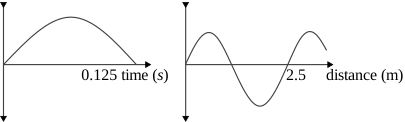
Determine the speed of the following wave.   (2 marks)
 

--- 4 WORK AREA LINES (style=lined) ---
Show Answers Only

\(v=10\ \text{ms}^{-1}\).

Show Worked Solution
  • From the first diagram it takes 0.125 s for half a cycle of the wave, hence the period \((T)\) of the wave is 0.25 s.
  • From the second diagram the wavelength of the wave, \(\lambda = 2.5\ \text{m}\).
  •    \(v = f\lambda = \dfrac{\lambda}{T} = \dfrac{2.5}{0.25} = 10\ \text{ms}^{-1}\).

Filed Under: Wave Properties and Behaviour Tagged With: Band 4, smc-4278-20-Wave calculations

PHYSICS, M3 EQ-Bank 8 MC

A mechanical wave is travelling along a stretched rope. It has a period of 0.4 seconds and a wavelength of 2.8 metres.

Which of the following statements correctly describes the wave?

  1. Its speed is 7.0 m/s
  2. Its speed is 1.1 m/s
  3. Its speed is 0.72 m/s
  4. The wave's speed cannot be determined with the given information
Show Answers Only

\(A\)

Show Worked Solution

\(f=\dfrac{1}{T} = \dfrac{1}{0.4} = 2.5\ \text{Hz}\)

\(v = f\lambda = 2.5 \times 2.8 = 7.0\ \text{m/s}\)

\(\Rightarrow A\)

Filed Under: Wave Properties and Behaviour Tagged With: Band 3, smc-4278-20-Wave calculations

PHYSICS, M3 EQ-Bank 7 MC

A marine communication system operates at a frequency of \(92.9\ \text{MHz}\). What is the wavelength of the signal being transmitted?

  1. \(3.2 \times 10^6\ \text{m}\)
  2. \(3.2 \times 10^3\ \text{m}\)
  3. \(3.2\ \text{m}\)
  4. \(3.2 \times 10^{-3}\ \text{m}\)
Show Answers Only

\(C\)

Show Worked Solution
  • \(92.9\ \text{MHz} = 92.9 \times 10^6\ \text{Hz}\)
  • \(\lambda = \dfrac{v}{f} = \dfrac{3 \times 10^8}{92.9 \times 10^6} = 3.2\ \text{m}\)

\(\Rightarrow C\)

Filed Under: Wave Properties and Behaviour Tagged With: Band 4, smc-4278-20-Wave calculations

PHYSICS, M3 EQ-Bank 1

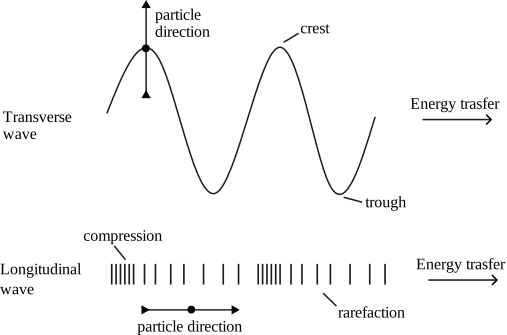
  1. Create a labelled diagram to illustrate the distinction between transverse and longitudinal wave types. Briefly describe how the particle motion differs in each case.   (3 marks)

--- 10 WORK AREA LINES (style=lined) ---

  1. Describe a difference between electromagnetic waves and mechanical waves, giving an example of each.   (2 marks)

--- 4 WORK AREA LINES (style=lined) ---
  1. A beam of light has a frequency of \(5.0 \times 10^{14}\ \text{Hz}\). Calculate the wavelength of this light in metres.   (1 mark)

--- 2 WORK AREA LINES (style=lined) ---
Show Answers Only

a.    


  • For transverse waves, particles move at 90 degrees to the direction of energy transfer.
  • For longitudinal waves, particles move back and forward in the same direction as the energy transfer.

b.   Electromagnetic wave example: radio wave.

  • EMR does not require a medium to travel through. i.e. they can travel through a vacuum.

Mechanical wave example: sound wave.

  • Mechanical waves require a medium to travel through.

c.    \(6 \times 10^{-7}\ \text{m}\).

Show Worked Solution

a.    


  • For transverse waves, particles move at 90 degrees to the direction of energy transfer.
  • For longitudinal waves, particles move back and forward in the same direction as the energy transfer.

b.   Electromagnetic wave example: radio wave.

  • EMR does not require a medium to travel through. i.e. they can travel through a vacuum.

Mechanical wave example: sound wave.

  • Mechanical waves require a medium to travel through.

c.   Using  \(v = f \lambda\):

\(\lambda = \dfrac{v}{f} = \dfrac{3 \times 10^8}{5.0 \times 10^{14}} = 6 \times 10^{-7}\ \text{m}\).

Filed Under: Wave Properties and Behaviour Tagged With: Band 4, smc-4278-20-Wave calculations, smc-4278-30-Transverse vs longitudinal, smc-4278-35-Mechanical Waves

PHYSICS, M3 EQ-Bank 5-6 MC

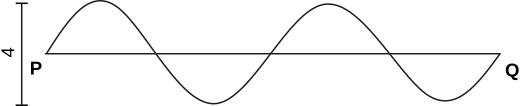
The diagram below shows a section of a wave traveling through a medium.
 

The segment displayed spans 0.8 seconds of wave motion. The length between points P and Q along the wave is 16 cm. All other measurements are in cm.
 

Part 1

Which answer shows the correct data for this wave:

\begin{align*}
\begin{array}{l}
\rule{0pt}{2.5ex} \ \rule[-1ex]{0pt}{0pt}& \\
\rule{0pt}{2.5ex}\textbf{A.}\rule[-1ex]{0pt}{0pt}\\
\rule{0pt}{2.5ex}\textbf{B.}\rule[-1ex]{0pt}{0pt}\\
\rule{0pt}{2.5ex}\textbf{C.}\rule[-1ex]{0pt}{0pt}\\
\rule{0pt}{2.5ex}\textbf{D.}\rule[-1ex]{0pt}{0pt}\\
\end{array}
\begin{array}{|c|c|}
\hline
\rule{0pt}{2.5ex}\text{Amplitude (cm)}\rule[-1ex]{0pt}{0pt}& \text{Wave Length (cm)} \\
\hline
\rule{0pt}{2.5ex}\text{2}\rule[-1ex]{0pt}{0pt}&\text{4}\\
\hline
\rule{0pt}{2.5ex}\text{2}\rule[-1ex]{0pt}{0pt}& \text{8}\\
\hline
\rule{0pt}{2.5ex}\text{4}\rule[-1ex]{0pt}{0pt}& \text{4} \\
\hline
\rule{0pt}{2.5ex}\text{4}\rule[-1ex]{0pt}{0pt}& \text{8} \\
\hline
\end{array}
\end{align*}

 
Part 2

Which answer shows the correct data for this wave:

\begin{align*}
\begin{array}{l}
\rule{0pt}{2.5ex} \ \rule[-1ex]{0pt}{0pt}& \\
\rule{0pt}{2.5ex}\textbf{A.}\rule[-1ex]{0pt}{0pt}\\
\rule{0pt}{2.5ex}\textbf{B.}\rule[-1ex]{0pt}{0pt}\\
\rule{0pt}{2.5ex}\textbf{C.}\rule[-1ex]{0pt}{0pt}\\
\rule{0pt}{2.5ex}\textbf{D.}\rule[-1ex]{0pt}{0pt}\\
\end{array}
\begin{array}{|c|c|}
\hline
\rule{0pt}{2.5ex}\text{Period (s)}\rule[-1ex]{0pt}{0pt}& \text{Velocity (m/s)} \\
\hline
\rule{0pt}{2.5ex}\text{0.4}\rule[-1ex]{0pt}{0pt}&\text{0.1}\\
\hline
\rule{0pt}{2.5ex}\text{0.4}\rule[-1ex]{0pt}{0pt}& \text{0.2}\\
\hline
\rule{0pt}{2.5ex}\text{0.8}\rule[-1ex]{0pt}{0pt}& \text{0.05} \\
\hline
\rule{0pt}{2.5ex}\text{0.8}\rule[-1ex]{0pt}{0pt}& \text{0.1} \\
\hline
\end{array}
\end{align*}

Show Answers Only

Part 1: \(B\)

Part 2: \(B\)

Show Worked Solution

Part 1

  • Amplitude = distance between the equilibrium position of the wave and the maximum displacement.
  • Therefore the amplitude of the wave is 2 cm.
  • The wavelength is the distance it takes for a wave to repeat itself.
  • As there are two wavelengths from P to Q which span 16 cm, the wavelength of the wave is 8 cm.

\(\Rightarrow B\)
 

Part 2

  • The period of a wave is how it takes for one cycle of the wave.
  • As there are two cycles of the wave in 0.8 s, the period of the wave is 0.4 s.
  •    \(v = f \lambda = \dfrac{1}{T} \times \lambda = \dfrac{1}{0.4} \times 0.08 = 0.2\ \text{ms}^{-1}\).

\(\Rightarrow B\)

Filed Under: Wave Properties and Behaviour Tagged With: Band 3, smc-4278-20-Wave calculations

PHYSICS, M3 EQ-Bank 2-3 MC

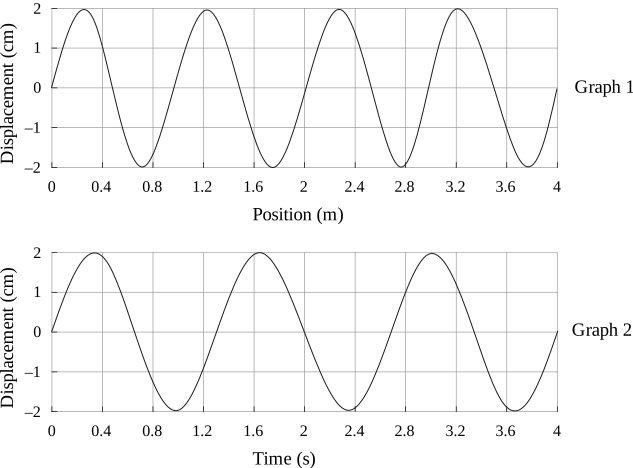
A wave is moving along a string. Graph 1 shows the displacement of the string at different positions, while Graph 2 shows how the displacement of a single point on the string changes over time.


Part 1

Based on Graph 1, what is the wavelength of the wave?

  1. \(1.0\ \text{m}\)
  2. \(2.0\ \text{m}\)
  3. \(3.0\ \text{m}\)
  4. \(4.0\ \text{m}\)

 
Part 2

What is the speed of the wave along the string?

  1. \(0.33\ \text{ms}^{-1}\)
  2. \(0.66\ \text{ms}^{-1}\)
  3. \(0.75\ \text{ms}^{-1}\)
  4. \(1.33\ \text{ms}^{-1}\)
Show Answers Only

Part 1: \(A\)

Part 2: \(C\)

Show Worked Solution

Part 1

  • The wavelength is given by the distance between two corresponding points on the wave (i.e. crest to crest or trough to trough).
  • The from the graph, the wave repeats itself after 1.0 m.

\(\Rightarrow A\)

 
Part 2

  • The wave repeats three times in 4 seconds → Period of the wave is 1.33 s.
  • The frequency of the wave, \(f = \dfrac{1}{T} = \dfrac{1}{1.33} = 0.75\ \text{Hz}\).
  •    \(v = f \lambda = 0.75 \times 1.0 = 0.75\ \text{ms}^{-1}\)

\(\Rightarrow C\)

Filed Under: Wave Properties and Behaviour Tagged With: Band 4, smc-4278-20-Wave calculations

PHYSICS, M3 EQ-Bank 1 MC

A microwave signal has a frequency of \(2.5 \times 10^8\ \text{Hz}\).

What is the closest value to its wavelength?

  1. \(0.83\ \text{m}\)
  2. \(1.2\ \text{m}\)
  3. \(1.6\ \text{m}\)
  4. \(2.0\ \text{m}\)
Show Answers Only

\(B\)

Show Worked Solution
  • The speed of a microwave is \(3 \times 10^8\ \text{ms}^{-1}\).
  • Using  \(v=f \lambda\):
  •    \(\lambda=\dfrac{v}{f}=\dfrac{3 \times 10^8}{2.5 \times 10^8}=1.2\ \text{m}\)

 \(\Rightarrow B\)

Filed Under: Wave Properties and Behaviour Tagged With: Band 3, smc-4278-20-Wave calculations

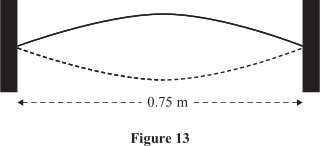
PHYSICS, M3 2023 VCE 11

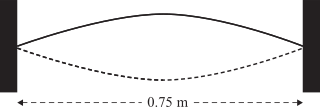
A guitar string of length 0.75 m and fixed at both ends is plucked and a standing wave is produced. The envelope of the standing wave is shown in the diagram.
 

The speed of the wave along the string is 393 m s\( ^{-1}\).

  1. What is the frequency of the wave?   (1 mark)

    --- 2 WORK AREA LINES (style=lined) ---
  2. Describe how the standing wave is produced on the string fixed at both ends.   (2 marks)

    --- 3 WORK AREA LINES (style=lined) ---
Show Answers Only

a.    262 Hz

b.   Standing wave:

  • When waves encounter fixed ends, they reflect.
  • If the string’s length is a multiple of half the wavelength, the reflected wave combines with the original wave, resulting in interference that forms a standing wave pattern
Show Worked Solution

a.   \(f=\dfrac{v}{\lambda}=\dfrac{393}{1.5}=262\ \text{Hz}\)
 

b.   Standing wave:

  • When waves encounter fixed ends, they reflect.
  • If the string’s length is a multiple of half the wavelength, the reflected wave combines with the original wave, resulting in interference that forms a standing wave pattern
♦ Mean mark (b) 47%.

Filed Under: Sound Waves, Wave Properties and Behaviour Tagged With: Band 4, Band 5, smc-4278-20-Wave calculations, smc-4280-20-Modelling standing waves

PHYSICS, M3 2017 VCE 16

Standing waves are formed on a string of length 4.0 m that is fixed at both ends. The speed of the waves is 240 m s\(^{-1}\).

  1. Calculate the wavelength of the lowest frequency resonance.  (2 marks)

    --- 3 WORK AREA LINES (style=lined) ---
  2. Calculate the frequency of the second-lowest frequency resonance.  (2 marks)

    --- 3 WORK AREA LINES (style=lined) ---

  3. Explain the physics of how standing waves are formed on the string. Include a diagram in your response.  (3 marks)

    --- 6 WORK AREA LINES (style=lined) ---
Show Answers Only

a.    30 Hz

b.    60 Hz

c.    Standing waves:

  • Produced when a wave travels down a string and is reflected back on itself such that the superposition of the two waves produce an interference pattern to form a standing wave.
  • The two waves must be travelling in opposite directions with the same frequency, wavelength and amplitude.


Show Worked Solution

a.     Lowest frequency resonance:

  • Occurs at the maximum wavelength. The maximum wavelength is 8 metres since the half wavelength is the length of the string (4m).
  •    \(f=\dfrac{v}{\lambda}=\dfrac{240}{8}=30\ \text{Hz}\) 

b.   When \(\lambda = 4: \)

    \(f=\dfrac{v}{\lambda}=\dfrac{240}{4}=60\ \text{Hz}\)
 

c.    Standing waves:

  • Produced when a wave travels down a string and is reflected back on itself such that the superposition of the two waves produce an interference pattern to form a standing wave.
  • The two waves must be travelling in opposite directions with the same frequency, wavelength and amplitude.


♦ Mean mark (c) 43%.

Filed Under: Sound Waves, Wave Properties and Behaviour Tagged With: Band 4, Band 5, smc-4278-20-Wave calculations, smc-4280-20-Modelling standing waves

PHYSICS, M3 2018 VCE 11

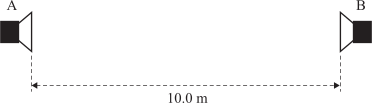
The diagram shows two speakers, \(\text{A}\) and \(\text{ B}\), facing each other. The speakers are connected to the same signal generator/amplifier and the speakers are simultaneously producing the same 340 Hz sound.
 

Take the speed of sound to be 340 ms\( ^{-1}\).

  1. Calculate the wavelength of the sound.   (1 mark)

    --- 2 WORK AREA LINES (style=lined) ---
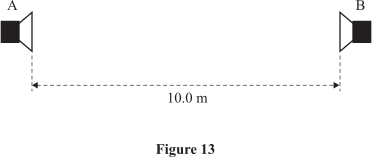
  2. A student stands in the centre, equidistant from speakers \(\text{A}\) and \(\text{B}\). He then moves towards speaker \(\text{B}\) and experiences a sequence of loud and quiet regions. He stops at the second region of quietness.
  3. How far has the student moved from the centre? Explain your reasoning.   (3 marks)

    --- 8 WORK AREA LINES (style=lined) ---

Show Answers Only

a.     \(\lambda=1\ \text{m}\)

b.   Distance moved from the centre:

  • At the centre of the speakers, there is an area of relative loudness
  • This is due to a path difference of 0 metres between the wavelengths of sounds coming from both speaker \(\text{A}\) and speaker \(\text{B}\). 
  • As the student moves towards speaker \(\text{B}\), the two sound waves will experience constructive and destructive interference.
  • The peak of speaker \(\text{A}\) will move into the trough of speaker \(\text{B}\) where he experiences the first region of quietness (node) which is 1 quarter wavelength (0.25m) from the centre.
  • The second region of quietness (node) will be half of a wavelength (0.5m) from the first region of quietness. Thus, the total distance from the centre to the second region of quietness is 0.75m.
Show Worked Solution

a.    \(\lambda=\dfrac{v}{f}=\dfrac{340}{340}=1\ \text{m}\)

  
b.   Distance moved from the centre:

  • At the centre of the speakers, there is an area of relative loudness
  • This is due to a path difference of 0 metres between the wavelengths of sounds coming from both speaker \(\text{A}\) and speaker \(\text{B}\). 
  • As the student moves towards speaker \(\text{B}\), the two sound waves will experience constructive and destructive interference.
  • The peak of speaker \(\text{A}\) will move into the trough of speaker \(\text{B}\) where he experiences the first region of quietness (node) which is 1 quarter wavelength (0.25m) from the centre.
  • The second region of quietness (node) will be half of a wavelength (0.5m) from the first region of quietness. Thus, the total distance from the centre to the second region of quietness is 0.75m.
♦♦♦ Mean mark (b) 20%.

Filed Under: Wave Properties and Behaviour Tagged With: Band 3, Band 6, smc-4278-20-Wave calculations, smc-4278-50-Wave superposition

PHYSICS, M3 2019 VCE 12

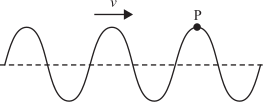
A sinusoidal wave of wavelength 1.40 m is travelling along a stretched string with constant speed \(v\), as shown in the figure below. The time taken for point \(\text{P}\) on the string to move from maximum displacement to zero is 0.120 s.
 

Calculate the speed of the wave, \(v\). Give your answer correct to three significant figures. Show your working.   (3 marks)

--- 5 WORK AREA LINES (style=lined) ---

Show Answers Only

\(v=2.92\ \text{ms}^{-1}\)

Show Worked Solution

Using  \(v=f\lambda\) and  \(f=\dfrac{1}{T}\):

\(v=\dfrac{\lambda}{T}=\dfrac{1.4}{4 \times 0.120}=2.92\ \text{ms}^{-1}\)

♦ Mean mark 50%.

Filed Under: Wave Properties and Behaviour Tagged With: Band 5, smc-4278-20-Wave calculations

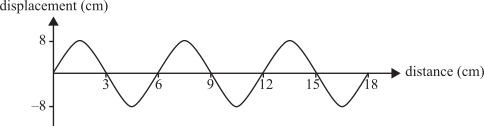
PHYSICS, M3 2021 VCE 13

The diagram below shows part of a travelling wave.
 

The wave propagates with a speed of 18 ms\(^{-1}\).

What is the amplitude and frequency of the wave?   (2 marks)

--- 4 WORK AREA LINES (style=lined) ---

Show Answers Only

Amplitude = 8 cm

Frequency = 300 Hz

Show Worked Solution
  • Amplitude: the distance from the centre line to maximum displacement.
  • Amplitude = 8 cm.
  • Frequency: can be determined using  \(f=\dfrac{v}{\lambda}\), (wavelength in metres):
  •    \(f=\dfrac{v}{\lambda}=\dfrac{18}{0.06}=300\ \text{Hz} \)

Filed Under: Wave Properties and Behaviour Tagged With: Band 4, smc-4278-20-Wave calculations

PHYSICS, M3 2022 VCE 13*

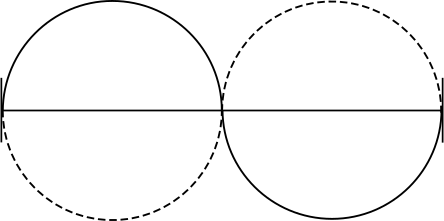
A travelling wave produced at point \(\text{A}\) is reflected at point \(\text{B}\) to produce a standing wave on a rope, as represented in the diagram below.


The distance between points \(\text{A}\) and \(\text{B}\) is 2.4 m. The period of vibration of the standing wave is 1.6 s.

Find the speed of the travelling wave along the rope in metres per second.   (2 marks)

--- 4 WORK AREA LINES (style=lined) ---

Show Answers Only

\(A\)

Show Worked Solution

\( \lambda = 1.2\ \text{m}\)

\(f= \dfrac{1}{T} = \dfrac{1}{1.6} = 0.625\)

\(v\) \(=f \lambda\)  
  \(=0.625 \times 1.2\)  
  \(=0.75\ \text{ms}^{-1}\)  

Filed Under: Wave Properties and Behaviour Tagged With: Band 4, smc-4278-20-Wave calculations

PHYSICS, M3 2017 HSC 21a

A laser emits light of wavelength 550 nm. (\(v=3 \times 10^8\) ms\(^{-1}\))

Calculate the frequency of this light.   (2 marks)


Show Answers Only

\(f= 5.45 \times 10^{14}\) Hz

Show Worked Solution

Using  \(v=f \lambda :\)

\(f=\dfrac{v}{\lambda}=\dfrac{3 \times 10^8}{550 \times 10^{-9}}=5.45 \times 10^{14}\ \text{Hz}\)

Filed Under: Wave Properties and Behaviour Tagged With: Band 3, smc-4278-20-Wave calculations

Copyright © 2014–2025 SmarterEd.com.au · Log in