SmarterEd

Aussie Maths & Science Teachers: Save your time with SmarterEd

  • Login
  • Get Help
  • About

PHYSICS, M4 EQ-Bank 10

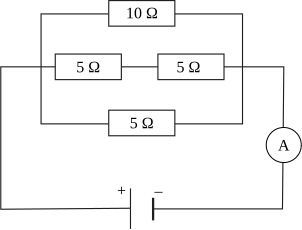
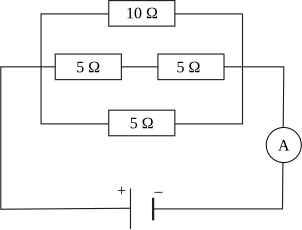
A camping lantern consists of four smaller light bulbs, each of which can be modelled as an ohmic resistor. The lantern is powered by a 9 V battery, as shown in the circuit diagram.
 

  1. Calculate the current measured by the ammeter in the circuit.   (3 marks)

--- 5 WORK AREA LINES (style=lined) ---

  1. Determine the amount of electrical energy used by the lantern over a period of 2 hours.   (2 marks)

--- 4 WORK AREA LINES (style=lined) ---
Show Answers Only

a.    \(3.6\ \text{A}\)

b.    \(233\,280\ \text{J}\)

Show Worked Solution

a.    Combining the resistors in series:

\(R_{\text{series}} = 5 + 5 = 10\ \Omega\).
 

Combing the resistors in parallel:

\(\dfrac{1}{R_T}\) \(=\dfrac{1}{10} + \dfrac{1}{10} + \dfrac{1}{5} = \dfrac{2}{5}\)  
\(R_T\) \(=2.5\ \Omega\)  

 
The current through circuit can be calculated through Ohm’s law:

\(I_{\text{circuit}} = \dfrac{V_{\text{circuit}}}{R_T} = \dfrac{9}{2.5} = 3.6\ \text{A}\).
 

b.    \(P = IV = 3.6 \times 9 = 32.4\ \text{W}\)

\(E = P\Delta t = 32.4 \times (2 \times 60 \times 60) = 233\,280\ \text{J}\)

Filed Under: Electric Circuits Tagged With: Band 4, Band 5, smc-4284-10-V=IR, smc-4284-20-Resistence in circuits, smc-4284-30-Power

PHYSICS, M4 EQ-Bank 10 MC

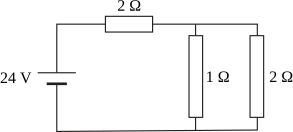
Determine the current flowing through the \(2\ \Omega\) resistor in parallel in the following circuit.
 

  1. \(\text{3 A}\)
  2. \(\text{6 A}\)
  3. \(\text{9 A}\)
  4. \(\text{12 A}\)
Show Answers Only

\(A\)

Show Worked Solution
\(\dfrac{1}{R_{\text{parallel}}}\) \(=\dfrac{1}{1} + \dfrac{1}{2} = \dfrac{3}{2}\)  
\(R_{\text{parallel}}\) \(= \dfrac{2}{3}\ \Omega\)  
\(R_T\) \(= \dfrac{2}{3} +2 = 2.67\ \Omega\)  
  •  The current through the circuit is:
  •    \(I_{\text{circuit}} = \dfrac{V}{R_T} = \dfrac{24}{2.67} = 9\ \text{A}\)
  • The voltage drop across the \(2\ \Omega\) resistor in series is:
  •    \(V = I_{\text{circuit}} \times R = 9 \times 2 = 18\ \text{V}\).
  • Therefore each resistor in parallel has a \(6\ \text{V}\) drop across it. 
  • Current through \(2\ \Omega\) resistor \(=\dfrac{V}{R} = \dfrac{6}{2} = 3\ \text{A}\)

\(\Rightarrow A\)

Filed Under: Electric Circuits Tagged With: Band 4, smc-4284-10-V=IR, smc-4284-20-Resistence in circuits

PHYSICS, M4 EQ-Bank 5

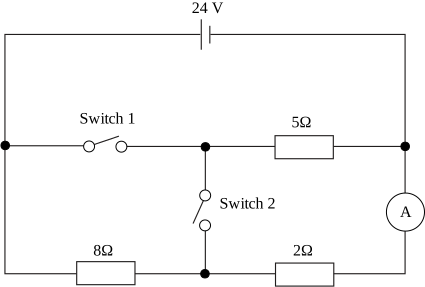
A circuit contains two switches, S\(_1\) and S\(_2\). The configuration of the circuit changes depending on which of the switches are open.
 

  1. S\(_1\) is closed and S\(_2\) is open. What current would the ammeter display, assuming ideal conditions?   (2 marks)

--- 3 WORK AREA LINES (style=lined) ---

  1. The switch S\(_1\) is open, and S\(_2\) is closed. What is the equivalent resistance of the circuit in this configuration?  (2 marks)

--- 3 WORK AREA LINES (style=lined) ---

  1. Both S\(_1\) and S\(_2\) are now closed. Calculate the power dissipated by the \(2\ \Omega\) resistor under this condition.  (2 marks)

--- 3 WORK AREA LINES (style=lined) ---

Show Answers Only

a.    \(2.4\ \text{A}\)

b.    \(9.43\ \Omega\)

c.    \(288\ \text{W}\)

Show Worked Solution

a.    When S\(_1\) is closed and S\(_2\) is open:

  • The circuit becomes a parallel circuit where the bottom branch contains both the \(2\ \Omega\) and \(8\ \Omega\) resistor. 
  • The voltage through each arm of the parallel circuit is equal to the total voltage which is equal to \(24\ \text{V}\).
  • Therefore, the reading on the ammeter  \(I = \dfrac{V}{R} = \dfrac{24}{10} = 2.4\ \text{A}\)
     

b.    When the switch S\(_1\) is open, and S\(_2\) is closed:

  • The resistance in the parallel part of the circuit \((5\ \Omega\) and \(2\ \Omega)\) resistors is calculated by:
\(\dfrac{1}{R}\) \(=\dfrac{1}{5} + \dfrac{1}{2} = \dfrac{7}{10}\)  
\(R\) \(=\dfrac{10}{7}\ \Omega\)  

 
Total resistance through the circuit \(= \dfrac{10}{7} + 8 = 9.43\ \Omega\).
 

c.    When both S\(_1\) and S\(_2\) are closed:

  • The system acts as a parallel circuit through the \(5\ \Omega\) and \(2\ \Omega\) resistors and then all current will pass through the switch as it has no resistance and no current will pass through the \(8\ \Omega\) resistor.
  • Therefore the voltage drop over the \(2\ \Omega\) resistor will be \(24\ \text{V}\)
  • By combining  \(P= IV\)  and  \(V=IR\):
  •    \(P = \dfrac{V^2}{R} = \dfrac{24^2}{2} = 288\ \text{W}\)

Filed Under: Electric Circuits Tagged With: Band 4, Band 5, smc-4284-10-V=IR, smc-4284-30-Power, smc-4284-50-Parallel Circuits

PHYSICS, M4 EQ-Bank 4

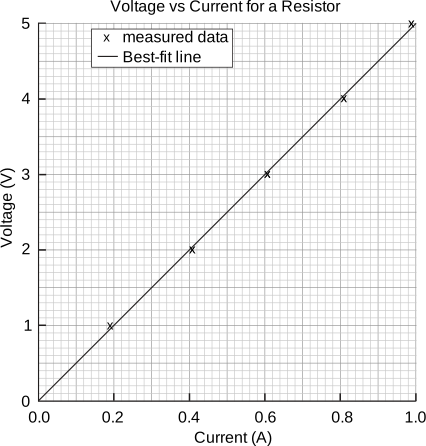
A student investigates the relationship between the current through a resistor and the potential difference across it.

They collect the following data:

\begin{array} {|c|c|c|}
\hline \text{Voltage (V)} & \text{Current (A)} \\
\hline 0.0 & 0.00 \\
\hline 1.0 & 0.19  \\
\hline 2.0& 0.41 \\
\hline 3.0 & 0.61 \\
\hline 4.0 & 0.82  \\
\hline 5.0& 0.98 \\
\hline \end{array}

  1. Plot a graph of Voltage \(\text{(V)}\) on the \(y\)-axis against Current \(\text{(A)}\) on the \(x\)-axis using the data above.
  2. Label your axes clearly and draw the best-fit straight line.   (3 marks)
     
  1. Use your graph to calculate the resistance of the resistor. Show your working and include the correct units.   (2 marks)

--- 4 WORK AREA LINES (style=lined) ---
Show Answers Only

a.    
     

b.    \(5\ \Omega\)

Show Worked Solution

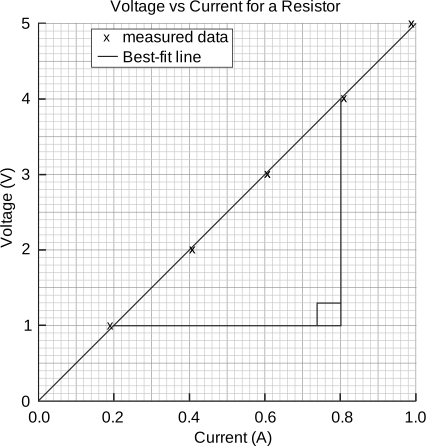
a. and b.    


  • By choosing two points on the graph we can find the gradient by calculating the rise over the run.
  •    \(m = \dfrac{\Delta V}{\Delta I} = \dfrac{4-1}{0.8-0.2} = 5\).
  • Using  \(V = IR\ \ \Rightarrow\ \ R = \dfrac{V}{I}\), we can see the the gradient of the graph is equal to the value of the resistor.
  • Resistance \(=5\ \Omega\).

Filed Under: Electric Circuits Tagged With: Band 4, Band 5, smc-4284-10-V=IR

PHYSICS, M4 EQ-Bank 7 MC

Consider the circuit below.
 

The readings on the meters are \(I_1\), \(I_2\), \(V_1\) and \(V_2\). Which of the following pairs of inequalities are correct.

  1. \(I_1 > I_2\) and \(V_1 > V_2\)
  2. \(I_1 > I_2\) and \(V_1 < V_2\)
  3. \(I_1 < I_2\) and \(V_1 > V_2\)
  4. \(I_1 < I_2\) and \(V_1 < V_2\)
Show Answers Only

\(A\)

Show Worked Solution
  • Let the supplied voltage to the circuit be 25 V.
  • The total resistance of the 4 \(\Omega\) and 8 \(\Omega\) resistors are:
\(\dfrac{1}{R_{T_1}}\) \(= \dfrac{1}{8} + \dfrac{1}{4} = \dfrac{3}{8}\)  
\(R_{T_1}\) \(=\dfrac{8}{3}\ \Omega\)  
  •  Similarly, the total resistance of the 3 \(\Omega\) and 3 \(\Omega\) resistors are:
\(\dfrac{1}{R_{T_2}}\) \(= \dfrac{1}{3} + \dfrac{1}{3} = \dfrac{2}{3}\)
\(R_{T_2}\) \(=\dfrac{3}{2}\ \Omega\)
  •  The total resistance of the circuit is \(\dfrac{8}{3} + \dfrac{3}{2} = \dfrac{25}{6}\ \Omega\)
  • The total current running through circuit is:
  •    \(I = \dfrac{V}{R} = \dfrac{25}{\frac{25}{6}} = 6\ \text{A}\)
  • The voltage drop across the first two resistors \(=R_{T_1} \times I = \dfrac{8}{3} \times 6 = 16\ \text{V}\)
  • Therefore the voltage drop across the second two resistors \(=25-16 = 9\ \text{V}\)
  • As the voltage across each branch of a parallel circuit is the same and equal to the total voltage drop, \(V_1 > V_2\)
  • The current in each branch of a parallel circuit is split depending on the resistance of each branch. 
  •    \(I_1 = \dfrac{V}{R} = \dfrac{16}{4} = 4\ \text{A}\)
  •    \(I_2 = \dfrac{V}{R} = \dfrac{9}{3} = 3\ \text{A}\)

\(\therefore I_1 > I_2\)

\(\Rightarrow A\)

Filed Under: Electric Circuits Tagged With: Band 6, smc-4284-10-V=IR, smc-4284-50-Parallel Circuits, smc-4284-60-Voltmeters/Ammeters

PHYSICS, M4 EQ-Bank 5 MC

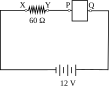
A student sets up an electric circuit with a power supply providing a total potential difference of 12 V. A 60 \(\Omega\) resistor is connected between terminals \(\text{X}\) and \(\text{Y}\), causing a voltage drop of 9 V across it, along with a mystery component between terminals \(\text{P}\) and \(\text{Q}\), which is part of the same circuit.


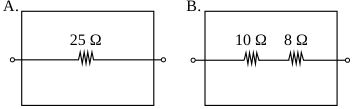
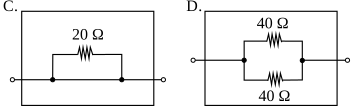
Which of the following components could be connected between \(\text{P}\) and \(\text{Q}\)?


Show Answers Only

\(D\)

Show Worked Solution
  • If the voltage drop between terminals \(\text{X}\) and \(\text{Y}\) was 9 V we can use  \(V=IR\)  to work out the current in the circuit.
  •    \(I = \dfrac{V}{R} = \dfrac{9}{60} = 0.15\ \text{A}\).
  • As the voltage drop across the mystery component must be 3 V, the total resistance of the mystery component must be:
  •    \(R = \dfrac{V}{I} = \dfrac{3}{0.15} = 20\ \Omega\)

Consider each option:

\(A\): \(25\ \Omega\ \cross\)

\(B\): \(18\ \Omega\ \cross\)

\(C\): As the resistor is connected in parallel, it will be irrelevant to the circuit. Hence \(C\) is equivalent to \(0\ \Omega\ \cross\)

\(D\): \(\dfrac{1}{R_T} = \dfrac{1}{40} + \dfrac{1}{40} = \dfrac{1}{20}\ \ \Rightarrow\ \ R_T = 20\ \Omega\)

\(\Rightarrow D\)

Filed Under: Electric Circuits Tagged With: Band 5, smc-4284-10-V=IR, smc-4284-20-Resistence in circuits

PHYSICS, M4 EQ-Bank 2 MC

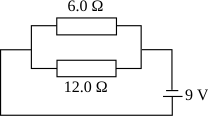
An electric circuit contains a 6.0 \(\Omega\) resistor and a 12.0 \(\Omega\) resistor connected in parallel. The circuit is powered by a 9.0 V battery.
 

What is the total current flowing through the circuit?

  1. 0.75 A
  2. 1.25 A
  3. 2.25 A
  4. 3.0 A
Show Answers Only

\(C\)

Show Worked Solution
  • The resistance in a parallel circuit is given by \(\dfrac{1}{R_T} = \dfrac{1}{R_1} + \dfrac{1}{R_2} \cdots \)
\(\dfrac{1}{R_T}\) \(=\dfrac{1}{6} + \dfrac{1}{12} = \dfrac{1}{4}\)  
\(R_T\) \(=4\ \Omega\)  
  •  Using  \(V=IR_T:\)
  • \(I=\dfrac{V}{R_T} = \dfrac{9}{4} = 2.25\ \text{A}\)

\(\Rightarrow C\)

Filed Under: Electric Circuits Tagged With: Band 4, smc-4284-10-V=IR, smc-4284-50-Parallel Circuits

PHYSICS, M4 EQ-Bank 1

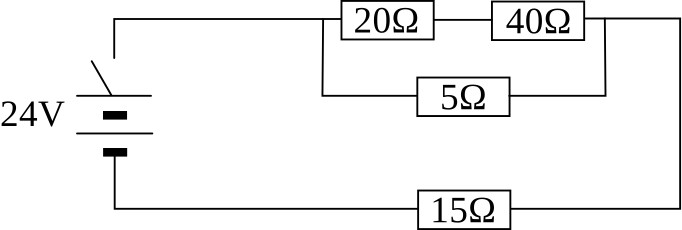
The following circuit has 4 resistors and a 24 V DC supply with a switch.
 

  1. Calculate the value of the single resistor that is equivalent to the 5 \(\Omega\), 20 \(\Omega\), and 40 \(\Omega\) resistors.   (2 marks)

    --- 3 WORK AREA LINES (style=lined) ---

  2. Determine the potential difference across the 15 \(\Omega\) resistor when the switch is closed.   (2 mark)

    --- 5 WORK AREA LINES (style=lined) ---
  3. Determine the current through the 5 \(\Omega\) resistor when the switch is closed.   (2 mark)

    --- 5 WORK AREA LINES (style=lined) ---
Show Answers Only

a.    \(4.6\ \Omega\)

b.    \(18.37\ \text{V}\)

c.   \(1.126\ \text{A}\)

Show Worked Solution
a.     \(R_{series}\) \(= 20 + 40 = 60\ \Omega\)
  \(\dfrac{1}{R_T}\) \(=\dfrac{1}{60}+\dfrac{1}{5}=\dfrac{13}{60}\)
  \(R_T\) \(=\dfrac{60}{13}=4.6\ \Omega\)


b.   \(R_{circuit} = 4.6 +15 = 19.6\ \Omega\)

Circuit current:

\(I=\dfrac{V}{R}=\dfrac{24}{19.6}=1.2245\ \text{A}\)
 

Potential difference across the 15 \(\Omega\) resistor:

\(V=IR=1.2245 \times 15=18.37\ \text{V}\)
 

c.   Potential difference across the 5 \(\Omega\) resistor: 

\(V_{(5\ \Omega)}=24-18.37= 5.63\ \text{V}\)
 

Current through the \(5\ \Omega\) resistor:

\(I=\dfrac{V}{R}=\dfrac{5.63}{5}=1.126\ \text{A}\)

Filed Under: Electric Circuits Tagged With: Band 3, Band 4, smc-4284-10-V=IR, smc-4284-20-Resistence in circuits

PHYSICS, M4 2020 VCE 18

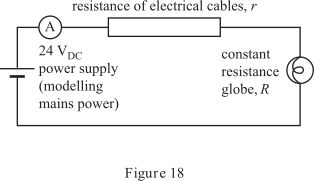
Students are modelling the effect of the resistance of electrical cables, \(r\), on the transmission of electrical power. They model the cables using the circuit shown in Figure 18.
 

The students investigate the effect of changing \(r\) by measuring the current in the electrical cables for a range of values. Their results are shown in Table 1 below.
 

\begin{array} {|c|c|c|}
\hline
\rule{0pt}{2.5ex} \text{Resistance of cables,}\ r\ (\Omega) \rule[-1ex]{0pt}{0pt} & \text{Current in cables},\ i\ (\text{A}) & \ \ \ \dfrac{1}{i} \Big{(}\text{A}^{-1}\Big{)}\ \ \  \\
\hline
\rule{0pt}{2.5ex} 2.4 \rule[-1ex]{0pt}{0pt} & 2.4 &  \\
\hline
\rule{0pt}{2.5ex} 3.6 \rule[-1ex]{0pt}{0pt} & 2.0 &  \\
\hline
\rule{0pt}{2.5ex} 6.4 \rule[-1ex]{0pt}{0pt} & 1.7 &  \\
\hline
\rule{0pt}{2.5ex} 7.6 \rule[-1ex]{0pt}{0pt} & 1.5 &  \\
\hline
\rule{0pt}{2.5ex} 10.4 \rule[-1ex]{0pt}{0pt} & 1.3 &  \\
\hline
\end{array}

  1. To analyse the data, the students use the following equation to calculate the resistance of the cables for the circuit.
  2.         \(r=\dfrac{24}{i}-R\)
  3. Show that this equation is true for the circuit shown in Figure 18. Show your working.  (2 marks)

    --- 3 WORK AREA LINES (style=lined) ---
  4. Calculate the values of \(\dfrac{1}{i}\) and write them in the spaces provided in the last column of Table 1 . (1 mark)

    --- 0 WORK AREA LINES (style=lined) ---
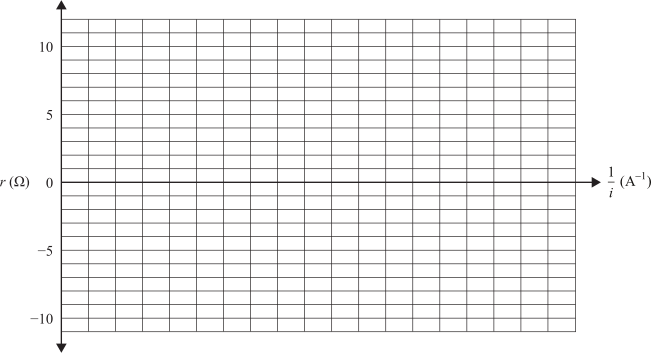
  5. Plot a graph of \(r\) on the \(y\)-axis against \(\dfrac{1}{i}\) on the \(x\)-axis on the grid provided below. On your graph:
    • choose an appropriate scale and numbers for the \(x\)-axis
    • draw a straight line of best fit through the plotted points  (3 marks)


--- 0 WORK AREA LINES (style=lined) ---
  1. Use the straight line of best fit to find the value of the constant resistance globe, \(R\). Give your reasoning.  (2 marks)

    --- 5 WORK AREA LINES (style=lined) ---
Show Answers Only

a.      \(V\) \(=iR\)  
\(V\) \(=i(r+R)\)  
\(\dfrac{V}{i}\) \(=r+R\)  
\(r\) \(=\dfrac{V}{i}-R\)  
\(r\) \(=\dfrac{24}{i}-R\)  

b.   

\begin{array} {|c|c|c|}
\hline
\rule{0pt}{2.5ex} \text{Resistance of cables,}\ r\ (\Omega) \rule[-1ex]{0pt}{0pt} & \text{Current in cables},\ i\ (\text{A}) & \ \ \ \dfrac{1}{i} \Big{(}\text{A}^{-1}\Big{)}\ \ \  \\
\hline
\rule{0pt}{2.5ex} 2.4 \rule[-1ex]{0pt}{0pt} & 2.4 & 0.42 \\
\hline
\rule{0pt}{2.5ex} 3.6 \rule[-1ex]{0pt}{0pt} & 2.0 & 0.5 \\
\hline
\rule{0pt}{2.5ex} 6.4 \rule[-1ex]{0pt}{0pt} & 1.7 & 0.59 \\
\hline
\rule{0pt}{2.5ex} 7.6 \rule[-1ex]{0pt}{0pt} & 1.5 & 0.67 \\
\hline
\rule{0pt}{2.5ex} 10.4 \rule[-1ex]{0pt}{0pt} & 1.3 & 0.77 \\
\hline
\end{array}

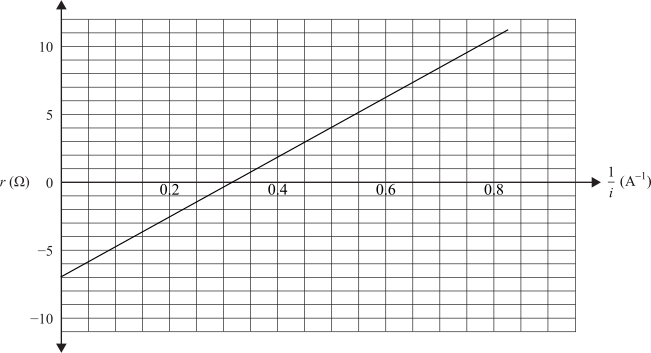
c.    
       

d.    The equation for the line:  \(r=\dfrac{24}{i}-R\).

  • The \(y\)-intercept of the graph correlates to the value of \(R\).
  • Reading from the graph, \(R= 7\ \Omega\).

Show Worked Solution

a.      \(V\) \(=iR\)  
\(V\) \(=i(r+R)\)  
\(\dfrac{V}{i}\) \(=r+R\)  
\(r\) \(=\dfrac{V}{i}-R\)  
\(r\) \(=\dfrac{24}{i}-R\)  
♦♦ Mean mark (a) 37%.

b.   

\begin{array} {|c|c|c|}
\hline
\rule{0pt}{2.5ex} \text{Resistance of cables,}\ r\ (\Omega) \rule[-1ex]{0pt}{0pt} & \text{Current in cables},\ i\ (\text{A}) & \ \ \ \dfrac{1}{i} \Big{(}\text{A}^{-1}\Big{)}\ \ \  \\
\hline
\rule{0pt}{2.5ex} 2.4 \rule[-1ex]{0pt}{0pt} & 2.4 & 0.42 \\
\hline
\rule{0pt}{2.5ex} 3.6 \rule[-1ex]{0pt}{0pt} & 2.0 & 0.5 \\
\hline
\rule{0pt}{2.5ex} 6.4 \rule[-1ex]{0pt}{0pt} & 1.7 & 0.59 \\
\hline
\rule{0pt}{2.5ex} 7.6 \rule[-1ex]{0pt}{0pt} & 1.5 & 0.67 \\
\hline
\rule{0pt}{2.5ex} 10.4 \rule[-1ex]{0pt}{0pt} & 1.3 & 0.77 \\
\hline
\end{array}

c.    
       

d.    The equation for the line:  \(r=\dfrac{24}{i}-R\).

  • The \(y\)-intercept of the graph correlates to the value of \(R\).
  • Reading from the graph, \(R= 7\ \Omega\).
♦♦ Mean mark (d) 33%.

Filed Under: Electric Circuits Tagged With: Band 5, Band 6, smc-4284-10-V=IR, smc-4284-20-Resistence in circuits, smc-4284-40-Heating effects of current

Copyright © 2014–2025 SmarterEd.com.au · Log in