SmarterEd

Aussie Maths & Science Teachers: Save your time with SmarterEd

  • Login
  • Get Help
  • About

PHYSICS, M4 EQ-Bank 10

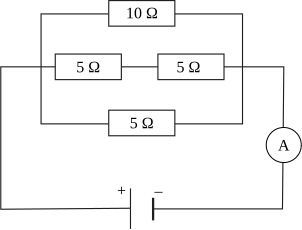
A camping lantern consists of four smaller light bulbs, each of which can be modelled as an ohmic resistor. The lantern is powered by a 9 V battery, as shown in the circuit diagram.
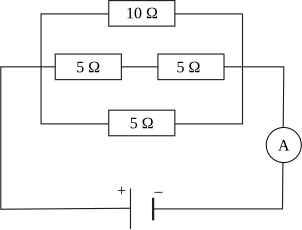
 

  1. Calculate the current measured by the ammeter in the circuit.   (3 marks)

--- 5 WORK AREA LINES (style=lined) ---

  1. Determine the amount of electrical energy used by the lantern over a period of 2 hours.   (2 marks)

--- 4 WORK AREA LINES (style=lined) ---
Show Answers Only

a.    \(3.6\ \text{A}\)

b.    \(233\,280\ \text{J}\)

Show Worked Solution

a.    Combining the resistors in series:

\(R_{\text{series}} = 5 + 5 = 10\ \Omega\).
 

Combing the resistors in parallel:

\(\dfrac{1}{R_T}\) \(=\dfrac{1}{10} + \dfrac{1}{10} + \dfrac{1}{5} = \dfrac{2}{5}\)  
\(R_T\) \(=2.5\ \Omega\)  

 
The current through circuit can be calculated through Ohm’s law:

\(I_{\text{circuit}} = \dfrac{V_{\text{circuit}}}{R_T} = \dfrac{9}{2.5} = 3.6\ \text{A}\).
 

b.    \(P = IV = 3.6 \times 9 = 32.4\ \text{W}\)

\(E = P\Delta t = 32.4 \times (2 \times 60 \times 60) = 233\,280\ \text{J}\)

Filed Under: Electric Circuits Tagged With: Band 4, Band 5, smc-4284-10-V=IR, smc-4284-20-Resistence in circuits, smc-4284-30-Power

PHYSICS, M4 EQ-Bank 9

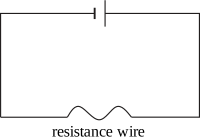
Jordan is investigating how the resistance of an ohmic resistance wire changes with its length. They have set up a circuit and have access to a voltmeter, ammeter, and a ruler.
 

Explain how Jordan should collect the necessary data for this experiment.   (5 marks)

--- 10 WORK AREA LINES (style=lined) ---

Show Answers Only
  • v
Show Worked Solution
  • To begin the investigation, Jordan should use a ruler to accurately measure different lengths of the resistance wire. For each selected length, they should connect the wire into the circuit and ensure the power supply remains at a constant voltage.
  • Jordan should then use an ammeter in series to record the current flowing through the circuit and place a voltmeter in parallel across the length of wire being tested to measure the potential difference.
  • Using the formula  \(R=\dfrac{V}{I}\)​, they can calculate the resistance for each length tested. This process should be repeated for several different lengths of wire.
  • To analyse the results, Jordan should plot a graph of resistance versus length. The shape and trend of the graph will show how resistance depends on the length of the wire.
  • Throughout the experiment, Jordan should ensure that other variables such as the wire’s material, thickness (cross-sectional area), and temperature remain constant to maintain a fair test.

Filed Under: Electric Circuits Tagged With: Band 4, Band 5, smc-4284-20-Resistence in circuits

PHYSICS, M4 EQ-Bank 10 MC

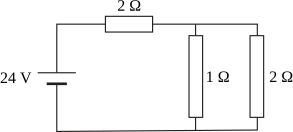
Determine the current flowing through the \(2\ \Omega\) resistor in parallel in the following circuit.
 

  1. \(\text{3 A}\)
  2. \(\text{6 A}\)
  3. \(\text{9 A}\)
  4. \(\text{12 A}\)
Show Answers Only

\(A\)

Show Worked Solution
\(\dfrac{1}{R_{\text{parallel}}}\) \(=\dfrac{1}{1} + \dfrac{1}{2} = \dfrac{3}{2}\)  
\(R_{\text{parallel}}\) \(= \dfrac{2}{3}\ \Omega\)  
\(R_T\) \(= \dfrac{2}{3} +2 = 2.67\ \Omega\)  
  •  The current through the circuit is:
  •    \(I_{\text{circuit}} = \dfrac{V}{R_T} = \dfrac{24}{2.67} = 9\ \text{A}\)
  • The voltage drop across the \(2\ \Omega\) resistor in series is:
  •    \(V = I_{\text{circuit}} \times R = 9 \times 2 = 18\ \text{V}\).
  • Therefore each resistor in parallel has a \(6\ \text{V}\) drop across it. 
  • Current through \(2\ \Omega\) resistor \(=\dfrac{V}{R} = \dfrac{6}{2} = 3\ \text{A}\)

\(\Rightarrow A\)

Filed Under: Electric Circuits Tagged With: Band 4, smc-4284-10-V=IR, smc-4284-20-Resistence in circuits

PHYSICS, M4 EQ-Bank 9 MC

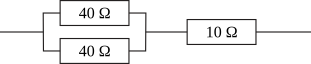
The resistors in the circuit diagram below are connected in a combination of series and/or parallel.
 

To simplify the circuit, this network of resistors can be replaced by a single resistor with an equivalent resistance of:

  1.  \(90\ \Omega\)
  2. \(70\ \Omega\)
  3. \(50\ \Omega\)
  4. \(30\ \Omega\)
Show Answers Only

\(D\)

Show Worked Solution
\(\dfrac{1}{R_{\text{para}}}\) \(=\dfrac{1}{40} + \dfrac{1}{40} = \dfrac{1}{20}\)  
\(R_{\text{para}}\) \(=20\ \Omega\)  

 
\(R_T = 20 + 10 = 30\ \Omega\)

\(\Rightarrow D\)

Filed Under: Electric Circuits Tagged With: Band 3, smc-4284-20-Resistence in circuits

PHYSICS, M4 EQ-Bank 3

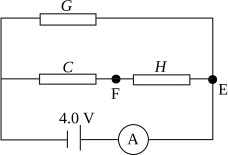
Three resistors, \(C\), \(H\) and \(G\) are connected to a 4.0 V battery.
 

The current flowing through the ammeter is 4.0 A and the resistance of \(C\) and \(G\) are 2.0 \(\Omega\) and 1.5 \(\Omega\) respectively. The resistance of \(H\) is unknown.

  1. Calculate the total resistance of the circuit.   (1 mark)

--- 2 WORK AREA LINES (style=lined) ---

  1. Calculate the resistance of resistor \(H\).   (2 marks)

--- 4 WORK AREA LINES (style=lined) ---
Show Answers Only

a.    \(1\ \Omega\)

b.    \(1\ \Omega\)

Show Worked Solution

a.    \(R= \dfrac{V}{I} =\dfrac{4.0}{4.0} =1\ \Omega\).
  

b.    The total resistance \(R_1\) across \(C\) and \(H\) is \(2 + R_H\ \Omega\).

The total resistance in the parallel circuit is:

\(\dfrac{1}{R_T}\) \(=\dfrac{1}{R_1} + \dfrac{1}{G}\)  
\(\dfrac{1}{1}\) \(=\dfrac{1}{2+R_H} + \dfrac{1}{1.5}\)  
\(\dfrac{1}{2+R_H}\) \(=\dfrac{1}{3}\)  
\(R_H\) \(=1\ \Omega\)  

Filed Under: Electric Circuits Tagged With: Band 3, Band 4, smc-4284-20-Resistence in circuits, smc-4284-50-Parallel Circuits

PHYSICS, M4 EQ-Bank 5 MC

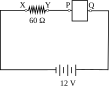
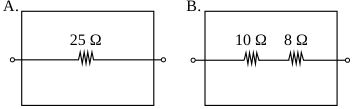
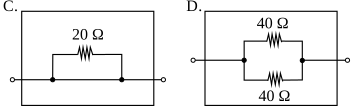
A student sets up an electric circuit with a power supply providing a total potential difference of 12 V. A 60 \(\Omega\) resistor is connected between terminals \(\text{X}\) and \(\text{Y}\), causing a voltage drop of 9 V across it, along with a mystery component between terminals \(\text{P}\) and \(\text{Q}\), which is part of the same circuit.


Which of the following components could be connected between \(\text{P}\) and \(\text{Q}\)?


Show Answers Only

\(D\)

Show Worked Solution
  • If the voltage drop between terminals \(\text{X}\) and \(\text{Y}\) was 9 V we can use  \(V=IR\)  to work out the current in the circuit.
  •    \(I = \dfrac{V}{R} = \dfrac{9}{60} = 0.15\ \text{A}\).
  • As the voltage drop across the mystery component must be 3 V, the total resistance of the mystery component must be:
  •    \(R = \dfrac{V}{I} = \dfrac{3}{0.15} = 20\ \Omega\)

Consider each option:

\(A\): \(25\ \Omega\ \cross\)

\(B\): \(18\ \Omega\ \cross\)

\(C\): As the resistor is connected in parallel, it will be irrelevant to the circuit. Hence \(C\) is equivalent to \(0\ \Omega\ \cross\)

\(D\): \(\dfrac{1}{R_T} = \dfrac{1}{40} + \dfrac{1}{40} = \dfrac{1}{20}\ \ \Rightarrow\ \ R_T = 20\ \Omega\)

\(\Rightarrow D\)

Filed Under: Electric Circuits Tagged With: Band 5, smc-4284-10-V=IR, smc-4284-20-Resistence in circuits

PHYSICS, M4 EQ-Bank 3 MC

Which of the following describes what happens to a circuit when more resistors are added in parallel?

  1. The total resistance increases and the total current decreases.
  2. The total current increases while the total resistance decreases.
  3. The voltage across each resistor increases.
  4. The total resistance remains unchanged.
Show Answers Only

\(B\)

Show Worked Solution
  • When resistors are connected in parallel, each new resistor provides an additional path for current to flow.
  • This increases the total current in the circuit because more charge can move through the circuit per unit of time.
  • At the same time, the total resistance of the circuit decreases because the overall opposition to current is reduced when multiple pathways are available. This is the opposite of what happens when resistors are added in series, where resistance increases.
  • The voltage across each resistor in a parallel circuit remains the same as the source voltage.

\(\Rightarrow B\)

Filed Under: Electric Circuits Tagged With: Band 4, smc-4284-20-Resistence in circuits, smc-4284-50-Parallel Circuits

PHYSICS, M4 EQ-Bank 1

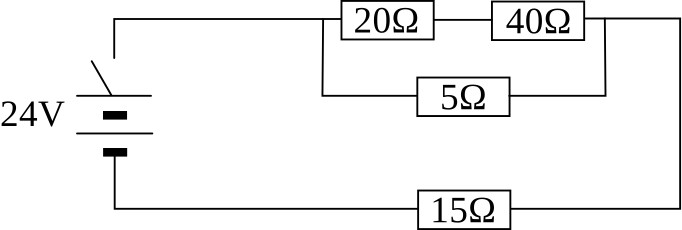
The following circuit has 4 resistors and a 24 V DC supply with a switch.
 

  1. Calculate the value of the single resistor that is equivalent to the 5 \(\Omega\), 20 \(\Omega\), and 40 \(\Omega\) resistors.   (2 marks)

    --- 3 WORK AREA LINES (style=lined) ---
  2. Determine the potential difference across the 15 \(\Omega\) resistor when the switch is closed.   (2 mark)

    --- 5 WORK AREA LINES (style=lined) ---
  3. Determine the current through the 5 \(\Omega\) resistor when the switch is closed.   (2 mark)

    --- 5 WORK AREA LINES (style=lined) ---
Show Answers Only

a.    \(4.6\ \Omega\)

b.    \(18.37\ \text{V}\)

c.   \(1.126\ \text{A}\)

Show Worked Solution
a.     \(R_{series}\) \(= 20 + 40 = 60\ \Omega\)
  \(\dfrac{1}{R_T}\) \(=\dfrac{1}{60}+\dfrac{1}{5}=\dfrac{13}{60}\)
  \(R_T\) \(=\dfrac{60}{13}=4.6\ \Omega\)


b.   \(R_{circuit} = 4.6 +15 = 19.6\ \Omega\)

Circuit current:

\(I=\dfrac{V}{R}=\dfrac{24}{19.6}=1.2245\ \text{A}\)
 

Potential difference across the 15 \(\Omega\) resistor:

\(V=IR=1.2245 \times 15=18.37\ \text{V}\)
 

c.   Potential difference across the 5 \(\Omega\) resistor: 

\(V_{(5\ \Omega)}=24-18.37= 5.63\ \text{V}\)
 

Current through the \(5\ \Omega\) resistor:

\(I=\dfrac{V}{R}=\dfrac{5.63}{5}=1.126\ \text{A}\)

Filed Under: Electric Circuits Tagged With: Band 3, Band 4, smc-4284-10-V=IR, smc-4284-20-Resistence in circuits

PHYSICS, M4 2020 VCE 18a

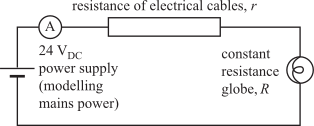
Students are modelling the effect of the resistance of electrical cables, \(r\), on the transmission of electrical power. They model the cables using the circuit shown in the diagram.
 

The 24 V DC power supply models the mains power.

Describe the effect of increasing the resistance of the electrical cables, \(r\), on the brightness of the constant resistance globe, \(R\).   (2 marks)

--- 5 WORK AREA LINES (style=lined) ---
Show Answers Only

Increasing the resistance of the electrical cables:

  • Increases the power used by the electrical cables  \(P=IV\). This results in less power in the circuit for the resistance light globe.
  • Therefore, the brightness of the resistance light globe will decrease.

Show Worked Solution

Increasing the resistance of the electrical cables:

  • Increases the power used by the electrical cables  \(P=IV\). This results in less power in the circuit for the resistance light globe.
  • Therefore, the brightness of the resistance light globe will decrease.

Filed Under: Electric Circuits Tagged With: Band 4, smc-4284-20-Resistence in circuits

PHYSICS, M4 2020 VCE 18

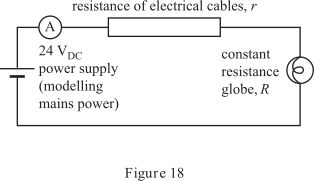
Students are modelling the effect of the resistance of electrical cables, \(r\), on the transmission of electrical power. They model the cables using the circuit shown in Figure 18.
 

The students investigate the effect of changing \(r\) by measuring the current in the electrical cables for a range of values. Their results are shown in Table 1 below.
 

\begin{array} {|c|c|c|}
\hline
\rule{0pt}{2.5ex} \text{Resistance of cables,}\ r\ (\Omega) \rule[-1ex]{0pt}{0pt} & \text{Current in cables},\ i\ (\text{A}) & \ \ \ \dfrac{1}{i} \Big{(}\text{A}^{-1}\Big{)}\ \ \  \\
\hline
\rule{0pt}{2.5ex} 2.4 \rule[-1ex]{0pt}{0pt} & 2.4 &  \\
\hline
\rule{0pt}{2.5ex} 3.6 \rule[-1ex]{0pt}{0pt} & 2.0 &  \\
\hline
\rule{0pt}{2.5ex} 6.4 \rule[-1ex]{0pt}{0pt} & 1.7 &  \\
\hline
\rule{0pt}{2.5ex} 7.6 \rule[-1ex]{0pt}{0pt} & 1.5 &  \\
\hline
\rule{0pt}{2.5ex} 10.4 \rule[-1ex]{0pt}{0pt} & 1.3 &  \\
\hline
\end{array}

  1. To analyse the data, the students use the following equation to calculate the resistance of the cables for the circuit.
  2.         \(r=\dfrac{24}{i}-R\)
  3. Show that this equation is true for the circuit shown in Figure 18. Show your working.  (2 marks)

    --- 3 WORK AREA LINES (style=lined) ---
  4. Calculate the values of \(\dfrac{1}{i}\) and write them in the spaces provided in the last column of Table 1 . (1 mark)

    --- 0 WORK AREA LINES (style=lined) ---
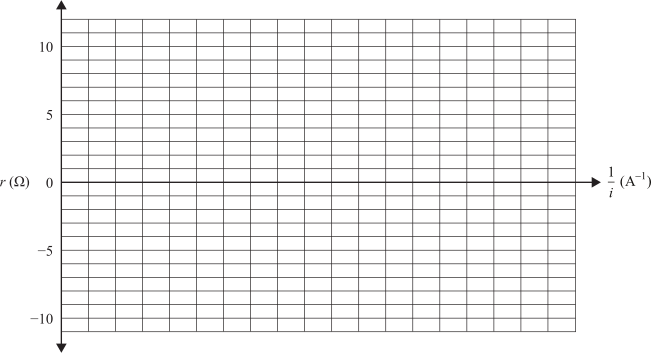
  5. Plot a graph of \(r\) on the \(y\)-axis against \(\dfrac{1}{i}\) on the \(x\)-axis on the grid provided below. On your graph:
    • choose an appropriate scale and numbers for the \(x\)-axis
    • draw a straight line of best fit through the plotted points  (3 marks)


--- 0 WORK AREA LINES (style=lined) ---
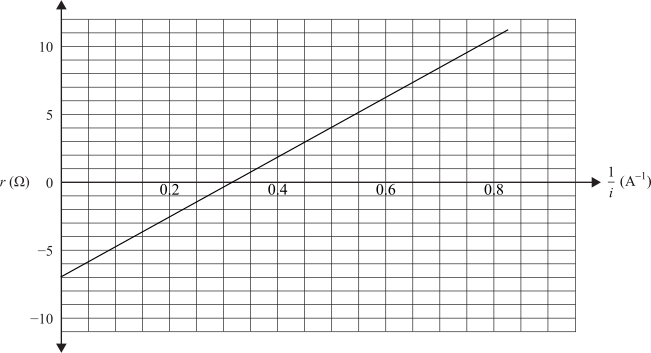
  1. Use the straight line of best fit to find the value of the constant resistance globe, \(R\). Give your reasoning.  (2 marks)

    --- 5 WORK AREA LINES (style=lined) ---
Show Answers Only

a.      \(V\) \(=iR\)  
\(V\) \(=i(r+R)\)  
\(\dfrac{V}{i}\) \(=r+R\)  
\(r\) \(=\dfrac{V}{i}-R\)  
\(r\) \(=\dfrac{24}{i}-R\)  

b.   

\begin{array} {|c|c|c|}
\hline
\rule{0pt}{2.5ex} \text{Resistance of cables,}\ r\ (\Omega) \rule[-1ex]{0pt}{0pt} & \text{Current in cables},\ i\ (\text{A}) & \ \ \ \dfrac{1}{i} \Big{(}\text{A}^{-1}\Big{)}\ \ \  \\
\hline
\rule{0pt}{2.5ex} 2.4 \rule[-1ex]{0pt}{0pt} & 2.4 & 0.42 \\
\hline
\rule{0pt}{2.5ex} 3.6 \rule[-1ex]{0pt}{0pt} & 2.0 & 0.5 \\
\hline
\rule{0pt}{2.5ex} 6.4 \rule[-1ex]{0pt}{0pt} & 1.7 & 0.59 \\
\hline
\rule{0pt}{2.5ex} 7.6 \rule[-1ex]{0pt}{0pt} & 1.5 & 0.67 \\
\hline
\rule{0pt}{2.5ex} 10.4 \rule[-1ex]{0pt}{0pt} & 1.3 & 0.77 \\
\hline
\end{array}

c.    
       

d.    The equation for the line:  \(r=\dfrac{24}{i}-R\).

  • The \(y\)-intercept of the graph correlates to the value of \(R\).
  • Reading from the graph, \(R= 7\ \Omega\).

Show Worked Solution

a.      \(V\) \(=iR\)  
\(V\) \(=i(r+R)\)  
\(\dfrac{V}{i}\) \(=r+R\)  
\(r\) \(=\dfrac{V}{i}-R\)  
\(r\) \(=\dfrac{24}{i}-R\)  
♦♦ Mean mark (a) 37%.

b.   

\begin{array} {|c|c|c|}
\hline
\rule{0pt}{2.5ex} \text{Resistance of cables,}\ r\ (\Omega) \rule[-1ex]{0pt}{0pt} & \text{Current in cables},\ i\ (\text{A}) & \ \ \ \dfrac{1}{i} \Big{(}\text{A}^{-1}\Big{)}\ \ \  \\
\hline
\rule{0pt}{2.5ex} 2.4 \rule[-1ex]{0pt}{0pt} & 2.4 & 0.42 \\
\hline
\rule{0pt}{2.5ex} 3.6 \rule[-1ex]{0pt}{0pt} & 2.0 & 0.5 \\
\hline
\rule{0pt}{2.5ex} 6.4 \rule[-1ex]{0pt}{0pt} & 1.7 & 0.59 \\
\hline
\rule{0pt}{2.5ex} 7.6 \rule[-1ex]{0pt}{0pt} & 1.5 & 0.67 \\
\hline
\rule{0pt}{2.5ex} 10.4 \rule[-1ex]{0pt}{0pt} & 1.3 & 0.77 \\
\hline
\end{array}

c.    
       

d.    The equation for the line:  \(r=\dfrac{24}{i}-R\).

  • The \(y\)-intercept of the graph correlates to the value of \(R\).
  • Reading from the graph, \(R= 7\ \Omega\).
♦♦ Mean mark (d) 33%.

Filed Under: Electric Circuits Tagged With: Band 5, Band 6, smc-4284-10-V=IR, smc-4284-20-Resistence in circuits, smc-4284-40-Heating effects of current

Copyright © 2014–2025 SmarterEd.com.au · Log in