SmarterEd

Aussie Maths & Science Teachers: Save your time with SmarterEd

  • Login
  • Get Help
  • About

PHYSICS, M4 EQ-Bank 5

A circuit contains two switches, S\(_1\) and S\(_2\). The configuration of the circuit changes depending on which of the switches are open.
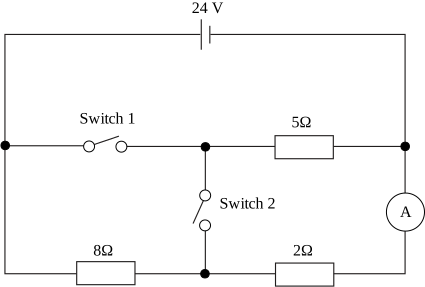
 

  1. S\(_1\) is closed and S\(_2\) is open. What current would the ammeter display, assuming ideal conditions?   (2 marks)

--- 3 WORK AREA LINES (style=lined) ---

  1. The switch S\(_1\) is open, and S\(_2\) is closed. What is the equivalent resistance of the circuit in this configuration?  (2 marks)

--- 3 WORK AREA LINES (style=lined) ---

  1. Both S\(_1\) and S\(_2\) are now closed. Calculate the power dissipated by the \(2\ \Omega\) resistor under this condition.  (2 marks)

--- 3 WORK AREA LINES (style=lined) ---

Show Answers Only

a.    \(2.4\ \text{A}\)

b.    \(9.43\ \Omega\)

c.    \(288\ \text{W}\)

Show Worked Solution

a.    When S\(_1\) is closed and S\(_2\) is open:

  • The circuit becomes a parallel circuit where the bottom branch contains both the \(2\ \Omega\) and \(8\ \Omega\) resistor. 
  • The voltage through each arm of the parallel circuit is equal to the total voltage which is equal to \(24\ \text{V}\).
  • Therefore, the reading on the ammeter  \(I = \dfrac{V}{R} = \dfrac{24}{10} = 2.4\ \text{A}\)
     

b.    When the switch S\(_1\) is open, and S\(_2\) is closed:

  • The resistance in the parallel part of the circuit \((5\ \Omega\) and \(2\ \Omega)\) resistors is calculated by:
\(\dfrac{1}{R}\) \(=\dfrac{1}{5} + \dfrac{1}{2} = \dfrac{7}{10}\)  
\(R\) \(=\dfrac{10}{7}\ \Omega\)  

 
Total resistance through the circuit \(= \dfrac{10}{7} + 8 = 9.43\ \Omega\).
 

c.    When both S\(_1\) and S\(_2\) are closed:

  • The system acts as a parallel circuit through the \(5\ \Omega\) and \(2\ \Omega\) resistors and then all current will pass through the switch as it has no resistance and no current will pass through the \(8\ \Omega\) resistor.
  • Therefore the voltage drop over the \(2\ \Omega\) resistor will be \(24\ \text{V}\)
  • By combining  \(P= IV\)  and  \(V=IR\):
  •    \(P = \dfrac{V^2}{R} = \dfrac{24^2}{2} = 288\ \text{W}\)

Filed Under: Electric Circuits Tagged With: Band 4, Band 5, smc-4284-10-V=IR, smc-4284-30-Power, smc-4284-50-Parallel Circuits

PHYSICS, M4 EQ-Bank 8 MC

In the circuit shown, the currents \(I_T\), \(I_1\) and \(I_2\) are all positive and flow in the directions indicated. The voltage drops across each resistor are labelled \(V_1\), \(V_2\), \(V_3\) and \(V_4\), and the total voltage from the battery is \(V_T\)​.
 

Which of the following equations is correct?

  1. \(V_1 + V_2 = V_3 + V_4\)​
  2. \(V_T = V_1 + V_2 + V_3 + V_4\)​
  3. \(V_1 = V_3\)​
  4. \(V_1 = V_2\)​
Show Answers Only

\(A\)

Show Worked Solution
  • In a parallel circuit, the voltage across each branch is the same and equal to the source voltage.
  • Hence \(V_1+V_2 = V_T = V_3 + V_4\).

\(\Rightarrow A\)

Filed Under: Electric Circuits Tagged With: Band 4, smc-4284-50-Parallel Circuits

PHYSICS, M4 EQ-Bank 7 MC

Consider the circuit below.
 

The readings on the meters are \(I_1\), \(I_2\), \(V_1\) and \(V_2\). Which of the following pairs of inequalities are correct.

  1. \(I_1 > I_2\) and \(V_1 > V_2\)
  2. \(I_1 > I_2\) and \(V_1 < V_2\)
  3. \(I_1 < I_2\) and \(V_1 > V_2\)
  4. \(I_1 < I_2\) and \(V_1 < V_2\)
Show Answers Only

\(A\)

Show Worked Solution
  • Let the supplied voltage to the circuit be 25 V.
  • The total resistance of the 4 \(\Omega\) and 8 \(\Omega\) resistors are:
\(\dfrac{1}{R_{T_1}}\) \(= \dfrac{1}{8} + \dfrac{1}{4} = \dfrac{3}{8}\)  
\(R_{T_1}\) \(=\dfrac{8}{3}\ \Omega\)  
  •  Similarly, the total resistance of the 3 \(\Omega\) and 3 \(\Omega\) resistors are:
\(\dfrac{1}{R_{T_2}}\) \(= \dfrac{1}{3} + \dfrac{1}{3} = \dfrac{2}{3}\)
\(R_{T_2}\) \(=\dfrac{3}{2}\ \Omega\)
  •  The total resistance of the circuit is \(\dfrac{8}{3} + \dfrac{3}{2} = \dfrac{25}{6}\ \Omega\)
  • The total current running through circuit is:
  •    \(I = \dfrac{V}{R} = \dfrac{25}{\frac{25}{6}} = 6\ \text{A}\)
  • The voltage drop across the first two resistors \(=R_{T_1} \times I = \dfrac{8}{3} \times 6 = 16\ \text{V}\)
  • Therefore the voltage drop across the second two resistors \(=25-16 = 9\ \text{V}\)
  • As the voltage across each branch of a parallel circuit is the same and equal to the total voltage drop, \(V_1 > V_2\)
  • The current in each branch of a parallel circuit is split depending on the resistance of each branch. 
  •    \(I_1 = \dfrac{V}{R} = \dfrac{16}{4} = 4\ \text{A}\)
  •    \(I_2 = \dfrac{V}{R} = \dfrac{9}{3} = 3\ \text{A}\)

\(\therefore I_1 > I_2\)

\(\Rightarrow A\)

Filed Under: Electric Circuits Tagged With: Band 6, smc-4284-10-V=IR, smc-4284-50-Parallel Circuits, smc-4284-60-Voltmeters/Ammeters

PHYSICS, M4 EQ-Bank 3

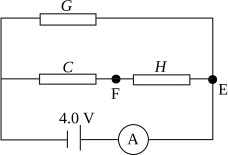
Three resistors, \(C\), \(H\) and \(G\) are connected to a 4.0 V battery.
 

The current flowing through the ammeter is 4.0 A and the resistance of \(C\) and \(G\) are 2.0 \(\Omega\) and 1.5 \(\Omega\) respectively. The resistance of \(H\) is unknown.

  1. Calculate the total resistance of the circuit.   (1 mark)

--- 2 WORK AREA LINES (style=lined) ---

  1. Calculate the resistance of resistor \(H\).   (2 marks)

--- 4 WORK AREA LINES (style=lined) ---

Show Answers Only

a.    \(1\ \Omega\)

b.    \(1\ \Omega\)

Show Worked Solution

a.    \(R= \dfrac{V}{I} =\dfrac{4.0}{4.0} =1\ \Omega\).
  

b.    The total resistance \(R_1\) across \(C\) and \(H\) is \(2 + R_H\ \Omega\).

The total resistance in the parallel circuit is:

\(\dfrac{1}{R_T}\) \(=\dfrac{1}{R_1} + \dfrac{1}{G}\)  
\(\dfrac{1}{1}\) \(=\dfrac{1}{2+R_H} + \dfrac{1}{1.5}\)  
\(\dfrac{1}{2+R_H}\) \(=\dfrac{1}{3}\)  
\(R_H\) \(=1\ \Omega\)  

Filed Under: Electric Circuits Tagged With: Band 3, Band 4, smc-4284-20-Resistence in circuits, smc-4284-50-Parallel Circuits

PHYSICS, M4 EQ-Bank 2

The circuit shown below contains three identical light bulbs: \(\text{X}\), \(\text{Y}\), and \(\text{Z}\), connected to a DC power supply and a switch \(\text{S}\).

  1. When switch \(\text{S}\) is open, compare the brightness of bulbs \(\text{X}\), \(\text{Y}\), and \(\text{Z}\).   (2 marks)

--- 4 WORK AREA LINES (style=lined) ---

  1. When switch \(\text{S}\) is closed, compare the brightness of bulbs \(\text{X}\), \(\text{Y}\), and \(\text{Z}\). Be quantitative in your reasoning.   (3 marks)

--- 6 WORK AREA LINES (style=lined) ---

Show Answers Only

a.   When the switch is open:

  • \(\text{X}\) and \(\text{Y}\) are in series, have equal resistance and the current through each is the same.
  • Using  \(P= I^2R\), the power dissipated in each light bulb is the same. Therefore, \(\text{X}\) and \(\text{Y}\) have the same brightness.
  • \(\text{Z}\) is not in the circuit (as the switch \(\text{S}\) is open), so there is no current through \(\text{Z}\). Therefore, light bulb \(\text{Z}\) will not light up.
     

b.    When the switch is closed:

  • Since \(\text{Y}\) and \(\text{Z}\) are in parallel, they each get the same voltage. Given they have equal resistance, the current through each is equal and they will have equal brightness.
  • The voltage drop across bulb \(\text{X}\) will be the same as the voltage drop across \(\text{Y}\) and \(\text{Z}\) combined. Since \(\text{Y}\) and \(\text{Z}\) are connected in parallel, the voltage drop across each individual bulb will be half of the voltage drop across \(\text{X}\).
  • Using \(P= \dfrac{V^2}{R}\), the power dissipated in \(\text{X}\) will be four times larger than the power dissipated in either \(\text{Y}\) or \(\text{Z}\).
  • Therefore the brightness in \(\text{X}\) will be four times that of \(\text{Y}\) or \(\text{Z}\).
Show Worked Solution

a.   When the switch is open:

  • \(\text{X}\) and \(\text{Y}\) are in series, have equal resistance and the current through each is the same.
  • Using  \(P= I^2R\), the power dissipated in each light bulb is the same. Therefore, \(\text{X}\) and \(\text{Y}\) have the same brightness.
  • \(\text{Z}\) is not in the circuit (as the switch \(\text{S}\) is open), so there is no current through \(\text{Z}\). Therefore, light bulb \(\text{Z}\) will not light up.
     

b.    When the switch is closed:

  • Since \(\text{Y}\) and \(\text{Z}\) are in parallel, they each get the same voltage. Given they have equal resistance, the current through each is equal and they will have equal brightness.
  • The voltage drop across bulb \(\text{X}\) will be the same as the voltage drop across \(\text{Y}\) and \(\text{Z}\) combined. Since \(\text{Y}\) and \(\text{Z}\) are connected in parallel, the voltage drop across each individual bulb will be half of the voltage drop across \(\text{X}\).
  • Using \(P= \dfrac{V^2}{R}\), the power dissipated in \(\text{X}\) will be four times larger than the power dissipated in either \(\text{Y}\) or \(\text{Z}\).
  • Therefore the brightness in \(\text{X}\) will be four times that of \(\text{Y}\) or \(\text{Z}\).

Filed Under: Electric Circuits Tagged With: Band 4, Band 5, smc-4284-30-Power, smc-4284-50-Parallel Circuits

PHYSICS, M4 EQ-Bank 3 MC

Which of the following describes what happens to a circuit when more resistors are added in parallel?

  1. The total resistance increases and the total current decreases.
  2. The total current increases while the total resistance decreases.
  3. The voltage across each resistor increases.
  4. The total resistance remains unchanged.
Show Answers Only

\(B\)

Show Worked Solution
  • When resistors are connected in parallel, each new resistor provides an additional path for current to flow.
  • This increases the total current in the circuit because more charge can move through the circuit per unit of time.
  • At the same time, the total resistance of the circuit decreases because the overall opposition to current is reduced when multiple pathways are available. This is the opposite of what happens when resistors are added in series, where resistance increases.
  • The voltage across each resistor in a parallel circuit remains the same as the source voltage.

\(\Rightarrow B\)

Filed Under: Electric Circuits Tagged With: Band 4, smc-4284-20-Resistence in circuits, smc-4284-50-Parallel Circuits

PHYSICS, M4 EQ-Bank 2 MC

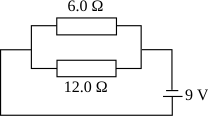
An electric circuit contains a 6.0 \(\Omega\) resistor and a 12.0 \(\Omega\) resistor connected in parallel. The circuit is powered by a 9.0 V battery.
 

What is the total current flowing through the circuit?

  1. 0.75 A
  2. 1.25 A
  3. 2.25 A
  4. 3.0 A
Show Answers Only

\(C\)

Show Worked Solution
  • The resistance in a parallel circuit is given by \(\dfrac{1}{R_T} = \dfrac{1}{R_1} + \dfrac{1}{R_2} \cdots \)
\(\dfrac{1}{R_T}\) \(=\dfrac{1}{6} + \dfrac{1}{12} = \dfrac{1}{4}\)  
\(R_T\) \(=4\ \Omega\)  
  •  Using  \(V=IR_T:\)
  • \(I=\dfrac{V}{R_T} = \dfrac{9}{4} = 2.25\ \text{A}\)

\(\Rightarrow C\)

Filed Under: Electric Circuits Tagged With: Band 4, smc-4284-10-V=IR, smc-4284-50-Parallel Circuits

Copyright © 2014–2025 SmarterEd.com.au · Log in