SmarterEd

Aussie Maths & Science Teachers: Save your time with SmarterEd

  • Login
  • Get Help
  • About

BIOLOGY, M1 2020 VCE 3

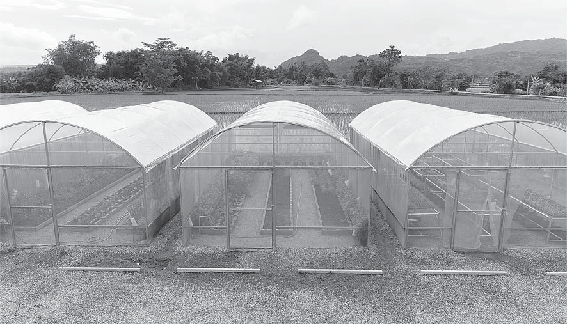
Greenhouses have been used to generate higher crop yields than open-field agriculture. To encourage plant growth in greenhouses, the conditions required for photosynthesis are controlled. Commercial greenhouses, like the ones shown below, often use a lot of energy for heating, ventilation, lighting and water.
  1. Consider the reactions of photosynthesis. Why would it be important to maintain the temperature within narrow limits in a commercial greenhouse? Justify your answer.  (2 marks)

    --- 5 WORK AREA LINES (style=lined) ---

  2. Scientists are developing a new material to cover greenhouses, which can split incoming light and convert the rays from green wavelengths into red wavelengths.
  3. Explain how this new material increases crop yields.  (2 marks)

    --- 4 WORK AREA LINES (style=lined) ---
Show Answers Only

a.    Temperature maintenance:

  • Photosynthesis is regulated by different enzymes which are intrinsic to numerous processes involved in photosynthesis.
  • If the temperature of a greenhouse is changed, then the enzymes may decrease in activity or denature, causing a reduction in the rate of photosynthesis or even ceasing it all together.
  • This can cause problems in the plants such as a reduction in growth or plant death. 

b.    Crop yield increases:

  • Red wavelengths of light are used during photosynthesis, while green light is reflected off the plants.
  • This technology will allow an increase in crop yields by increasing the amount of red light which increases the rate of photosynthesis.
Show Worked Solution

a.    Temperature maintenance:

  • Photosynthesis is regulated by different enzymes which are intrinsic to numerous processes involved in photosynthesis.
  • If the temperature of a greenhouse is changed, then the enzymes may decrease in activity or denature, causing a reduction in the rate of photosynthesis or even ceasing it all together.
  • This can cause problems in the plants such as a reduction in growth or plant death. 

b.    Crop yield increases:

  • Red wavelengths of light are used during photosynthesis, while green light is reflected off the plants.
  • This technology will allow an increase in crop yields by increasing the amount of red light which increases the rate of photosynthesis.

Filed Under: Cell Function Tagged With: Band 3, Band 5, smc-4303-10-Photosynthesis

BIOLOGY, M1 2021 VCE 6 MC

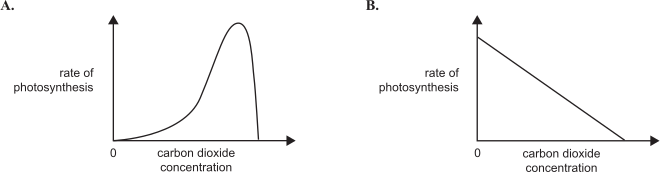
In a series of experiments, the rate of photosynthesis in plant cells was measured in environments with different concentrations of carbon dioxide. All other variables were kept constant.

Which one of the following graphs reflects the trend that would be shown by the results of these experiments?


Show Answers Only

\(C\)

Show Worked Solution
  • As carbon dioxide is a reactant in photosynthesis, increasing the concentration will lead to a higher rate of photosynthesis initially.
  • This rate of increase will plateau and eventually stop as all the active sites of involved enzymes are being used.
  • If this relationship was graphed, the shape seen would most accurately resemble that in graph \(C\).

\(\Rightarrow C\)

Filed Under: Cell Function Tagged With: Band 3, smc-4303-10-Photosynthesis, smc-4303-60-Enzymes

BIOLOGY, M1 2016 HSC 36ai

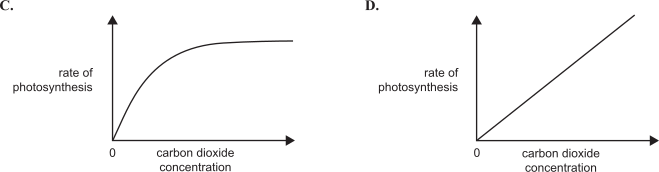
The diagram shows a plant cell organelle.

Name the organelle shown.  (1 mark)

--- 1 WORK AREA LINES (style=lined) ---

Show Answers Only
  • Chloroplast.
Show Worked Solution
  • Chloroplast.

Filed Under: Cell Function Tagged With: Band 4, smc-4303-10-Photosynthesis

BIOLOGY, M1 2017 HSC 36a

  1. Identify TWO reasons for studying photosynthesis.  (2 marks)

    --- 4 WORK AREA LINES (style=lined) ---
  2. What are the functions of the products of photosynthesis?  (2 marks)

    --- 3 WORK AREA LINES (style=lined) ---

Show Answers Only

i.     Studying the process of photosynthesis:

  • Leads to an understanding of how oxygen is produced.
  • Leads to an understanding of how raw materials can be produced for a range of human needs, such as in medicinal and agricultural fields. 

ii.    Functions of photosynthesis products:

  • The products of photosynthesis are oxygen and sugar.
  • They are used in cellular respiration in all cells which contain mitochondria, in both animals and plants.

Show Worked Solution

i.     Studying the process of photosynthesis:

  • Leads to an understanding of how oxygen is produced.
  • Leads to an understanding of how raw materials can be produced for a range of human needs, such as in medicinal and agricultural fields. 

ii.    Functions of photosynthesis products:

  • The products of photosynthesis are oxygen and sugar.
  • They are used in cellular respiration in all cells which contain mitochondria, in both animals and plants.

Filed Under: Cell Function Tagged With: Band 4, smc-4303-10-Photosynthesis

BIOLOGY, M1 2017 HSC 36e

Analyse the impact of the development of the electron microscope on the understanding of chloroplast structure and function.  (7 marks)

--- 14 WORK AREA LINES (style=lined) ---

Show Answers Only
  • Using light microscopes, scientists were able to view and identify chloroplasts. However, it wasn’t until the development of the electron microscope with its greater magnification and resolution, that scientists were able to view a chloroplast’s internal structure.
  • Structures such as the grana, stroma and thylakoids could then be identified. The role of each in the process of photosynthesis could then be studied.
  • Thylakoids are flattened, hollow discs which are arranged in stacks called grana. The stacking of the layers into grana increases stability and surface area for the capture of light.
  • The membranes of these thylakoids contain chlorophyll and are the site for the light-dependent reactions of photosynthesis.
  • The space outside the thylakoid is called the stroma, which is an aqueous fluid present within the inner membrane of the chloroplast. It contains DNA, ribosomes, lipid droplets and starch granules. This is where the light independent reactions, the Calvin cycle, takes place.
  • The functions described would not have been linked to the internal structures of the chloroplast without the development of an electron microscope.
Show Worked Solution
  • Using light microscopes, scientists were able to view and identify chloroplasts. However, it wasn’t until the development of the electron microscope with its greater magnification and resolution, that scientists were able to view a chloroplast’s internal structure.
  • Structures such as the grana, stroma and thylakoids could then be identified. The role of each in the process of photosynthesis could then be studied.
  • Thylakoids are flattened, hollow discs which are arranged in stacks called grana. The stacking of the layers into grana increases stability and surface area for the capture of light.
  • The membranes of these thylakoids contain chlorophyll and are the site for the light-dependent reactions of photosynthesis.
  • The space outside the thylakoid is called the stroma, which is an aqueous fluid present within the inner membrane of the chloroplast. It contains DNA, ribosomes, lipid droplets and starch granules. This is where the light independent reactions, the Calvin cycle, takes place.
  • The functions described would not have been linked to the internal structures of the chloroplast without the development of an electron microscope.

Filed Under: Cell Function, Cell Structure Tagged With: Band 4, Band 5, Band 6, smc-4302-30-Technology, smc-4303-10-Photosynthesis

BIOLOGY, M1 2018 HSC 35d

Construct a flow chart to summarise the main steps and products of the light-independent reactions of photosynthesis.  (5 marks)

Show Answers Only

Show Worked Solution

Filed Under: Cell Function Tagged With: Band 4, Band 5, smc-4303-10-Photosynthesis

BIOLOGY, M1 2018 HSC 23

  1. A student plans to investigate the effect of light intensity on transpiration in plants. 
  2. Complete the table, identifying features that this student should include to ensure valid experimental design.  (3 marks)

\begin{array} {|l|l|}
\hline
\rule{0pt}{2.5ex}\textit{Dependent variable}\rule[-1ex]{0pt}{0pt} &  \text{•}  \ \ \ \ \ \ \ \ \ \ \ \ \ \ \ \ \ \ \ \ \ \ \ \ \ \ \ \ \ \ \ \ \ \ \ \ \ \ \ \ \ \ \ \ \ \ \ \ \ \ \ \ \ \ \ \ \ \ \ \ \ \ \ \ \ \ \ \  \ \ \ \ \ \ \ \ \\
\hline
\rule{0pt}{2.5ex}\textit{Control}\rule[-1ex]{0pt}{0pt} &  \text{•} \\
\hline
\rule{0pt}{2.5ex}\textit{Variables to be kept constant}\rule[-1ex]{0pt}{0pt} &   \text{•} \\  &   \text{•} \\
\hline
\end{array}

  1. Explain ONE mechanism for the movement of materials in xylem vessels.  (2 marks)

    --- 4 WORK AREA LINES (style=lined) ---
Show Answers Only

a.   

\begin{array} {|l|l|}
\hline
\rule{0pt}{2.5ex}\textit{Dependent variable}\rule[-1ex]{0pt}{0pt} &  \text{• Amount of water lost}  \\
\hline
\rule{0pt}{2.5ex}\textit{Control}\rule[-1ex]{0pt}{0pt} &  \text{• Plant kept in the dark} \\
\hline
\rule{0pt}{2.5ex}\textit{Variables to be kept constant}\rule[-1ex]{0pt}{0pt} &   \text{• Plant type} \\  &   \text{• Temperature} \\
\hline
\end{array}
 

b.    Water molecules have chemical properties which make them cohesive.

  • Due to this, when water evaporates or transpires, other water molecules are pulled up the xylem vessels.
  • This is one of the core mechanisms that drives the movement of water from roots to leaves.

Show Worked Solution

a.   

\begin{array} {|l|l|}
\hline
\rule{0pt}{2.5ex}\textit{Dependent variable}\rule[-1ex]{0pt}{0pt} &  \text{• Amount of water lost}  \\
\hline
\rule{0pt}{2.5ex}\textit{Control}\rule[-1ex]{0pt}{0pt} &  \text{• Plant kept in the dark} \\
\hline
\rule{0pt}{2.5ex}\textit{Variables to be kept constant}\rule[-1ex]{0pt}{0pt} &   \text{• Plant type} \\  &   \text{• Temperature} \\
\hline
\end{array}

♦ Mean mark (a) 54%.

 b.    Water molecules have chemical properties which make them cohesive.

  • Due to this, when water evaporates or transpires, other water molecules are pulled up the xylem vessels.
  • This is one of the core mechanisms that drives the movement of water from roots to leaves. 

Filed Under: Cell Function Tagged With: Band 4, Band 5, smc-4303-10-Photosynthesis, smc-4303-30-Movement of materials

Copyright © 2014–2025 SmarterEd.com.au · Log in