SmarterEd

Aussie Maths & Science Teachers: Save your time with SmarterEd

  • Login
  • Get Help
  • About

BIOLOGY, M1 2021 VCE 6 MC

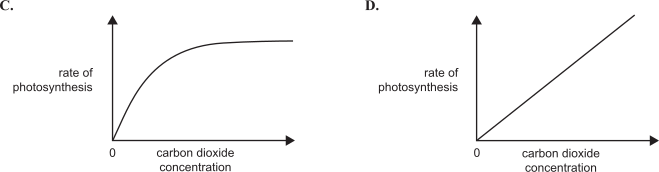
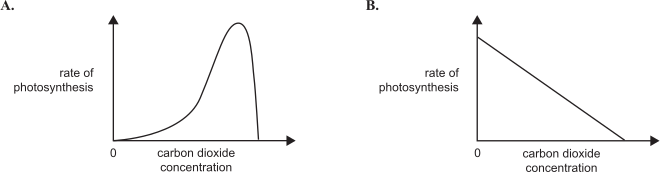
In a series of experiments, the rate of photosynthesis in plant cells was measured in environments with different concentrations of carbon dioxide. All other variables were kept constant.

Which one of the following graphs reflects the trend that would be shown by the results of these experiments?


Show Answers Only

\(C\)

Show Worked Solution
  • As carbon dioxide is a reactant in photosynthesis, increasing the concentration will lead to a higher rate of photosynthesis initially.
  • This rate of increase will plateau and eventually stop as all the active sites of involved enzymes are being used.
  • If this relationship was graphed, the shape seen would most accurately resemble that in graph \(C\).

\(\Rightarrow C\)

Filed Under: Cell Function Tagged With: Band 3, smc-4303-10-Photosynthesis, smc-4303-60-Enzymes

BIOLOGY, M1 2022 VCE 19 MC

Enzymes are associated with the biochemical pathways of cellular respiration and photosynthesis.

Consider a cell that carries out both cellular respiration and photosynthesis.

Which one of the following is a correct statement about the enzymes associated with these pathways?

  1. Both pathways are catalysed by the same enzymes.
  2. An increase in pH above the optimal pH for cellular respiration may cause the enzymes to denature.
  3. The rates of these biochemical pathway reactions are not affected by changes in the concentrations of the enzymes.
  4. A drastic increase in temperature above the optimal temperature for photosynthesis will cause an increase in the rate of photosynthesis.
Show Answers Only

\(B\)

Show Worked Solution

By Elimination

  • While the net chemical equations for photosynthesis and cellular respiration appear to be the reverse of each other, each reaction is made up of various processes which require different reaction conditions, including different enzymes (Eliminate A).
  • Enzyme concentrations can increase/decrease the amount of available active sites which can change the rate of reaction rate (Eliminate C).
  • A large increase in temperature would not increase reaction rate but would denature the enzymes (Eliminate D).
  • Changes in various factors, including pH, can denature an enzyme if the change is outside the optimal range for that factor.

\(\Rightarrow B\)

Filed Under: Cell Function Tagged With: Band 3, smc-4303-60-Enzymes

BIOLOGY, M1 2013 HSC 19 MC

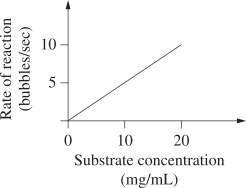
An enzyme was extracted from a mammal. The graph shows the rate at which bubbles are produced in a reaction at 36°C using the extracted enzyme.
 

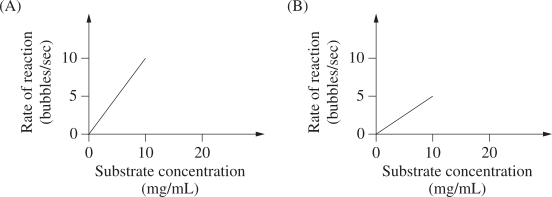
Which of the following graphs would show the results if the enzyme reaction were carried out at 18°C ?
 

Show Answers Only

\(D\)

Show Worked Solution
  • The reduction in temperature will reduce the reaction rate. Option D is the only graph which accurately represents this change in relevance to the original.

\(\Rightarrow D\)

Filed Under: Cell Function Tagged With: Band 4, smc-4303-60-Enzymes

BIOLOGY, M1 2014 HSC 19 MC

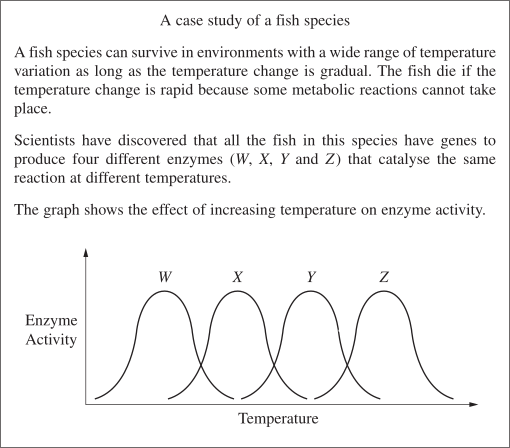
What is the best explanation for the fish surviving gradual temperature change but not a rapid temperature change?

  1. It takes time for each gene to be expressed.
  2. Enzyme activity is decreased at low temperatures.
  3. The fish produce different enzymes at different temperatures.
  4. Some enzymes will not denature if the temperature change is gradual.
Show Answers Only

\(A\)

Show Worked Solution
  • It takes time for each gene to be expressed, due to the time taken to both detect change and for the fish to create the optimal enzymes.
  • Rapid change would result in not enough time for the new enzyme to be utilised, and the fish may not survive due to denatured enzymes.

\(\Rightarrow A\)

♦♦♦ Mean mark 25%.

Filed Under: Cell Function Tagged With: Band 6, smc-4303-60-Enzymes

BIOLOGY, M1 2015 HSC 18 MC

Students conducted a large first-hand investigation into enzyme activity.

The aim in the report is shown.

Aim: To determine the optimum pH of four different enzymes.

How many independent variables were in this first-hand investigation?

  1. 1
  2. 2
  3. 4
  4. 5
Show Answers Only

\(B\)

Show Worked Solution
  • There are two independent variables, the pH and the selected enzyme. Both are changed in order to measure something, e.g. substrate concentration, in order to determine optimum pH for each of the enzymes individually.

\(\Rightarrow B\)

♦♦♦ Mean mark 22%.

Filed Under: Cell Function Tagged With: Band 6, smc-4303-60-Enzymes

BIOLOGY, M1 2015 HSC 5 MC

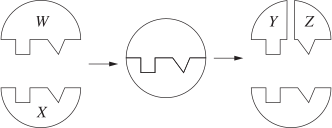
The diagram shows a model for enzyme action.
 

Which letter indicates the substrate in this diagram?

  1. \(W\)
  2. \(X\)
  3. \(Y\)
  4. \(Z\)
Show Answers Only

\(A\)

Show Worked Solution
  • \(W\) splits into 2 components, \(Y\) and \(Z\), indicating that this is the substrate being split into the products, while the molecule that remains in contact, \(X\) is the enzyme.

\(\Rightarrow A\)

Filed Under: Cell Function Tagged With: Band 4, smc-4303-60-Enzymes

BIOLOGY, M1 2016 HSC 5 MC

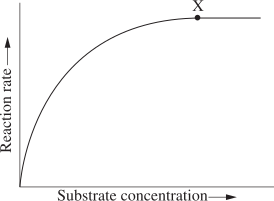
The graph shows the relationship between substrate concentration and reaction rate in an enzyme-catalysed reaction.
  

Why does the reaction rate NOT continue to increase after point \(X\)?

  1. The enzyme has been denatured.
  2. The substrate has been denatured.
  3. The enzyme is no longer acting as a catalyst.
  4. All the enzyme active sites are being occupied.
Show Answers Only

\(D\)

Show Worked Solution
  • The reason substrate concentration does not increase but reaction rate is still at it’s peak is due to all the enzyme active sites being occupied.

\(\Rightarrow D\)

Filed Under: Cell Function Tagged With: Band 4, smc-4303-60-Enzymes

BIOLOGY, M1 2017 HSC 20 MC

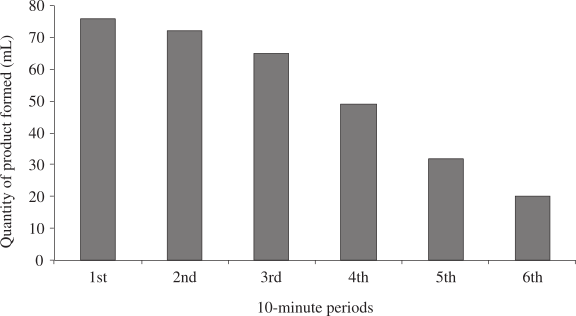
A student performed a valid enzyme-substrate experiment. At the end of each 10-minute period, the quantity of the gaseous product formed was collected,

removed and measured. The graph shows the results of this experiment.
 

Which of the following statements explains the trend shown in the graph?

  1. The rate of enzyme activity is decreasing.
  2. The concentration of the product is decreasing.
  3. The concentration of the enzyme is decreasing.
  4. The concentration of the substrate is decreasing.
Show Answers Only

\(D\)

Show Worked Solution
  • The graph shows that over the periods, the substrate concentration/quantity decreased.

\(\Rightarrow D\)

♦♦ Mean mark 37%.

Filed Under: Cell Function Tagged With: Band 5, smc-4303-60-Enzymes

BIOLOGY, M1 2012 HSC 24

You conducted first-hand investigations to test the effects of temperature, pH and substrate concentration on enzyme activity.

  1. Complete the following table by identifying the variables for ONE of your investigations.  (1 mark)

\begin{array} {|l|c|c|}
\hline
\rule{0pt}{2.5ex} \textit{Independent variable} \rule[-1ex]{0pt}{0pt} & \textit{Dependent variable} & \textit{Kept constant} \\
\hline
\rule{0pt}{2.5ex}   \rule[-1ex]{0pt}{0pt} & & \text{pH,} \\ & & \text{substrate concentration,} \\ \text{................................} & \text{................................} & \text{enzyme concentration} \\
\hline
\end{array}

--- 0 WORK AREA LINES (style=lined) ---

  1. Outline how you measured the activity of an enzyme in your investigation. In your answer, name the enzyme.  (2 marks)

    --- 3 WORK AREA LINES (style=lined) ---

  2. Describe how a condition needed for optimal enzyme activity would be expected to vary between endotherms and ectotherms.   (2 marks)

    --- 5 WORK AREA LINES (style=lined) ---

Show Answers Only

a.    Independent variable: Temperature

Dependent variable: Enzyme Activity
 

b.    Activity measure:

  • The activity of catalase is measured by the height of oxygen in a test tube when a fresh piece of raw potato is added to hydrogen peroxide. 

c.    Optimal enzyme activity:

  • The body temperature of ectotherms changes to be similar to the environment, while endotherms maintain a relatively stable internal temperature.
  • Enzyme activity is dependant on temperature.
  • Therefore, it is expected that an ectotherm’s enzymes can function effectively over a much greater temperature range as apposed to endotherms.

Show Worked Solution

a.    Independent variable: Temperature

Dependent variable: Enzyme Activity
 

b.    Activity measure:

  • The activity of catalase is measured by the height of oxygen in a test tube when a fresh piece of raw potato is added to hydrogen peroxide. 

c.    Optimal enzyme activity:

  • The body temperature of ectotherms changes to be similar to the environment, while endotherms maintain a relatively stable internal temperature.
  • Enzyme activity is dependant on temperature.
  • Therefore, it is expected that an ectotherm’s enzymes can function effectively over a much greater temperature range as apposed to endotherms.

Filed Under: Cell Function Tagged With: Band 4, smc-4303-60-Enzymes

BIOLOGY, M1 2014 HSC 28

Rennin is an enzyme found in the stomach of young mammals. Rennin curdles the milk drunk by the mammal and allows the milk solids to stay longer in the stomach to be further digested.

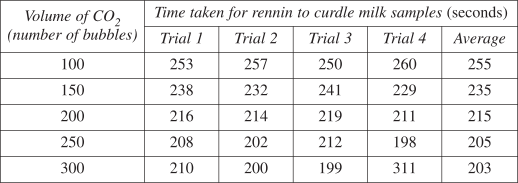
Students conducted an investigation into rennin activity. They bubbled different volumes of carbon dioxide gas into milk samples. Each sample was 50mL and was kept at a constant temperature. The students then added rennin to each milk sample and recorded the time taken for the milk to curdle.
 

  1. Account for the students' calculated average time for 300 bubbles of \( \ce{CO_2} \).  (2 marks)

    --- 4 WORK AREA LINES (style=lined) ---

  2. Explain the results of this experiment.  (4 marks)

    --- 8 WORK AREA LINES (style=lined) ---

Show Answers Only

a.    Calculating the average:

  • The outlier (311 seconds) was removed from the data set, then the remaining data points at 300 bubbles of \(\ce{CO_2}\) were averaged.
  • This was necessary as it is significantly different to other values for time taken to curdle at that \(\ce{CO_2}\) volume and allowed the calculated average to fall within the predetermined trend. 

b.    As bubbles of \(\ce{CO_2}\) increase, time to curdle decreases.

  • This scenario is explicitly seen between 100-200 bubbles, where the curdling time reduces by 20 seconds at each interval.
  • This means increased concentration of \(\ce{CO_2}\) also increases activity of the enzyme.
  • As \(\ce{CO_2}\) increases acidity of a solution, these results show us that rennin activity increases at reduced pH levels.
  • The slower increase of enzyme activity after 250 bubbles of \(\ce{CO_2}\) is due to the enzyme being close to its optimum pH where the enzyme activity graph flattens off at the peak of the curve.

Show Worked Solution

a.    Calculating the average:

  • The outlier (311 seconds) was removed from the data set, then the remaining data points at 300 bubbles of \(\ce{CO_2}\) were averaged.
  • This was necessary as it is significantly different to other values for time taken to curdle at that \(\ce{CO_2}\) volume and allowed the calculated average to fall within the predetermined trend. 
♦ Mean mark (a) 46%.

b.    As bubbles of \(\ce{CO_2}\) increase, time to curdle decreases.

  • This scenario is explicitly seen between 100-200 bubbles, where the curdling time reduces by 20 seconds at each interval.
  • This means increased concentration of \(\ce{CO_2}\) also increases activity of the enzyme.
  • As \(\ce{CO_2}\) increases acidity of a solution, these results show us that rennin activity increases at reduced pH levels.
  • The slower increase of enzyme activity after 250 bubbles of \(\ce{CO_2}\) is due to the enzyme being close to its optimum pH where the enzyme activity graph flattens off at the peak of the curve.
♦♦♦ Mean mark (b) 35%.

Filed Under: Cell Function Tagged With: Band 5, Band 6, smc-4303-60-Enzymes

BIOLOGY, M1 2013 HSC 25

The graph below shows the results obtained from testing the activity of a bacterial enzyme.
 

  1. Name ONE variable, other than temperature, that would have been controlled in the experiment.  (1 mark)

    --- 2 WORK AREA LINES (style=lined) ---

  2. For what temperature range does the enzyme display the maximum rate of change in activity?   (1 mark)

    --- 1 WORK AREA LINES (style=lined) ---

  3. Account for the activity of the enzyme at the parts of the graph labelled A, B, C and D.  (4 marks)

    --- 8 WORK AREA LINES (style=lined) ---

  4. Based on the information in the graph, suggest the type of environment in which these bacteria might survive. (1 mark)

    --- 1 WORK AREA LINES (style=lined) ---

Show Answers Only

a.    Answers could include:

  • pH
  • Enzyme concentration
  • Substrate concentration 

b.    89 – 93°C (D).

c.    Enzyme activity at each point:

A: A constant gradient indicates a constant increasing rate of enzyme activity as temperature increases.

B: Graph level at a maximum (10 μmol/s). Enzyme-substrate complex operating at maximum even though temperature is increasing.

C: Graph decreasing indicating a reduction in enzyme efficiency due to increasing temperature denaturing enzyme.

D: Graph rapidly goes to 0 indicating enzyme activity stops because the enzyme is denatured.

d.    Hotter environments, such as desserts or hot, geothermal springs.

Show Worked Solution

a.    Answers could include:

  • pH
  • Enzyme concentration
  • Substrate concentration 

b.    89 – 93°C (D).

c.    Enzyme activity at each point:

A: A constant gradient indicates a constant increasing rate of enzyme activity as temperature increases.

B: Graph level at a maximum (10 μmol/s). Enzyme-substrate complex operating at maximum even though temperature is increasing.

C: Graph decreasing indicating a reduction in enzyme efficiency due to increasing temperature denaturing enzyme.

D: Graph rapidly goes to 0 indicating enzyme activity stops because the enzyme is denatured.

♦♦♦ Mean mark (b) 22%.

d.    Hotter environments, such as desserts or hot, geothermal springs.

Filed Under: Cell Function Tagged With: Band 4, Band 5, smc-4303-60-Enzymes

BIOLOGY, M1 2017 HSC 26

A controlled experiment was performed to investigate the effect of substrate concentration on the rate of an enzyme-catalysed reaction. Data were collected and are presented in the graph.
 

  1. What is the independent variable in this experiment?  (1 mark)

    --- 1 WORK AREA LINES (style=lined) ---

  2. Explain the trends shown in the graph.  (3 marks)

    --- 6 WORK AREA LINES (style=lined) ---

Show Answers Only

a.    Substrate concentration.

b.    Graph trends:

  • As the substrate concentration increases, the rate of reaction will increase because more substrate is available to undergo the reaction.
  • At higher substrate concentrations the rate of reaction will plateau as all enzyme active sites are utilised, so no more substrate can undergo the reaction.
Show Worked Solution

a.    Substrate concentration.

b.    Graph trends:

  • As the substrate concentration increases, the rate of reaction will increase because more substrate is available to undergo the reaction.
  • At higher substrate concentrations the rate of reaction will plateau as all enzyme active sites are utilised, so no more substrate can undergo the reaction.

Filed Under: Cell Function Tagged With: Band 4, smc-4303-60-Enzymes

BIOLOGY, M1 2017 HSC 21

A model of enzyme activity is shown.
 

Name the TWO labelled components.  (2 marks)

Show Answers Only

A – Enzyme

B – Substrate

Show Worked Solution

A – Enzyme

B – Substrate

Filed Under: Cell Function Tagged With: Band 3, smc-4303-60-Enzymes

Copyright © 2014–2025 SmarterEd.com.au · Log in