SmarterEd

Aussie Maths & Science Teachers: Save your time with SmarterEd

  • Login
  • Get Help
  • About

BIOLOGY, M2 EQ-Bank 10

"The circulatory and excretory systems in humans are intricately linked, each depending on the other for optimal function."

  1. Describe two ways in which the circulatory system and the excretory system of humans exhibit interdependence.   (2 marks)

    --- 5 WORK AREA LINES (style=lined) ---

  2. Provide one example of a disorder that could affect both systems.   (2 marks)

    --- 5 WORK AREA LINES (style=lined) ---
Show Answers Only

a.   Examples of system interdependence:

  • The circulatory system delivers blood to the kidneys, allowing waste products and excess water to be filtered out, which is crucial for the excretory system’s function.
  • Conversely, the kidneys produce a hormone that stimulates red blood cell production in the bone marrow, directly influencing the circulatory system. 

b.   Disorder that can affect both systems:

  • High blood pressure (hypertension) is a disorder that affects both the circulatory and excretory systems.
  • Persistent high blood pressure can damage the blood vessels in the kidneys, impairing their ability to filter blood effectively and clear waste.
  • This kidney damage can lead to a toxic environment that, in turn, adversely affects the function of the circulatory system.
Show Worked Solution

a.   Examples of system interdependence:

  • The circulatory system delivers blood to the kidneys, allowing waste products and excess water to be filtered out, which is crucial for the excretory system’s function.
  • Conversely, the kidneys produce a hormone that stimulates red blood cell production in the bone marrow, directly influencing the circulatory system. 

b.   Disorder that can affect both systems:

  • High blood pressure (hypertension) is a disorder that affects both the circulatory and excretory systems.
  • Persistent high blood pressure can damage the blood vessels in the kidneys, impairing their ability to filter blood effectively and clear waste.
  • This kidney damage can lead to a toxic environment that, in turn, adversely affects the function of the circulatory system.

Filed Under: Organisation of Cells Tagged With: Band 4, Band 5, smc-4304-75-Cardiorespiratory System, smc-4304-78-Other Organ Systems

BIOLOGY, M2 EQ-Bank 11

A table has been created to examine the roles of the human circulatory system, along with examples of the organs and tissues involved.

Fill in the table by providing two examples for each.   (3 marks)

\begin{array} {|l|c|}
\hline
\rule{0pt}{2.5ex} \text{Role} & \text{1.   ___________________________________________}  \\
\text{(2 examples)}\rule[-1ex]{0pt}{0pt} & \text{2.   ___________________________________________}  \\
\hline
\rule{0pt}{2.5ex} \text{Organs} &\text{1.   ___________________________________________}  \\
\text{(2 examples)}\rule[-1ex]{0pt}{0pt} & \text{2.   ___________________________________________}  \\
\hline
\hline
\rule{0pt}{2.5ex} \text{Tissues} & \text{1.   ___________________________________________}  \\
\text{(2 examples)}\rule[-1ex]{0pt}{0pt} & \text{2.   ___________________________________________}  \\
\hline
\end{array}

--- 0 WORK AREA LINES (style=lined) ---

Show Answers Only

\begin{array} {|l|c|}
\hline
\rule{0pt}{2.5ex} \text{Role} & \quad\text {Transports food, waste material and} \quad\\
\text{(2 examples)}\rule[-1ex]{0pt}{0pt} & \text {oxygen around the body (choose 2)} \\
\hline
\rule{0pt}{2.5ex} \text{Organs} & \text {Heart, blood vessels}\\
\text{(2 examples)}\rule[-1ex]{0pt}{0pt} & \\
\hline
\hline
\rule{0pt}{2.5ex} \text{Tissues} & \text {Capillaries, blood, epithelial tissue}\\
\text{(2 examples)}\rule[-1ex]{0pt}{0pt} & \text{(choose 2)}\\
\hline
\end{array}

Show Worked Solution

\begin{array} {|l|c|}
\hline
\rule{0pt}{2.5ex} \text{Role} & \quad\text {Transports food, waste material and} \quad\\
\text{(2 examples)}\rule[-1ex]{0pt}{0pt} & \text {oxygen around the body (choose 2)} \\
\hline
\rule{0pt}{2.5ex} \text{Organs} & \text {Heart, blood vessels}\\
\text{(2 examples)}\rule[-1ex]{0pt}{0pt} & \\
\hline
\hline
\rule{0pt}{2.5ex} \text{Tissues} & \text {Capillaries, blood, epithelial tissue}\\
\text{(2 examples)}\rule[-1ex]{0pt}{0pt} & \text{(choose 2)}\\
\hline
\end{array}

Filed Under: Organisation of Cells Tagged With: Band 4, smc-4304-60-Hierarchy, smc-4304-75-Cardiorespiratory System

BIOLOGY, M2 EQ-Bank 6

Describe the role of tissues in an organ, using a specific example to illustrate your answer.   (3 marks)

--- 6 WORK AREA LINES (style=lined) ---

Show Answers Only

Exemplar answer 1 (using the circulatory system):

  • Tissues play a crucial role in organs by providing specialised structures that work together to perform the organ’s function.
  • In the heart, cardiac muscle tissue forms the bulk of the organ and is responsible for its pumping action. Connective tissue provides support and protection, while epithelial tissue lines the inner chambers of the heart to provide a smooth surface for blood flow.
  • The coordinated action of these different tissues allows the heart to function effectively as a pump, demonstrating how the organisation of tissues contributes to an organ’s overall function in the circulatory system. 

Exemplar answer 2 (using the digestive system):

  • In the stomach, epithelial tissue forms the inner lining that secretes gastric juices and protects the organ from the acidic environment.
  • Smooth muscle tissue in the stomach wall enables the churning and mixing of food, while connective tissue provides structure and support.
  • Additionally, nervous tissue allows for the regulation of digestive processes through nerve signals.
  • The coordinated action of these different tissues enables the stomach to break down food, mix it with digestive enzymes and move it along the digestive tract. This illustrates how the organisation of tissues contributes to an organ’s overall function in the digestive system.
Show Worked Solution

Exemplar answer 1 (using the circulatory system):

  • Tissues play a crucial role in organs by providing specialised structures that work together to perform the organ’s function.
  • In the heart, cardiac muscle tissue forms the bulk of the organ and is responsible for its pumping action. Connective tissue provides support and protection, while epithelial tissue lines the inner chambers of the heart to provide a smooth surface for blood flow.
  • The coordinated action of these different tissues allows the heart to function effectively as a pump, demonstrating how the organisation of tissues contributes to an organ’s overall function in the circulatory system. 

Exemplar answer 2 (using the digestive system):

  • In the stomach, epithelial tissue forms the inner lining that secretes gastric juices and protects the organ from the acidic environment.
  • Smooth muscle tissue in the stomach wall enables the churning and mixing of food, while connective tissue provides structure and support.
  • Additionally, nervous tissue allows for the regulation of digestive processes through nerve signals.
  • The coordinated action of these different tissues enables the stomach to break down food, mix it with digestive enzymes and move it along the digestive tract. This illustrates how the organisation of tissues contributes to an organ’s overall function in the digestive system.

Filed Under: Organisation of Cells Tagged With: Band 4, smc-4304-60-Hierarchy, smc-4304-75-Cardiorespiratory System, smc-4304-78-Other Organ Systems

BIOLOGY, M2 EQ-Bank 29

The countercurrent flow in the gills of fish allow for up to 95% of oxygen to be extracted from water.

Explain how the structure of fish gills and the countercurrent flow contribute to the efficiency of the gas exchange process.   (4 marks)

--- 8 WORK AREA LINES (style=lined) ---

Show Answers Only
  • Fish do not breathe air like humans but instead acquire oxygen through water when it flows over their gills.
  • The gill is structured by a gill bar (in bony fish) and contains thousands of leaf like filaments called lamellae.
  • Gas exchange can occur when water flows over the lamellae and their abundance drastically increases surface area, allowing for a higher frequency of gas exchange.
  • Gills also utilise countercurrent flow, where the water and deoxygenated blood will flow in opposite directions.
  • This allows for a concentration gradient to be maintained, rather than co-current flow which results in diffusion stopping when the oxygen is ‘evenly split’ 50/50 between the water and the blood.
Show Worked Solution
  • Fish do not breathe air like humans but instead acquire oxygen through water when it flows over their gills.
  • The gill is structured by a gill bar (in bony fish) and contains thousands of leaf like filaments called lamellae.
  • Gas exchange can occur when water flows over the lamellae and their abundance drastically increases surface area, allowing for a higher frequency of gas exchange.
  • Gills also utilise countercurrent flow, where the water and deoxygenated blood will flow in opposite directions.
  • This allows for a concentration gradient to be maintained, rather than co-current flow which results in diffusion stopping when the oxygen is ‘evenly split’ 50/50 between the water and the blood.

Filed Under: Organisation of Cells Tagged With: Band 5, Band 6, smc-4304-75-Cardiorespiratory System

BIOLOGY, M2 2013 HSC 10 MC

What does the structure of arteries allow them to do?

  1. Transport oxygen rich blood
  2. Withstand high blood pressure
  3. Release carbon dioxide to the lungs
  4. Remove nitrogenous waste via the kidneys
Show Answers Only

\(B\)

Show Worked Solution
  • Arteries have thick muscular walls which allow them to withstand the higher blood pressure when it is pumped from the heart.

\(\Rightarrow B\)

Filed Under: Organisation of Cells Tagged With: Band 4, smc-4304-75-Cardiorespiratory System

BIOLOGY, M2 2014 HSC 24

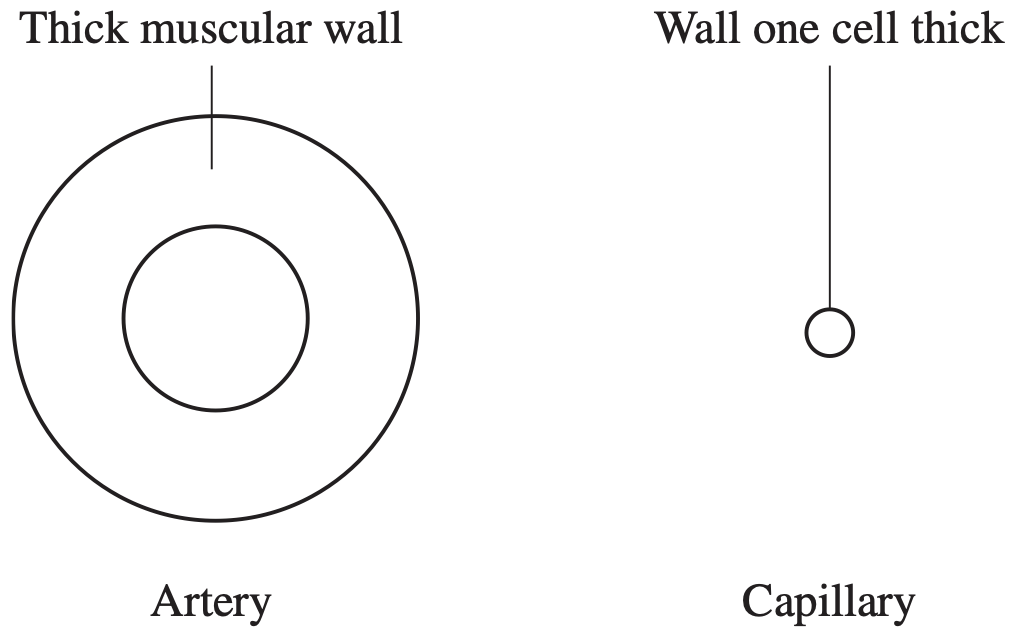
  1. Use labelled diagrams to distinguish between the structure of an artery and that of a capillary.   (2 marks)

    --- 8 WORK AREA LINES (style=blank) ---

  2. Relate one structure of a capillary to its function.   (2 marks)

    --- 5 WORK AREA LINES (style=lined) ---

Show Answers Only

a.   
       

b.    Structure: One cell thick wall.

Related function: Allows diffusion of small molecules through the capillary wall to allow substances in and out of the bloodstream.

Show Worked Solution

a.   
       

b.    Structure: One cell thick wall.

Related function: Allows diffusion of small molecules through the capillary wall to allow substances in and out of the bloodstream.

♦ Mean mark 49%.

Filed Under: Organisation of Cells Tagged With: Band 4, Band 5, smc-4304-75-Cardiorespiratory System

BIOLOGY, M2 2015 HSC 24

Data can be provided by a pulse oximeter pegged to a person's finger, as shown in the diagram.

  1. What is the oxygen saturation for this person?  (1 mark)

    --- 1 WORK AREA LINES (style=lined) ---

  2. Outline TWO limitations of using only the information provided in the diagram to determine the 'health' of a person.  (2 marks)

    --- 5 WORK AREA LINES (style=lined) ---
  3. Explain TWO advantages in using a pulse oximeter to measure oxygen saturation compared to using another named technology in a specific setting.  (4 marks)

    --- 8 WORK AREA LINES (style=lined) ---

Show Answers Only

a.   97%
 

b.   Answers could include:

→ Data requires context (eg. is the user exercising or resting).

→ There are many other parameters of physical health: disease status, blood levels of toxic environmental substances, presence of cancers etc…

→ There are other aspects of non-physical health (eg. mental health).

→ The pulse oximeter could read faulty i.e. if not properly calibrated, so comparing with results from another form of test such as a blood pressure monitor would give a better indication of cardiorespiratory health.
 

c.   Answers could include:

→ The pulse oximeter can give you immediate and continuous data. This makes it better than arterial blood gas determination from a blood sample that requires the sample to be analysed in a laboratory with a delayed and one-off reading.

→ The pulse oximeter is very portable being compact and battery operated.

→ The pulse oximeter is better for an ambulance where fast and continuous data delivery in an emergency setting is required.

Show Worked Solution

a.   97%
 

b.   Answers could include:

→ Data requires context (eg. is the user exercising or resting).

→ There are many other parameters of physical health: disease status, blood levels of toxic environmental substances, presence of cancers etc…

→ There are other aspects of non-physical health (eg. mental health).

→ The pulse oximeter could read faulty i.e. if not properly calibrated, so comparing with results from another form of test such as a blood pressure monitor would give a better indication of cardiorespiratory health.
 

c.   Answers could include:

→ The pulse oximeter can give you immediate and continuous data. This makes it better than arterial blood gas determination from a blood sample that requires the sample to be analysed in a laboratory with a delayed and one-off reading.

→ The pulse oximeter is very portable being compact and battery operated.

→ The pulse oximeter is better for an ambulance where fast and continuous data delivery in an emergency setting is required.

Filed Under: BIO - Ex-syllabus checks required Tagged With: Band 3, Band 4, smc-4304-75-Cardiorespiratory System

BIOLOGY, M2 2017 HSC 23

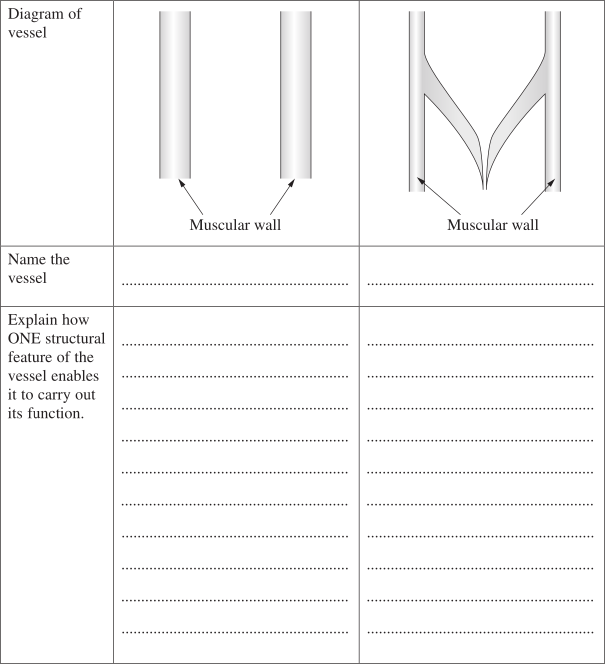
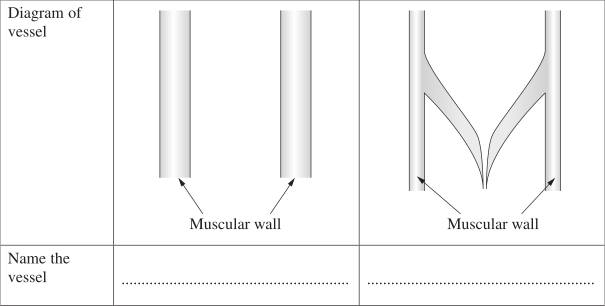
Complete the table with reference to the two types of blood vessel shown.   (5 marks)

Name the vessel in the space provided and explain how ONE structural feature of the vessel enables it to carry out its function.   (5 marks)

--- 8 WORK AREA LINES (style=lined) ---

Show Answers Only

Left image: Artery

  • Arteries have thick muscular walls.
  • This enables them to withstand the high pressure at which blood is pumped from the heart. 

Right image: Vein

  • Nutrients are absorbed from the blood at the capillaries. This results in the lowering of blood pressure.
  • The valves are used to prevent backflow of blood at these lower pressures.
Show Worked Solution

Left image: Artery

  • Arteries have thick muscular walls.
  • This enables them to withstand the high pressure at which blood is pumped from the heart. 

Right image: Vein

  • Nutrients are absorbed from the blood at the capillaries. This results in the lowering of blood pressure.
  • The valves are used to prevent backflow of blood at these lower pressures.

Filed Under: Organisation of Cells Tagged With: Band 4, smc-4304-75-Cardiorespiratory System

Copyright © 2014–2025 SmarterEd.com.au · Log in