SmarterEd

Aussie Maths & Science Teachers: Save your time with SmarterEd

  • Login
  • Get Help
  • About

BIOLOGY, M2 EQ-Bank 17

The image below shows a dinosaur fossil found in South Africa believed to be 200 million years old.
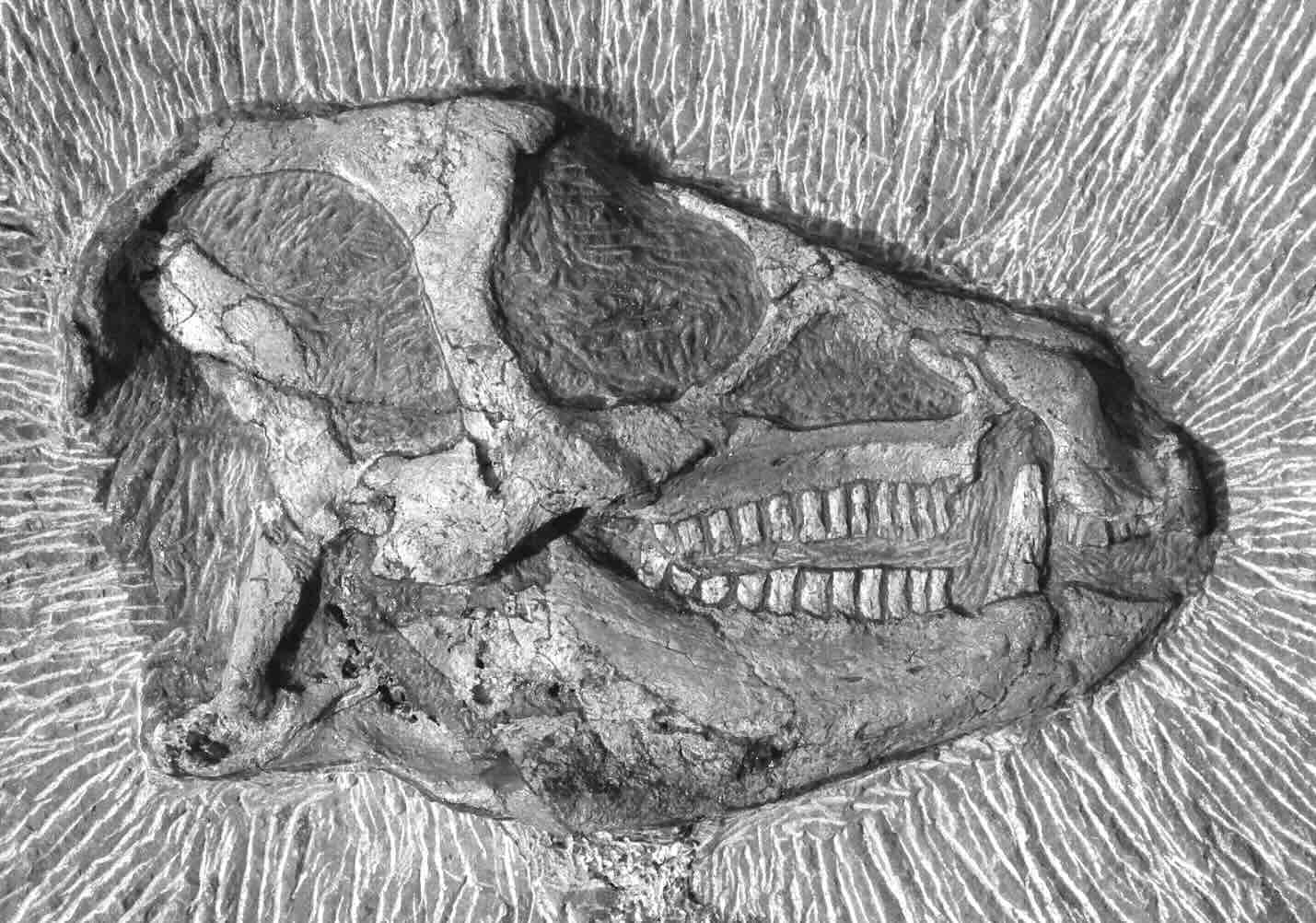
  1. What type of diet did this dinosaur likely consume? Explain your answer.   (1 mark)

    --- 2 WORK AREA LINES (style=lined) ---

  2. Discuss two features that could be observed in the dinosaur’s digestive tract.   (3 marks)

    --- 5 WORK AREA LINES (style=lined) ---

Show Answers Only

a.   Diet: herbivore

  • The presence of flat teeth in a dinosaur species strongly indicates a herbivorous diet, as these teeth are well-suited for grinding and processing plant material.

b.   Digestive tract features:

  • Herbivorous dinosaurs likely possessed specialised digestive tracts adapted for processing plant material.
  • One key feature would be an enlarged caecum, a pouch-like structure connected to the large intestine, which housed symbiotic bacteria to break down cellulose through fermentation. This process would have allowed dinosaurs to extract more nutrients from tough plant matter.
  • Additionally, these dinosaurs may have had elongated intestines to increase the surface area for nutrient absorption and provide more time for the digestion of fibrous plant material.
Show Worked Solution

a.   Diet: herbivore

  • The presence of flat teeth in a dinosaur species strongly indicates a herbivorous diet, as these teeth are well-suited for grinding and processing plant material.

b.   Digestive tract features:

  • Herbivorous dinosaurs likely possessed specialised digestive tracts adapted for processing plant material.
  • One key feature would be an enlarged caecum, a pouch-like structure connected to the large intestine, which housed symbiotic bacteria to break down cellulose through fermentation. This process would have allowed dinosaurs to extract more nutrients from tough plant matter.
  • Additionally, these dinosaurs may have had elongated intestines to increase the surface area for nutrient absorption and provide more time for the digestion of fibrous plant material.

Filed Under: Nutrient and Gas Requirements Tagged With: Band 3, Band 5, smc-4305-52-Digestive system

BIOLOGY, M2 EQ-Bank 14

Explain how both physical and chemical digestion take place in the mammalian stomach.

Include specific details about the mechanisms involved in each process.   (3 marks)

--- 6 WORK AREA LINES (style=lined) ---

Show Answers Only
  • Physical digestion in the stomach occurs when muscular contractions churn and mix the food, breaking it into smaller pieces (peristalsis).
  • Chemical digestion in the stomach involves the secretion of hydrochloric acid and pepsin enzyme into the stomach.
  • The acid and enzymes then begin breaking down protein molecules into smaller peptides.
  • The combination of the physical and chemical digestion processes produce a semi-digested fluid known as chyme. This flows through to the small intestine where most of the nutrient absorption occurs.
  • We note that some absorption of water and simple molecules occurs within the stomach.
Show Worked Solution
  • Physical digestion in the stomach occurs when muscular contractions churn and mix the food, breaking it into smaller pieces (peristalsis).
  • Chemical digestion in the stomach involves the secretion of hydrochloric acid and pepsin enzyme into the stomach.
  • The acid and enzymes then begin breaking down protein molecules into smaller peptides.
  • The combination of the physical and chemical digestion processes produce a semi-digested fluid known as chyme. This flows through to the small intestine where most of the nutrient absorption occurs.
  • We note that some absorption of water and simple molecules occurs within the stomach.

Filed Under: Nutrient and Gas Requirements Tagged With: Band 4, smc-4305-52-Digestive system

BIOLOGY, M2 EQ-Bank 13

"The digestive system is a masterpiece of efficiency, selectively absorbing nutrients while eliminating waste."

Compare the processes of absorption and elimination in the mammalian digestive system.   (4 marks)

--- 8 WORK AREA LINES (style=lined) ---

Show Answers Only
  • Absorption is the process by which nutrients, water, and electrolytes are taken up from the digestive tract into the bloodstream for use by the body’s cells.
  • The main site of nutrient absorption is the small intestine, although some absorption also occurs in the stomach and large intestine.
  • The small intestine is well-suited for this function due to its extensive surface area, created by numerous finger-like projections called villi and microvilli.
  • Elimination is the process of expelling undigested food materials, waste products, and excess water from the body through the anus as faeces.
  • The main site of elimination is the large intestine, ending with the rectum and anus.
  • Unlike the small intestine, the large intestine has a smoother inner surface and is wider in diameter, which allows for the formation and storage of faeces before elimination.
  • The body regulates the balance between absorption and elimination through the action of the nervous and endocrine systems. For example, the presence of food releases hormones that increase absorption, while the build-up of waste in the large intestine triggers nerve reflexes that initiate elimination.
Show Worked Solution
  • Absorption is the process by which nutrients, water, and electrolytes are taken up from the digestive tract into the bloodstream for use by the body’s cells.
  • The main site of nutrient absorption is the small intestine, although some absorption also occurs in the stomach and large intestine.
  • The small intestine is well-suited for this function due to its extensive surface area, created by numerous finger-like projections called villi and microvilli.
  • Elimination is the process of expelling undigested food materials, waste products, and excess water from the body through the anus as faeces.
  • The main site of elimination is the large intestine, ending with the rectum and anus.
  • Unlike the small intestine, the large intestine has a smoother inner surface and is wider in diameter, which allows for the formation and storage of faeces before elimination.
  • The body regulates the balance between absorption and elimination through the action of the nervous and endocrine systems. For example, the presence of food releases hormones that increase absorption, while the build-up of waste in the large intestine triggers nerve reflexes that initiate elimination.

Filed Under: Nutrient and Gas Requirements Tagged With: Band 4, smc-4305-52-Digestive system

BIOLOGY, M2 EQ-Bank 11

Compare the digestive systems of carnivores and herbivores, highlighting their adaptations to different diets.   (3 marks)

--- 6 WORK AREA LINES (style=lined) ---

Show Answers Only
  • Carnivores typically have sharp, pointed canine teeth for tearing meat, while herbivores have flat molars for grinding plant material.
  • This difference in tooth structure reflects adaptations for their respective diets.
  • Herbivores generally have longer small intestines compared to carnivores of similar size.
  • This adaptation provides herbivores with more surface area and time to break down and absorb nutrients from their plant-based diet, which is often more difficult to digest than animal tissue.
  • Many herbivores have a specialised chamber called the cecum or an enlarged stomach compartment (like the rumen in cows) that houses symbiotic microorganisms.
  • These structures allow herbivores to ferment and break down cellulose in plant cell walls, a process that carnivores don’t require due to their protein-rich diet.
Show Worked Solution
  • Carnivores typically have sharp, pointed canine teeth for tearing meat, while herbivores have flat molars for grinding plant material.
  • This difference in tooth structure reflects adaptations for their respective diets.
  • Herbivores generally have longer small intestines compared to carnivores of similar size.
  • This adaptation provides herbivores with more surface area and time to break down and absorb nutrients from their plant-based diet, which is often more difficult to digest than animal tissue.
  • Many herbivores have a specialised chamber called the cecum or an enlarged stomach compartment (like the rumen in cows) that houses symbiotic microorganisms.
  • These structures allow herbivores to ferment and break down cellulose in plant cell walls, a process that carnivores don’t require due to their protein-rich diet.

Filed Under: Nutrient and Gas Requirements Tagged With: Band 4, smc-4305-52-Digestive system

BIOLOGY, M2 EQ-Bank 10

Explain how physical and chemical digestion work together in mammals to improve the efficiency of nutrient absorption.   (3 marks)

--- 6 WORK AREA LINES (style=lined) ---

Show Answers Only
  • Physical and chemical digestion work together synergistically to improve the efficiency of nutrient absorption in mammals.
  • For example, in the stomach, muscular contractions churn food, breaking it into smaller pieces and increasing its surface area.
  • This increased surface area allows the chemical digestive processes to work more effectively on the food particles.
  • The combined action continues in the small intestine, where physical segmentation movements mix the chyme with digestive enzymes, further breaking down nutrients chemically.
  • This teamwork between physical and chemical processes ensures that nutrients are broken down into their simplest forms, maximising their absorption through the intestinal wall.
Show Worked Solution
  • Physical and chemical digestion work together synergistically to improve the efficiency of nutrient absorption in mammals.
  • For example, in the stomach, muscular contractions churn food, breaking it into smaller pieces and increasing its surface area.
  • This increased surface area allows the chemical digestive processes to work more effectively on the food particles.
  • The combined action continues in the small intestine, where physical segmentation movements mix the chyme with digestive enzymes, further breaking down nutrients chemically.
  • This teamwork between physical and chemical processes ensures that nutrients are broken down into their simplest forms, maximising their absorption through the intestinal wall.

Filed Under: Nutrient and Gas Requirements Tagged With: Band 3, Band 4, smc-4305-52-Digestive system

BIOLOGY, M2 EQ-Bank 9 MC

When proteins are broken down in chemical digestion, they become

  1. Lipids
  2. Glucose
  3. Glycerol
  4. Amino acids
Show Answers Only

\(D\)

Show Worked Solution
  • Proteins are broken down so as their beneficial components can be absorbed in the small intestine.
  • Amino acid chains (called polypeptide chains) make up all proteins, and are hence the smallest unit of a protein possible in chemical digestion.

\(\Rightarrow D\)

Filed Under: Nutrient and Gas Requirements Tagged With: Band 3, smc-4305-52-Digestive system

BIOLOGY, M2 EQ-Bank 26

Explain the process by which nutrients are absorbed in the small intestine, giving examples.   (5 marks)

--- 10 WORK AREA LINES (style=lined) ---

Show Answers Only
  • When food is broken down in the stomach, it forms a slurry of nutrients called chyme.
  • When chyme travels through the small intestine it passes over millions of folds called villi, each containing its own set of millions of microvilli which increase its surface area to roughly 300m2. Each villi is lined with one epithelial cell before reaching the blood vessels and then the lymph.
  • When thew chyme passes through the lumen (the space between villi), certain molecules can be rapidly absorbed by simple or facilitated diffusion across a concentration gradient.
    • Example: fructose and water soluble vitamins can pass via facilitated diffusion through carrier and channel proteins respectively.
  • Large molecules cannot diffuse through the cells and instead must be actively transported. To accommodate this, villi contain many mitochondria which produce the ATP required for active transport.
    • Example: amino acids and glucose must be actively transported, while fatty acids and glycerol don’t need to be as they can diffuse through the epithelial cells.
Show Worked Solution
  • When food is broken down in the stomach, it forms a slurry of nutrients called chyme.
  • When chyme travels through the small intestine it passes over millions of folds called villi, each containing its own set of millions of microvilli which increase its surface area to roughly 300m2. Each villi is lined with one epithelial cell before reaching the blood vessels and then the lymph.
  • When thew chyme passes through the lumen (the space between villi), certain molecules can be rapidly absorbed by simple or facilitated diffusion across a concentration gradient.
    • Example: fructose and water soluble vitamins can pass via facilitated diffusion through carrier and channel proteins respectively.
  • Large molecules cannot diffuse through the cells and instead must be actively transported. To accommodate this, villi contain many mitochondria which produce the ATP required for active transport.
    • Example: amino acids and glucose must be actively transported, while fatty acids and glycerol don’t need to be as they can diffuse through the epithelial cells.

Filed Under: Nutrient and Gas Requirements Tagged With: Band 5, smc-4305-52-Digestive system

BIOLOGY, M2 EQ-Bank 3 MC

Which of the following does NOT occur in the mouth?

  1. Lubrication of food.
  2. Breakdown of starch.
  3. Beginning of protein digestion.
  4. Breakdown of food into smaller fragments.
Show Answers Only

\(C\)

Show Worked Solution

By Elimination

  • Saliva in the mouth lubricates food to help in pass through the oesophagus easier (Eliminate A).
  • The enzyme amylase, found in saliva, is able to breakdown starch into maltose (Eliminate B).
  • Chewing breaks down food into smaller pieces which both allows for easier movement through the rest of the digestive system and increasing surface area to allow enzymes to work more effectively (Eliminate D).
  • The breakdown of proteins begins in the stomach as it contains the adequate enzymes.

\(\Rightarrow C\)

Filed Under: Nutrient and Gas Requirements Tagged With: Band 4, smc-4305-52-Digestive system

Copyright © 2014–2025 SmarterEd.com.au · Log in