SmarterEd

Aussie Maths & Science Teachers: Save your time with SmarterEd

  • Login
  • Get Help
  • About

BIOLOGY, M2 EQ-Bank 2 MC

Blood was analysed after passing through a particular organ. It was observed that oxygen levels increased, while carbon dioxide and urea levels decreased. Which tissue is most likely responsible for these changes in blood composition?

  1. Brain
  2. Heart
  3. Kidneys
  4. Lungs
Show Answers Only

\(D\)

Show Worked Solution
  • In the lungs, oxygen diffuses into the blood while carbon dioxide diffuses out, resulting in an increase in oxygen levels and a decrease in carbon dioxide levels in the blood leaving the lungs.
  • The decrease in urea is not typical of lung function, but could be explained by small amounts of urea being excreted in exhaled air.

\(\Rightarrow D\)

Filed Under: Transport Tagged With: Band 4, smc-4306-10-Blood

BIOLOGY, M2 EQ-Bank 5

Compare and contrast the structure of red blood cells (erythrocytes) and platelets (thrombocytes), explaining how their unique features contribute to their efficiency in performing their respective functions in the circulatory system.   (4 marks)

--- 8 WORK AREA LINES (style=lined) ---

Show Answers Only
  • Red blood cells are biconcave discs lacking a nucleus, which maximises their capacity to carry haemoglobin and increases their flexibility to squeeze through narrow capillaries, enhancing oxygen transport efficiency.
  • Platelets are flat, irregularly-shaped cell fragments that lack both organelles and nuclei. When blood vessel damage occurs, they change shape and aggregate to form a blood clot and stop bleeding.
  • The absence of a nucleus in red blood cells allows for more haemoglobin but limits their lifespan to about 120 days, while platelets typically survive for 8-10 days.
  • Red blood cells’ structure optimises oxygen carrying capacity and delivery, while platelets’ structure facilitates rapid response to vascular damage. 
  • Both red blood cells and platelets have high surface area to volume ratios which allows them to efficiently carry out their primary functions.
Show Worked Solution
  • Red blood cells are biconcave discs lacking a nucleus, which maximises their capacity to carry haemoglobin and increases their flexibility to squeeze through narrow capillaries, enhancing oxygen transport efficiency.
  • Platelets are flat, irregularly-shaped cell fragments that lack both organelles and nuclei. When blood vessel damage occurs, they change shape and aggregate to form a blood clot and stop bleeding.
  • The absence of a nucleus in red blood cells allows for more haemoglobin but limits their lifespan to about 120 days, while platelets typically survive for 8-10 days.
  • Red blood cells’ structure optimises oxygen carrying capacity and delivery, while platelets’ structure facilitates rapid response to vascular damage. 
  • Both red blood cells and platelets have high surface area to volume ratios which allows them to efficiently carry out their primary functions.

Filed Under: Transport Tagged With: Band 4, Band 5, smc-4306-10-Blood

BIOLOGY, M2 EQ-Bank 3

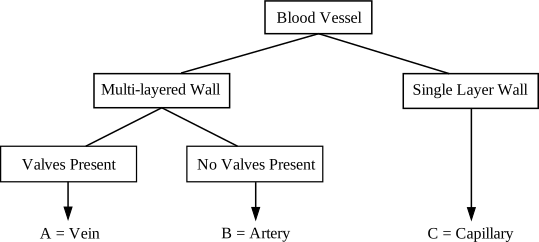
The diagram below shows features that are observed in cross-sections of three types of blood vessel.


  1. Complete the diagram by identifying the type of blood vessel identified by \(\text{A}\) and \(\text{C}\).   (2 marks)

    --- 2 WORK AREA LINES (style=lined) ---

  2. Describe how the structural features of \(\text{B}\) contribute to its role in the circulatory system.   (2 marks)

    --- 5 WORK AREA LINES (style=lined) ---

Show Answers Only

a.   

 
b.
   \(\text{B}\) is an artery.

  • Arteries have thick, elastic walls with multiple layers of smooth muscle, allowing them to withstand and maintain the high pressure of blood pumped directly from the heart.
  • This elasticity also enables arteries to expand and recoil with each heartbeat, helping to propel blood forward in a phenomenon known as the “pulse.”
  • Additionally, the smooth inner lining of arteries reduces friction, facilitating efficient blood flow and preventing clot formation.
Show Worked Solution

a.   


b.   \(\text{B}\) is an artery.

  • Arteries have thick, elastic walls with multiple layers of smooth muscle, allowing them to withstand and maintain the high pressure of blood pumped directly from the heart.
  • This elasticity also enables arteries to expand and recoil with each heartbeat, helping to propel blood forward in a phenomenon known as the “pulse.”
  • Additionally, the smooth inner lining of arteries reduces friction, facilitating efficient blood flow and preventing clot formation.


Filed Under: Transport Tagged With: Band 4, Band 5, smc-4306-10-Blood

BIOLOGY, M2 EQ-Bank 2

Describe the nature and significance of plasma in the circulatory system. In your answer, include two crucial functions that plasma performs in the body and how a deficiency or imbalance in plasma components might affect overall health.   (4 marks)

--- 7 WORK AREA LINES (style=lined) ---

Show Answers Only
  • Plasma is the liquid component of blood, making up about 55% of its volume, and consists primarily of water with dissolved proteins, glucose, clotting factors, hormones, and electrolytes.
  • One crucial function of plasma is transport, carrying nutrients, hormones, and waste products throughout the body, fuelling cells and removing metabolic waste.
  • Another vital role of plasma is in maintaining blood pressure and volume, with plasma proteins keeping fluid within blood vessels.
  • A deficiency or imbalance in plasma components can reduce the ability to form blood clots and lead to excessive bleeding.
  • A decrease in plasma proteins can result in edema where fluid leaks from blood vessels into surrounding tissues, causing swelling.
Show Worked Solution
  • Plasma is the liquid component of blood, making up about 55% of its volume, and consists primarily of water with dissolved proteins, glucose, clotting factors, hormones, and electrolytes.
  • One crucial function of plasma is transport, carrying nutrients, hormones, and waste products throughout the body, fuelling cells and removing metabolic waste.
  • Another vital role of plasma is in maintaining blood pressure and volume, with plasma proteins keeping fluid within blood vessels.
  • A deficiency or imbalance in plasma components can reduce the ability to form blood clots and lead to excessive bleeding.
  • A decrease in plasma proteins can result in edema where fluid leaks from blood vessels into surrounding tissues, causing swelling.

Filed Under: Transport Tagged With: Band 4, Band 5, smc-4306-10-Blood

BIOLOGY, M2 EQ-Bank 32

Human blood is composed of various cellular and non-cellular components, each uniquely contributing to different processes and roles required by the circulatory system.

Explain the importance of TWO different non-cellular components of blood.   (4 marks)

--- 8 WORK AREA LINES (style=lined) ---

Show Answers Only

Answers can include two of the following.

Water:

  • Water is a main constituent of blood and lymph. It is critical in blood as it is a solvent for many substances, helping transport nutrients to all cells in the body.
  • Water in blood also helps lubricate joints and helps replace fluids lost to metabolism, breathing and the removal of waste.

Mineral ions:

  • There are many different types of mineral ions which are dissolved in blood including sodium, bicarbonate, magnesium, potassium, calcium and chloride.
  • These mineral ions regulate osmotic balance, pH and membrane permeability, amongst many other functions.

Plasma proteins:

  • Plasma proteins make up a significant portion of blood by volume (7–9%).
  • They regulate osmotic balance and pH (serum albumin) and contain enzymes and antibodies.
Show Worked Solution

Answers can include two of the following.

Water:

  • Water is a main constituent of blood and lymph. It is critical in blood as it is a solvent for many substances, helping transport nutrients to all cells in the body.
  • Water in blood also helps lubricate joints and helps replace fluids lost to metabolism, breathing and the removal of waste.

Mineral ions:

  • There are many different types of mineral ions which are dissolved in blood including sodium, bicarbonate, magnesium, potassium, calcium and chloride.
  • These mineral ions regulate osmotic balance, pH and membrane permeability, amongst many other functions.

Plasma proteins:

  • Plasma proteins make up a significant portion of blood by volume (7–9%).
  • They regulate osmotic balance and pH (serum albumin) and contain enzymes and antibodies.

Filed Under: Transport Tagged With: Band 5, smc-4306-10-Blood

BIOLOGY, M2 EQ-Bank 30

Red and white blood cells are critical components of human blood with very different functions.

  1. Describe the structure and role of red blood cells.   (3 marks)

    --- 7 WORK AREA LINES (style=lined) ---

  2. Describe the the role of white blood cells and platelets.   (2 marks)

    --- 5 WORK AREA LINES (style=lined) ---

Show Answers Only

a.    Red blood cells:

  • Red blood cells (RBCs) make up 40-50% of total blood volume and transport oxygen and carbon dioxide throughout the body.
  • They are able to achieve this by haemoglobin, a globular protein consisting of 4 polypeptide chains and iron. Haemoglobin’s structure allows each of its proteins to carry 4 molecules of oxygen and 4 molecules of carbon dioxide.
  • RBCs are specialised cells and have no nucleus which allows them to carry more haemoglobin, and therefore more oxygen, around the body. 

b.   White blood cells and platelets:

  • Platelets are small membrane bound cell fragments derived from bone marrow. They are involved in initiating blood clotting.
  • White blood cells (leucocytes) are involved in internal defence.
  • This can include antibody production (B cells), mediating allergic responses (eosinophils) and fighting inflammation (basophils).
Show Worked Solution

a.    Red blood cells:

  • Red blood cells (RBCs) make up 40-50% of total blood volume and transport oxygen and carbon dioxide throughout the body.
  • They are able to achieve this by haemoglobin, a globular protein consisting of 4 polypeptide chains and iron. Haemoglobin’s structure allows each of its proteins to carry 4 molecules of oxygen and 4 molecules of carbon dioxide.
  • RBCs are specialised cells and have no nucleus which allows them to carry more haemoglobin, and therefore more oxygen, around the body. 

b.   White blood cells and platelets:

  • Platelets are small membrane bound cell fragments derived from bone marrow. They are involved in initiating blood clotting.
  • White blood cells (leucocytes) are involved in internal defence.
  • This can include antibody production (B cells), mediating allergic responses (eosinophils) and fighting inflammation (basophils).

Filed Under: Transport Tagged With: Band 3, Band 4, smc-4306-10-Blood

BIOLOGY, M2 2016 HSC 17 MC

Capillaries have thin walls that help them perform their main function.

The best explanation for this is that

  1. capillaries are the smallest vessels in the body.
  2. thin walls are an adaptation that help diffusion.
  3. blood flow in capillaries is under very low pressure.
  4. thin walls maximise the surface area available for gas exchange.
Show Answers Only

\(\Rightarrow B\)

Show Worked Solution
  • Thin walls are needed in capillaries as this helps oxygen and carbon dioxide be diffused in and out much easier.

\(\Rightarrow B\)

♦ Mean mark 47%.

Filed Under: Transport Tagged With: Band 5, smc-4306-10-Blood

BIOLOGY, M2 2018 HSC 18 MC

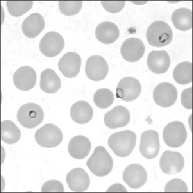
The micrograph shows normal-sized human red blood cells.

Within three of these red blood cells, an infection known as Plasmodium falciparum appears under the microscope view as a dark ring shape.
 

Which of the following is the best estimate of the diameter of the Plasmodium?

  1. \(0.002\ \text{mm}\)
  2. \(0.8\ \mu \text{m}\)
  3.  \(2\ \text{mm}\)
  4.  \(8\ \mu \text{m}\)
Show Answers Only

\(A\)

Show Worked Solution
  • The plasmodium are about 25% the size of the red blood cells.
  • As red blood cells are around 8µm, the plasmodium is approximately 2µm in diameter, or 0.002mm.

\(\Rightarrow A\)

♦♦♦ Mean mark 22%.

Filed Under: Transport Tagged With: Band 6, smc-4306-10-Blood

BIOLOGY, M2 2015 HSC 27

  1. Outline TWO differences between whole blood and plasma.  (2 marks)

    --- 3 WORK AREA LINES (style=lined) ---

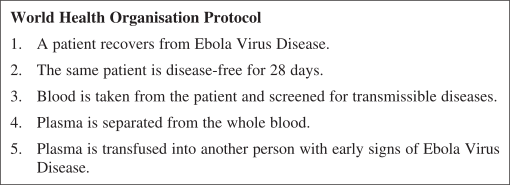
The steps below show the preparation and use of blood products in the treatment of Ebola Virus Disease. This disease is characterised by significant blood loss.

  1. Explain why this protocol produces an effective treatment for Ebola Virus Disease.  (3 marks)

    --- 8 WORK AREA LINES (style=lined) ---

Show Answers Only

a.    Whole blood and plasma differences:

→ Whole blood contains cells including WBC’s, RBC’s and platelets while plasma does not.

→ Plasma is a straw coloured liquid and whole blood is a thick red liquid.
 

b.   Answers could include:

→ The plasma will contain antibodies for this disease because it has been taken from someone who has survived the disease. This will help to immobilise the virus in recipients blood stream.

→ Screening blood prevents the spread of Ebola and other blood-borne diseases from donor to recipient.

→ The plasma is separated from the whole blood meaning no blood type match is needed as there are no cells in the plasma but it still contains the beneficial antibodies.

Show Worked Solution

a.    Whole blood and plasma differences:

→ Whole blood contains cells including WBC’s, RBC’s and platelets while plasma does not.

→ Plasma is a straw coloured liquid and whole blood is a thick red liquid.

♦ Mean mark (a) 49%.

b.   Answers could include:

→ The plasma will contain antibodies for this disease because it has been taken from someone who has survived the disease. This will help to immobilise the virus in recipients blood stream.

→ Screening blood prevents the spread of Ebola and other blood-borne diseases from donor to recipient.

→ The plasma is separated from the whole blood meaning no blood type match is needed as there are no cells in the plasma but it still contains the beneficial antibodies.

Filed Under: BIO - Ex-syllabus checks required Tagged With: Band 4, Band 5, smc-4306-10-Blood

BIOLOGY, M2 2016 HSC 21

Give TWO potential benefits of artificial blood.  (2 marks)

Show Answers Only

Answers can include:

  • It does not need to be refrigerated.
  • It does not require blood-type matching.
  • Can be a valid substitute for certain ethnic/cultural groups which have concerns surrounding blood products.
  • Does not require a donor.
Show Worked Solution

Answers can include:

  • It does not need to be refrigerated.
  • It does not require blood-type matching.
  • Can be a valid substitute for certain ethnic/cultural groups which have concerns surrounding blood products.
  • Does not require a donor.

Filed Under: Transport Tagged With: Band 3, smc-4306-10-Blood

Copyright © 2014–2025 SmarterEd.com.au · Log in