SmarterEd

Aussie Maths & Science Teachers: Save your time with SmarterEd

  • Login
  • Get Help
  • About

BIOLOGY, M3 EQ-Bank 2

  1. Define convergent evolution within the context of Darwin and Wallace's Theory of Evolution by Natural Selection.   (1 mark)

    --- 2 WORK AREA LINES (style=lined) ---

  2. Describe two key principles of natural selection that lead to convergent evolution.   (2 marks)

    --- 4 WORK AREA LINES (style=lined) ---

  3. Provide two examples of convergent evolution, one involving Australian fauna and one non-Australian, explaining how each demonstrates the process of natural selection.   (2 marks)

    --- 4 WORK AREA LINES (style=lined) ---

Show Answers Only

a.   Convergent evolution definition:

  • The process by which unrelated organisms develop similar traits or features as a result of adapting to similar environmental pressures or ecological niches. 

b.   Key principles that lead to convergent evolution:

  • Natural selection acts on existing variations within populations, favouring traits that enhance survival and reproduction in specific environments.
  • When unrelated organisms face similar environmental challenges, natural selection can lead to the evolution of similar adaptations, even in distantly related species.
  • This process occurs independently in each lineage, resulting in analogous structures or behaviours that serve similar functions but have different evolutionary origins. 

c.   Australian fauna (example):

  • The similarity between the marsupial Tasmanian tiger (thylacine) and the placental grey wolf is an example of convergent evolution.
  • Despite their distant relationship, both evolved similar body shapes, jaw structures, and striped patterns due to adapting to similar predatory lifestyles.  

Non-Australian (example):

  • The similar body shapes of sharks and dolphins is another example of convergent evolution.
  • Though one is a fish and the other a mammal, both have evolved streamlined bodies, dorsal fins, and tail flukes as adaptations for efficient swimming in marine environments.
  • This demonstrates how natural selection can produce similar outcomes in response to comparable environmental pressures.
Show Worked Solution

a.   Convergent evolution definition:

  • The process by which unrelated organisms develop similar traits or features as a result of adapting to similar environmental pressures or ecological niches. 

b.   Key principles that lead to convergent evolution:

  • Natural selection acts on existing variations within populations, favouring traits that enhance survival and reproduction in specific environments.
  • When unrelated organisms face similar environmental challenges, natural selection can lead to the evolution of similar adaptations, even in distantly related species.
  • This process occurs independently in each lineage, resulting in analogous structures or behaviours that serve similar functions but have different evolutionary origins. 

c.   Australian fauna (example):

  • The similarity between the marsupial Tasmanian tiger (thylacine) and the placental grey wolf is an example of convergent evolution.
  • Despite their distant relationship, both evolved similar body shapes, jaw structures, and striped patterns due to adapting to similar predatory lifestyles.  

Non-Australian (example):

  • The similar body shapes of sharks and dolphins is another example of convergent evolution.
  • Though one is a fish and the other a mammal, both have evolved streamlined bodies, dorsal fins, and tail flukes as adaptations for efficient swimming in marine environments.
  • This demonstrates how natural selection can produce similar outcomes in response to comparable environmental pressures.

Filed Under: Natural Selection Tagged With: Band 3, Band 4, Band 5, smc-4309-35-Convergent/Divergent

BIOLOGY, M3 EQ-Bank 3 MC

Which of the following groups of organisms is the best example of divergent evolution?

  1. Sharks, dolphins, and penguins
  2. Darwin's finches in the Galapagos Islands
  3. Cacti in America and euphorbia (a succulent species) in Africa
  4. Marsupial and placental mammals
Show Answers Only

\(B\)

Show Worked Solution
  • Darwin’s finches in the Galapagos Islands are a classic example of divergent evolution because they all descended from a common ancestor but evolved different beak shapes and sizes to exploit differing food sources.
  • This adaptation to different ecological niches led to the formation of distinct species from a single ancestral population.

\(\Rightarrow B\)

Filed Under: Natural Selection Tagged With: Band 4, smc-4309-35-Convergent/Divergent

BIOLOGY, M3 EQ-Bank 2 MC

Which of the following pairs of organisms best demonstrates convergent evolution?

  1. Tasmanian tiger and grey wolf
  2. Kangaroo and wallaby
  3. Eucalyptus and acacia trees
  4. Platypus and echidna
Show Answers Only

\(A\)

Show Worked Solution
  • The Tasmanian tiger (a marsupial) and grey wolf (a placental mammal) demonstrate convergent evolution because they developed similar body shapes and predatory features despite being unrelated and evolving in different parts of the world.
  • This similarity in form is due to adapting to similar ecological niches and hunting strategies.

\(\Rightarrow A\)

Filed Under: Natural Selection Tagged With: Band 4, smc-4309-35-Convergent/Divergent

BIOLOGY, M3 2004 HSC 18a

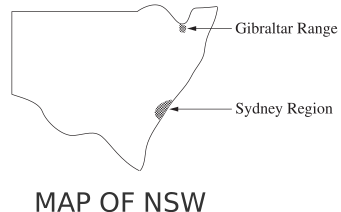
A plant species found in the area immediately around Sydney has also been found in a small area in the Gibraltar Range in the far north of NSW. 
 

Predict what might happen to the TWO populations over the next 5 million years, in terms of Darwin/Wallace's theory of evolution.   (3 marks)
Show Answers Only

  • According to Darwin/Wallace’s theory of evolution these two plant populations will undergo divergent evolution over the next 5 million years due to their seperate geographical location.
  • The Sydney population will likely experience significantly more rainfall than the Gibralter range population. As a result, this plant will evolve to require more water and have less resistance to drier conditions.
  • The Gibralter range species exist further inland and at a higher altitude and are likely to experience less rainfall and a greater range of temperatures. This species could evolve to be more drought resistant and hardier in extreme temperatures.
  • While the theory of evolution can provide a prediction, the actual outcome may be vastly different due to other abiotic and biotic factors, such as the presence of predators.

Show Worked Solution

  • According to Darwin/Wallace’s theory of evolution these two plant populations will undergo divergent evolution over the next 5 million years due to their seperate geographical location.
  • The Sydney population will likely experience significantly more rainfall than the Gibralter range population. As a result, this plant will evolve to require more water and have less resistance to drier conditions.
  • The Gibralter range species exist further inland and at a higher altitude and are likely to experience less rainfall and a greater range of temperatures. This species could evolve to be more drought resistant and hardier in extreme temperatures.
  • While the theory of evolution can provide a prediction, the actual outcome may be vastly different due to other abiotic and biotic factors, such as the presence of predators.

Filed Under: Effects of the Environment on Organisms, Natural Selection Tagged With: Band 4, smc-4307-40-Selection pressures, smc-4309-35-Convergent/Divergent

BIOLOGY, M3 2010 HSC 30

Geological and biological history of New Zealand
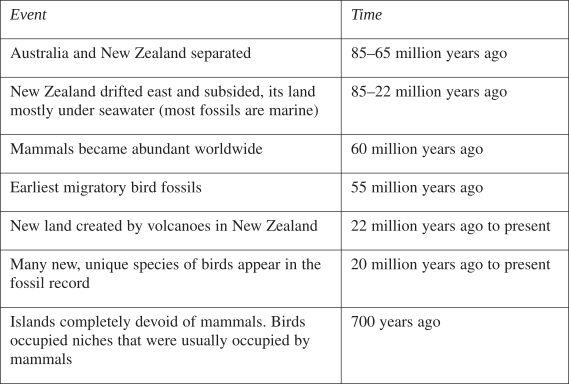
Use this information and other relevant knowledge to demonstrate how the practice of biology has led to the validation of current theories of evolution.  (7 marks)

--- 18 WORK AREA LINES (style=lined) ---

Show Answers Only
  • In the New Zealand information, many practices of biology were undertaken to compile the data.
  • The observations of fauna in New Zealand represent an important practice in biological science. Making clear, dispassionate and unbiased observations, and recording such observations are intrinsic to science and provide an essential pathway to validating theories.
  • These observations validated the idea of convergent evolution; birds in New Zealand, without competition from mammals, developed similar characteristics and were able to live in the same environments as mammals do elsewhere.
  • Practices in palaeontology of ageing fossils by radiometric dating or stratigraphy, describing fossils and comparing fossils, allows a history of fauna of New Zealand to be compiled, and history of islands (eg. deducing from fossils found to be almost completely marine that New Zealand was covered by oceans).
  • The history of fauna and geologic events validates Charles Darwin’s theory of evolution in that populations of birds, which began as occasional visitors, gradually changed into permanent endemic species.
  • Divergent evolution is validated as new unique species develop from migratory species, as shown by the fossils of new, unique birds.
  • The data also validates the punctuated equilibrium theory in that the diversification of bird species happened very quickly in the space of only 2 million years.
Show Worked Solution
  • In the New Zealand information, many practices of biology were undertaken to compile the data.
  • The observations of fauna in New Zealand represent an important practice in biological science. Making clear, dispassionate and unbiased observations, and recording such observations are intrinsic to science and provide an essential pathway to validating theories.
  • These observations validated the idea of convergent evolution; birds in New Zealand, without competition from mammals, developed similar characteristics and were able to live in the same environments as mammals do elsewhere.
  • Practices in palaeontology of ageing fossils by radiometric dating or stratigraphy, describing fossils and comparing fossils, allows a history of fauna of New Zealand to be compiled, and history of islands (eg. deducing from fossils found to be almost completely marine that New Zealand was covered by oceans).
  • The history of fauna and geologic events validates Charles Darwin’s theory of evolution in that populations of birds, which began as occasional visitors, gradually changed into permanent endemic species.
  • Divergent evolution is validated as new unique species develop from migratory species, as shown by the fossils of new, unique birds.
  • The data also validates the punctuated equilibrium theory in that the diversification of bird species happened very quickly in the space of only 2 million years.

Filed Under: Evolution - The Evidence, Natural Selection Tagged With: Band 4, Band 5, smc-4309-35-Convergent/Divergent, smc-4310-05-Fossils

BIOLOGY, M3 2014 HSC 26

Explain how Darwin/Wallace's theory of evolution by natural selection and isolation accounts for convergent evolution. Use an example to support your answer.  (5 marks)

Show Answers Only
  • Convergent evolution occurs when two species evolve to possess similar characteristics by natural selection in similar environments.
  • The organisms cannot interbreed to share any new DNA generated by mutation: they are genetically isolated from each other yet they develop similar characteristics.
  • When variation exists in a population, the theory of evolution by natural selection states that this variation will cause some individuals to be better suited to their environment. In this way, they are more likely to survive and hence reproduce, passing on their adaptive characteristics to further generations. After many generations, the traits of those variants are common in the population.
  • Dolphins and sharks demonstrate convergent evolution. The dolphin is a mammal and the shark is a fish. They inhabit the marine environment which imposes the same selection pressures on both types of organism. 
  • Despite being genetically isolated, they both exhibit a streamlined body shape and possess fins for propulsion and stability.
  • These features are adaptive for movement in a highly viscous environment.
Show Worked Solution
  • Convergent evolution occurs when two species evolve to possess similar characteristics by natural selection in similar environments.
  • The organisms cannot interbreed to share any new DNA generated by mutation: they are genetically isolated from each other yet they develop similar characteristics.
  • When variation exists in a population, the theory of evolution by natural selection states that this variation will cause some individuals to be better suited to their environment. In this way, they are more likely to survive and hence reproduce, passing on their adaptive characteristics to further generations. After many generations, the traits of those variants are common in the population.
  • Dolphins and sharks demonstrate convergent evolution. The dolphin is a mammal and the shark is a fish. They inhabit the marine environment which imposes the same selection pressures on both types of organism. 
  • Despite being genetically isolated, they both exhibit a streamlined body shape and possess fins for propulsion and stability.
  • These features are adaptive for movement in a highly viscous environment.
Mean mark 51%.

Filed Under: Natural Selection Tagged With: Band 4, Band 5, smc-4309-35-Convergent/Divergent

Copyright © 2014–2025 SmarterEd.com.au · Log in