SmarterEd

Aussie Maths & Science Teachers: Save your time with SmarterEd

  • Login
  • Get Help
  • About

BIOLOGY, M3 EQ-Bank 8

Absolute dating techniques provide crucial information about the age of fossils and rocks, but different methods are suitable for different time periods.

Describe two absolute dating methods used by scientists, each appropriate for a different time scale.   (4 marks)

--- 8 WORK AREA LINES (style=lined) ---

Show Answers Only

Carbon-14 dating:

  • Carbon-14 dating is an absolute dating method used for relatively recent organic materials. It’s based on the decay of radioactive carbon-14 to nitrogen-14.
  • Carbon-14 has a half-life of 5730 years and measuring the ratio of carbon-14 to stable carbon-12, scientists can determine when the organism died.
  • Carbon-14 dating is most effective for materials up to about 50,000 years old, making it useful for dating recent fossils. 

Potassium-40 dating:

  • Potassium-40 dating is an absolute dating technique that can be used for much older materials.
  • It’s based on the decay of radioactive potassium-40 to argon-40. This method is effective for dating rocks and minerals containing potassium, typically those of igneous or metamorphic origin.
  • Potassium-40 has a half-life of about 1.3 billion years, making this method suitable for dating ancient fossils and rock layers from 50,000 to billions of years old.
Show Worked Solution

Carbon-14 dating:

  • Carbon-14 dating is an absolute dating method used for relatively recent organic materials. It’s based on the decay of radioactive carbon-14 to nitrogen-14.
  • Carbon-14 has a half-life of 5730 years and measuring the ratio of carbon-14 to stable carbon-12, scientists can determine when the organism died.
  • Carbon-14 dating is most effective for materials up to about 50,000 years old, making it useful for dating recent fossils. 

Potassium-40 dating:

  • Potassium-40 dating is an absolute dating technique that can be used for much older materials.
  • It’s based on the decay of radioactive potassium-40 to argon-40. This method is effective for dating rocks and minerals containing potassium, typically those of igneous or metamorphic origin.
  • Potassium-40 has a half-life of about 1.3 billion years, making this method suitable for dating ancient fossils and rock layers from 50,000 to billions of years old.

Filed Under: Evolution - The Evidence Tagged With: Band 4, Band 5, smc-4310-05-Fossils

BIOLOGY, M3 EQ-Bank 6

Paleontologists use various methods to determine the age of fossils, providing crucial information about Earth's history and the evolution of life.

Describe two techniques that can be used to date fossils. In your answer, discuss one advantage and one limitation of each method.   (4 marks)

--- 8 WORK AREA LINES (style=lined) ---

Show Answers Only

Stratigraphy:

  • Stratigraphy is a relative dating technique based on the principle that sedimentary rocks are deposited in layers, with older layers at the bottom and younger layers on top.
  • An advantage of stratigraphy is that it can provide relative ages for fossils without requiring specialised equipment.
  • However, a limitation is that it only provides relative dates, not absolute ages, and can be disrupted by geological processes like folding or faulting. 

Radiocarbon dating:

  • Radiocarbon dating is an absolute dating technique used to determine the age of organic materials up to about 50,000 years old by measuring the decay of radioactive carbon-14 in fossils.
  • An advantage of this method is that it can provide precise absolute dates for relatively recent fossils.
  • However, a limitation is its restricted time range; it cannot be used for fossils older than about 50,000 years because most of the carbon-14 will have decayed.
Show Worked Solution

Stratigraphy:

  • Stratigraphy is a relative dating technique based on the principle that sedimentary rocks are deposited in layers, with older layers at the bottom and younger layers on top.
  • An advantage of stratigraphy is that it can provide relative ages for fossils without requiring specialised equipment.
  • However, a limitation is that it only provides relative dates, not absolute ages, and can be disrupted by geological processes like folding or faulting. 

Radiocarbon dating:

  • Radiocarbon dating is an absolute dating technique used to determine the age of organic materials up to about 50,000 years old by measuring the decay of radioactive carbon-14 in fossils.
  • An advantage of this method is that it can provide precise absolute dates for relatively recent fossils.
  • However, a limitation is its restricted time range; it cannot be used for fossils older than about 50,000 years because most of the carbon-14 will have decayed.

Filed Under: Evolution - The Evidence Tagged With: Band 4, Band 5, smc-4310-05-Fossils

BIOLOGY, M3 2020 VCE 8*

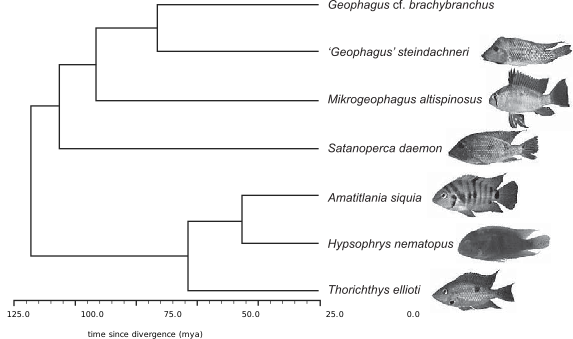
The phylogenetic tree below shows the evolutionary relationship between seven species of cichlid fish.
 

  1. Fossils of species of fish are more likely to be found than fossils of land-dwelling animals.
  2. Explain why this is the case with reference to two conditions required for the fossilisation of an organism.   (2 marks)

    --- 4 WORK AREA LINES (style=lined) ---

  1. A group of scientists stated that a particular fossilised fish was 5000 years old.
  2. Outline a dating technique that could have been used by the scientists to determine the age of the fossil.   (2 marks)

    --- 4 WORK AREA LINES (style=lined) ---

Show Answers Only

a.    Fossilisation is more likely in water than on land because:

  • Water contains more sediment which allows remains to be covered quicker, reducing disturbance and hiding them from scavengers.
  • Water contains less oxygen and lower temperatures, factors which reduce decomposition of remains.

b.   Carbon dating:

  • This technique can be used to validate the age of fossils between 500 and 50,000 years old.
  • It involves measuring the ratio of carbon-14 to carbon-12. Since carbon-14 decays into carbon-12 over time and knowing the half-life of carbon-14, the age of fossils can be accurately calculated.
Show Worked Solution

a.    Fossilisation is more likely in water than on land because:

  • Water contains more sediment which allows remains to be covered quicker, reducing disturbance and hiding them from scavengers.
  • Water contains less oxygen and lower temperatures, factors which reduce decomposition of remains.

b.   Carbon dating:

  • This technique can be used to validate the age of fossils between 500 and 50,000 years old.
  • It involves measuring the ratio of carbon-14 to carbon-12. Since carbon-14 decays into carbon-12 over time and knowing the half-life of carbon-14, the age of fossils can be accurately calculated.

Filed Under: Evolution - The Evidence Tagged With: Band 4, smc-4310-05-Fossils

BIOLOGY, M3 2022 VCE 32-33 MC

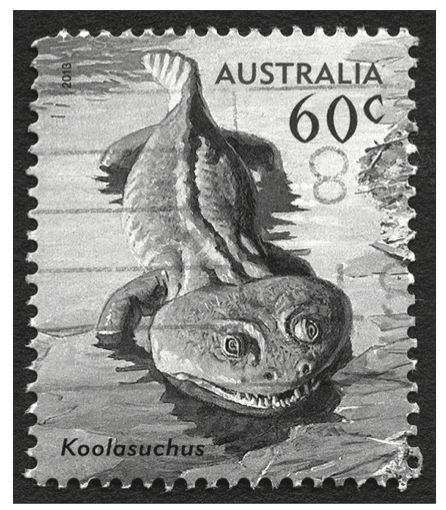
Victoria’s fossil emblem Koolasuchus cleelandi, shown on the stamp above, was chosen in January 2022.

K. cleelandi fossils have been found in Boonwurrung country in Gippsland. Studies of K. cleelandi fossils have revealed many interesting findings. Several of these findings are summarised below.

K. cleelandi findings

    1. It was an amphibian that lived 125 million years ago.
    2. It had a jaw, a skull, vertebrae and ribs made of bone.
    3. It was covered in scales and had fangs on the roof of its mouth.
    4. It lived in rivers carrying many sediments.
    5. It lived in Victoria for 50 million years after its closest relatives in the rest of the world became extinct.
    6. It fed on small dinosaurs, turtles and fish.
    7. It was the size of a small car, 4 m long and weighed 500 kg. 


Part 1

Which combination of findings from the list above is most likely to be associated with an increased chance of formation of K. cleelandi fossils?

  1. findings 1 and 6
  2. findings 2 and 4
  3. findings 3 and 5
  4. findings 2 and 7

 
Part 2

It is most likely that scientists determined the absolute age of K. cleelandi fossils

  1. through mtDNA analysis of K. cleelandi scales and fangs.
  2. through carbon-14 dating of jaw bones, skull, vertebrae and ribs.
  3. by finding index fossils nearby, such as those of small dinosaurs and turtles.
  4. through radioisotope dating of rock surrounding the fossils.
Show Answers Only

Part 1: \(B\)

Part 2: \(D\)

Show Worked Solution

Part 1

  • K. cleelandi has large, dense bones (finding 2) which are less likely to decay overtime and hence have a higher chnace of being fossilised for a long period of time.
  • Because these bones are remaining in a river carrying many sediments (finding 4) the bones are more likely to be fossilised as they are covered quicker, reducing disturbance and hiding them from scavnegers.

\(\Rightarrow B\)
  

Part 2

  • Radioisotope dating of rocks is extremely accurate and reliable source of dating.
  • Therefore it is likely that scientists dated K. cleelandi fossils by dating the surrounding rock.

\(\Rightarrow D\)

♦ Mean mark (part 2) 52%.

Filed Under: Evolution - The Evidence Tagged With: Band 3, Band 5, smc-4310-05-Fossils

BIOLOGY, M3 2013 HSC 16 MC

The theory of evolution has been supported by studying the structures of vertebrate forelimbs from the fossil record.

This type of study is best described as

  1. biogeography.
  2. comparative biochemistry.
  3. comparative embryology.
  4. palaeontology.
Show Answers Only

\(D\)

Show Worked Solution
  • Palaeontology is simply, the study of fossils.

\(\Rightarrow D\)

Filed Under: Evolution - The Evidence Tagged With: Band 3, smc-4310-05-Fossils

BIOLOGY, M3 2010 HSC 30

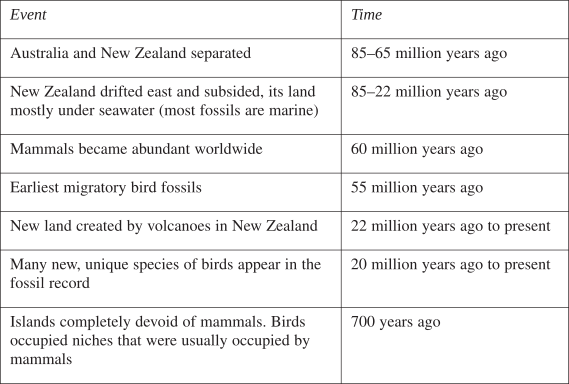
Geological and biological history of New Zealand

Use this information and other relevant knowledge to demonstrate how the practice of biology has led to the validation of current theories of evolution.  (7 marks)

--- 18 WORK AREA LINES (style=lined) ---

Show Answers Only
  • In the New Zealand information, many practices of biology were undertaken to compile the data.
  • The observations of fauna in New Zealand represent an important practice in biological science. Making clear, dispassionate and unbiased observations, and recording such observations are intrinsic to science and provide an essential pathway to validating theories.
  • These observations validated the idea of convergent evolution; birds in New Zealand, without competition from mammals, developed similar characteristics and were able to live in the same environments as mammals do elsewhere.
  • Practices in palaeontology of ageing fossils by radiometric dating or stratigraphy, describing fossils and comparing fossils, allows a history of fauna of New Zealand to be compiled, and history of islands (eg. deducing from fossils found to be almost completely marine that New Zealand was covered by oceans).
  • The history of fauna and geologic events validates Charles Darwin’s theory of evolution in that populations of birds, which began as occasional visitors, gradually changed into permanent endemic species.
  • Divergent evolution is validated as new unique species develop from migratory species, as shown by the fossils of new, unique birds.
  • The data also validates the punctuated equilibrium theory in that the diversification of bird species happened very quickly in the space of only 2 million years.
Show Worked Solution
  • In the New Zealand information, many practices of biology were undertaken to compile the data.
  • The observations of fauna in New Zealand represent an important practice in biological science. Making clear, dispassionate and unbiased observations, and recording such observations are intrinsic to science and provide an essential pathway to validating theories.
  • These observations validated the idea of convergent evolution; birds in New Zealand, without competition from mammals, developed similar characteristics and were able to live in the same environments as mammals do elsewhere.
  • Practices in palaeontology of ageing fossils by radiometric dating or stratigraphy, describing fossils and comparing fossils, allows a history of fauna of New Zealand to be compiled, and history of islands (eg. deducing from fossils found to be almost completely marine that New Zealand was covered by oceans).
  • The history of fauna and geologic events validates Charles Darwin’s theory of evolution in that populations of birds, which began as occasional visitors, gradually changed into permanent endemic species.
  • Divergent evolution is validated as new unique species develop from migratory species, as shown by the fossils of new, unique birds.
  • The data also validates the punctuated equilibrium theory in that the diversification of bird species happened very quickly in the space of only 2 million years.

Filed Under: Evolution - The Evidence, Natural Selection Tagged With: Band 4, Band 5, smc-4309-35-Convergent/Divergent, smc-4310-05-Fossils

BIOLOGY, M3 2013 SM-Bank 21

Explain how ONE secondary source has provided support for the theory of evolution.  (4 marks)

--- 10 WORK AREA LINES (style=lined) ---

Show Answers Only
  • The theory of evolution suggests that species occur by variation of a common ancestor.
  • Variation within an ancient species caused certain characteristics to be favoured in certain environments, causing divergent evolution and overtime the development of new species.
  • This theory can be validated by comparative anatomy, the practise of comparing body structures of different species.
  • When comparing forelimbs of vertebrate, such as canines, humans and whales, we are presented with similarities in their structures. The bone structure is especially similar, with the named animals all having the same pentadactyl (five-digit) limb plan, as they all possess some form of humerus, ulna, radius, carpels and metacarpals. This suggests common ancestry.
Show Worked Solution
  • The theory of evolution suggests that species occur by variation of a common ancestor.
  • Variation within an ancient species caused certain characteristics to be favoured in certain environments, causing divergent evolution and overtime the development of new species.
  • This theory can be validated by comparative anatomy, the practise of comparing body structures of different species.
  • When comparing forelimbs of vertebrate, such as canines, humans and whales, we are presented with similarities in their structures. The bone structure is especially similar, with the named animals all having the same pentadactyl (five-digit) limb plan, as they all possess some form of humerus, ulna, radius, carpels and metacarpals. This suggests common ancestry.

Filed Under: Evolution - The Evidence Tagged With: Band 4, smc-4310-05-Fossils, smc-4310-15-Comparative anatomy

Copyright © 2014–2026 SmarterEd.com.au · Log in