SmarterEd

Aussie Maths & Science Teachers: Save your time with SmarterEd

  • Login
  • Get Help
  • About

v1 Algebra, STD2 A4 2014 HSC 29a

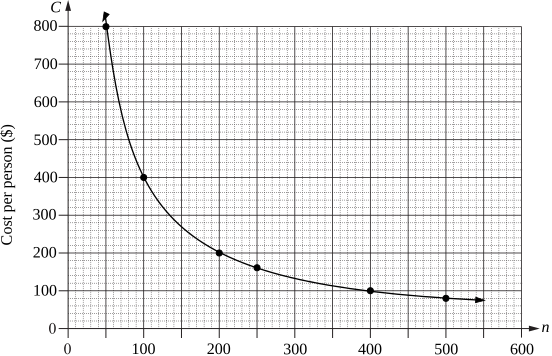
A golf club hires an entire course for a charity event at a total cost of `$40\ 000`. The cost will be shared equally among the players, so that `C` (in dollars) is the cost per player when `n` players attend.

  1. Complete the table below by filling in the three missing values.   (1 mark)
    \begin{array} {|l|c|c|c|c|c|c|}
    \hline
    \rule{0pt}{2.5ex}\text{Number of players} (n) \rule[-1ex]{0pt}{0pt} & \ 50\ & \ 100 \ & 200 \ & 250 \ & 400\ & 500 \ \\
    \hline
    \rule{0pt}{2.5ex}\text{Cost per person} (C)\rule[-1ex]{0pt}{0pt} &  &  &  & 160 & 100\ & 80 \ \\
    \hline
    \end{array}
  2. Using the values from the table, draw the graph showing the relationship between `n` and `C`.   (2 marks)
     
  3. What equation represents the relationship between `n` and `C`?   (1 mark)

    --- 1 WORK AREA LINES (style=lined) ---

  4. Give ONE limitation of this equation in relation to this context.   (1 mark)

    --- 2 WORK AREA LINES (style=lined) ---

  5. Is it possible for the cost per person to be $94? Support your answer with appropriate calculations.   (1 mark)

    --- 4 WORK AREA LINES (style=lined) ---

Show Answers Only

a.   

\begin{array} {|l|c|c|c|c|c|c|}
\hline
\rule{0pt}{2.5ex}\text{Number of players} (n) \rule[-1ex]{0pt}{0pt} & \ 500\ & \ 1000 \ & 1500 \ & 2000 \ & 2500\ & 3000 \ \\
\hline
\rule{0pt}{2.5ex}\text{Cost per person} (C)\rule[-1ex]{0pt}{0pt} & 240 & 120 & 80 & 60 & 48\ & 40 \ \\
\hline
\end{array}
 

b. 

c.   `C = (40\ 000)/n`

`n\ text(must be a whole number)`
 

d.    `text(Limitations can include:)`

  `•\ n\ text(must be a whole number)`

  `•\ C > 0`
 

e.   `text(If)\ C = 94:`

`94` `= (120\ 000)/n`
`94n` `= 120\ 000`
`n` `= (120\ 000)/94`
  `= 1276.595…`

 
`:.\ text(C)text(ost cannot be $94 per person, because)\ n\ text(isn’t a whole number.)`

Show Worked Solution

a.   

\begin{array} {|l|c|c|c|c|c|c|}
\hline
\rule{0pt}{2.5ex}\text{Number of players} (n) \rule[-1ex]{0pt}{0pt} & \ 50\ & \ 100 \ & 200 \ & 250 \ & 400\ & 500 \ \\
\hline
\rule{0pt}{2.5ex}\text{Cost per person} (C)\rule[-1ex]{0pt}{0pt} & 800 & 400 & 200 & 160 & 100\ & 80 \ \\
\hline
\end{array}

b.   


c.   `C = (40\ 000)/n`


TIP: Limitations require looking at possible restrictions of both the domain and range.

d.   `text(Limitations can include:)`

  `•\ n\ text(must be a whole number)`

  `•\ C > 0`
 

e.   `text(If)\ C = 120`

`120` `= (40\ 000)/n`
`120n` `= 40\ 000`
`n` `= (40\ 000)/120`
  `= 333.33..`

  
`:.\ text{Cost cannot be $120 per person because the required}\ n\ \text{is not a whole number.}`
Filed Under: Non-Linear: Inverse and Other Problems (Std 2-X) Tagged With: Band 4, Band 5, Band 6, num-title-ct-pathc, num-title-qs-hsc, smc-4445-60-Hyperbola applications, smc-795-10-Inverse, smc-795-30-Limitations

v1 Algebra, STD2 A4 2022 HSC 24

A chef believes that the time it takes to defrost a turkey (`D` hours) varies inversely with the room temperature (`T^\circ \text{C}`). The chef observes that at a room temperature of `20^\circ \text{C}`, it takes 15 hours for the turkey to fully defrost.

  1. Find the equation relating `D` and `T`.   (2 marks)

    --- 4 WORK AREA LINES (style=lined) ---

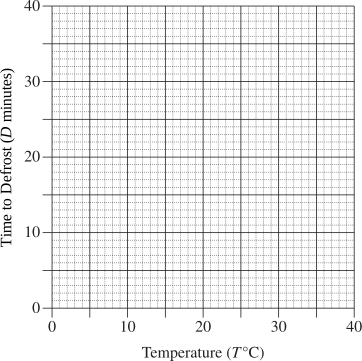
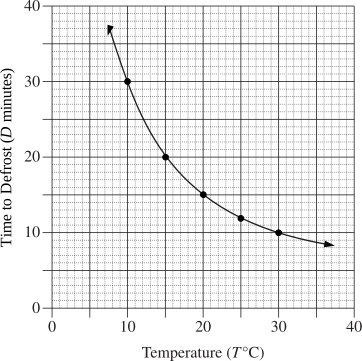
  2. By first completing this table of values, graph the relationship between temperature and time.   (2 marks)

\begin{array} {|l|c|c|c|c|c|}
\hline
\rule{0pt}{2.5ex} \ \ T\ \  \rule[-1ex]{0pt}{0pt} & \ \ \ 10\ \ \  & \ \ 15\ \ \  & \ \ \ 20\ \ \  & \ \ \ 25\ \ \ & \ \ \ 30\ \ \ \\
\hline
\rule{0pt}{2.5ex} \ \ D\ \  \rule[-1ex]{0pt}{0pt} & \ \ \ \  & \ \ \  & \ \ \ \  & \ \ \ \ & \ \ \ \\
\hline
\end{array}


--- 0 WORK AREA LINES (style=lined) ---

Show Answers Only

a.   `D \prop 1/T\ \ =>\ \ D=k/T`

  `15` `=k/20`
  `k` `=15 xx 20=300`

 
`:.D=300/T`

b.   

\begin{array} {|l|c|c|c|c|c|}
\hline
\rule{0pt}{2.5ex} \ \ T\ \  \rule[-1ex]{0pt}{0pt} & \ \ \ 10\ \ \  & \ \ 15\ \ \  & \ \ \ 20\ \ \  & \ \ \ 25\ \ \ & \ \ \ 30\ \ \ \\
\hline
\rule{0pt}{2.5ex} \ \ D\ \  \rule[-1ex]{0pt}{0pt} & \ \ \ 30\ \ \  & \ \ 20\ \ \  & \ \ \ 15\ \ \  & \ \ \ 12\ \ \ & \ \ \ 10\ \ \ \\
\hline
\end{array}


Show Worked Solution

a.   `D \prop 1/T\ \ =>\ \ D=k/T`

  `15` `=k/20`
  `k` `=15 xx 20=300`

 
`:.D=300/T`

b.   

\begin{array} {|l|c|c|c|c|c|}
\hline
\rule{0pt}{2.5ex} \ \ D\ \  \rule[-1ex]{0pt}{0pt} & \ \ \ 10\ \ \  & \ \ 15\ \ \  & \ \ \ 20\ \ \  & \ \ \ 25\ \ \ & \ \ \ 30\ \ \ \\
\hline
\rule{0pt}{2.5ex} \ \ T\ \ \rule[-1ex]{0pt}{0pt} & 30 & 20 & 15 & 12 & 10  \\
\hline
\end{array}


Filed Under: Non-Linear: Inverse and Other Problems (Std 2-X) Tagged With: 2adv-std2-common, Band 5, num-title-ct-pathc, num-title-qs-hsc, smc-4445-60-Hyperbola applications, smc-795-10-Inverse

Algebra, STD2 A4 2022 HSC 24

A student believes that the time it takes for an ice cube to melt (`M` minutes) varies inversely with the room temperature `(T^@ text{C})`. The student observes that at a room temperature of `15^@text{C}` it takes 12 minutes for an ice cube to melt.

  1. Find the equation relating `M` and `T`.   (2 marks)

    --- 4 WORK AREA LINES (style=lined) ---

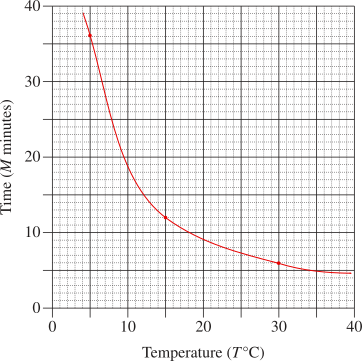
  2. By first completing this table of values, graph the relationship between temperature and time from `T=5^@C` to `T=30^@ text{C}.`   (2 marks)

\begin{array} {|l|c|c|c|}
\hline
\rule{0pt}{2.5ex} \ \ T\ \  \rule[-1ex]{0pt}{0pt} & \ \ \ 5\ \ \  & \ \ 15\ \ \  & \ \ \ 30\ \ \  \\
\hline
\rule{0pt}{2.5ex} \ \ M\ \ \rule[-1ex]{0pt}{0pt} & & & \\
\hline
\end{array}


--- 0 WORK AREA LINES (style=lined) ---

Show Answers Only

a.  `M prop 1/T \ \ =>\ \ M=k/T`

  `12` `=k/15`
  `k` `=15 xx 12=180`

 
`:.M=180/T`

b.   

\begin{array} {|l|c|c|c|}
\hline
\rule{0pt}{2.5ex} \ \ T\ \  \rule[-1ex]{0pt}{0pt} & \ \ \ 5\ \ \  & \ \ 15\ \ \  & \ \ 30\ \  \\
\hline
\rule{0pt}{2.5ex} \ \ M\ \ \rule[-1ex]{0pt}{0pt} & 36 & 12 & 6 \\
\hline
\end{array}


Show Worked Solution
a.    `M` `prop 1/T`
  `M` `=k/T`
  `12` `=k/15`
  `k` `=15 xx 12`
    `=180`

 
`:.M=180/T`


♦♦ Mean mark part (a) 29%.

b.   

\begin{array} {|l|c|c|c|}
\hline
\rule{0pt}{2.5ex} \ \ T\ \  \rule[-1ex]{0pt}{0pt} & \ \ \ 5\ \ \  & \ \ 15\ \ \  & \ \ 30\ \  \\
\hline
\rule{0pt}{2.5ex} \ \ M\ \ \rule[-1ex]{0pt}{0pt} & 36 & 12 & 6 \\
\hline
\end{array}


♦ Mean mark 44%.

Filed Under: Circles and Hyperbola, Non-Linear: Inverse and Other Problems (Std 2) Tagged With: 2adv-std2-common, Band 5, num-title-ct-pathc, num-title-qs-hsc, smc-4445-60-Hyperbola applications, smc-795-10-Inverse

Algebra, STD2 A4 2014 HSC 29a

The cost of hiring an open space for a music festival is  $120 000. The cost will be shared equally by the people attending the festival, so that  `C`  (in dollars) is the cost per person when  `n`  people attend the festival.

  1. Complete the table below by filling in the THREE missing values.   (1 mark)
    \begin{array} {|l|c|c|c|c|c|c|}
    \hline
    \rule{0pt}{2.5ex}\text{Number of people} (n) \rule[-1ex]{0pt}{0pt} & \ 500\ & \ 1000 \ & 1500 \ & 2000 \ & 2500\ & 3000 \ \\
    \hline
    \rule{0pt}{2.5ex}\text{Cost per person} (C)\rule[-1ex]{0pt}{0pt} &  &  &  & 60 & 48\ & 40 \ \\
    \hline
    \end{array}
  2. Using the values from the table, draw the graph showing the relationship between  `n`  and  `C`.   (2 marks)
     
  3. What equation represents the relationship between `n` and `C`?   (1 mark)

    --- 1 WORK AREA LINES (style=lined) ---

  4. Give ONE limitation of this equation in relation to this context.   (1 mark)

    --- 2 WORK AREA LINES (style=lined) ---

  5. Is it possible for the cost per person to be $94? Support your answer with appropriate calculations.   (1 mark)

    --- 2 WORK AREA LINES (style=lined) ---

Show Answers Only

i.   

\begin{array} {|l|c|c|c|c|c|c|}
\hline
\rule{0pt}{2.5ex}\text{Number of people} (n) \rule[-1ex]{0pt}{0pt} & \ 500\ & \ 1000 \ & 1500 \ & 2000 \ & 2500\ & 3000 \ \\
\hline
\rule{0pt}{2.5ex}\text{Cost per person} (C)\rule[-1ex]{0pt}{0pt} & 240 & 120 & 80 & 60 & 48\ & 40 \ \\
\hline
\end{array}
 

ii. 

iii.   `C = (120\ 000)/n`

`n\ text(must be a whole number)`
 

iv.   `text(Limitations can include:)`

  `•\ n\ text(must be a whole number)`

  `•\ C > 0`
 

v.   `text(If)\ C = 94:`

`94` `= (120\ 000)/n`
`94n` `= 120\ 000`
`n` `= (120\ 000)/94`
  `= 1276.595…`

 
`:.\ text(C)text(ost cannot be $94 per person,)`

`text(because)\ n\ text(isn’t a whole number.)`

Show Worked Solution

i.   

\begin{array} {|l|c|c|c|c|c|c|}
\hline
\rule{0pt}{2.5ex}\text{Number of people} (n) \rule[-1ex]{0pt}{0pt} & \ 500\ & \ 1000 \ & 1500 \ & 2000 \ & 2500\ & 3000 \ \\
\hline
\rule{0pt}{2.5ex}\text{Cost per person} (C)\rule[-1ex]{0pt}{0pt} & 240 & 120 & 80 & 60 & 48\ & 40 \ \\
\hline
\end{array}
 

ii. 


♦ Mean mark (iii) 48%

iii.   `C = (120\ 000)/n`


♦♦♦ Mean mark (iv) 7%
COMMENT: When asked for limitations of an equation, look carefully at potential restrictions with respect to both the domain and range.

iv.   `text(Limitations can include:)`

  `•\ n\ text(must be a whole number)`

  `•\ C > 0`


v.   `text(If)\ C = 94`

`=> 94` `= (120\ 000)/n`
`94n` `= 120\ 000`
`n` `= (120\ 000)/94`
  `= 1276.595…`
♦ Mean mark (v) 38%


`:.\ text(C)text(ost cannot be $94 per person,)`

`text(because)\ n\ text(isn’t a whole number.)`

Filed Under: Circles and Hyperbola, Inverse, Non-Linear: Inverse and Other Problems (Std 2) Tagged With: Band 4, Band 5, Band 6, num-title-ct-pathc, num-title-qs-hsc, smc-4445-60-Hyperbola applications, smc-795-10-Inverse, smc-795-30-Limitations

Copyright © 2014–2025 SmarterEd.com.au · Log in