Consider the algorithm below.

In order, the values printed by the algorithm are
- \( 12\)
- \( 12,7\)
- \(12,7,2\)
- \(12,7,2,-3\)
Aussie Maths & Science Teachers: Save your time with SmarterEd
Consider the algorithm below.
In order, the values printed by the algorithm are
Consider the algorithm below, which prints the roots of the cubic polynomial \(f(x)=x^3-2 x^2-9 x+18\).
\begin{array} {l}
\rule{0pt}{2.5ex} \textbf{ define} \ \text{ f (x) } \\
\rule{0pt}{2.5ex} \quad \quad \textbf{return} \ \text{(x} ^3 - 2 \text{x}^2 - 9 \text{x} + 18) \\
\rule{0pt}{2.5ex} \text{c} \leftarrow \text{f} \ (0) \\
\rule{0pt}{2.5ex} \textbf{if}\ \ \text{c < 0} \ \textbf{then}\\
\rule{0pt}{2.5ex} \quad \quad \text{c} \ \leftarrow \ \text{(- c)} \\
\rule{0pt}{2.5ex} \textbf{end if} \\
\rule{0pt}{2.5ex} \textbf{while} \ \text{ c > 0 } \\
\rule{0pt}{2.5ex} \quad \quad \textbf{if} \ \ \text{f (c) = 0 } \ \textbf{then} \\
\rule{0pt}{2.5ex} \quad \quad \quad \quad \textbf{print} \ \text{c } \\
\rule{0pt}{2.5ex} \quad \quad \textbf{end if} \\
\rule{0pt}{2.5ex} \quad \quad \textbf{if} \ \ \text{f (-c) = 0} \ \textbf{then} \\
\rule{0pt}{2.5ex} \quad \quad \quad \quad \textbf{print} \ \text{-c } \\
\rule{0pt}{2.5ex} \quad \quad \textbf{end if} \\
\rule{0pt}{2.5ex} \quad \quad \text{c} \ \leftarrow \ \text{c - 1} \\
\rule{0pt}{2.5ex} \textbf{ end while } \\
\end{array}
In order, the algorithm prints the values
Consider the algorithm below, which uses the bisection method to estimate the solution to an equation in the form \(f(x)=0\).
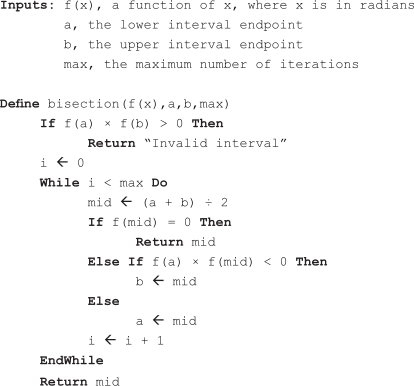
The algorithm is implemented as follows.

Which value would be returned when the algorithm is implemented as given?