SmarterEd

Aussie Maths & Science Teachers: Save your time with SmarterEd

  • Login
  • Get Help
  • About

Calculus, MET2 2023 VCAA 5

Let \(f:R \to R, f(x)=e^x+e^{-x}\) and \(g:R \to R, g(x)=\dfrac{1}{2}f(2-x)\).

  1. Complete a possible sequence of transformations to map \(f\) to \(g\).   (2 marks)
    •    Dilation of factor \(\dfrac{1}{2}\) from the \(x\) axis.

    --- 2 WORK AREA LINES (style=lined) ---

Two functions \(g_1\) and \(g_2\) are created, both with the same rule as \(g\) but with distinct domains, such that \(g_1\) is strictly increasing and \(g_2\) is strictly decreasing.

  1. Give the domain and range for the inverse of \(g_1\).   (2 marks)

    --- 3 WORK AREA LINES (style=lined) ---

Shown below is the graph of \(g\), the inverse of \(g_1\) and \(g_2\), and the line \(y=x\).
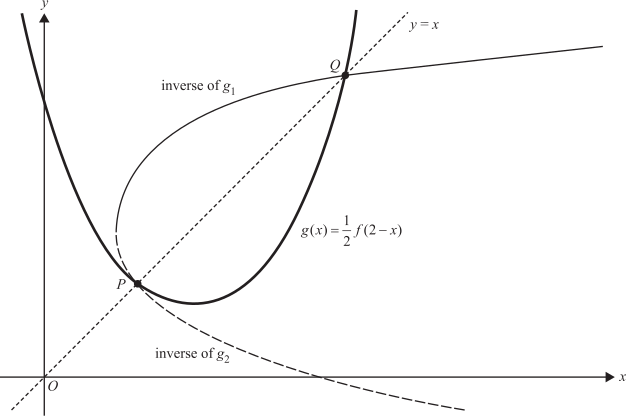
 

The intersection points between the graphs of \(y=x, y=g(x)\) and the inverses of \(g_1\) and \(g_2\), are labelled \(P\) and \(Q\).

    1. Find the coordinates of \(P\) and \(Q\), correct to two decimal places.   (1 mark)

      --- 2 WORK AREA LINES (style=lined) ---

    1. Find the area of the region bound by the graphs of \(g\), the inverse of \(g_1\) and the inverse of \(g_2\).
    2. Give your answer correct to two decimal places.   (2 marks)

      --- 4 WORK AREA LINES (style=lined) ---

Let \(h:R\to R, h(x)=\dfrac{1}{k}f(k-x)\), where \(k\in (o, \infty)\).

  1. The turning point of \(h\) always lies on the graph of the function \(y=2x^n\), where \(n\) is an integer.
  2. Find the value of \(n\).  (1 mark)

    --- 2 WORK AREA LINES (style=lined) ---

Let \(h_1:[k, \infty)\to R, h_1(x)=h(x)\).

The rule for the inverse of \(h_1\) is \(y=\log_{e}\Bigg(\dfrac{1}{k}x+\dfrac{1}{2}\sqrt{k^2x^2-4}\Bigg)+k\)

  1. What is the smallest value of \(k\) such that \(h\) will intersect with the inverse of \(h_1\)?\
  2. Give your answer correct to two decimal places.   (1 mark)

    --- 3 WORK AREA LINES (style=lined) ---

It is possible for the graphs of \(h\) and the inverse of \(h_1\) to intersect twice. This occurs when \(k=5\).

  1. Find the area of the region bound by the graphs of \(h\) and the inverse of \(h_1\), where \(k=5\).
  2. Give your answer correct to two decimal places.   (2 marks)

    --- 5 WORK AREA LINES (style=lined) ---
Show Answers Only

a.    \(\text{Reflect in the }y\text{-axis}\)

\(\text{Then translate 2 units to the right}\)

\(\text{OR}\)

\(\text{Translate 2 units to the left}\)

\(\text{Then reflect in the }y\text{-axis}\)

\(\text{OR}\)

\(\text{Translate 2 units to the right only }(f \ \text{even function})\)

b.    \(\text{See worked solution}\)

c.i.  \(P(1.27, 1.27\), Q(4.09, 4.09)\)

c.ii. \(2\displaystyle \int_{1.27…}^{4.09…} (x-g(x))\,dx=5.56\)

d.    \(n=-1\)

e. \(k\approx 1.27\)

f. \(A=43.91\)

Show Worked Solution

a.    \(\text{Reflect in the }y\text{-axis}\)

\(\text{Then translate 2 units to the right}\)

\(\text{OR}\)

\(\text{Translate 2 units to the left}\)

\(\text{Then reflect in the }y\text{-axis}\)

\(\text{OR}\)

\(\text{Translate 2 units to the right only }(f \ \text{even function})\)

b.    \(\text{Some options include:}\)

•  \(\text{Domain}\to [1, \infty)\ \ \ \text{Range}\to [2, \infty)\)
\(\text{or}\)
•  \(\text{Domain}\to (1, \infty)\ \ \ \text{Range}\to (2, \infty)\)
 

\(\text{If functions split at turning point } (2, 1)\ \text{then possible options:}\)

• \(\text{Domain}\ g_1\to [2, \infty)\ \ \ \text{Range}\to [1, \infty)\)
   \(\text{and }\)
  \(\text{Domain}\ g_1^{-1}\to [1, \infty)\ \ \ \text{Range}\to [2, \infty)\)

\(\text{or}\)

•  \(\text{Domain}\ g_1\to (2, \infty)\ \ \ \text{Range}\to (1, \infty)\)
   \(\text{and }\)
   \(\text{Domain}\ g_1^{-1}\to (1, \infty)\ \ \ \text{Range}\to (2, \infty)\)


♦ Mean mark 50%.
MARKER’S COMMENT: Note: maximal domain not requested so there were many correct answers. Many students seemed to be confused by notation. Often domain and range reversed.

c.i.  \(\text{By CAS:}\  P(1.27, 1.27), Q(4.09, 4.09)\)

c.ii.   \(\text{Area}\) \(=2\displaystyle \int_{1.27…}^{4.09…} (x-g(x))\,dx\)
    \(=2\displaystyle \int_{1.27…}^{4.09…} \Bigg(x-\dfrac{1}{2}\Big(e^{2-x}+e^{x-2}\Big)\Bigg)\,dx\)
    \(\approx 5.56\)

♦♦ Mean mark (c)(ii) 30%.
MARKER’S COMMENT: Some students set up the integral but did not provide an answer.
Others did not double the integral. Some incorrectly used \(\displaystyle \int_{1.27…}^{4.09…}(g_1^-1-g(x))\,dx\).
Others had correct answer but incorrect integral.

d.    \((0, 2)\ \text{turning pt of }f(x)\)

\(\text{and }h(x) \text{is the transformation from }f(x)\)

\(\therefore \Bigg(k, \dfrac{2}{k}\Bigg)\ \text{turning tp of }h(x)\)

\(\text{so the coordinates have the relationship}\)

\(y=\dfrac{2}{x}=2x^{-1}\)

\(\therefore\ n=-1\)


♦♦♦ Mean mark (d) 10%.
MARKER’S COMMENT: Question not well done. \(n=1\) a common error.

e.    \(\text{Smallest }k\ \text{is when inverse of the curves }h_1\ \text{and}\ h\)

\(\text{touch with the line }y=x.\)

\(\therefore\ h(x)\) \(=\dfrac{1}{k}\Big(e^{k-x}+e^{x-k}\Big)\)
  \(=x\)


\(\text{and}\ h'(x)\) \(=\dfrac{1}{k}\Big(-e^{k-x}+e^{x-k}\Big)\)
  \(=1\)

\(\text{at point of intersection, where }k>0.\)

\(\text{Using CAS graph both functions to solve or solve as simultaneous equations.}\)

\(\rightarrow\ k\approx 1.2687\approx 1.27\)


♦♦♦♦ Mean mark (e) 0%.
MARKER’S COMMENT: Question poorly done with many students not attempting.

f.    \(\text{When}\ k=5\)

\(h_1^{-1}(x)=\log_e\Bigg(\dfrac{5}{2}x+\dfrac{1}{2}\sqrt{25x^2-4}\Bigg)+5\)

\(\text{and }h(x)=\dfrac{1}{5}\Big(e^{5-x}+e^{x-5}\Big)\)

\(\text{Using CAS: values of }x\ \text{at of intersection of fns are}\)

\(x\approx 1.45091…\ \text{and}\ 8.78157…\)

\(\text{Area}\) \(=\displaystyle \int_{1.45091…}^{8.78157…}h_1^{-1}(x)- h(x)\,dx\)
  \(=\displaystyle \int_{1.45091…}^{8.78157…} \log_e\Bigg(\dfrac{5}{2}x+\dfrac{1}{2}\sqrt{25x^2-4}\Bigg)+5-\dfrac{1}{5}\Big(e^{5-x}+e^{x-5}\Big)\,dx\)
  \(=43.91\) 

♦♦♦ Mean mark (f) 15%.
MARKER’S COMMENT: Errors were made with terminals. Common error using \(x=2.468\), which was the \(x\) value of the pt of intersection of \(h\) and \(y=x\).

Filed Under: Area Under Curves, Integration (L&E), L&E Integration, Logs and Exponential Functions, Transformations Tagged With: Band 4, Band 5, Band 6, smc-5204-50-Find intersection, smc-5204-80-Area between curves, smc-723-50-Log/Exponential, smc-723-95-Transformations, smc-740-20-Exponential (definite), smc-748-20-Exponential (definite)

Calculus, MET2-NHT 2019 VCAA 5

Let  `f: R → R, \ f(x) = e^((x/2))`  and  `g: R → R, \ g(x) = 2log_e(x)`.

  1. Find  `g^-1 (x)`.   (1 mark)

    --- 4 WORK AREA LINES (style=lined) ---

  2. Find the coordinates of point  `A`, where the tangent to the graph of  `f` at  `A` is parallel to the graph of  `y = x`.   (2 marks)

    --- 5 WORK AREA LINES (style=lined) ---
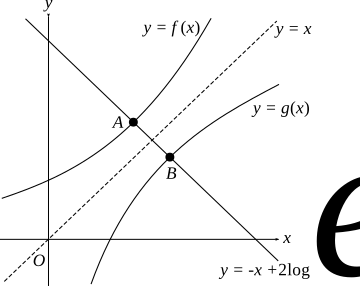
  3. Show that the equation of the line that is perpendicular to the graph of  `y = x`  and goes through point  `A` is  `y = -x + 2log_e(2) + 2`.   (1 mark)

    --- 3 WORK AREA LINES (style=lined) ---

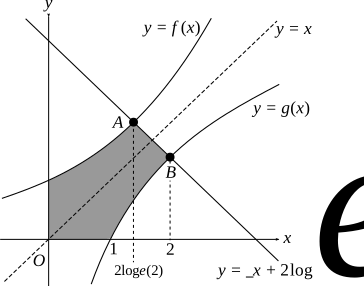
Let `B` be the point of intersection of the graphs of `g` and  `y =-x + 2log_e(2) + 2`, as shown in the diagram below.


  1. Determine the coordinates of point `B`.   (1 mark)

    --- 4 WORK AREA LINES (style=lined) ---

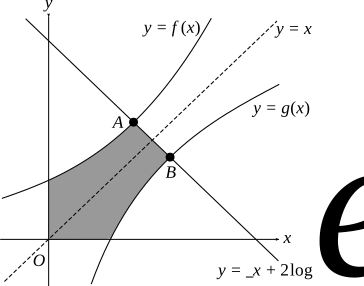
  2. The shaded region below is enclosed by the axes, the graphs of  `f` and `g`, and the line  `y =-x + 2log_e(2) + 2`.


    Find the area of the shaded region.   (2 marks)

    --- 4 WORK AREA LINES (style=lined) ---

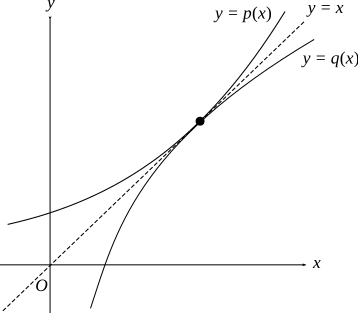
Let  `p : R→ R, \ p(x) = e^(kx)`  and  `q : R→ R, \ q(x) = (1)/(k) log_e(x)`.

  1. The graphs of `p`, `q` and  `y = x`  are shown in the diagram below. The graphs of `p` and `q` touch but do not cross.


     Find the value of  `k`.   (2 marks)

    --- 6 WORK AREA LINES (style=lined) ---

  2. Find the value of  `k, k > 0`, for which the tangent to the graph of `p` at its `y`-intercept and the tangent to the graph of `q` at its `x`-intercept are parallel.   (1 mark)

    --- 5 WORK AREA LINES (style=lined) ---
Show Answers Only
  1. `e^{(x)/(2)}`
  2. `(2log_e 2, 2)`
  3. `text(Proof(See Worked Solution))`
  4. `(2, 2log_e 2)`
  5. `6-2(log_e 2)^2-4 log_e 2`
  6. `(1)/(e)`
  7. `k =1`
Show Worked Solution

a.    `g(x) = 2log_e x`

`text(Inverse: swap) \ x ↔ y`

`x` `= 2log_e y`
`log_e y` `= (x)/(2)`
`y` `= e^{(x)/(2)}`


b.    `f(x) = e^{(x)/(2)}`

`f′(x) = (1)/(2) e^{(x)/(2)}`
 
`text(S) text(olve) \ \ f′(x) = 1 \ text(for) \ x:`

`x = 2log_e 2`

`y = e^(log_e 2) = 2`
 
`:. \ A\ text(has coordinates)\  (2log_e 2, 2)`


c.    `m_(⊥) = -1`

`text(Equation of line) \ \ m = -1 \ \ text(through)\ \ (2log_e 2, 2) :`

`y-2` `= -(x-2log_e 2)`
`y` `= -x +  2log_e 2 + 2`


d.    `text(Method 1)`

`text(S) text(olve for) \ x :`

`-x + 2log_e 2 + 2 = 2log_e x`

`=> x = 2 , \ y = 2log_e 2`

`:. B ≡ (2, 2log_e 2)`
 

`text(Method 2)`

`text(S) text(ince) \ \ f(x) = g^-1 (x)`

`B \ text(is the reflection of) \ \ A(2log_e 2, 2) \ \ text(in the) \ \ y=x \ \ text(axis)`

`:. \ B ≡ (2, 2log_e 2)`


e.


`y = g(x) \ \ text(intersects) \ x text(-axis at) \ \ x = 1`

`text(Dividing shaded area into 3 sections:)`

`A` `= int_0^1 f(x)\ dx \ + \ int_1^(2log_e 2) f(x)-g(x)\ dx`  
  ` \ + \ int_(2log_e 2)^2 (-x + 2log_e 2 + 2)-g(x)\ dx`  
  `= 6-2(log_e 2)^2-4 log_e 2`  


f.   `p(x) = e^(kx) \ , \ q(x) = (1)/(k) log_e x`

`p′(x) = k e^(kx) \ , \ q′(x) = (1)/(kx)`
 
`text(S) text(ince graphs touch on) \ y = x`

`k e^(kx) = 1\ …\ (1)`

`(1)/(kx) = 1\ …\ (2)`

`text(Substitute) \ x = (1)/(k) \ text{from (2) into (1)}`

`k e^(k xx 1/k)` `= 1`
`:. k` `= (1)/(e)`


g.   `text(Consider)\ \ p(x):`

`text(When) \ \ x = 0 , \ p(0) = 1 , \ p′(0) = k`
 

 `text(Consider) \ \ q(x):`

`text(When) \ \ y= 0, \ (1)/(k) log_e x = 0 \ => \ x = 1`

`q′(1) = (1)/(k)`

`text(If lines are parallel), \ k = (1)/(k)`
 
`:. \ k = 1`

Filed Under: Area Under Curves, Logs and Exponential Functions Tagged With: Band 4, Band 5, Band 6, smc-5204-50-Find intersection, smc-723-50-Log/Exponential

Algebra, MET2 2017 VCAA 4

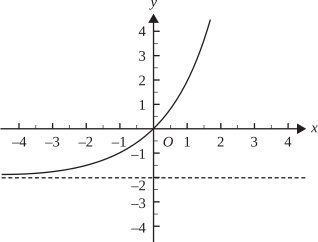
Let  `f : R → R :\  f (x) = 2^(x + 1)-2`. Part of the graph of  `f` is shown below.
 

  1. The transformation  `T: R^2 -> R^2, \ T([(x),(y)]) = [(x),(y)] + [(c),(d)]`  maps the graph of  `y = 2^x`  onto the graph of  `f`.


    State the values of `c` and `d`.   (2 marks)

    --- 5 WORK AREA LINES (style=lined) ---
  2. Find the rule and domain for  `f^(-1)`, the inverse function of  `f`.   (2 marks)

    --- 5 WORK AREA LINES (style=lined) ---
  3. Find the area bounded by the graphs of  `f` and  `f^(-1)`.   (3 marks)

    --- 3 WORK AREA LINES (style=lined) ---
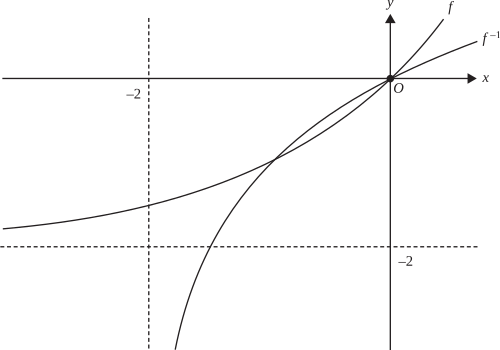
  4. Part of the graphs of  `f` and  `f^(-1)` are shown below.


    Find the gradient of  `f` and the gradient of  `f^(-1)`  at  `x = 0`.   (2 marks)

    --- 2 WORK AREA LINES (style=lined) ---
The functions of  `g_k`, where  `k ∈ R^+`, are defined with domain `R` such that  `g_k(x) = 2e^(kx)-2`.

  1. Find the value of `k` such that  `g_k(x) = f(x)`.  (1 mark)

    --- 3 WORK AREA LINES (style=lined) ---

  2. Find the rule for the inverse functions  `g_k^(-1)` of  `g_k`, where  `k ∈ R^+`.   (1 mark)

    --- 5 WORK AREA LINES (style=lined) ---

  3. i. Describe the transformation that maps the graph of  `g_1` onto the graph of  `g_k`.   (1 mark)

    --- 3 WORK AREA LINES (style=lined) ---

    ii. Describe the transformation that maps the graph of  `g_1^(-1)` onto the graph of  `g_k^(-1)`.   (1 mark)

    --- 3 WORK AREA LINES (style=lined) ---

  4. The lines `L_1` and `L_2` are the tangents at the origin to the graphs of  `g_k`  and  `g_k^(-1)`  respectively.
  5. Find the value(s) of `k` for which the angle between `L_1` and `L_2` is 30°.   (2 marks)

    --- 6 WORK AREA LINES (style=lined) ---

  6. Let `p` be the value of `k` for which  `g_k(x) = g_k^(−1)(x)`  has only one solution.
  7.  i. Find `p`.   (2 marks)

    --- 4 WORK AREA LINES (style=lined) ---

  8. ii. Let  `A(k)`  be the area bounded by the graphs of  `g_k`  and  `g_k^(-1)`  for all  `k > p`.
  9.     State the smallest value of `b` such that  `A(k) < b`.   (1 mark)

    --- 4 WORK AREA LINES (style=lined) ---

Show Answers Only

a.  `c =-1, \ d =-2`

b.  `f^(-1)(x) = log_2 (x + 2)-1, \ x ∈ (-2,∞)`

c.  `3-2/(log_e(2))\ text(units)²`

d. `f^{prime}(0)= 2log_e(2) and f^(-1)^{prime}(0)= 1/(2log_e(2))`

e.  `k = log_e(2)`

f.  `g_k^(-1)(x)= 1/k log_e((x + 2)/2)`

g.i.  `text(Dilation by factor of)\ 1/k\ text(from the)\ ytext(-axis)`

g.ii.  `text(Dilation by factor of)\ 1/k\ text(from the)\ xtext(-axis)`

h.  `k=sqrt3/6\ or\ sqrt3/2`

i.i.  `p = 1/2`

i.ii.  `b=4`

Show Worked Solution

a.   `text(Using the matrix transformation:)`

`x^{prime}` `=x+c\ \ => x=x^{prime}-c`
`y^{prime}` `=y+d\ \ =>y= y^{prime}-d`
   
`y^{prime}-d` `=2^((x)^{prime}-c)`
`y^{prime}` `= 2^((x)^{prime}-c)+d`


`:. c = -1, \ d = -2`


b.   `text(Let)\ \ y = f(x)`

`text(Inverse : swap)\ x\ ↔ \ y`

`x` `= 2^(y + 1)-2`
`x + 2` `= 2^(y + 1)`
`y + 1` `= log_2(x + 2)`
`y` `= log_2(x + 2)-1`


`text(dom)(f^(-1)) = text(ran)(f)`

`:. f^(-1)(x) = log_2 (x + 2)-1, \ x ∈ (-2,∞)`


c.   `text(Intersection points occur when)\ \ f(x)=f^(-1)(x)`

MARKER’S COMMENT: Specifically recommends using  `f^(-1)(x)-f(x)`  in this type of integral to avoid errors in stating the integral.

`x` `= -1, 0`


`text(Area)` `= int_(-1)^0 (f^(-1)(x)-f(x))\ dx`
  `= 3-2/(log_e(2))\ text(units)²`


d.    `f^{prime}(0)` `= 2log_e(2)`
  `f^{(-1)^prime}(0)` `= 1/(2log_e(2))`


e.   `g_k(x) = 2e^(kx)-2`

`text(Solve:)\ \ g_k(x) = f(x)quad text(for)\ k ∈ R^+`

`:. k = log_e(2)`


f.   `text(Let)\ \ y = g_k(x)`

`text(Inverse : swap)\ x\ text(and)\ y`

`x` `= 2e^(ky)-2`
`e^(ky)` `=(x+2)/2`
`ky` `=log_e((x+2)/2)`
`:. g_k^(-1)(x)` `= 1/k log_e((x + 2)/2)`


♦♦ Mean mark part (g)(i) 31%.

g.i.    `g_1(x)` `= 2e^x-2`
  `g_k(x)` `= 2e^(kx)-2`

 
`:. text(Dilation by factor of)\ 1/k\ text(from the)\ ytext(-axis)`


♦♦ Mean mark part (g)(ii) 30%.

g.ii.    `g_1^(-1)(x)` `= log_e((x + 2)/2)`
  `g_k^(-1)(x)` `= 1/klog_e((x + 2)/2)`

 
`:. text(Dilation by factor of)\ 1/k\ text(from the)\ xtext(-axis)`


h.   `text(When)\ \ x=0,`

♦♦♦ Mean mark part (h) 13%.

`g_k^{prime}(0)=2k\ \ => m_(L_1)=2k`

`g_k^{(-1)^prime}(0)=1/(2k)\ \ => m_(L_2)=1/(2k)`


`text(Using)\ \ tan 30^@=|(m_1-m_2)/(1+m_1m_2)|,`

`text(Solve:)\ \ 1/sqrt3` `=+- ((2k-1/(2k)))/2\ \ text(for)\ k`

 
`:. k=sqrt3/6\ or\ sqrt3/2`


i.i   `text(By inspection, graphs will touch once if at)\ \ x=0,`

♦♦♦ Mean mark part (i)(i) 4%.

`m_(L_1)` `=m_(L_2)`
`2k` `=1/(2k)`
`k` `=1/2,\ \ (k>0)`

 
`:. p = 1/2`


i.ii  `text(As)\ k→oo, text(the graph of)\ g_k\ text(approaches)\ \ x=0`

♦♦♦ Mean mark part (i)(ii) 2%.

`text{(vertically) and}\ \ y=-2\ \ text{(horizontally).}`

`text(Similarly,)\ \ g_k^(-1)\ \ text(approaches)\ \ x=-2`

`text{(vertically) and}\ \ y=0\ \ text{(horizontally).}`


`:. lim_(k→oo) A(k) = 4`

`:.b=4`

Filed Under: Area Under Curves, Logs and Exponential Functions, Tangents and Normals, Transformations Tagged With: Band 4, Band 5, Band 6, page-break-before-question, smc-5204-50-Find intersection, smc-634-20-Log/Exp Function, smc-634-80-Angle between tangents/axes, smc-723-50-Log/Exponential, smc-723-80-Area between graphs, smc-753-20-Dilation (Only), smc-753-60-Matrix

Copyright © 2014–2025 SmarterEd.com.au · Log in