SmarterEd

Aussie Maths & Science Teachers: Save your time with SmarterEd

  • Login
  • Get Help
  • About

HMS, TIP EQ-Bank 242

A powerlifter focuses on absolute strength development using 1-6 repetitions at maximum resistance, while a cyclist trains for strength endurance using 15-20 repetitions at moderate resistance. Both athletes are applying different strength training thresholds.

Compare the effectiveness of these different training thresholds for developing the specific strength qualities required by each athlete.   (4 marks)

--- 12 WORK AREA LINES (style=lined) ---

Show Answers Only

Similarities

  • Both training thresholds require progressive overload principles to achieve strength adaptations over time.
  • Each method stimulates muscle protein synthesis and strength development through resistance-based training stimulus.
  • Both approaches demand proper technique and recovery periods to prevent injury and optimise adaptation responses.

Differences

  • The powerlifter’s 1-6 repetition threshold develops maximal strength by recruiting maximum motor units for explosive power.
  • In contrast, the cyclist’s 15-20 repetition threshold targets muscular endurance through sustained muscle contractions and aerobic metabolism.
  • Powerlifting thresholds create neural adaptations for maximum force production, while cycling thresholds enhance capillary density for endurance performance.
  • Therefore threshold selection determines whether athletes develop explosive strength or sustained muscular endurance capacities.
Show Worked Solution

Similarities

  • Both training thresholds require progressive overload principles to achieve strength adaptations over time.
  • Each method stimulates muscle protein synthesis and strength development through resistance-based training stimulus.
  • Both approaches demand proper technique and recovery periods to prevent injury and optimise adaptation responses.

Differences

  • The powerlifter’s 1-6 repetition threshold develops maximal strength by recruiting maximum motor units for explosive power.
  • In contrast, the cyclist’s 15-20 repetition threshold targets muscular endurance through sustained muscle contractions and aerobic metabolism.
  • Powerlifting thresholds create neural adaptations for maximum force production, while cycling thresholds enhance capillary density for endurance performance.
  • Therefore threshold selection determines whether athletes develop explosive strength or sustained muscular endurance capacities.

Filed Under: Principles of training Tagged With: Band 4, smc-5460-10-Thresholds

HMS, TIP EQ-Bank 241

A 20-year-old athlete wants to train within their aerobic training zone to improve cardiovascular fitness. They calculate their maximum heart rate as 200 beats per minute and know that the aerobic threshold is approximately 70% of maximum heart rate.

Describe the characteristics of training at the aerobic threshold and what happens when the athlete exercises above this intensity level.   (3 marks)

--- 9 WORK AREA LINES (style=lined) ---

Show Answers Only
  • Training at aerobic threshold involves exercising at approximately 140 beats per minute for sustained periods.
  • Aerobic threshold represents the minimum intensity required to achieve cardiovascular training adaptations and improvements.
  • Athletes can maintain steady-state exercise at this level using primarily aerobic energy systems for fuel.
  • Exercising above aerobic threshold but below anaerobic threshold places athletes in the aerobic training zone.
  • Training above anaerobic threshold results in rapid lactate accumulation and inability to sustain exercise intensity.
Show Worked Solution
  • Training at aerobic threshold involves exercising at approximately 140 beats per minute for sustained periods.
  • Aerobic threshold represents the minimum intensity required to achieve cardiovascular training adaptations and improvements.
  • Athletes can maintain steady-state exercise at this level using primarily aerobic energy systems for fuel.
  • Exercising above aerobic threshold but below anaerobic threshold places athletes in the aerobic training zone.
  • Training above anaerobic threshold results in rapid lactate accumulation and inability to sustain exercise intensity.

Filed Under: Principles of training Tagged With: Band 2, smc-5460-10-Thresholds

HMS, TIP 2014 HSC 20 MC

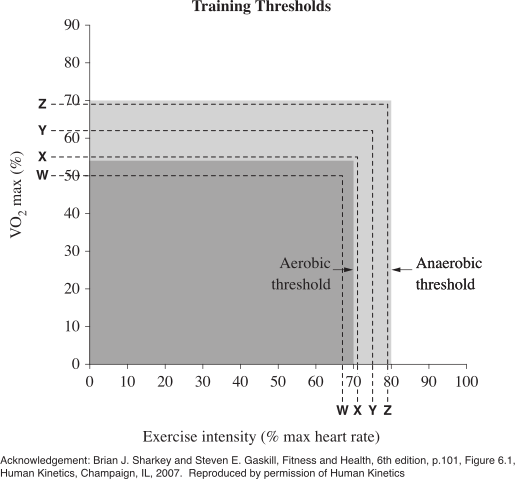
The graph shows training thresholds for aerobic and anaerobic conditioning.
 

Which exercise intensity indicates the greatest potential for gain in aerobic conditioning?

  1. W
  2. X
  3. Y
  4. Z
Show Answers Only

\(D\)

Show Worked Solution
  • D is correct: Zone Z is just below anaerobic threshold providing maximum aerobic benefit.

Other Options:

  • A is incorrect: Zone W is below aerobic threshold with minimal conditioning benefit.
  • B is incorrect: Zone X is at aerobic threshold but not optimal intensity.
  • C is incorrect: Zone Y provides some benefit but not maximum aerobic gain.

♦♦♦♦♦ Mean mark 13%.

Filed Under: Principles of training Tagged With: Band 6, smc-5460-10-Thresholds

HMS, TIP 2017 HSC 26

Explain the physiological adaptations an individual develops in response to the different principles of training. Use examples to support your answer.   (8 marks)

--- 24 WORK AREA LINES (style=lined) ---

Show Answers Only

  • Progressive overload directly triggers cardiovascular adaptations in trained athletes. This occurs because gradually increasing training intensity forces the heart to work harder over time. As a result, stroke volume increases as the heart becomes stronger and pumps more blood per beat. For instance, when a cyclist progressively increases weekly mileage, their resting heart rate decreases significantly. This demonstrates why endurance athletes develop enlarged left ventricles and improved cardiac efficiency.
  • The principle of specificity generates targeted muscular adaptations based on training type performed. This happens because muscles adapt specifically to the demands placed upon them during exercise. Consequently, resistance training causes muscle hypertrophy whilst endurance training increases mitochondrial density. A clear example is powerlifters developing increased fast-twitch muscle fibres for explosive movements. In contrast, marathon runners develop enhanced slow-twitch fibres for sustained aerobic performance.
  • Training thresholds produce specific metabolic adaptations when athletes train at appropriate intensities. This works by challenging energy systems at their optimal training zones for maximum adaptation. Therefore, training above the anaerobic threshold improves lactate buffering capacity and tolerance. Evidence of this includes sprint athletes who can maintain higher lactate concentrations without performance decline. This explains why proper intensity prescription maximises physiological improvements.

Show Worked Solution

  • Progressive overload directly triggers cardiovascular adaptations in trained athletes. This occurs because gradually increasing training intensity forces the heart to work harder over time. As a result, stroke volume increases as the heart becomes stronger and pumps more blood per beat. For instance, when a cyclist progressively increases weekly mileage, their resting heart rate decreases significantly. This demonstrates why endurance athletes develop enlarged left ventricles and improved cardiac efficiency.
  • The principle of specificity generates targeted muscular adaptations based on training type performed. This happens because muscles adapt specifically to the demands placed upon them during exercise. Consequently, resistance training causes muscle hypertrophy whilst endurance training increases mitochondrial density. A clear example is powerlifters developing increased fast-twitch muscle fibres for explosive movements. In contrast, marathon runners develop enhanced slow-twitch fibres for sustained aerobic performance.
  • Training thresholds produce specific metabolic adaptations when athletes train at appropriate intensities. This works by challenging energy systems at their optimal training zones for maximum adaptation. Therefore, training above the anaerobic threshold improves lactate buffering capacity and tolerance. Evidence of this includes sprint athletes who can maintain higher lactate concentrations without performance decline. This explains why proper intensity prescription maximises physiological improvements.

♦♦♦ Mean mark 43%.

Filed Under: Physiological adaptations and improved performance Tagged With: Band 5, smc-5460-05-Adaptations, smc-5460-10-Thresholds

HMS, TIP 2019 HSC 27

An athlete is participating in a 12-week aerobic training program.

Analyse how progressive overload and training thresholds can result in physiological adaptations for the athlete.   (8 marks)

--- 24 WORK AREA LINES (style=lined) ---

Show Answers Only

Overview Statement

  • Progressive overload and training thresholds interact to create systematic stress that triggers cardiovascular and respiratory adaptations over 12 weeks.

Component Relationship 1 – Progressive Overload and Cardiovascular Adaptations

  • Progressive overload involves gradually increasing training frequency, intensity, and duration throughout the program. This systematic increase places greater demands on the cardiovascular system each week.
  • As a result, the heart muscle strengthens and stroke volume increases significantly. The left ventricle enlarges to pump more blood per contraction.
  • Consequently, resting heart rate decreases as the heart becomes more efficient. Cardiac output improves during exercise, enabling enhanced oxygen delivery to working muscles.
  • This relationship demonstrates how progressive stress leads to superior cardiovascular function.

Component Relationship 2 – Training Thresholds and Respiratory Adaptations

  • Training thresholds ensure exercise intensity remains between aerobic and anaerobic zones throughout the program. This targeted intensity optimises oxygen utilisation without excessive lactate accumulation.
  • Therefore, respiratory muscles strengthen and lung capacity increases. Oxygen uptake improves as alveoli become more efficient at gas exchange.
  • This connection between threshold training and respiratory adaptation results in enhanced endurance capacity and delayed fatigue onset.

Implications and Synthesis

  • These interactions create a synergistic effect where cardiovascular and respiratory improvements work together.
  • The combined adaptations significantly enhance athletic performance and exercise tolerance.

Show Worked Solution

Overview Statement

  • Progressive overload and training thresholds interact to create systematic stress that triggers cardiovascular and respiratory adaptations over 12 weeks.

Component Relationship 1 – Progressive Overload and Cardiovascular Adaptations

  • Progressive overload involves gradually increasing training frequency, intensity, and duration throughout the program. This systematic increase places greater demands on the cardiovascular system each week.
  • As a result, the heart muscle strengthens and stroke volume increases significantly. The left ventricle enlarges to pump more blood per contraction.
  • Consequently, resting heart rate decreases as the heart becomes more efficient. Cardiac output improves during exercise, enabling enhanced oxygen delivery to working muscles.
  • This relationship demonstrates how progressive stress leads to superior cardiovascular function.

Component Relationship 2 – Training Thresholds and Respiratory Adaptations

  • Training thresholds ensure exercise intensity remains between aerobic and anaerobic zones throughout the program. This targeted intensity optimises oxygen utilisation without excessive lactate accumulation.
  • Therefore, respiratory muscles strengthen and lung capacity increases. Oxygen uptake improves as alveoli become more efficient at gas exchange.
  • This connection between threshold training and respiratory adaptation results in enhanced endurance capacity and delayed fatigue onset.

Implications and Synthesis

  • These interactions create a synergistic effect where cardiovascular and respiratory improvements work together.
  • The combined adaptations significantly enhance athletic performance and exercise tolerance.

♦♦♦♦ Mean mark 39%.

Filed Under: Physiological adaptations and improved performance, Principles of training Tagged With: Band 5, smc-5460-10-Thresholds, smc-5461-10-Cardio adaptations

HMS, TIP 2022 HSC 17 MC

The table shows the physiological adaptations an athlete has experienced as a result of an 8 -week training program.

\begin{array} {|l||l|}
\hline
\rule{0pt}{2.5ex}\textbf{Physiological adaptation}\rule[-1ex]{0pt}{0pt} & \textbf{Effect} \\ 
\hline
\rule{0pt}{2.5ex}\text{Stroke volume}\rule[-1ex]{0pt}{0pt} & \text{Increased}\\
\hline
\rule{0pt}{2.5ex}\text{Cardiac output}\rule[-1ex]{0pt}{0pt} & \text{Increased}\\
\hline
\rule{0pt}{2.5ex}\text{Resting heart rate}\rule[-1ex]{0pt}{0pt} & \text{Decreased}\\
\hline
\rule{0pt}{2.5ex}\text{Fast twitch muscle fibre size}\rule[-1ex]{0pt}{0pt} & \text{Increased}\\ 
\hline
\end{array}

Which of the following identifies the principles of training most likely to have been applied in the training program to produce these adaptations?

  1. Specificity, progressive overload, variety
  2. Variety, reversibility, warm up and cool down
  3. Specificity, progressive overload, training thresholds
  4. Warm up and cool down, progressive overload, training thresholds
Show Answers Only

\( C \)

Show Worked Solution

  • C is correct: Cardiovascular and strength adaptations require specific, progressive training at appropriate thresholds.

Other Options:

  • A is incorrect: Variety wouldn’t produce such specific targeted adaptations.
  • B is incorrect: Reversibility explains fitness loss, not gains shown.
  • D is incorrect: Warm-up/cool-down don’t drive physiological adaptations.

Filed Under: Principles of training Tagged With: Band 4, smc-5460-05-Adaptations, smc-5460-10-Thresholds

HMS, TIP 2022 HSC 15 MC

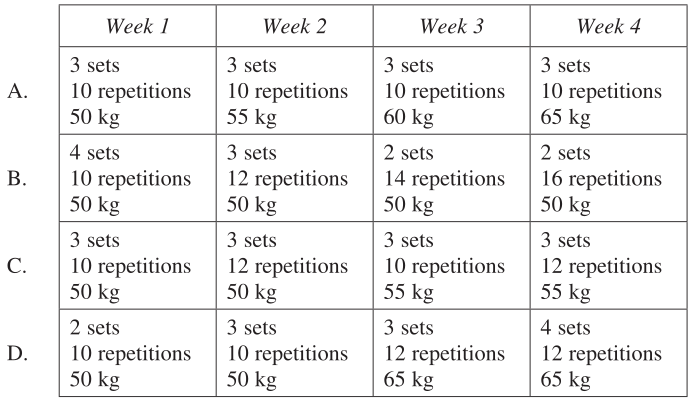
An athlete is aiming to maximise their muscular strength when performing a bench press.

Which row in the table represents the most effective four week application of progressive overload?

Show Answers Only

\( A \)

Show Worked Solution
  • A is correct: Systematic weight increases with consistent volume optimises strength development.

Other Options:

  • B is incorrect: No weight progression; increasing reps reduces strength focus.
  • C is incorrect: Inconsistent progression pattern doesn’t optimise strength gains.
  • D is incorrect: Erratic volume changes and sudden weight jumps.

♦♦ Mean mark 52%.

Filed Under: Principles of training Tagged With: Band 5, smc-5460-10-Thresholds

Copyright © 2014–2025 SmarterEd.com.au · Log in