SmarterEd

Aussie Maths & Science Teachers: Save your time with SmarterEd

  • Login
  • Get Help
  • About

HMS, TIP NSE-Bank 16 MC

The graph shows the volume and intensity of an aerobic athlete’s training plan over a year.
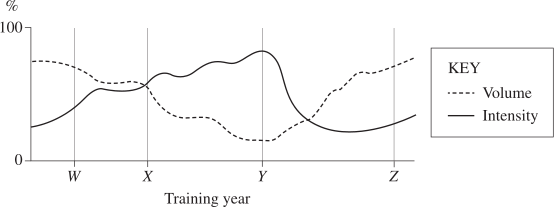
 

At which point in the year is the athlete entering the pre-season phase of competition?

  1. \(W\)
  2. \(X\)
  3. \(Y\)
  4. \(Z\)
Show Answers Only

D

Show Worked Solution
  • D is correct: At Z, volume is high and increasing. Intensity is low and increasing. This is characteristic of the pre-season phase where an athlete’s aerobic base is built through increasing high-volume sessions with growing intensity.

Other options:

  • A is incorrect: At W, training volume is high but decreasing.
  • B is incorrect: At X, volume is mid-level and decreasing which is not a feature of the pre-season phase.
  • C is incorrect: At Y, training intensity is peaking and training volume is at its lowest phase.

Filed Under: Individual vs group programs Tagged With: Band 4, smc-5463-10-Competition phases

HMS, TIP EQ-Bank 346 MC

At what stage of yearly training should sport-specific attributes receive the greatest emphasis for optimal competition preparation?

  1. During off-season periods to maintain fitness levels
  2. Throughout the entire yearly program with equal emphasis
  3. Early in the pre-season during general preparation phases
  4. Towards the end of pre-season following general preparation work
Show Answers Only

\(D\)

Show Worked Solution
  • D is correct: Sport-specific attributes are emphasised towards the end of pre-season after general fitness has been established. This allows safe conversion of base fitness into competition-specific demands.

Other Options:

  • A is incorrect: Off-season focuses on recovery and variety rather than intensive sport-specific preparation.
  • B is incorrect: Sport-specific emphasis varies throughout the year with peak focus in late pre-season periods.
  • C is incorrect: Early pre-season emphasises general preparation before progressing to specific attributes later in the phase.

Filed Under: Individual vs group programs Tagged With: Band 4, smc-5463-10-Competition phases, smc-5463-30-Sport-specific attributes

HMS, TIP EQ-Bank 333

Why might the pre-season requirements be different for individuals within a group sport compared to individual sport athletes?   (4 marks)

--- 12 WORK AREA LINES (style=lined) ---

Show Answers Only
  • Group sport athletes require team-oriented training that includes positional play, communication and coordination with teammates during preparation.
  • Individual differences within teams necessitate varied training focus as each position has different physical and skill demands.
  • For example, a football goalkeeper needs different preparation compared to a centre midfielder who requires enhanced aerobic fitness.
  • Individual sport athletes focus on personal technique refinement and addressing individual weaknesses whilst capitalising on personal strengths.
  • Team sport preparation involves integrating individual skills within team strategies, whilst individual athletes concentrate on self-directed performance optimisation.
  • Therefore group sport pre-season requires balancing individual needs with collective team preparation demands.
Show Worked Solution
  • Group sport athletes require team-oriented training that includes positional play, communication and coordination with teammates during preparation.
  • Individual differences within teams necessitate varied training focus as each position has different physical and skill demands.
  • For example, a football goalkeeper needs different preparation compared to a centre midfielder who requires enhanced aerobic fitness.
  • Individual sport athletes focus on personal technique refinement and addressing individual weaknesses whilst capitalising on personal strengths.
  • Team sport preparation involves integrating individual skills within team strategies, whilst individual athletes concentrate on self-directed performance optimisation.
  • Therefore group sport pre-season requires balancing individual needs with collective team preparation demands.

Filed Under: Individual vs group programs Tagged With: Band 3, smc-5463-10-Competition phases, smc-5463-30-Sport-specific attributes

HMS, TIP EQ-Bank 332 MC

Which combination of aims best describes the primary objectives of the in-season (competition) phase?

  1. Develop technique, improve biomechanics and introduce new strategies for upcoming competitions
  2. Maintain stamina, practise tactics and strategies, and gain competitive experience
  3. Build aerobic base, increase training volume and focus on general fitness development
  4. Allow complete rest, incorporate variety activities and target areas needing improvement
Show Answers Only

\(B\)

Show Worked Solution
  • B is correct: The in-season phase aims to maintain stamina, practise and improve tactics and strategies and gain competitive experience.

Other options:

  • A is incorrect: Developing technique, improving biomechanics and introducing strategies are pre-season objectives.
  • C is incorrect: Building aerobic base and increasing volume are pre-season general preparation activities.
  • D is incorrect: Complete rest, variety and targeting improvements describe off-season transition phase goals.

Filed Under: Individual vs group programs Tagged With: Band 4, smc-5463-10-Competition phases

HMS, TIP EQ-Bank 331 MC

What is the main purpose of the off-season (transition) phase for athletes in both individual and group sports?

  1. To begin intensive skill development and tactical preparation for the upcoming season
  2. To maintain peak competitive fitness levels achieved during the competitive season
  3. To allow physical and mental recovery whilst incorporating variety and rehabilitation
  4. To focus exclusively on strength training and power development for improved performance
Show Answers Only

\(C\)

Show Worked Solution
  • C is correct: The off-season allows for physical and mental recovery whilst incorporating variety, rehabilitation and targeting areas for improvement.

Other options:

  • A is incorrect: Intensive skill and tactical development are pre-season activities, not off-season recovery focuses.
  • B is incorrect: Maintaining peak fitness contradicts the recovery purpose of the transition phase.
  • D is incorrect: Exclusive strength focus ignores the broader recovery and variety needs of the off-season.

Filed Under: Individual vs group programs Tagged With: Band 4, smc-5463-10-Competition phases

HMS, TIP EQ-Bank 330 MC

During the in-season phase, how do training volume and intensity typically change compared to pre-season training?

  1. Both volume and intensity remain constant throughout the competitive period
  2. Volume increases significantly whilst intensity decreases to prevent overtraining
  3. Volume decreases whilst intensity increases to match competitive demands
  4. Both volume and intensity decrease to allow for recovery between competitions
Show Answers Only

\(C\)

Show Worked Solution
  • C is correct: During in-season, a general increase in intensity is matched by a corresponding decrease in volume with less time spent on continuous repetitive work.

Other options:

  • A is incorrect: Training characteristics change significantly from pre-season to in-season rather than remaining constant.
  • B is incorrect: Volume increases would contradict the need to balance training with competition recovery demands.
  • D is incorrect: While volume decreases, intensity actually increases rather than decreases during competitive periods.

Filed Under: Individual vs group programs Tagged With: Band 4, smc-5463-10-Competition phases

HMS, TIP EQ-Bank 329 MC

What is the primary focus during the pre-season phase for both individual and group sports?

  1. Maintaining fitness levels developed during the previous competitive season
  2. Developing fitness components, technique and introducing strategies for the upcoming season
  3. Perfecting skill execution and gaining competitive experience against opponents
  4. Reducing training volume while increasing intensity to peak for major competitions
Show Answers Only

\(B\)

Show Worked Solution
  • B is correct: The pre-season phase focuses on developing fitness components required for the season ahead, developing technique, and introducing strategies.

Other options:

  • A is incorrect: Maintaining fitness is the focus of in-season training, not pre-season development.
  • C is incorrect: Perfecting skill execution and gaining competitive experience are in-season phase objectives.
  • D is incorrect: Reducing volume while increasing intensity describes tapering strategies, not pre-season training.

Filed Under: Individual vs group programs Tagged With: Band 3, smc-5463-10-Competition phases

HMS, TIP 2014 HSC 32b

Justify how each of the periodisation phases is used when planning a training year.   (12 marks)

--- 28 WORK AREA LINES (style=lined) ---

Show Answers Only

Position Statement

  • Each periodisation phase is essential when planning a training year. Each phase has a distinct purpose: developing, maintaining or restoring the athlete’s physical and psychological capacities so they peak for competition without overtraining.

Pre-Season Foundation Building

  • The pre-season phase builds the fitness base and fundamental skills that the competition phase depends on.
  • A rugby team’s pre-season might run 12–16 weeks. It begins with high-volume aerobic conditioning and general strength work, then progresses to higher-intensity, game-specific training such as repeated sprints and contact drills.
  • This progression is justified by the principle of progressive overload. Gradual increases in training load allow the body to adapt safely, building cardiovascular endurance, muscular strength and technical competence.
  • Skipping or shortening this phase leaves athletes underprepared for competition loads, which increases injury risk and leads to poor early-season performance.
  • This shows that pre-season is the foundation on which every later phase depends.

In-Season Performance Maintenance

  • In-season training maintains the fitness gained in pre-season while managing fatigue from regular competition.
  • The principle of reversibility justifies this phase: if training stops, fitness adaptations begin to decline within weeks. Maintenance training is therefore needed to keep the athlete competitive across the season.
  • Training volume is reduced while intensity stays high. For example, a basketball player maintains strength with two shorter sessions per week and spends more time on tactical preparation and recovery between games.
  • Peaking and tapering are planned within this phase so that athletes reach their best condition for finals or major events.
  • This shows that in-season planning balances training stress against competition stress, which keeps performance consistent when it matters most.

Off-Season Recovery Integration

  • The off-season gives athletes time for physical and mental recovery after the demands of competition, which reduces the risk of burnout.
  • Active rest and cross-training, such as swimming or cycling for a rugby player, maintain a base level of fitness. This limits detraining, so the next pre-season does not start from scratch.
  • This phase also allows full rehabilitation of injuries and lets the athlete work on weaknesses identified during the season.
  • This shows that the off-season is a deliberate part of the plan, not a break from it.

Reinforcement

  • Each periodisation phase is justified because it addresses a specific physiological and psychological need at the right point in the year.
  • Together, the phases follow the principles of progressive overload, reversibility and specificity. This lets athletes peak for competition while avoiding overtraining and injury.
Show Worked Solution

Position Statement

  • Each periodisation phase is essential when planning a training year. Each phase has a distinct purpose: developing, maintaining or restoring the athlete’s physical and psychological capacities so they peak for competition without overtraining.

Pre-Season Foundation Building

  • The pre-season phase builds the fitness base and fundamental skills that the competition phase depends on.
  • A rugby team’s pre-season might run 12–16 weeks. It begins with high-volume aerobic conditioning and general strength work, then progresses to higher-intensity, game-specific training such as repeated sprints and contact drills.
  • This progression is justified by the principle of progressive overload. Gradual increases in training load allow the body to adapt safely, building cardiovascular endurance, muscular strength and technical competence.
  • Skipping or shortening this phase leaves athletes underprepared for competition loads, which increases injury risk and leads to poor early-season performance.
  • This shows that pre-season is the foundation on which every later phase depends.

In-Season Performance Maintenance

  • In-season training maintains the fitness gained in pre-season while managing fatigue from regular competition.
  • The principle of reversibility justifies this phase: if training stops, fitness adaptations begin to decline within weeks. Maintenance training is therefore needed to keep the athlete competitive across the season.
  • Training volume is reduced while intensity stays high. For example, a basketball player maintains strength with two shorter sessions per week and spends more time on tactical preparation and recovery between games.
  • Peaking and tapering are planned within this phase so that athletes reach their best condition for finals or major events.
  • This shows that in-season planning balances training stress against competition stress, which keeps performance consistent when it matters most.

Off-Season Recovery Integration

  • The off-season gives athletes time for physical and mental recovery after the demands of competition, which reduces the risk of burnout.
  • Active rest and cross-training, such as swimming or cycling for a rugby player, maintain a base level of fitness. This limits detraining, so the next pre-season does not start from scratch.
  • This phase also allows full rehabilitation of injuries and lets the athlete work on weaknesses identified during the season.
  • This shows that the off-season is a deliberate part of the plan, not a break from it.

Reinforcement

  • Each periodisation phase is justified because it addresses a specific physiological and psychological need at the right point in the year.
  • Together, the phases follow the principles of progressive overload, reversibility and specificity. This lets athletes peak for competition while avoiding overtraining and injury.

♦♦ Mean mark 54%.

Filed Under: Individual vs group programs Tagged With: Band 4, Band 5, smc-5463-10-Competition phases

HMS, TIP 2019 HSC 31b

A periodisation chart is being developed for an athlete in a particular sport. Analyse why the athlete’s fitness and skill-specific requirements change during each phase of competition.   (12 marks)

--- 26 WORK AREA LINES (style=lined) ---

Show Answers Only

Overview Statement

  • A netball goal attack’s fitness and skill needs change across competition phases to assist performance while avoiding overtraining and injury throughout the year.

Component Relationship 1 – Pre-season Fitness Development

  • Pre-season focuses on building anaerobic power and developing netball-specific conditioning over longer periods. This happens because goal attacks need explosive speed for quick movements and physical preparation takes time.
  • Anaerobic interval training is most important in early pre-season to build speed endurance through sprint intervals and court runs.
  • As time goes on, plyometric training and agility work become more important to match the jumping and direction-change demands of netball.
  • Strength training becomes more common to develop upper body power for shooting and lower body strength for quick starts and stops.
  • This step-by-step approach ensures the goal attack reaches peak physical condition before competition starts while reducing injury risk.
  • Shooting accuracy and passing practice increases during late pre-season as fitness base allows harder technical training without excessive fatigue.
  • As a result, tactical understanding of attacking patterns grows alongside physical preparation, creating complete readiness for competition.

Component Relationship 2 – In-season Maintenance and Skill Focus

  • In-season requirements shift towards keeping explosive power while improving technical skills under game pressure. This change happens because netball games require best shooting accuracy and court awareness rather than fitness building, and training time becomes limited between games.
  • Training volume decreases to prevent overtraining while intensity stays high to keep game fitness during the season. Therefore, shooting drills and movement patterns become the main focus with defensive positioning becoming most important for competitive success.
  • Recovery strategies become more important as weekly competition games create leg fatigue that needs careful management through stretching and recovery techniques.
  • Consequently, periodisation must balance maintaining explosive power with sufficient recovery between games.

Implications and Synthesis

  • These phase-specific changes work together to create optimal performance timing for netball and prevent performance decline. The systematic variation prevents staleness while ensuring goal attacks peak during finals competition and maintain performance standards throughout the netball season.

Show Worked Solution

Overview Statement

  • A netball goal attack’s fitness and skill needs change across competition phases to assist performance while avoiding overtraining and injury throughout the year.

Component Relationship 1 – Pre-season Fitness Development

  • Pre-season focuses on building anaerobic power and developing netball-specific conditioning over longer periods. This happens because goal attacks need explosive speed for quick movements and physical preparation takes time.
  • Anaerobic interval training is most important in early pre-season to build speed endurance through sprint intervals and court runs.
  • As time goes on, plyometric training and agility work become more important to match the jumping and direction-change demands of netball.
  • Strength training becomes more common to develop upper body power for shooting and lower body strength for quick starts and stops.
  • This step-by-step approach ensures the goal attack reaches peak physical condition before competition starts while reducing injury risk.
  • Shooting accuracy and passing practice increases during late pre-season as fitness base allows harder technical training without excessive fatigue.
  • As a result, tactical understanding of attacking patterns grows alongside physical preparation, creating complete readiness for competition.

Component Relationship 2 – In-season Maintenance and Skill Focus

  • In-season requirements shift towards keeping explosive power while improving technical skills under game pressure. This change happens because netball games require best shooting accuracy and court awareness rather than fitness building, and training time becomes limited between games.
  • Training volume decreases to prevent overtraining while intensity stays high to keep game fitness during the season. Therefore, shooting drills and movement patterns become the main focus with defensive positioning becoming most important for competitive success.
  • Recovery strategies become more important as weekly competition games create leg fatigue that needs careful management through stretching and recovery techniques.
  • Consequently, periodisation must balance maintaining explosive power with sufficient recovery between games.

Implications and Synthesis

  • These phase-specific changes work together to create optimal performance timing for netball and prevent performance decline. The systematic variation prevents staleness while ensuring goal attacks peak during finals competition and maintain performance standards throughout the netball season.

♦♦ Mean mark 52%.

Filed Under: Individual vs group programs Tagged With: Band 5, smc-5463-10-Competition phases, smc-5463-30-Sport-specific attributes

HMS, TIP 2024 HSC 31ai

Describe ONE phase of competition that can be included when planning a training year?   (3 marks)

--- 10 WORK AREA LINES (style=lined) ---

Show Answers Only

In-season phase

  • The in-season phase is the competitive period where athletes participate in scheduled competitions and matches, focusing on maintaining peak performance levels while managing fatigue.
  • Training volume typically decreases while intensity remains high to simulate competition demands.
  • Emphasis is on tactical preparation and skill refinement rather than developing fitness.
  • Training sessions become more sport-specific with reduced frequency (usually 2-3 sessions per week) to allow sufficient recovery between competitions.
  • Physical conditioning shifts to maintenance work rather than development.
  • Psychological preparation becomes increasingly important for consistent performance in competitive situations.
Show Worked Solution

In-season phase

  • The in-season phase is the competitive period where athletes participate in scheduled competitions and matches, focusing on maintaining peak performance levels while managing fatigue.
  • Training volume typically decreases while intensity remains high to simulate competition demands.
  • Emphasis is on tactical preparation and skill refinement rather than developing fitness.
  • Training sessions become more sport-specific with reduced frequency (usually 2-3 sessions per week) to allow sufficient recovery between competitions.
  • Physical conditioning shifts to maintenance work rather than development.
  • Psychological preparation becomes increasingly important for consistent performance in competitive situations.

Filed Under: Individual vs group programs Tagged With: Band 4, smc-5463-10-Competition phases

HMS, BM EQ-Bank 244

Evaluate the effectiveness of different training methods for a 400 metre track athlete throughout a competition season.   (8 marks)

--- 28 WORK AREA LINES (style=lined) ---

Show Answers Only

Evaluation Statement

  • Different training methods prove highly effective when applied progressively throughout a 400m athlete’s season.
  • Effectiveness depends on timing, matching training to race demands, and recovery management.

Pre-Season Foundation

  • Continuous training (3 x 20 minutes at 70% MHR) and fartlek sessions effectively build aerobic fitness.
  • This foundation proves essential for handling later training demands.
  • Athletes develop the endurance to complete multiple training sessions weekly.
  • Without this base, high-intensity work becomes unsustainable.
  • Evidence shows athletes with strong aerobic base recover faster between sessions.

Early Competition Phase

  • Tempo training (6 x 200m at 85% race pace) demonstrates high effectiveness for 400m preparation.
  • These sessions improve the body’s ability to handle moderate-high intensity work.
  • Recovery periods decrease progressively from 3 to 2 minutes.
  • This prepares athletes for the sustained effort required in 400m racing.
  • Athletes report feeling stronger in the final 100m of races.

Mid-Season Power

  • Sprint interval training (6-8 x 60m maximal sprints) proves most effective during mid-season.
  • Full recovery between efforts maintains sprint quality throughout sessions.
  • This develops explosive power needed for strong race starts.
  • Athletes achieve personal best times when this phase is timed correctly.
  • The focus shifts from endurance to pure speed development.

Competition Preparation

  • Race-pace training (2 x 300m at 90% effort) shows maximum effectiveness near competitions.
  • These sessions closely mirror actual race demands and pacing.
  • Athletes practice their race strategy while maintaining high intensity.
  • Recovery matches competition warm-up timing.
  • This close match to race conditions translates directly to race performance.

Final Evaluation

  • Progressive training from aerobic to anaerobic methods proves highly effective overall.
  • Each phase builds upon previous work when timed appropriately.
  • Success depends on balancing high-intensity work with adequate recovery.
  • Athletes avoiding injury through proper progression achieve best results.
  • The systematic approach optimises performance for target competitions.
Show Worked Solution

Evaluation Statement

  • Different training methods prove highly effective when applied progressively throughout a 400m athlete’s season.
  • Effectiveness depends on timing, matching training to race demands, and recovery management.

Pre-Season Foundation

  • Continuous training (3 x 20 minutes at 70% MHR) and fartlek sessions effectively build aerobic fitness.
  • This foundation proves essential for handling later training demands.
  • Athletes develop the endurance to complete multiple training sessions weekly.
  • Without this base, high-intensity work becomes unsustainable.
  • Evidence shows athletes with strong aerobic base recover faster between sessions.

Early Competition Phase

  • Tempo training (6 x 200m at 85% race pace) demonstrates high effectiveness for 400m preparation.
  • These sessions improve the body’s ability to handle moderate-high intensity work.
  • Recovery periods decrease progressively from 3 to 2 minutes.
  • This prepares athletes for the sustained effort required in 400m racing.
  • Athletes report feeling stronger in the final 100m of races.

Mid-Season Power

  • Sprint interval training (6-8 x 60m maximal sprints) proves most effective during mid-season.
  • Full recovery between efforts maintains sprint quality throughout sessions.
  • This develops explosive power needed for strong race starts.
  • Athletes achieve personal best times when this phase is timed correctly.
  • The focus shifts from endurance to pure speed development.

Competition Preparation

  • Race-pace training (2 x 300m at 90% effort) shows maximum effectiveness near competitions.
  • These sessions closely mirror actual race demands and pacing.
  • Athletes practice their race strategy while maintaining high intensity.
  • Recovery matches competition warm-up timing.
  • This close match to race conditions translates directly to race performance.

Final Evaluation

  • Progressive training from aerobic to anaerobic methods proves highly effective overall.
  • Each phase builds upon previous work when timed appropriately.
  • Success depends on balancing high-intensity work with adequate recovery.
  • Athletes avoiding injury through proper progression achieve best results.
  • The systematic approach optimises performance for target competitions.

Filed Under: Individual vs group programs Tagged With: Band 4, Band 5, smc-5463-10-Competition phases

Copyright © 2014–2026 SmarterEd.com.au · Log in