SmarterEd

Aussie Maths & Science Teachers: Save your time with SmarterEd

  • Login
  • Get Help
  • About

HMS, HAG 2013 HSC 3 MC

What would a comparison of the health status of Indigenous and non­Indigenous Australians show?

  1. Non­-Indigenous Australians have higher infant mortality rates.
  2. Non­-Indigenous Australians have a lower prevalence of acute diseases.
  3. Indigenous Australians have lower hospital admission rates.
  4. Indigenous Australians have a higher prevalence of chronic diseases
Show Answers Only

\(D\)

Show Worked Solution
  • D is correct: Indigenous Australians experience significantly higher chronic disease rates.

Other Options:

  • A is incorrect: Indigenous Australians have higher infant mortality rates.
  • B is incorrect: Non-Indigenous Australians have lower chronic disease prevalence.
  • C is incorrect: Indigenous Australians have higher hospitalisation rates overall.

Filed Under: Groups Experiencing Inequities Tagged With: Band 3, smc-5475-05-Indigenous health

HMS, HAG 2014 HSC 7 MC

Which of the following is an environmental determinant that best explains why Indigenous Australians have a shorter life expectancy than non-Indigenous Australians?

  1. The types of illness Indigenous Australians develop are more likely to result in death.
  2. Traditional forms of medicine are no longer widely used by Indigenous Australians.
  3. Indigenous Australians are less likely to have access to primary health care and adequate treatment.
  4. Indigenous Australians have higher rates of unemployment so they cannot afford to visit the doctor regularly.
Show Answers Only

\(C\)

Show Worked Solution
  • C is correct: Limited healthcare access is an environmental determinant affecting outcomes.

Other Options:

  • A is incorrect: This describes disease outcomes not environmental determinants.
  • B is incorrect: Traditional medicine use is cultural not environmental.
  • D is incorrect: Unemployment is socioeconomic not environmental determinant.

Filed Under: Groups Experiencing Inequities Tagged With: Band 3, smc-5475-05-Indigenous health, smc-5475-10-Determinants interaction, smc-5475-15-Inequity causes

HMS, HAG 2018 HSC 24

Explain the roles of individuals, communities and governments in addressing health inequities experienced by Aboriginal and Torres Strait Islander peoples. Use examples to support your answer.   (8 marks)

--- 24 WORK AREA LINES (style=lined) ---

Show Answers Only

Governments

  • Governments play crucial roles in addressing Aboriginal and Torres Strait Islander health inequities. This occurs because governments control funding allocation and policy development. For example, the Close the Gap strategy provides targeted funding for Indigenous health programs and services. This leads to improved access to culturally appropriate healthcare in remote communities. The reason for this is governments have the legislative power to create systemic change. Consequently, initiatives like Aboriginal Community Controlled Health Services receive ongoing support.

Communities

  • Communities are essential in implementing culturally safe health programs. This happens when local Aboriginal communities take ownership of health initiatives. For instance, community elders provide health education using traditional knowledge and storytelling methods. This creates trust between health services and community members. This relationship results in higher participation rates in screening programs and health checks. As a result, communities can address specific local health needs more effectively.

Individuals

  • Individuals contribute by adopting healthier behaviours and advocating for change. This works by personal responsibility combining with community support. For example, Aboriginal health workers serve as role models, encouraging smoking cessation and regular health checks. This demonstrates how individuals can influence family and peer networks. Therefore, personal actions create ripple effects throughout communities, improving overall health outcomes.

Show Worked Solution

Governments

  • Governments play crucial roles in addressing Aboriginal and Torres Strait Islander health inequities. This occurs because governments control funding allocation and policy development. For example, the Close the Gap strategy provides targeted funding for Indigenous health programs and services. This leads to improved access to culturally appropriate healthcare in remote communities. The reason for this is governments have the legislative power to create systemic change. Consequently, initiatives like Aboriginal Community Controlled Health Services receive ongoing support.

Communities

  • Communities are essential in implementing culturally safe health programs. This happens when local Aboriginal communities take ownership of health initiatives. For instance, community elders provide health education using traditional knowledge and storytelling methods. This creates trust between health services and community members. This relationship results in higher participation rates in screening programs and health checks. As a result, communities can address specific local health needs more effectively.

Individuals

  • Individuals contribute by adopting healthier behaviours and advocating for change. This works by personal responsibility combining with community support. For example, Aboriginal health workers serve as role models, encouraging smoking cessation and regular health checks. This demonstrates how individuals can influence family and peer networks. Therefore, personal actions create ripple effects throughout communities, improving overall health outcomes.

Filed Under: Groups Experiencing Inequities Tagged With: Band 4, smc-5475-05-Indigenous health

HMS, HAG 2020 HSC 16 MC

Which of the following identifies the health inequities experienced by Aboriginal and Torres Strait Islander peoples when compared to non-Indigenous Australians?

  1. Lower life expectancy, higher mortality rate from diabetes, higher incidence of lung cancer
  2. Lower life expectancy, lower morbidity rate from diabetes, higher incidence of breast cancer
  3. Higher infant mortality rate, lower mortality rate from diabetes, higher incidence of lung cancer
  4. Higher infant mortality rate, higher morbidity rate from diabetes, lower rate of hospitalisation due to injury
Show Answers Only

\(A\)

Show Worked Solution
  • A is correct: Aboriginal peoples have lower life expectancy, higher diabetes mortality, higher lung cancer.

Other Options:

  • B is incorrect: Aboriginal peoples have higher not lower diabetes morbidity.
  • C is incorrect: Aboriginal peoples have higher not lower diabetes mortality.
  • D is incorrect: Aboriginal peoples have higher not lower injury hospitalisation rates.

Filed Under: Groups Experiencing Inequities Tagged With: Band 3, smc-5475-05-Indigenous health, smc-5475-10-Determinants interaction

HMS, HIC 2022 HSC 18 MC

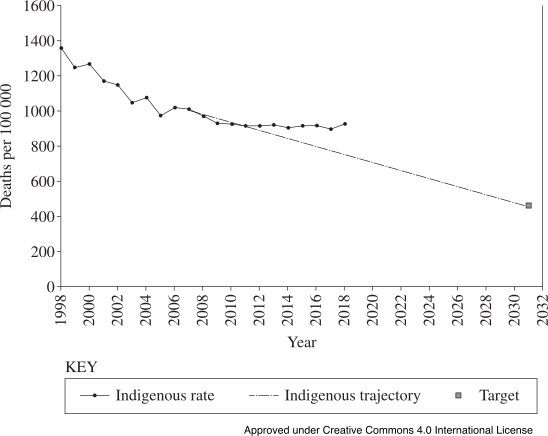
The graph shows the mortality rate and projected trajectory to the year 2031 for Indigenous Australians.

Which of the following was the most significant factor that contributed to the trend in the mortality rate for Indigenous Australians from 1998-2005?

  1. More Indigenous Australian students completed Year 12
  2. The Australian Government's implementation of the Closing the Gap framework
  3. Increased childhood immunisation rates among Indigenous populations in Australia
  4. Improvement in the early detection and management of chronic disease for Indigenous Australians
Show Answers Only

\( D \)

Show Worked Solution
  • D is correct: Early detection and chronic disease management directly reduces mortality rates.

Other Options:

  • A is incorrect: Education improvements have longer-term rather than immediate mortality impact.
  • B is incorrect: Closing the Gap was implemented after 2008, not 1998-2005.
  • C is incorrect: Immunisation affects childhood mortality, not overall population trends.

♦♦ Mean mark 40%.

Filed Under: Groups Experiencing Inequities Tagged With: Band 5, smc-5475-05-Indigenous health

HMS, HAG 2021 HSC 15 MC

Which row in the table shows the trend over the past 10 years for Aboriginal and Torres Strait Islander peoples in relation to the identified health measures?

Show Answers Only

\(B\)

Show Worked Solution
  • B is correct: All three measures show positive improvements over decade.

Other Options:

  • A is incorrect: Life expectancy has been increasing not decreasing.
  • C is incorrect: Infant mortality and cardiovascular mortality have decreased.
  • D is incorrect: Infant mortality has decreased and life expectancy increased.

Filed Under: Groups Experiencing Inequities Tagged With: Band 4, smc-5475-05-Indigenous health

HMS, HAG 2021 HSC 32a

  1. In relation to ONE population group experiencing health inequities, outline the media's role in influencing public policy.   (3 marks)

    --- 6 WORK AREA LINES (style=lined) ---

  2. Explain the effects of a government intervention for ONE population group that experiences health inequities.   (5 marks)

    --- 15 WORK AREA LINES (style=lined) ---

Show Answers Only

i.    Aboriginal and Torres Strait Islander Peoples

  • Media coverage of Aboriginal and Torres Strait Islander health inequities raises public awareness about persistent disparities in life expectancy and chronic disease rates.
  • Investigative journalism highlighting inadequate healthcare access in remote communities creates pressure for government policy responses.
  • Media campaigns featuring Indigenous health advocates amplify community voices and demands for culturally appropriate services.
  • Television documentaries and news reports generate public support for increased health funding and policy reforms addressing systemic barriers to healthcare access.

ii.    Aboriginal and Torres Strait Islander Peoples

  • The Closing the Gap strategy aims to reduce health disparities between Aboriginal and Torres Strait Islander Peoples and non-Indigenous Australians. This intervention works by establishing measurable targets for life expectancy, infant mortality, and chronic disease management.
  • The strategy has resulted in improved access to culturally appropriate healthcare through increased funding for Aboriginal Community Controlled Health Organisations. These services consequently provide more effective primary healthcare because they incorporate traditional healing with Western medicine and employ Indigenous health workers.
  • Educational initiatives have led to enhanced health literacy among Indigenous communities. Programs teaching diabetes management and nutrition have enabled better chronic condition self-management. This approach produces measurable improvements in blood glucose control and medication adherence.
  • However, progress remains limited in remote areas where geographical barriers continue to restrict specialist access. Additionally, social determinants like housing and employment still influence health outcomes despite targeted interventions. Overall effects demonstrate modest improvements in specific indicators while highlighting the need for broader social policy integration to address underlying inequality causes.
Show Worked Solution

i.    Aboriginal and Torres Strait Islander Peoples

  • Media coverage of Aboriginal and Torres Strait Islander health inequities raises public awareness about persistent disparities in life expectancy and chronic disease rates.
  • Investigative journalism highlighting inadequate healthcare access in remote communities creates pressure for government policy responses.
  • Media campaigns featuring Indigenous health advocates amplify community voices and demands for culturally appropriate services.
  • Television documentaries and news reports generate public support for increased health funding and policy reforms addressing systemic barriers to healthcare access.

ii.    Aboriginal and Torres Strait Islander Peoples

  • The Closing the Gap strategy aims to reduce health disparities between Aboriginal and Torres Strait Islander Peoples and non-Indigenous Australians. This intervention works by establishing measurable targets for life expectancy, infant mortality, and chronic disease management.
  • The strategy has resulted in improved access to culturally appropriate healthcare through increased funding for Aboriginal Community Controlled Health Organisations. These services consequently provide more effective primary healthcare because they incorporate traditional healing with Western medicine and employ Indigenous health workers.
  • Educational initiatives have led to enhanced health literacy among Indigenous communities. Programs teaching diabetes management and nutrition have enabled better chronic condition self-management. This approach produces measurable improvements in blood glucose control and medication adherence.
  • However, progress remains limited in remote areas where geographical barriers continue to restrict specialist access. Additionally, social determinants like housing and employment still influence health outcomes despite targeted interventions. Overall effects demonstrate modest improvements in specific indicators while highlighting the need for broader social policy integration to address underlying inequality causes.

♦ Mean mark 50%.

Filed Under: Groups Experiencing Inequities Tagged With: Band 3, Band 5, smc-5475-05-Indigenous health

HMS, HAG 2023 HSC 32aii

Explain how ensuring cultural relevance improves the potential for the success of ONE health promotion strategy.   (5 marks)

--- 15 WORK AREA LINES (style=lined) ---

Show Answers Only

Sample answer

  • Cultural relevance in the Aboriginal and Torres Strait Islander health promotion campaign “Bring the Mob Home Safely” significantly improves success potential through multiple mechanisms.
  • This occurs because acknowledging and respecting cultural values and beliefs ensures that health messages align with cultural worldviews. As a result, community members are more likely to accept and act on safety messages rather than rejecting externally imposed solutions.
  • Using appropriate language, terminology and communication styles leads to better message resonance with target audiences. This creates stronger connections when visual representations reflect community members rather than generic imagery. Therefore, culturally appropriate messaging enables deeper engagement with road safety content.
  • Community involvement in planning and implementation produces genuine ownership of the campaign. This mechanism allows communities to identify locally relevant barriers to safe road practices. Consequently, solutions become more practical and sustainable because they address specific contextual factors affecting each community.
  • The underlying reason is that cultural relevance builds trust with communities historically subjected to inappropriate interventions. This relationship results in improved participation rates and generates lasting behaviour change towards safer road practices.

Show Worked Solution

  • Cultural relevance in the Aboriginal and Torres Strait Islander health promotion campaign “Bring the Mob Home Safely” significantly improves success potential through multiple mechanisms.
  • This occurs because acknowledging and respecting cultural values and beliefs ensures that health messages align with cultural worldviews. As a result, community members are more likely to accept and act on safety messages rather than rejecting externally imposed solutions.
  • Using appropriate language, terminology and communication styles leads to better message resonance with target audiences. This creates stronger connections when visual representations reflect community members rather than generic imagery. Therefore, culturally appropriate messaging enables deeper engagement with road safety content.
  • Community involvement in planning and implementation produces genuine ownership of the campaign. This mechanism allows communities to identify locally relevant barriers to safe road practices. Consequently, solutions become more practical and sustainable because they address specific contextual factors affecting each community.
  • The underlying reason is that cultural relevance builds trust with communities historically subjected to inappropriate interventions. This relationship results in improved participation rates and generates lasting behaviour change towards safer road practices.

♦♦ Mean mark 41%.

Filed Under: Groups Experiencing Inequities Tagged With: Band 5, smc-5475-05-Indigenous health, smc-5475-10-Determinants interaction

HMS HAG 2023 HSC 8 MC

What strategy would be most effective in improving equity of access to health services for Aboriginal and Torres Strait Islander peoples?

  1. Increasing awareness of online health resources
  2. Increasing the funding for child immunisation programs
  3. Providing a telephone or video consultation with a specialist
  4. Implementing training for community members to become health care providers
Show Answers Only

\(D\)

Show Worked Solution
  • D is correct: Training community members addresses cultural barriers and sustainability by building capacity within Aboriginal and Torres Strait Islander communities.

Other Options:

  • A is incorrect: Online resources may not address cultural barriers or internet access issues.
  • B is incorrect: Child immunisation doesn’t address broader healthcare access barriers.
  • C is incorrect: Telehealth helps but doesn’t address cultural barriers comprehensively.

♦♦ Mean mark 39%.

Filed Under: Groups Experiencing Inequities Tagged With: Band 5, smc-5475-05-Indigenous health

HMS, HAG 2024 HSC 19 MC

Improvements in the health of Aboriginal and Torres Strait Islander peoples in relation to which THREE chronic health conditions has resulted in a reduction in mortality rates?

  1. Cancer, diabetes, kidney disease
  2. Cancer, cardiovascular disease, diabetes
  3. Cancer, cardiovascular disease, kidney disease
  4. Cardiovascular disease, diabetes, kidney disease
Show Answers Only

\(D\)

Show Worked Solution
  • D is correct: These three chronic conditions have shown reduced mortality rates in Aboriginal and Torres Strait Islander populations due to targeted interventions.

Other Options:

  • A,B and C are incorrect: Combinations of chronic conditions don’t match the mortality rate improvement patterns.

♦♦♦♦ Mean mark 17%.

Filed Under: Groups Experiencing Inequities Tagged With: Band 6, smc-5475-05-Indigenous health

Copyright © 2014–2025 SmarterEd.com.au · Log in