SmarterEd

Aussie Maths & Science Teachers: Save your time with SmarterEd

  • Login
  • Get Help
  • About

HMS, BM EQ-Bank 834

Describe the role of different types of muscle contractions during a tennis serve.   (5 marks)

--- 15 WORK AREA LINES (style=lined) ---

Show Answers Only

Sample Answer

  • Preparation phase: Core muscles (rectus abdominis, transverse abdominis, erector spinae) maintain isometric contractions to stabilise the trunk. Lower body muscles also contract isometrically to maintain balance during the ball toss.
  • Ball toss:Shoulder muscles (deltoids, supraspinatus) perform concentric contractions to raise the tossing arm. Simultaneously, the serving arm begins moving into position through concentric contractions of posterior deltoid and latissimus dorsi.
  • Loading phase: Eccentric contractions occur in shoulder internal rotators and triceps as the racquet drops behind the head. These contractions control the backward movement while storing elastic energy for the forward swing.
  • Acceleration phase: Powerful concentric contractions drive the serve. Pectoralis major, anterior deltoid, and internal rotators accelerate the shoulder. Triceps extends the elbow explosively. Core muscles contract concentrically to rotate the trunk.
  • Follow through: Eccentric contractions in posterior shoulder muscles and biceps decelerate the arm after ball contact. These contractions prevent joint damage by controlling the rapid deceleration forces.
Show Worked Solution

Sample Answer

  • Preparation phase: Core muscles (rectus abdominis, transverse abdominis, erector spinae) maintain isometric contractions to stabilise the trunk. Lower body muscles also contract isometrically to maintain balance during the ball toss.
  • Ball toss:Shoulder muscles (deltoids, supraspinatus) perform concentric contractions to raise the tossing arm. Simultaneously, the serving arm begins moving into position through concentric contractions of posterior deltoid and latissimus dorsi.
  • Loading phase: Eccentric contractions occur in shoulder internal rotators and triceps as the racquet drops behind the head. These contractions control the backward movement while storing elastic energy for the forward swing.
  • Acceleration phase: Powerful concentric contractions drive the serve. Pectoralis major, anterior deltoid, and internal rotators accelerate the shoulder. Triceps extends the elbow explosively. Core muscles contract concentrically to rotate the trunk.
  • Follow through: Eccentric contractions in posterior shoulder muscles and biceps decelerate the arm after ball contact. These contractions prevent joint damage by controlling the rapid deceleration forces.

Filed Under: Skeletal and muscular systems Tagged With: Band 4, Band 5, smc-5521-15-Muscle contractions

HMS, BM EQ-Bank 833

Explain how eccentric muscle contractions function during landing from a jump.   (4 marks)

--- 12 WORK AREA LINES (style=lined) ---

Show Answers Only

Sample Answer

  • During landing, muscles lengthen while contracting to control joint movement. This occurs because the body must decelerate safely from gravitational forces.
  • In the quadriceps, eccentric contraction controls knee flexion. As a result, the knee bends gradually rather than collapsing suddenly. Similarly, gastrocnemius and soleus undergo eccentric contraction to control ankle dorsiflexion.
  • These contractions function as biological shock absorbers. Consequently, landing forces are spread over time rather than creating sudden impact. The reason eccentric contractions are effective is they can manage forces up to 40% greater than concentric contractions.
  • Therefore, eccentric contractions during landing enable safe deceleration by controlling joint movement against gravity.
Show Worked Solution

Sample Answer

  • During landing, muscles lengthen while contracting to control joint movement. This occurs because the body must decelerate safely from gravitational forces.
  • In the quadriceps, eccentric contraction controls knee flexion. As a result, the knee bends gradually rather than collapsing suddenly. Similarly, gastrocnemius and soleus undergo eccentric contraction to control ankle dorsiflexion.
  • These contractions function as biological shock absorbers. Consequently, landing forces are spread over time rather than creating sudden impact. The reason eccentric contractions are effective is they can manage forces up to 40% greater than concentric contractions.
  • Therefore, eccentric contractions during landing enable safe deceleration by controlling joint movement against gravity.

Filed Under: Skeletal and muscular systems Tagged With: Band 4, smc-5521-15-Muscle contractions

HMS, BM EQ-Bank 832

Describe the three types of muscle contractions and provide an example of each in sporting movements.   (3 marks)

--- 9 WORK AREA LINES (style=lined) ---

Show Answers Only

Sample Answer

  • Isotonic concentric contractions shorten muscles while generating force, like biceps during a bicep curl’s lifting phase.
  • Isotonic eccentric contractions lengthen muscles under tension, like quadriceps controlling descent during a squat’s lowering phase.
  • Isometric contractions generate tension without changing muscle length, like core muscles maintaining a plank position.
Show Worked Solution

Sample Answer

  • Isotonic concentric contractions shorten muscles while generating force, like biceps during a bicep curl’s lifting phase.
  • Isotonic eccentric contractions lengthen muscles under tension, like quadriceps controlling descent during a squat’s lowering phase.
  • Isometric contractions generate tension without changing muscle length, like core muscles maintaining a plank position.

Filed Under: Skeletal and muscular systems Tagged With: Band 3, smc-5521-15-Muscle contractions

HMS, BM EQ-Bank 831 MC

Which of the following best demonstrates an isometric contraction?

  1. Holding a plank position for 30 seconds
  2. Lowering into a push-up
  3. Lifting a weight during a bicep curl
  4. Running on a treadmill
Show Answers Only

\(A\)

Show Worked Solution
  • A is correct: During a plank hold, core muscles maintain constant tension without changing length.

Other Options:

  • B is incorrect: Eccentric contractions during lowering
  • C is incorrect: Concentric contractions during lifting
  • D is incorrect: Alternating contractions during running

Filed Under: Skeletal and muscular systems Tagged With: Band 4, smc-5521-15-Muscle contractions

HMS, BM EQ-Bank 31

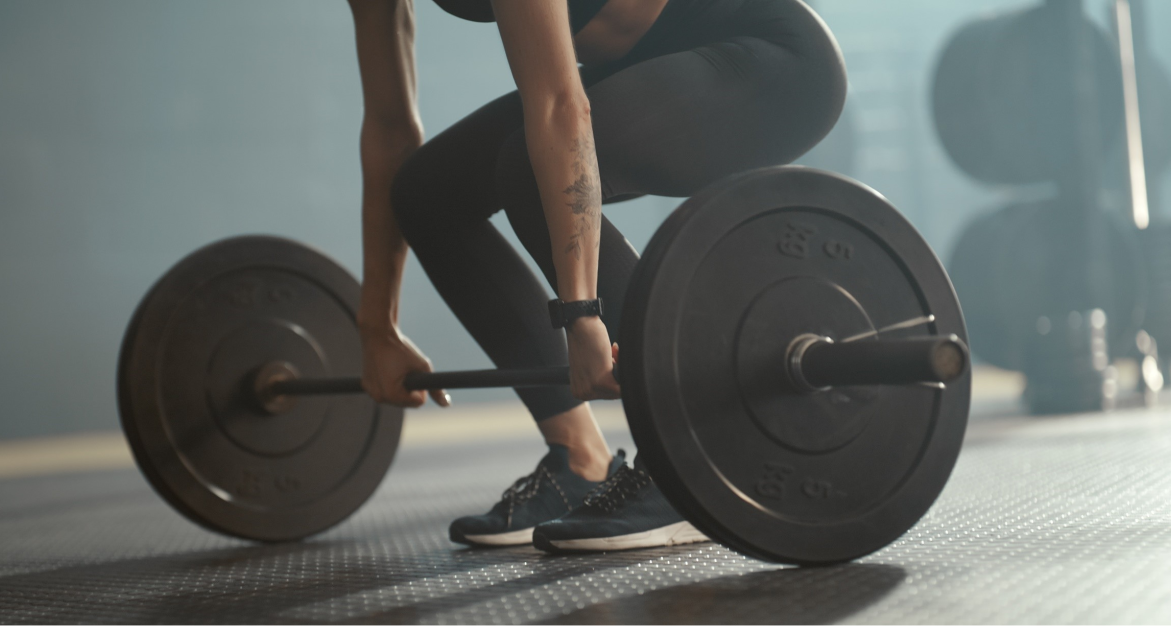
Explain the role of major muscles in performing a deadlift.
  

In your response, identify the types of muscle contractions occurring and explain how these muscles work together to execute the movement safely.   (5 marks)

--- 18 WORK AREA LINES (style=lined) ---

Show Answers Only

Sample Answer

  • During the lifting phase, multiple muscle groups work simultaneously. Erector spinae muscles contract isometrically, maintaining a rigid spine position. This prevents dangerous spinal flexion under load. Meanwhile, gluteus maximus and hamstrings perform concentric contractions to extend the hips. Similarly, quadriceps contract concentrically to extend the knees.
  • These coordinated actions create the upward force needed to lift the weight. The reason for simultaneous activation is load distribution – sharing the work prevents any single muscle group from overloading. Additionally, trapezius muscles contract isometrically to stabilise the shoulder girdle and maintain bar position.
  • In the lowering phase, the same muscles perform eccentric contractions. This controlled lengthening prevents the weight from dropping suddenly. Hamstrings and glutes gradually lengthen while maintaining tension, which protects the lower back from sudden loading.
  • Throughout both phases, core muscles (rectus abdominis, transverse abdominis) maintain isometric contraction. This continuous bracing protects the spine and enables efficient force transfer. Therefore, coordinated muscle contractions ensure both effective lifting and injury prevention.
Show Worked Solution

Sample Answer

  • During the lifting phase, multiple muscle groups work simultaneously. Erector spinae muscles contract isometrically, maintaining a rigid spine position. This prevents dangerous spinal flexion under load. Meanwhile, gluteus maximus and hamstrings perform concentric contractions to extend the hips. Similarly, quadriceps contract concentrically to extend the knees.
  • These coordinated actions create the upward force needed to lift the weight. The reason for simultaneous activation is load distribution – sharing the work prevents any single muscle group from overloading. Additionally, trapezius muscles contract isometrically to stabilise the shoulder girdle and maintain bar position.
  • In the lowering phase, the same muscles perform eccentric contractions. This controlled lengthening prevents the weight from dropping suddenly. Hamstrings and glutes gradually lengthen while maintaining tension, which protects the lower back from sudden loading.
  • Throughout both phases, core muscles (rectus abdominis, transverse abdominis) maintain isometric contraction. This continuous bracing protects the spine and enables efficient force transfer. Therefore, coordinated muscle contractions ensure both effective lifting and injury prevention.

Filed Under: Skeletal and muscular systems Tagged With: Band 5, Band 6, smc-5521-15-Muscle contractions, smc-5521-30-Major muscles

HMS, BM EQ-Bank 30

Explain how the hamstring muscle group and quadriceps work together during a running stride. In your answer, refer to types of muscle contractions.   (4 marks)

--- 8 WORK AREA LINES (style=lined) ---

Show Answers Only

Sample Answer

  • During the running stride, the hamstrings and quadriceps demonstrate the antagonistic relationship between muscle groups.
  • As the leg drives forward, the quadriceps contract concentrically to extend the knee. This causes the hamstrings to undergo eccentric contraction to control the movement, preventing hyperextension.
  • During the recovery phase, the hamstrings contract concentrically to flex the knee. As a result, the quadriceps must lengthen eccentrically to control this flexion.
  • This alternating pattern occurs because when one muscle group acts as the agonist (contracting), the opposing muscle must act as the antagonist (lengthening). Therefore, this coordinated action enables controlled movement and efficient force production throughout the running stride.
Show Worked Solution

Sample Answer

  • During the running stride, the hamstrings and quadriceps demonstrate the antagonistic relationship between muscle groups.
  • As the leg drives forward, the quadriceps contract concentrically to extend the knee. This causes the hamstrings to undergo eccentric contraction to control the movement, preventing hyperextension.
  • During the recovery phase, the hamstrings contract concentrically to flex the knee. As a result, the quadriceps must lengthen eccentrically to control this flexion.
  • This alternating pattern occurs because when one muscle group acts as the agonist (contracting), the opposing muscle must act as the antagonist (lengthening). Therefore, this coordinated action enables controlled movement and efficient force production throughout the running stride.

Filed Under: Skeletal and muscular systems Tagged With: Band 4, smc-5521-15-Muscle contractions, smc-5521-30-Major muscles

HMS, BM EQ-Bank 28 MC

During a push-up, the pectoralis major:

  1. Contracts eccentrically during the downward phase and concentrically during the upward phase.
  2. Contracts concentrically during the downward phase and eccentrically during the upward phase.
  3. Acts as a stabiliser throughout the entire movement.
  4. Works as an antagonist to the deltoid muscle.
Show Answers Only

\(A\)

Show Worked Solution
  • A is correct: Pectoralis major contracts eccentrically lowering, concentrically pushing up.

Other Options:

  • B is incorrect: Reverses the contraction types
  • C is incorrect: Pectoralis major is a prime mover, not stabiliser
  • D is incorrect: Both muscles work together as agonists

Filed Under: Skeletal and muscular systems Tagged With: Band 4, smc-5521-15-Muscle contractions, smc-5521-30-Major muscles

HMS, BM EQ-Bank 24

Outline how the structure of ball and socket joints enables a greater range of movement than hinge joints. Support your response with examples.  (3 marks)

--- 6 WORK AREA LINES (style=lined) ---

Show Answers Only

Sample answer

Ball-and-socket joints

  • Feature a spherical head fitting into a cup-shaped socket, enabling multi-directional movement.
  • This structure permits flexion, extension, abduction, adduction and rotation.

Hinge joints

  • Have cylindrical surfaces allowing movement in only one plane – flexion and extension.

Examples:

  • The shoulder (ball-and-socket) allows arm movement in all directions for throwing.
  • The elbow (hinge) only bends and straightens, providing stability for lifting.
Show Worked Solution

Sample answer

Ball-and-socket joints

  • Feature a spherical head fitting into a cup-shaped socket, enabling multi-directional movement.
  • This structure permits flexion, extension, abduction, adduction and rotation.

Hinge joints

  • Have cylindrical surfaces allowing movement in only one plane – flexion and extension.

Examples:

  • The shoulder (ball-and-socket) allows arm movement in all directions for throwing.
  • The elbow (hinge) only bends and straightens, providing stability for lifting.

Filed Under: Skeletal and muscular systems Tagged With: Band 4, smc-5521-10-Joint actions, smc-5521-15-Muscle contractions, smc-5521-35-Structure/function

HMS, BM EQ-Bank 16 MC

Which sequence correctly describes the quadriceps muscle action and knee joint movement when performing a squat?

\begin{align*}
\begin{array}{l}
\rule{0pt}{2.5ex} \ \rule[-1ex]{0pt}{0pt}& \\
\rule{0pt}{2.5ex}\textbf{A.}\rule[-1ex]{0pt}{0pt}\\
\rule{0pt}{2.5ex}\textbf{B.}\rule[-1ex]{0pt}{0pt}\\
\rule{0pt}{2.5ex}\textbf{C.}\rule[-1ex]{0pt}{0pt}\\
\rule{0pt}{2.5ex}\textbf{D.}\rule[-1ex]{0pt}{0pt}\\
\end{array}
\begin{array}{|l|l|l|}
\hline
\rule{0pt}{2.5ex}\textbf{Descent Phase}\rule[-1ex]{0pt}{0pt}& \textbf{Bottom Position}& \textbf{Ascent Phase} \\
\hline
\rule{0pt}{2.5ex}\text{Eccentric}\rule[-1ex]{0pt}{0pt}&\text{Isometric }&\text{Concentric}\\
\hline
\rule{0pt}{2.5ex}\text{Concentric}\rule[-1ex]{0pt}{0pt}& \text{Isometric concentric}&\text{Eccentric}\\
\hline
\rule{0pt}{2.5ex}\text{Isometric}\rule[-1ex]{0pt}{0pt}& \text{Eccentric}&\text{Concentric} \\
\hline
\rule{0pt}{2.5ex}\text{Concentric}\rule[-1ex]{0pt}{0pt}& \text{Eccentric}&\text{Isometric} \\
\hline
\end{array}
\end{align*}

Show Answers Only

\(A\)

Show Worked Solution

A is correct: Quadriceps contract eccentrically (descent), isometrically (bottom), then concentrically (ascent).

\(\Rightarrow A\)

Filed Under: Skeletal and muscular systems Tagged With: Band 4, smc-5521-10-Joint actions, smc-5521-15-Muscle contractions

HMS, BM EQ-Bank 15 MC

Which type of muscular contraction is occurring in the quadriceps when descending into a squat?

  1. Isometric contraction
  2. Eccentric contraction
  3. Concentric contraction
  4. Dynamic contraction
Show Answers Only

\(B\)

Show Worked Solution

B is correct: During descent, the quadriceps lengthen under tension to control movement – this is eccentric contraction.

\(\Rightarrow B\)

Filed Under: Skeletal and muscular systems Tagged With: Band 3, smc-5521-10-Joint actions, smc-5521-15-Muscle contractions

HMS, BM EQ-Bank 14 MC

Which row correctly identifies the action of performing a bicep curl? 

\begin{align*}
\begin{array}{l}
\rule{0pt}{2.5ex} \ \rule[-1ex]{0pt}{0pt}& \\
\rule{0pt}{2.5ex}\textbf{A.}\rule[-1ex]{0pt}{0pt}\\
\rule{0pt}{2.5ex}\textbf{B.}\rule[-1ex]{0pt}{0pt}\\
\rule{0pt}{2.5ex}\textbf{C.}\rule[-1ex]{0pt}{0pt}\\
\rule{0pt}{2.5ex}\textbf{D.}\rule[-1ex]{0pt}{0pt}\\
\end{array}
\begin{array}{|l|l|l|}
\hline
\rule{0pt}{2.5ex}\textbf{Agonist Muscle}\rule[-1ex]{0pt}{0pt}& \textbf{Muscular Contraction}& \textbf{Joint Action} \\
\hline
\rule{0pt}{2.5ex}\text{Biceps brachii}\rule[-1ex]{0pt}{0pt}&\text{Isometric eccentric}&\text{Elbow extension}\\
\hline
\rule{0pt}{2.5ex}\text{Biceps brachii}\rule[-1ex]{0pt}{0pt}& \text{Isometric concentric}&\text{Elbow flexion}\\
\hline
\rule{0pt}{2.5ex}\text{Triceps brachii}\rule[-1ex]{0pt}{0pt}& \text{Isometric concentric}&\text{Elbow flexion} \\
\hline
\rule{0pt}{2.5ex}\text{Triceps brachii}\rule[-1ex]{0pt}{0pt}& \text{Isometric eccentric}&\text{Elbow extension} \\
\hline
\end{array}
\end{align*}

Show Answers Only

\(B\)

Show Worked Solution

B is correct: During the upward (concentric) phase of a bicep curl:

  • The biceps brachii is the agonist muscle.
  • It contracts concentrically (shortens) to generate force.
  • This produces elbow flexion to lift the weight.

\(\Rightarrow B\)

Filed Under: Skeletal and muscular systems Tagged With: Band 3, smc-5521-10-Joint actions, smc-5521-15-Muscle contractions

Copyright © 2014–2025 SmarterEd.com.au · Log in