SmarterEd

Aussie Maths & Science Teachers: Save your time with SmarterEd

  • Login
  • Get Help
  • About

HMS, BM EQ-Bank 827

Explain how major muscles in the upper body work together to perform an overhead throw.   (5 marks)

--- 16 WORK AREA LINES (style=lined) ---

Show Answers Only

Sample Answer

  • During the wind-up phase, latissimus dorsi and posterior deltoids contract to pull the arm backward into extension. This action stretches the anterior muscles (pectorals, anterior deltoid), creating stored elastic energy. Meanwhile, the external rotators position the shoulder in external rotation. As a result, the throwing arm is optimally positioned for force generation.
  • Core muscles initiate the forward phase through trunk rotation. Obliques and rectus abdominis contract to rotate the trunk toward the target. This rotation generates the initial force that will transfer up the kinetic chain.
  • Subsequently, pectoralis major and anterior deltoid contract powerfully. These muscles accelerate the arm forward through horizontal adduction and flexion. At the same time, rotator cuff muscles (supraspinatus, infraspinatus) stabilise the shoulder joint, preventing injury during rapid movement.
  • Finally, the triceps contracts explosively to extend the elbow at release. This final extension adds velocity to the ball. Therefore, coordinated muscle activation from core to fingertips enables powerful, accurate throwing.
Show Worked Solution

Sample Answer

  • During the wind-up phase, latissimus dorsi and posterior deltoids contract to pull the arm backward into extension. This action stretches the anterior muscles (pectorals, anterior deltoid), creating stored elastic energy. Meanwhile, the external rotators position the shoulder in external rotation. As a result, the throwing arm is optimally positioned for force generation.
  • Core muscles initiate the forward phase through trunk rotation. Obliques and rectus abdominis contract to rotate the trunk toward the target. This rotation generates the initial force that will transfer up the kinetic chain.
  • Subsequently, pectoralis major and anterior deltoid contract powerfully. These muscles accelerate the arm forward through horizontal adduction and flexion. At the same time, rotator cuff muscles (supraspinatus, infraspinatus) stabilise the shoulder joint, preventing injury during rapid movement.
  • Finally, the triceps contracts explosively to extend the elbow at release. This final extension adds velocity to the ball. Therefore, coordinated muscle activation from core to fingertips enables powerful, accurate throwing.

Filed Under: Skeletal and muscular systems Tagged With: Band 4, Band 5, smc-5521-30-Major muscles

HMS, BM EQ-Bank 826

Describe the role of the major muscles in the lower leg during running.   (4 marks)

--- 10 WORK AREA LINES (style=lined) ---

Show Answers Only

Sample Answer

Gastrocnemius:

  • The large calf muscle provides powerful plantar flexion during the push-off phase.
  • Contracts concentrically to propel the body forward and upward with each stride.

Soleus:

  • Works with gastrocnemius for sustained plantar flexion throughout the stance phase.
  • Provides endurance for prolonged running due to its predominantly slow-twitch fibre composition.

Tibialis anterior:

  • Located on the shin, this muscle performs dorsiflexion during the swing phase.
  • Lifts the toes to clear the ground and positions the foot for heel strike.

Peroneals:

  • Stabilise the ankle laterally during ground contact.
  • Prevent excessive inversion and maintain balance throughout the running gait cycle.
Show Worked Solution

Sample Answer

Gastrocnemius:

  • The large calf muscle provides powerful plantar flexion during the push-off phase.
  • Contracts concentrically to propel the body forward and upward with each stride.

Soleus:

  • Works with gastrocnemius for sustained plantar flexion throughout the stance phase.
  • Provides endurance for prolonged running due to its predominantly slow-twitch fibre composition.

Tibialis anterior:

  • Located on the shin, this muscle performs dorsiflexion during the swing phase.
  • Lifts the toes to clear the ground and positions the foot for heel strike.

Peroneals:

  • Stabilise the ankle laterally during ground contact.
  • Prevent excessive inversion and maintain balance throughout the running gait cycle.

Filed Under: Skeletal and muscular systems Tagged With: Band 4, smc-5521-30-Major muscles

HMS, BM EQ-Bank 825

Outline the location and function of the quadriceps muscles.   (3 marks)

--- 6 WORK AREA LINES (style=lined) ---

Show Answers Only

Sample Answer

Location:

  • The quadriceps are a group of four muscles located on the anterior (front) surface of the thigh, extending from the hip to the knee.

Function:

  • Their primary role is knee extension, straightening the leg during walking, running, and jumping movements.
  • They also provide knee joint stability during weight-bearing activities.
  • Additionally, the quadriceps assist with hip flexion as one portion crosses both joints.
Show Worked Solution

Sample Answer

Location:

  • The quadriceps are a group of four muscles located on the anterior (front) surface of the thigh, extending from the hip to the knee.

Function:

  • Their primary role is knee extension, straightening the leg during walking, running, and jumping movements.
  • They also provide knee joint stability during weight-bearing activities.
  • Additionally, the quadriceps assist with hip flexion as one portion crosses both joints.

Filed Under: Skeletal and muscular systems Tagged With: Band 3, smc-5521-30-Major muscles

HMS, BM EQ-Bank 824 MC

During a push-up exercise, which of the following muscles is primarily responsible for the upward phase of the movement?

  1. Biceps brachii
  2. Latissimus dorsi
  3. Rectus abdominis
  4. Pectoralis major
Show Answers Only

\(D\)

Show Worked Solution
  • D is correct: Pectoralis major contracts to push the body up.

Other Options:

  • A is incorrect: Biceps flex the elbow (lowering movement)
  • B is incorrect: Latissimus dorsi is for pulling movements
  • C is incorrect: Rectus abdominis stabilises, not primary mover

Filed Under: Skeletal and muscular systems Tagged With: Band 4, smc-5521-30-Major muscles

HMS, BM EQ-Bank 31

Explain the role of major muscles in performing a deadlift.
  

In your response, identify the types of muscle contractions occurring and explain how these muscles work together to execute the movement safely.   (5 marks)

--- 18 WORK AREA LINES (style=lined) ---

Show Answers Only

Sample Answer

  • During the lifting phase, multiple muscle groups work simultaneously. Erector spinae muscles contract isometrically, maintaining a rigid spine position. This prevents dangerous spinal flexion under load. Meanwhile, gluteus maximus and hamstrings perform concentric contractions to extend the hips. Similarly, quadriceps contract concentrically to extend the knees.
  • These coordinated actions create the upward force needed to lift the weight. The reason for simultaneous activation is load distribution – sharing the work prevents any single muscle group from overloading. Additionally, trapezius muscles contract isometrically to stabilise the shoulder girdle and maintain bar position.
  • In the lowering phase, the same muscles perform eccentric contractions. This controlled lengthening prevents the weight from dropping suddenly. Hamstrings and glutes gradually lengthen while maintaining tension, which protects the lower back from sudden loading.
  • Throughout both phases, core muscles (rectus abdominis, transverse abdominis) maintain isometric contraction. This continuous bracing protects the spine and enables efficient force transfer. Therefore, coordinated muscle contractions ensure both effective lifting and injury prevention.
Show Worked Solution

Sample Answer

  • During the lifting phase, multiple muscle groups work simultaneously. Erector spinae muscles contract isometrically, maintaining a rigid spine position. This prevents dangerous spinal flexion under load. Meanwhile, gluteus maximus and hamstrings perform concentric contractions to extend the hips. Similarly, quadriceps contract concentrically to extend the knees.
  • These coordinated actions create the upward force needed to lift the weight. The reason for simultaneous activation is load distribution – sharing the work prevents any single muscle group from overloading. Additionally, trapezius muscles contract isometrically to stabilise the shoulder girdle and maintain bar position.
  • In the lowering phase, the same muscles perform eccentric contractions. This controlled lengthening prevents the weight from dropping suddenly. Hamstrings and glutes gradually lengthen while maintaining tension, which protects the lower back from sudden loading.
  • Throughout both phases, core muscles (rectus abdominis, transverse abdominis) maintain isometric contraction. This continuous bracing protects the spine and enables efficient force transfer. Therefore, coordinated muscle contractions ensure both effective lifting and injury prevention.

Filed Under: Skeletal and muscular systems Tagged With: Band 5, Band 6, smc-5521-15-Muscle contractions, smc-5521-30-Major muscles

HMS, BM EQ-Bank 30

Explain how the hamstring muscle group and quadriceps work together during a running stride. In your answer, refer to types of muscle contractions.   (4 marks)

--- 8 WORK AREA LINES (style=lined) ---

Show Answers Only

Sample Answer

  • During the running stride, the hamstrings and quadriceps demonstrate the antagonistic relationship between muscle groups.
  • As the leg drives forward, the quadriceps contract concentrically to extend the knee. This causes the hamstrings to undergo eccentric contraction to control the movement, preventing hyperextension.
  • During the recovery phase, the hamstrings contract concentrically to flex the knee. As a result, the quadriceps must lengthen eccentrically to control this flexion.
  • This alternating pattern occurs because when one muscle group acts as the agonist (contracting), the opposing muscle must act as the antagonist (lengthening). Therefore, this coordinated action enables controlled movement and efficient force production throughout the running stride.
Show Worked Solution

Sample Answer

  • During the running stride, the hamstrings and quadriceps demonstrate the antagonistic relationship between muscle groups.
  • As the leg drives forward, the quadriceps contract concentrically to extend the knee. This causes the hamstrings to undergo eccentric contraction to control the movement, preventing hyperextension.
  • During the recovery phase, the hamstrings contract concentrically to flex the knee. As a result, the quadriceps must lengthen eccentrically to control this flexion.
  • This alternating pattern occurs because when one muscle group acts as the agonist (contracting), the opposing muscle must act as the antagonist (lengthening). Therefore, this coordinated action enables controlled movement and efficient force production throughout the running stride.

Filed Under: Skeletal and muscular systems Tagged With: Band 4, smc-5521-15-Muscle contractions, smc-5521-30-Major muscles

HMS, BM EQ-Bank 29

Name THREE major muscles of the upper body and outline their primary functions.   (3 marks)

--- 6 WORK AREA LINES (style=lined) ---

Show Answers Only

Sample Answer

Deltoid:

  • Located covering the shoulder joint, this muscle primarily abducts the arm (raises it laterally).
  • Also assists with flexion and extension depending on which portion contracts.

Pectoralis major:

  • Large chest muscle responsible for horizontal adduction of the arm (bringing arms together).
  • Also performs internal rotation and assists with arm flexion.

Latissimus dorsi:

  • Broad back muscle that extends, adducts and internally rotates the arm at the shoulder joint.
  • Essential for pulling movements.
Show Worked Solution

Sample Answer

Deltoid:

  • Located covering the shoulder joint, this muscle primarily abducts the arm (raises it laterally).
  • Also assists with flexion and extension depending on which portion contracts.

Pectoralis major:

  • Large chest muscle responsible for horizontal adduction of the arm (bringing arms together).
  • Also performs internal rotation and assists with arm flexion.

Latissimus dorsi:

  • Broad back muscle that extends, adducts and internally rotates the arm at the shoulder joint.
  • Essential for pulling movements.

Filed Under: Skeletal and muscular systems Tagged With: Band 3, smc-5521-30-Major muscles

HMS, BM EQ-Bank 28 MC

During a push-up, the pectoralis major:

  1. Contracts eccentrically during the downward phase and concentrically during the upward phase.
  2. Contracts concentrically during the downward phase and eccentrically during the upward phase.
  3. Acts as a stabiliser throughout the entire movement.
  4. Works as an antagonist to the deltoid muscle.
Show Answers Only

\(A\)

Show Worked Solution
  • A is correct: Pectoralis major contracts eccentrically lowering, concentrically pushing up.

Other Options:

  • B is incorrect: Reverses the contraction types
  • C is incorrect: Pectoralis major is a prime mover, not stabiliser
  • D is incorrect: Both muscles work together as agonists

Filed Under: Skeletal and muscular systems Tagged With: Band 4, smc-5521-15-Muscle contractions, smc-5521-30-Major muscles

HMS, BM EQ-Bank 27 MC

Which pair of muscles work together in an agonist-antagonist relationship?

  1. Deltoid and trapezius
  2. Biceps and gastrocnemius
  3. Triceps and biceps brachii
  4. Quadriceps and deltoid
Show Answers Only

\(C\)

Show Worked Solution
  • C is correct: Biceps and triceps are antagonists at the elbow – biceps flexes, triceps extends.

Other Options:

  • A is incorrect: Work in different regions, not antagonistic
  • B is incorrect: Work at different joints (elbow vs ankle)
  • D is incorrect: Work at different joints (knee vs shoulder)

Filed Under: Skeletal and muscular systems Tagged With: Band 3, smc-5521-25-Muscle relationships, smc-5521-30-Major muscles

HMS, BM EQ-Bank 26 MC

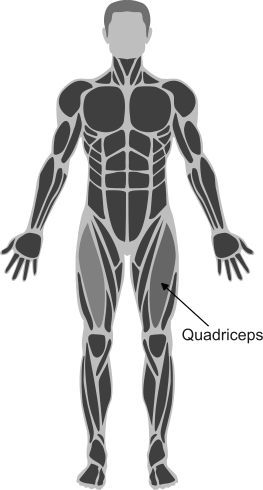
The muscle group indicated in the image below is primarily responsible for:

  1. Hip flexion
  2. Knee extension
  3. Knee flexion
  4. Hip extension
Show Answers Only

\(B\)

Show Worked Solution
  • B is correct. The quadriceps are the primary knee extensors

Other Options:

  • A is Incorrect: Hip flexion is primarily performed by the iliopsoas
  • C is Incorrect: Knee flexion is performed by the hamstrings
  • D is Incorrect: Hip extension is primarily performed by the gluteus maximus and hamstrings

Filed Under: Skeletal and muscular systems Tagged With: Band 2, smc-5521-30-Major muscles

Copyright © 2014–2025 SmarterEd.com.au · Log in