SmarterEd

Aussie Maths & Science Teachers: Save your time with SmarterEd

  • Login
  • Get Help
  • About

Recursion, GEN1 2024 NHT 17 MC

Mel bought a new car for $60 000. She will depreciate the value of the car using the reducing balance method. A recurrence relation that models the year-to-year value of her car, \(M_n\), is

\(M_0=60 \, 000, \quad M_{n+1}=0.85 \ M_n\)

An equivalent rule to determine the value of the car after \(n\) years is

  1. \(M_n=60\,000-0.85 n\)
  2. \(M_n=60\,000+0.85 n\)
  3. \(M_n=60\,000+0.85^n\)
  4. \(M_n=60\,000 \times 0.85^{n-1}\)
  5. \(M_n=60\,000 \times 0.85^n\)
Show Answers Only

\(E\)

Show Worked Solution

\(\text{Reducing balance}\ \ \Rightarrow \ \ \text{Eliminate A, B and C}\)

\(\text{After 1 year, value}\ M_1=60\,000 \times 0.85\)

\(\Rightarrow E\)

Filed Under: Depreciation, Recursion - Financial Tagged With: Band 4, smc-602-50-Recurrence relation, smc-717-60-Depreciation (reducing balance)

Financial Maths, GEN2 2024 VCAA 5

Emi operates a mobile dog-grooming business.

The value of her grooming equipment will depreciate.

Based on average usage, a rule for the value, in dollars, of the equipment, \(V_n\), after \(n\) weeks is

\(V_n=15000-60 n\)

Assume that there are exactly 52 weeks in a year.

  1. By what amount, in dollars, does the value of the grooming equipment depreciate each week?   (1 mark)

    --- 1 WORK AREA LINES (style=lined) ---
  2. Emi plans to replace the grooming equipment after four years.   
  3. What will be its value, in dollars, at this time?   (1 mark)

    --- 2 WORK AREA LINES (style=lined) ---

  4. \(V_n\) is the value of the grooming equipment, in dollars, after \(n\) weeks.   
  5. Write a recurrence relation in terms of \(V_0, V_{n+1}\) and \(V_n\) that can model this value from one week to the next.   (1 mark)

    --- 2 WORK AREA LINES (style=lined) ---

  6. The value of the grooming equipment decreases from one year to the next by the same percentage of the original $15 000 value.
  7. What is this annual flat rate percentage?   (1 mark)

    --- 2 WORK AREA LINES (style=lined) ---

Show Answers Only

a.    \($60\)

b.    \($2520\)

c.    \(V_0=15\,000 , \ \ V_{n+1}=V_n-60\)

d.    \(20.8\%\)

Show Worked Solution

a.    \($60\)
 

b.    \(n=4\times 52=208\)

\(V_{208}\) \(=15\,000-60\times208\)
  \(=$2520\)

 
c.   
\(V_0=15\,000 , \ \ V_{n+1}=V_n-60\)
 

d.    \(\text{Flat rate}\ =\dfrac{60}{15\,000}\times 52\times 100\%=20.8\%\)

♦ Mean mark (d) 42%.

Filed Under: Depreciation Tagged With: Band 3, Band 4, Band 5, smc-602-10-Flat rate, smc-602-50-Recurrence relation

CORE, FUR2 2021 VCAA 7

Sienna owns a coffee shop.

A coffee machine, purchased for $12 000, is depreciated in value using the unit cost method.

The rate of depreciation is $0.05 per cup of coffee made.

The recurrence relation that models the year-to-year value, in dollars, of the coffee machine is

`M_0 = 12 \ 000,`     `M_{n+1} = M_n - 1440`

  1. Calculate the number of cups of coffee that the machine produces per year.   (1 mark)

    --- 2 WORK AREA LINES (style=lined) ---

  2. The recurrence relation above could also represent the value of the coffee machine depreciating at a flat rate.
  3. What annual flat rate percentage of depreciation is represented?   (1 mark)

    --- 2 WORK AREA LINES (style=lined) ---

  4. Complete the rule below that gives the value of the coffee machine, `M_n`, in dollars, after `n` cups have been produced. Write your answers in the boxes provided.   (1 mark)

    --- 0 WORK AREA LINES (style=lined) ---

     
       `M_n =`
     
     `+`  
     
    `xx n`  

Show Answers Only

  1. `2880`
  2. `12text{% p.a.}`
  3. `12 \ 000 + (-0.05) xx n`

Show Worked Solution

a.   `text{Cups of coffee}` `= 1440/0.05`
    `= 28 \ 800`


b.   `text{Flat rate (%)}` `= {1440}/{12 \000}`
    `= 12text{% p.a.}`

   
c. 
`M_n = 12 \ 000 + (-0.05) xx n`

Filed Under: Depreciation, Recursion - Financial Tagged With: Band 3, Band 4, Band 5, smc-602-30-Unit cost, smc-602-50-Recurrence relation, smc-717-50-Depreciation (SL)

CORE, FUR2 2020 VCAA 7

Samuel owns a printing machine.

The printing machine is depreciated in value by Samuel using flat rate depreciation.

The value of the machine, in dollars, after `n` years, `Vn` , can be modelled by the recurrence relation

`V_0 = 120\ 000, qquad V_(n+1) = V_n-15\ 000`

  1. By what amount, in dollars, does the value of the machine decrease each year?   (1 mark)

    --- 1 WORK AREA LINES (style=lined) ---
  2. Showing recursive calculations, determine the value of the machine, in dollars, after two years.   (1 mark)

    --- 2 WORK AREA LINES (style=lined) ---

  3. What annual flat rate percentage of depreciation is used by Samuel?   (1 mark)

    --- 2 WORK AREA LINES (style=lined) ---

  4. The value of the machine, in dollars, after `n` years, `V_n`, could also be determined using a rule of the form `V_n = a + bn`.


    Write down this rule for `V_n`.   (1 mark)

    --- 2 WORK AREA LINES (style=lined) ---

Show Answers Only
  1. `$15\ 000`
  2. `$90\ 000`
  3. `12.5%`
  4. `V_n = 120\ 000-15\ 000n, n = 0, 1, 2, …`
Show Worked Solution

a. `$15\ 000`
  

b.   `V_1` `= 120\ 000-15\ 000 = $105\ 000`
  `V_2` `= 105\ 000-15\ 000 = $90\ 000`


c.   `text(Flat rate percentage` `= (15\ 000)/ (120\ 000) xx 100`
    `= 12.5 text(%)`


♦ Mean mark part d. 44%.

d.  `V_n = 120\ 000-15\ 000n, \ n = 0, 1, 2, …`

Filed Under: Depreciation, Recursion - Financial Tagged With: Band 1, Band 2, Band 4, smc-602-50-Recurrence relation, smc-717-50-Depreciation (SL)

CORE, FUR2 2019 VCAA 7

Phil is a builder who has purchased a large set of tools.

The value of Phil’s tools is depreciated using the reducing balance method.

The value of the tools, in dollars, after `n` years, `V_n` , can be modelled by the recurrence relation shown below.

`V_0 = 60\ 000, qquad V_(n + 1) = 0.9 V_n` 

  1. Use recursion to show that the value of the tools after two years, `V_2` , is $48 600.   (1 mark)

    --- 3 WORK AREA LINES (style=lined) ---

  2. What is the annual percentage rate of depreciation used by Phil?   (1 mark)

    --- 1 WORK AREA LINES (style=lined) ---

  3. Phil plans to replace these tools when their value first falls below $20 000.


    After how many years will Phil replace these tools?   (1 mark)

    --- 4 WORK AREA LINES (style=lined) ---

  4. Phil has another option for depreciation. He depreciates the value of the tools by a flat rate of 8% of the purchase price per annum.


    Let `V_n` be the value of the tools after `n` years, in dollars.


    Write down a recurrence relation, in terms of `V_0, V_(n + 1)` and `V_n`, that could be used to model the value of the tools using this flat rate depreciation.   (1 mark)

    --- 3 WORK AREA LINES (style=lined) ---

Show Answers Only
  1. `text(Proof)\ text{(See Worked Solutions)}`
  2. `text(10%)`
  3. `11\ text(years)`
  4. `V_0=60\ 000,\ \ \ V_(n + 1) = V_n-4800`
Show Worked Solution
a.   `V_0` `= 60\ 000`
  `V_1` `= 0.9 xx 60\ 000 = 54\ 000`
  `V_2` `= 0.9 xx 54\ 000 = $48\ 600`

  
b.
  `text(Depreciation rate) = 0.1 = 10%`

 
c.
  `text(Find)\ \ n\ \ text(such that)`

`60\ 000 xx 0.9^n = 20\ 000`

`=> n = 10.427\ \ \ text{(by CAS)}`

`:.\ text(Phil will replace in the 11th year.)`

 
d.
  `text(Annual depreciation) = 0.08 xx V_0 = 4800`

`:.\ text(Recurrence relation is:)`

`V_0=60\ 000,\ \ \ V_(n + 1) = V_n-4800`

Filed Under: Depreciation Tagged With: Band 3, Band 4, Band 5, smc-602-20-Reducing balance, smc-602-50-Recurrence relation

CORE, FUR2 2018 VCAA 5

After three years, Julie withdraws $14 000 from her account to purchase a car for her business.

For tax purposes, she plans to depreciate the value of her car using the reducing balance method.

The value of Julie’s car, in dollars, after `n` years, `C_n`, can be modelled by the recurrence relation shown below

`C_0 = 14\ 000, qquad C_(n + 1) = R xx C_n`

  1. For each of the first three years of reducing balance depreciation, the value of `R` is 0.85


    What is the annual rate of depreciation in the value of the car during these three years?  (1 mark)

    --- 4 WORK AREA LINES (style=lined) ---

  2. For the next five years of reducing balance depreciation, the annual rate of depreciation in the value of the car is changed to 8.6%.


    What is the value of the car eight years after it was purchased?
    Round your answer to the nearest cent.  (2 marks)

    --- 6 WORK AREA LINES (style=lined) ---

Show Answers Only
  1. `15 text(%)`
  2. `$5484.23\ text{(nearest cent)}`
Show Worked Solution

a.  `text(S)text(ince)\ \ R = 0.85,`

COMMENT: Note almost half of students answered incorrectly here!

`=> 85 text(% of the car’s value remains at the end of each)`

      `text{year (vs the value at the start of the same year.)}`

`:.\ text(Annual rate of depreciation) = 15 text(%)`

  
b.
   `text(Value after 3 years)`

♦ Mean mark 42%.

`C_3` `= (0.85)^3 xx 14\ 000`
  `= $8597.75`

 
`:.\ text(Value after 8 years)`

`C_8` `= (0.914)^5 xx C_3`
  `= (0.914)^5 xx 8597.75`
  `= $5484.23\ text{(nearest cent)}`

Filed Under: Depreciation, Recursion - Financial Tagged With: Band 4, Band 5, smc-602-20-Reducing balance, smc-602-50-Recurrence relation, smc-717-60-Depreciation (reducing balance), smc-717-80-Interpret RR

CORE, FUR2 2017 VCAA 5

Alex is a mobile mechanic.

He uses a van to travel to his customers to repair their cars.

The value of Alex’s van is depreciated using the flat rate method of depreciation.

The value of the van, in dollars, after `n` years, `V_n`, can be modelled by the recurrence relation shown below.

`V_0 = 75\ 000 qquad V_(n + 1) = V_n - 3375`

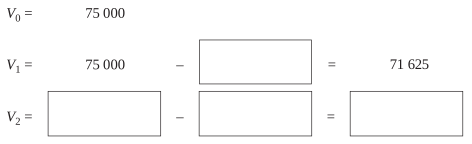
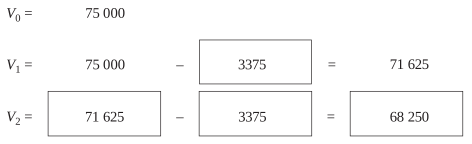
  1. Recursion can be used to calculate the value of the van after two years.


    Complete the calculations below by writing the appropriate numbers in the boxes provided.   (2 marks)

    --- 0 WORK AREA LINES (style=lined) ---


    1. By how many dollars is the value of the van depreciated each year?   (1 mark)

      --- 1 WORK AREA LINES (style=lined) ---

    2. Calculate the annual flat rate of depreciation in the value of the van.
    3. Write your answer as a percentage.   (1 mark)

      --- 2 WORK AREA LINES (style=lined) ---

  2. The value of Alex’s van could also be depreciated using the reducing balance method of depreciation.
  3. The value of the van, in dollars, after `n` years, `R_n`, can be modelled by the recurrence relation shown below.


            `R_0 = 75\ 000 qquad R_(n + 1) = 0.943R_n`

    At what annual percentage rate is the value of the van depreciated each year?   (1 mark)

    --- 2 WORK AREA LINES (style=lined) ---

Show Answers Only

a.

b.i.  `$3375`

b.ii. `4.5text(%)`

c.  `5.7text(%)`

Show Worked Solution

a.   

  
b.i.
   `$3375`


b.ii.    `text(Annual Rate)` `= 3375/(75\ 000) xx 100`
    `= 4.5text(%)`


c.    `text(Annual Rate)` `= (1-0.943) xx 100text(%)`
    `= 5.7text(%)`

Filed Under: Depreciation, Recursion - Financial Tagged With: Band 2, Band 3, Band 4, smc-602-40-Comparing methods, smc-602-50-Recurrence relation, smc-717-50-Depreciation (SL), smc-717-60-Depreciation (reducing balance)

CORE, FUR2 SM-Bank 4

Damon runs a swim school.

The value of his pool pump is depreciated over time using flat rate depreciation.

Damon purchased the pool pump for $28 000 and its value in dollars after `n` years, `P_n`, is modelled by the recursion equation below:

`P_0 = 28\ 000,qquad P_(n + 1) = P_n - 3500`

  1. Write down calculations, using the recurrence relation, to find the pool pump's value after 3 years.   (1 mark)

    --- 4 WORK AREA LINES (style=lined) ---

  2. After how many years will the pump's depreciated value reduce to $7000?   (1 mark)

    --- 5 WORK AREA LINES (style=lined) ---

The reducing balance depreciation method can also be used by Damon.

Using this method, the value of the pump is depreciated by 15% each year.

A recursion relation that models its value in dollars after `n` years, `P_n`, is:

`P_0 = 28\ 000, qquad P_(n + 1) = 0.85P_n`

  1. After how many years does the reducing balance method first give the pump a higher valuation than the flat rate method in part (a)?   (2 marks)

    --- 8 WORK AREA LINES (style=lined) ---

Show Answers Only
  1. `$17\ 500`
  2. `6\ text(years)`
  3. `4\ text(years)`
Show Worked Solution
a.    `P_1` `= 28\ 000-3500 = 24\ 500`
  `P_2` `= 24\ 500-3500 = 21\ 000`
  `P_3` `= 21\ 000-3500 = 17\ 500`

  
`:.\ text(After 3 years, the pump’s value is $17 500.)`
  

b.   `text(Find)\ n\ text(such that:)`

`7000` `= 28\ 000-3500n`
`3500n` `= 21\ 000`
`n` `= (21\ 000)/3500`
  `= 6\ text(years)`

  
c.
  `text(Using the reducing balance method)`

`P_1` `= 0.85 xx 28\ 000 = 23\ 800`
`P_2` `= 0.85 xx 23\ 800 = 20\ 230`
`P_3` `= 0.85 xx 20\ 230 = 17\ 195`
`P_4` `= 0.85 xx 17\ 195 = 14\ 615.75`

  
`text{Using the flat rate method (see part (a))}`

`P_4 = 17\ 500-3500 = 14\ 000`

`14\ 615.75 > 14\ 000`
  

`:.\ text(After 4 years, the reducing balance method)`

`text(first values the pump higher.)`

Filed Under: Depreciation, Recursion - Financial Tagged With: Band 4, Band 5, smc-602-40-Comparing methods, smc-602-50-Recurrence relation, smc-717-50-Depreciation (SL), smc-717-60-Depreciation (reducing balance)

CORE, FUR1 SM-Bank 3 MC

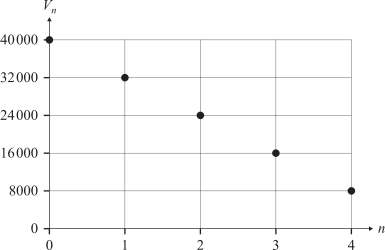
The decreasing value of a depreciating asset is shown in the graph below.


Let `A_n` be the value of the asset after `n` years, in dollars.

What recurrence relation below models the value of `A_n`?

  1. `A_0 = 120\ 000,qquadA_n = 120\ 000 xx 1.125 xx n` 
  2. `A_0 = 120\ 000,qquadA_n = 120\ 000 xx (0.125)^n` 
  3. `A_0 = 120\ 000,qquadA_n = 120\ 000 xx (1 - 0.125) xx n` 
  4. `A_0 = 120\ 000,qquadA_n = 120\ 000 xx (1 - 0.125)^n` 
  5. `A_0 = 120\ 000,qquadA_n = 120\ 000 xx (1 + 1.125)^n` 
Show Answers Only

`D`

Show Worked Solution

`text(The asset is decreasing at 12.5% per year)`

`text(on a decreasing balance basis.)`

`A_1` `= 120\ 000(1 – 0.125)^1`
`vdots`  
`A_n` `= 120\ 000(1 – 0.125)^n`

`=> D`

Filed Under: Depreciation, Recursion - Financial Tagged With: Band 4, smc-602-50-Recurrence relation, smc-602-60-Depreciation graphs, smc-717-90-RR and graphs

CORE, FUR2 SM-Bank 3

Luke purchased a new pizza oven for his restaurant for $23 500.

He can depreciate the pizza oven using the reducing balance method at a rate of 12.5% per year.

  1. If `V_n` represents the value of the pizza oven after `n` years, write a recurrence relation that models its value.   (1 mark)

    --- 6 WORK AREA LINES (style=lined) ---

  2. During what year will the pizza oven's value drop below $15 000?   (1 mark)

    --- 5 WORK AREA LINES (style=lined) ---

Luke has been advised that he can use flat rate depreciation at 10% of the purchase price.

  1. After 4 years, show which depreciation method gives the pizza oven the highest value?   (1 mark)

    --- 6 WORK AREA LINES (style=lined) ---

Show Answers Only
  1. `V_0 = 23\ 500,qquadV_(n + 1) = 0.875V_n`
  2. `text(year 4)`
  3. `text(See Worked Solutions)`
Show Worked Solution
a.    `V_0` `= 23\ 500`
  `V_1` `= 23\ 500-(12.5text(%) xx 23\ 500)`
    `= 0.875 V_0`
  `V_2` `= 0.875(0.875V_0)`
    `= 0.875 V_1`

  
`:.\ text(Recurrence relationship:)`

`V_0 = 23\ 500,qquadV_(n + 1) = 0.875V_n`
  

b.    `V_1` `= 0.875 xx 23\ 500 = 20\ 562.50`
  `V_2` `= 0.875 xx 20\ 562.50 = 17\ 992.1875`
  `V_3` `= 0.875 xx 17\ 992.1875 = 15\ 743.16…`
  `V_4` `= 0.875 xx 15\ 743.16… = 13\ 775.26…`

  
`:.\ text(The value drops below $15 000 in year 4.)`

  
c.
  `text(Value after 4 years using reducing balance)`

`= 13\ 775.26`

`text(Depreciation each year for flat rate)`

`= 10text(%) xx 23\ 500`

`= $2350`

`text(Value of pizza oven after 4 years,)`

`= 23\ 500-(4 xx 2350)`

`= $14\ 100`
 

`:.\ text(The flat rate depreciation method)`

`text(values the pizza oven highest.)`

Filed Under: Depreciation, Recursion - Financial Tagged With: Band 4, smc-602-40-Comparing methods, smc-602-50-Recurrence relation, smc-717-60-Depreciation (reducing balance), smc-717-70-Find RR

CORE, FUR2 SM-Bank 1

Joe buys a tractor under a buy-back scheme. This scheme gives Joe the right to sell the tractor back to the dealer through either a flat rate depreciation or unit cost depreciation.

  1. The recurrence relation below can be used to calculate the price Joe sells the tractor back to the dealer `(P_n)`, based on the flat rate depreciation, after `n` years
     
    `qquadP_0 = 56\ 000,qquadP_n = P_(n-1)-7000`
     

    1. Write the general rule to find the value of `P_n` in terms of `n`.?   (1 mark)

      --- 4 WORK AREA LINES (style=lined) ---

    2. Hence or otherwise, find the time it will take Joe's tractor to lose half of its value.   (1 mark)

      --- 4 WORK AREA LINES (style=lined) ---

  2. Joe uses the unit cost method to depreciate his tractor, he depreciates $2.75 per kilometre travelled.
    1. How many kilometres does Joe's tractor need to travel for half its value to be depreciated? Round your answer to the nearest kilometre?   (1 mark)

      --- 3 WORK AREA LINES (style=lined) ---

    2. Joe's tractor travels, on average, 2500 kilometres per year. Which method, flat rate depreciation or unit cost depreciation, will result in the greater annual depreciation? Write down the greater depreciation amount correct to the nearest dollar.   (1 mark)

      --- 5 WORK AREA LINES (style=lined) ---

Show Answers Only

  1. i.  `P_n = 56\ 000-7000n`
    ii. `4\ text(years)`
  2. i. `10\ 182\ text{km  (nearest km)}`
    ii. `text(The flat rate depreciation results in an extra)`
         `text($125 depreciation each year.)`

Show Worked Solution

a.i.    `P_1` `= P_0-7000`
  `P_2` `= P_0-7000-7000`
    `= 56\ 000-7000 xx 2`
  `vdots`  
  `P_n`  `= 56\ 000-7000n` 


a.ii.    `text(Depreciated value)` `= 56\ 000 ÷ 2=$28\ 000`

`text(Find)\ n,`

`28\ 000` `= 56\ 000-7000n`
`7000n` `= 28\ 000`
`:. n` `= 4\ text(years)`


b.i.    `text(Distance travelled)` `= ((56\ 000-28\ 000))/2.75`
    `= 10\ 181.81…`
    `= 10\ 182\ text{km  (nearest km)}`

  
b.ii.
  `text(Annual depreciation of unit cost)`

`= 2500 xx $2.75`

`= $6875`

`text(Annual flat rate depreciation = $7000)`

`text(Difference)\ = 7000-6875 = $125`
 

`:.\ text(The flat rate depreciation results in an extra)`

 `text($125 depreciation each year.)`

Filed Under: Depreciation, Recursion - Financial Tagged With: Band 3, Band 4, smc-602-40-Comparing methods, smc-602-50-Recurrence relation, smc-717-50-Depreciation (SL)

Copyright © 2014–2025 SmarterEd.com.au · Log in