SmarterEd

Aussie Maths & Science Teachers: Save your time with SmarterEd

  • Login
  • Get Help
  • About

CORE, FUR1 2018 VCAA 20 MC

The graph below shows the value, `V_n`, of an asset as it depreciates over a period of five months.
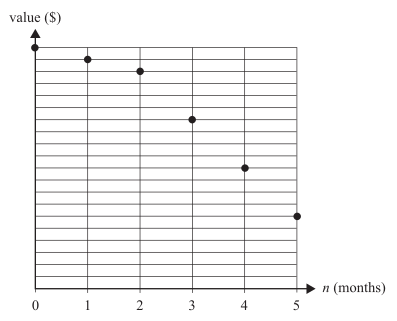
Which one of the following depreciation situations does this graph best represent?

  1. flat rate depreciation with a decrease in depreciation rate after two months
  2. flat rate depreciation with an increase in depreciation rate after two months
  3. unit cost depreciation with a decrease in units used per month after two months
  4. reducing balance depreciation with an increase in the rate of depreciation after two months
  5. reducing balance depreciation with a decrease in the rate of depreciation after two months
Show Answers Only

`B`

Show Worked Solution

`text(1-2 months → rate of depreciation is constant.)`

♦ Mean mark 39%.

`text{After 2 months → rate is again constant but}`

`text{has increased (line is steeper.)}`

`=> B`

Filed Under: Depreciation Tagged With: Band 5, smc-602-60-Depreciation graphs

CORE, FUR1 2017 VCAA 22 MC

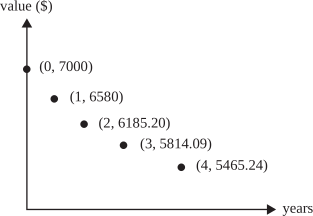
Consider the graph below.


This graph could show the value of

  1. a piano depreciating at a flat rate of 6% per annum.
  2. a car depreciating with a reducing balance rate of 6% per annum.
  3. a compound interest investment earning interest at the rate of 6% per annum.
  4. a perpetuity earning interest at the rate of 6% per annum.
  5. an annuity investment with additional payments of 6% of the initial investment amount per annum.
Show Answers Only

`B`

Show Worked Solution

`text(Consider the change in the)\ y text(-values:)`

`7000 xx 0.94` `= 6580`
`6580 xx 0.94` `= 6185.20`
`…\ \ text(and so on)`


`:.\ text(The asset is depreciating at 6% p. a. on a reducing)`

`text(balance basis.)`

`=> B`

Filed Under: Annuities and Perpetuities, Borrowing and Loans, Depreciation Tagged With: Band 5, smc-2512-60-Graphs, smc-602-60-Depreciation graphs, smc-603-80-Graphs

CORE, FUR1 SM-Bank 3 MC

The decreasing value of a depreciating asset is shown in the graph below.


Let `A_n` be the value of the asset after `n` years, in dollars.

What recurrence relation below models the value of `A_n`?

  1. `A_0 = 120\ 000,qquadA_n = 120\ 000 xx 1.125 xx n` 
  2. `A_0 = 120\ 000,qquadA_n = 120\ 000 xx (0.125)^n` 
  3. `A_0 = 120\ 000,qquadA_n = 120\ 000 xx (1 - 0.125) xx n` 
  4. `A_0 = 120\ 000,qquadA_n = 120\ 000 xx (1 - 0.125)^n` 
  5. `A_0 = 120\ 000,qquadA_n = 120\ 000 xx (1 + 1.125)^n` 
Show Answers Only

`D`

Show Worked Solution

`text(The asset is decreasing at 12.5% per year)`

`text(on a decreasing balance basis.)`

`A_1` `= 120\ 000(1 – 0.125)^1`
`vdots`  
`A_n` `= 120\ 000(1 – 0.125)^n`

`=> D`

Filed Under: Depreciation, Recursion - Financial Tagged With: Band 4, smc-602-50-Recurrence relation, smc-602-60-Depreciation graphs, smc-717-90-RR and graphs

CORE*, FUR2 2013 VCAA 1

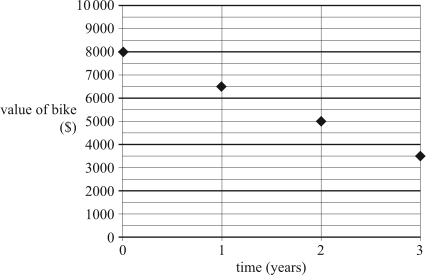
Hugo is a professional bike rider.

The value of his bike will be depreciated over time using the flat rate method of depreciation.

The graph below shows his bike’s initial purchase price and its value at the end of each year for a period of three years.
 

  1. What was the initial purchase price of the bike?   (1 mark)

    --- 1 WORK AREA LINES (style=lined) ---

    1. Show that the bike depreciates in value by $1500 each year.   (1 mark)

      --- 3 WORK AREA LINES (style=lined) ---

    2. Assume that the bike’s value continues to depreciate by $1500 each year.
    3. Determine its value five years after it was purchased.   (1 mark)

      --- 4 WORK AREA LINES (style=lined) ---

The unit cost method of depreciation can also be used to depreciate the value of the bike.

In a two-year period, the total depreciation calculated at $0.25 per kilometre travelled will equal the depreciation calculated using the flat rate method of depreciation as described above.

  1. Determine the number of kilometres the bike travels in the two-year period.   (1 mark)

    --- 5 WORK AREA LINES (style=lined) ---

Show Answers Only

  1. `$8000`
  2. i.  `text(See Worked Solutions)`
    ii. `$500`
  3. `12\ 000\ text(km)`

Show Worked Solution

a.   `$8000`
  

b.i.   `text(Value after 1 year) = $6500`

`:.\ text(Annual depreciation)` `= 8000-6500`
  `= $1500`

  
b.ii.
   `text(Value after)\ n\ text(years)`

`= 8000-1500n`

`:.\ text(After 5 years,)`

`text(Value)` `= 8000-1500 xx 5`
  `= $500`

  
c.
   `text(After 2 years,)`

`text(Depreciation)` `= 2 xx 1500`
  `= $3000`

  
`:.\ text(Distance travelled)`

`= 3000/0.25`

`= 12\ 000\ text(km)`

Filed Under: Depreciation Tagged With: Band 2, Band 3, Band 4, smc-602-40-Comparing methods, smc-602-60-Depreciation graphs

CORE*, FUR1 2015 VCAA 7 MC

The following graph shows the depreciating value of a van.
 

BUSINESS, FUR1 2015 VCAA 7 MC
 

The graph could represent the van being depreciated using

  1. flat rate depreciation with an initial value of $35 000 and a depreciation rate of $25 per year.
  2. flat rate depreciation with an initial value of $35 000 and a depreciation rate of 25 cents per year.
  3. reducing balance depreciation with an initial value of $35 000 and a depreciation rate of 2.5% per annum.
  4. unit cost depreciation with an initial value of $35 000 and a depreciation rate of 25 cents per kilometre travelled.
  5. unit cost depreciation with an initial value of $35 000 and a depreciation rate of $25 per kilometre travelled.
Show Answers Only

`D`

Show Worked Solution

`text{Initial value = $35 000 (from graph)}`

`text(Depreciation looks constant, and using the van)`

`text(valuation of $25 000 at 40 000 kms travelled.)`

`:.\ text(Depreciation Rate)` `= (35\ 000 – 25\ 000)/(40\ 000 – 0)`
  `= $0.25\ text(per km)`

`=> D`

Filed Under: Depreciation Tagged With: Band 4, smc-602-60-Depreciation graphs

CORE*, FUR1 2007 VCAA 5 MC

A new kitchen in a restaurant cost $50 000. Its value is depreciated over time using the reducing balance method.

The value of the kitchen in dollars at the end of each year for ten years is shown in the graph below.


Which one of the following statements is true?

A.  The kitchen depreciates by $4000 annually.

B.  At the end of five years, the kitchen's value is less than $20 000.

C.  The reducing balance depreciation rate is less than 5% per annum.

D.  The annual depreciation rate increases over time.

E.  The amount of depreciation each year decreases over time.

Show Answers Only

`E`

Show Worked Solution

`text(Consider) \ E,`

`text(The amount of depreciation each year is given by)`

`text(the decrease in the)\ y text(-value compared to the)`

`text(previous year. This clearly decreases over time, making)`

`E\ text(true.)`

`text(All other answers can be shown to be incorrect.)`

`=>  E`

Filed Under: Depreciation Tagged With: Band 3, smc-602-60-Depreciation graphs

CORE*, FUR1 2012 VCAA 7 MC

The following graph shows the decreasing value of an asset over eight years.


Let `P` be the value of the asset, in dollars, after `n` years.

A rule for evaluating `P` could be

A.   `P = 250\ 000 xx (1 + 0.14)^n`

B.   `P = 250\ 000 xx 1.14 xx n`

C.   `P = 250\ 000 xx (0.14)^n`

D.   `P = 250\ 000 xx (1 - 0.14)^n`

E.   `P = 250\ 000 xx (1 - 0.14) xx n`

Show Answers Only

`D`

Show Worked Solution

`text(By elimination,)`

`text(The graph shows as time increases, price decreases.)`

`:.\ text(A, B, E cannot be the rule.)`

`text(Consider C,)`

`text(After 1 year, asset would be just 14% of its original)`

`text(price, which is not the case.)`

`:.\ text(C cannot be the rule.)`

`=>  D`

Filed Under: Depreciation Tagged With: Band 4, smc-602-60-Depreciation graphs

Copyright © 2014–2025 SmarterEd.com.au · Log in