A population of a native animal species lives near the construction site. To ensure that the species is protected, information about the initial female population was collected at the beginning of 2023. The birth rates and the survival rates of the females in this population were also recorded. This species has a life span of 4 years and the information collected has been categorised into four age groups: 0-1 year, 1-2 years, 2-3 years, and 3-4 years. This information is displayed in the initial population matrix, \(R_0\), and the Leslie matrix, \(L\), below. \(R_0=\left[\begin{array}{c}70 \\ 80 \\ 90 \\ 40\end{array}\right] \quad \quad L=\left[\begin{array}{cccc}0.4 & 0.75 & 0.4 & 0 \\ 0.4 & 0 & 0 & 0 \\ 0 & 0.7 & 0 & 0 \\ 0 & 0 & 0.5 & 0\end{array}\right]\) --- 0 WORK AREA LINES (style=lined) --- --- 0 WORK AREA LINES (style=lined) --- --- 1 WORK AREA LINES (style=lined) --- a.i. a.ii. b. \(\text{5 years}\) a.ii. \(\text{Population after 1 yr calculations}\) \(0-1\ \text{year}\ =0.4\times 70+0.75\times 80+0.4\times 90=124\) \(1-2\ \text{years}\ =0.4\times 70=28\) \(2-3\ \text{years}\ =0.7\times 80=56\) \(3-4\ \text{years}\ =0.5\times 90=45\) b. \(\text{Using CAS:}\) \(R_1=L\times R_0=\begin{bmatrix} \(R_3=L\times R_2=\begin{bmatrix} \(R_5=L\times R_4=\begin{bmatrix}
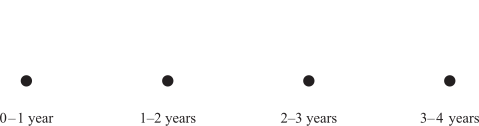
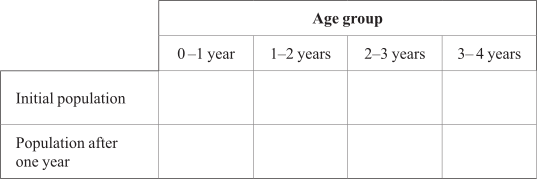
\(\textbf{Age Group}\)
\(\ 0-1\ \text{year}\ \)
\(\ 1-2\ \text{years}\ \)
\(\ 2-3\ \text{years}\ \)
\(\ 3-4\ \text{years}\ \)
\(\ \text{Initial population}\ \)
\(70\)
\(80\)
\(90\)
\(40\)
\(\ \text{Population after}\ \)
\(\ \text{one year}\)\(124\)
\(28\)
\(56\)
\(45\)
\(\textbf{Age Group}\)
\(\ 0-1\ \text{year}\ \)
\(\ 1-2\ \text{years}\ \)
\(\ 2-3\ \text{years}\ \)
\(\ 3-4\ \text{years}\ \)
\(\ \text{Initial population}\ \)
\(70\)
\(80\)
\(90\)
\(40\)
\(\ \text{Population after}\ \)
\(\ \text{one year}\)\(124\)
\(28\)
\(56\)
\(45\)
124 \\
28 \\
56 \\
45 \end{bmatrix}\ \ \text{Total = 253}\ ,\ \ R_2=L\times R_1=\begin{bmatrix}
93 \\
49.6 \\
19.6 \\
28 \end{bmatrix}\ \ \text{Total = 190.2}\)
82.24 \\
37.2 \\
34.72 \\
9.8 \end{bmatrix}\ \ \text{Total = 163.96}\ ,\ \ R_4=L\times R_3=\begin{bmatrix}
74.684 \\
32.896 \\
26.04 \\
17.36 \end{bmatrix}\ \ \text{Total =150.98}\)
64.9616 \\
29.8736 \\
23.0272 \\
13.02 \end{bmatrix}\ \ \text{Total = 130.8824}\)
\(\therefore\ \text{Total female population less than 140 after 5 years}\)
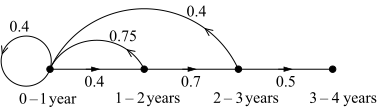
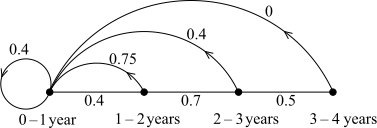
Matrices, GEN2 2023 VCAA 9
The circus is held at five different locations, \(E, F, G, H\) and \(I\).
The table below shows the total revenue for the ticket sales, rounded to the nearest hundred dollars, for the last 20 performances held at each of the five locations.
\begin{array} {|l|c|}
\hline
\rule{0pt}{2.5ex} \textbf{Location} \rule[-1ex]{0pt}{0pt} & E & F & G & H & I \\
\hline
\rule{0pt}{2.5ex} \textbf{Ticket Sales} \rule[-1ex]{0pt}{0pt} & \$960\ 000 & \$990\ 500 & \$940\ 100 & \$920\ 800 & \$901\ 300 \\
\hline
\end{array}
The ticket sales information is presented in matrix \(R\) below.
\(R=\begin{bmatrix}
960\ 000 & 990\ 500 & 940\ 100 & 920\ 800 & 901\ 300
\end{bmatrix}\)
- Complete the matrix equation below that calculates the average ticket sales per performance at each of the five locations. (1 mark)
--- 0 WORK AREA LINES (style=lined) ---
\(\begin {bmatrix}\rule{2cm}{0.25mm} \end {bmatrix}\times R = \begin {bmatrix}\rule{2cm}{0.25mm} &\rule{2cm}{0.25mm} &\rule{2cm}{0.25mm} &\rule{2cm}{0.25mm} &\rule{2cm}{0.25mm} \end {bmatrix}\)
The circus would like to increase its total revenue from the ticket sales from all five locations.
The circus will use the following matrix calculation to target the next 20 performances.
\( [t] \times R \times \begin{bmatrix}
1 \\
1 \\
1 \\
1 \\
1
\end{bmatrix}\)
- Determine the value of \(t\) if the circus would like to increase its revenue from ticket sales by 25%. (1 mark)
--- 2 WORK AREA LINES (style=lined) ---
The circus moves from one location to the next each month. It rotates through each of the five locations, before starting the cycle again.
The following matrix displays the movement between the five locations.
\begin{aligned}
& \quad \ \ \ this \ month\\
& \ \ \ E \ \ \ F \ \ \ G \ \ \ H \ \ \ I \\
& \begin{bmatrix}
0 & 0 & 0 & 1 & 0 \\
0 & 0 & 1 & 0 & 0 \\
1 & 0 & 0 & 0 & 0 \\
0 & 0 & 0 & 0 & 1 \\
0 & 1 & 0 & 0 & 0
\end{bmatrix} \begin{array}{ll}
E & \\
F\\
G & \ \ next \ month \\
H & \\
I
\end{array}\\
&
\end{aligned}
- The circus started in town \(I\).
- What is the order in which the circus will visit the five towns? (1 mark)
--- 2 WORK AREA LINES (style=lined) ---
Matrices, GEN1 2023 VCAA 31 MC
A species of bird has a life span of three years.
The females in this species do not reproduce in their first year but produce an average of four female offspring in their second year, and three in their third year.
The Leslie matrix, \(L\), below is used to model the female population distribution of this species of bird.
\(L=\begin{bmatrix}
0 & 4 & 3\\
0.2 & 0 & 0\\
0 & 0.4 & 0
\end{bmatrix}\)
The element in the second row, first column states that on average 20% of this population will
- be female.
- never reproduce.
- survive into their second year.
- produce offspring in their first year.
- live for the entire lifespan of three years.
MATRICES, FUR1 2021 VCAA 8 MC
A new colony of endangered marsupials is established on a remote island.
For one week, the marsupials can feed from only one of three feeding stations: `A`, `B` or `C`.
On Monday, 50% of the marsupials were observed feeding at station `A` and 50% were observed feeding at station `B`. No marsupials were observed feeding `C`.
The marsupials are expected to change their feeding stations each day this week according to the transition matrix `T`.
`qquadqquadqquadqquad \ text(this day)`
`P = {:(qquad\ A quadquadqquad \ B quadquad \ C ),([(0.4,0.1, 0.2),(0.2,0.5,0.2),(0.4,0.4,0.6)]{:(A),(B),(C):} qquad text(next day)):}`
Let `S_n` represent the state matrix showing the percentage of marsupials observed feeding at each feeding station `n` days after Monday of this week.
The matrix recurrence rule `S_{n+1} = TS_n` is used to model this situation.
From Tuesday to Wednesday, the percentage of marsupials who are not expected to change their feeding location is
- 44.5%
- 45%
- 50%
- 51.5%
- 52
MATRICES, FUR1 2019 VCAA 4 MC
Stella completed a multiple-choice test that had 10 questions.
Each question had five possible answers, `A, B, C, D` and `E`.
For question number one, Stella chose the answer `E`.
Stella chose each of the nine remaining answers, in order, by following the transition matrix, `T`, below
`{:(qquad qquad qquad quad text(this question)),(qquad qquad quad \ A quad\ B quad C quad D quad E),(T = [(0, 0, 1, 0, 0), (0, 0, 0, 1, 0), (0, 0, 0, 0, 1), (1, 0, 0, 0, 0), (0, 1, 0, 0, 0)]{:(A),(B),(C),(D),(E):} qquad text(next question)):}`
What answer did Stella choose for question number six?
- `A`
- `B`
- `C`
- `D`
- `E`
MATRICES, FUR1 2010 VCAA 9 MC
Robbie completed a test of four multiple-choice questions.
Each question had four alternatives, A, B, C or D.
Robbie randomly guessed the answer to the first question.
He then determined his answers to the remaining three questions by following the transition matrix
`{:(qquad qquad qquad {:text(this question):}), (qquad qquad quad \ {:(A, B, C, D):}), (T = [(1,\ 0,\ 0,\ 0), (0,\ 0,\ 1,\ 0), (0,\ 0,\ 0,\ 1), (0,\ 1,\ 0,\ 0)] {:(A), (B), (C), (D):} quad {:text(next question):}):}`
Which of the following statements is true?
A. It is impossible for Robbie to give the same answer to all four questions.
B. Robbie would always give the same answer to the first and fourth questions
C. Robbie would always give the same answer to the second and third questions.
D. If Robbie answered A for question one, he would have answered B for question two
E. It is possible that Robbie gave the same answer to exactly three of the four questions.
MATRICES, FUR1 2010 VCAA 7 MC
A new colony of several hundred birds is established on a remote island. The birds can feed at two locations, A and B. The birds are expected to change feeding locations each day according to the transition matrix
`{:(qquad qquad qquad {:text(this day):}), (qquad qquad qquad {: A\ \ \ \ \ B:}), (T = [(0.4, 0.3),(0.6, 0.7)] {:(A), (B):} {:quad text(next day):}):}`
In the beginning, approximately equal numbers of birds feed at each site each day.
Which of the following statements is not true
A. 70% of the birds that feed at B on a given day will feed at B the next day
B. 60% of the birds that feed at A on a given day will feed at B the next day.
C. In the long term, more birds will feed at B than at A.
D. The number of birds that change feeding locations each day will decrease over time to zero
E. In the long term, some birds will always be found feeding at each location.
MATRICES, FUR1 2012 VCAA 8 MC
There are 30 children in a Year 6 class. Each week every child participates in one of three activities: cycling (C), orienteering (O) or swimming (S).
The activities that the children select each week change according to the transition matrix below.
`{:({:qquadqquadqquadqquadtext(this week):}),(qquadqquadqquad\ Cqquad\ OqquadquadS),(T = [(0.5,0.3, 0.3), (0.1,0.6,0.2), (0.4,0.1,0.5)]{:(C), (O), (S):}qquadtext(next week)):}`
From the transition matrix it can be concluded that
A. in the first week of the program, ten children do cycling, ten children do orienteering and ten children do swimming.
B. at least 50% of the children do not change their activities from the first week to the second week.
C. in the long term, all of the children will choose the same activity.
D. orienteering is the most popular activity in the first week.
E. 50% of the children will do swimming each week.