Given \(p\) and \(q\) are rational numbers, and \(p, q \neq 0\), show
\(px^2-(p+q) x+q=0\)
has rational roots. (3 marks)
--- 10 WORK AREA LINES (style=lined) ---
Aussie Maths & Science Teachers: Save your time with SmarterEd
Given \(p\) and \(q\) are rational numbers, and \(p, q \neq 0\), show
\(px^2-(p+q) x+q=0\)
has rational roots. (3 marks)
--- 10 WORK AREA LINES (style=lined) ---
\(\text{Proof (See Worked Solution)}\)
| \(\Delta\) | \(=b^2-4 a c\) |
| \(=[-(p+q)]^2-4 \times p \times q\) | |
| \(=p^2+2 p q+q^2-4 p q\) | |
| \(=p^2-2 p q+q^2\) | |
| \(=(p-q)^2\) |
\(\text{Roots of equation using quadratic formula:}\)
| \(x\) | \(=\dfrac{(p+q) \pm \sqrt{(p-q)^2}}{2 p}\) |
| \(=\dfrac{p+q+(p-q)}{2 p} \ \ \text{or} \ \ \dfrac{p+q-(p-q)}{2 p}\) | |
| \(=1 \ \ \text{or} \ \ \dfrac{q}{p}\). |
\(\text{Since \(p, q\) are rational, all roots are rational.}\)
The equation `(p-1)x^2 + 4x = 5-p` has no real roots when
`B`
`(p-1)x^2 + 4x + (p-5) = 0`
`text(No real solutions when)\ \ Δ<0:`
| `b^2-4ac` | `<0` |
| `4^2-4 (p-1)(p-5)` | `< 0` |
| `16-4(p^2-6p+5)` | `<0` |
| `−4p^2 + 24p-4` | `< 0` |
| `p^2-6p + 1` | `> 0` |
`=> B`
The graphs of `y = mx + c` and `y = ax^2` will have no points of intersection for all values of `m, c` and `a` such that
`D`
`text(Intersect when:)`
| `mx + c` | `= ax^2` |
| `ax^2-mx-c` | `= 0` |
`text(S)text(ince no points of intersection:)`
| `Delta` | `< 0` |
| `m^2-4a(−c)` | `< 0` |
| `m^2 + 4ac` | `< 0` |
`text(Solve for)\ c:`
`:.\ c > (−m^2)/(4a),quada < 0`
`text(or)`
`c < (−m^2)/(4a),quada > 0`
`=> D`
Determine the value of `k` if the graph of `y = kx-4` intersects the graph of `y = x^2 + 2x` at two distinct points. Give your answer in set notation. (3 marks)
--- 8 WORK AREA LINES (style=lined) ---
`k \in (-oo,-2) \uu (6, oo)`
`text(Intersection when:)\ kx-4 = x^2 + 2x`
`x^2 + (2-k)x + 4 = 0`
`text(2 solutions when)\ \ Delta>0:`
| `(2-k)^2-4 xx 4` | `> 0` |
| `k^2-4k-12` | `>0` |
| `(k-6)(k+2)` | `>0` |
`k \in (-oo,-2) \uu (6, oo)`
Using the discriminant, or otherwise, justify why the graph of \(f(x)=-x^2+2 x-2\) lies entirely below the \(x\)-axis. (2 marks)
--- 5 WORK AREA LINES (style=lined) ---
\(\Delta=b^2-4 a c=2^2-4(-1)(-2)=-4\)
\(\text{Since \(\ \Delta<0, \ y=-x^2+2 x-2\ \) does not intersect the \(x\)-axis.}\)
\(\text{Since \(\ a=-1<0, f(x)\) is an upside down parabola.}\)
\(\Rightarrow f(x)\ \text{must lie entirely below} \ x\text{-axis.}\)
\(\Delta=b^2-4 a c=2^2-4(-1)(-2)=-4\)
\(\text{Since \(\ \Delta<0, \ y=-x^2+2 x-2\ \) does not intersect the \(x\)-axis.}\)
\(\text{Since \(\ a=-1<0, f(x)\) is an upside down parabola.}\)
\(\Rightarrow f(x)\ \text{must lie entirely below} \ x\text{-axis.}\)
The graph of a quadratic function \(f(x)=a x^2+b x+c\) is drawn below.
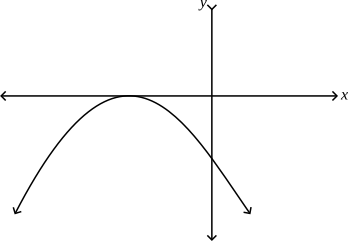
Which of the following are true?
\(D\)
\(\text{Quadratic touches } x \text{-axis once only} \ \ \Rightarrow b^2-4 a c=0\ \ \text{(eliminate C)}\)
\(\text{Quadratic is inverted} \Rightarrow a<0 \ \ \text{(eliminate B)}\)
\(\text{If} \ \ c=0, f(x)=a x^2+b x+0=x(a x+b) \Rightarrow \text{cuts twice (Eliminate A)}\)
\(\Rightarrow D\)
The tangent to the parabola \(y=x^2+2 x-4\) is \(y=px-5\) where \(p>0\).
Find the value of \(p\). (2 marks)
--- 5 WORK AREA LINES (style=lined) ---
\(p=4\)
\(\text{Intersection occurs when:}\)
| \(x^2+2x-4\) | \(=px-5\) | |
| \(x^2+(2-p)x+1\) | \(=0\) |
\(\text{Tangent touches once}\ \Rightarrow\ \text{Discriminant}\ \Delta=0\)
| \((2-p)^2-4 \times 1 \times 1\) | \(=0\) | |
| \(4-4p+p^2-4\) | \(=0\) | |
| \(p(p-4)\) | \(=0\) | |
| \(p\) | \(=4\ \ \ (p\gt 0)\) |
Find the values of `k` for which the expression `x^2-3x + (4-2k)` is always positive. (3 marks)
--- 7 WORK AREA LINES (style=lined) ---
`k < 7/8`
`x^2-3x + (4-2k) > 0`
`x^2-3x + (4-2k) = 0\ \ text(is a concave up parabola)`
`=>\ text{Always positive (no roots) if}\ \ Delta < 0`
`b^2-4ac < 0`
| `(−3)^2-4 · 1 · (4-2k)` | `< 0` |
| `9-16 + 8k` | `< 0` |
| `8k` | `< 7` |
| `k` | `< 7/8` |
--- 4 WORK AREA LINES (style=lined) ---
--- 6 WORK AREA LINES (style=lined) ---
i. `\Delta= k^2-4k-60`
ii. `-6 < k < 10`
i. `2x^2 + (k-2)x + 8`
| `Delta` | `= b^2-4ac` |
| `= (k-2)^2-4 xx 2 xx 8` | |
| `= k^2-4k + 4-64` | |
| `= k^2-4k-60` |
| ii. `y` | `= 2x^2 + kx + 9` | `\ \ text{… (1)}` |
| `y` | `= 2x + 1` | `\ \ text{… (2)}` |
`text(Substitute)\ y = 2x + 1\ text{into (1)}`
`2x + 1 = 2x^2 + kx + 9`
`2x^2 + kx-2x + 8 = 0`
`2x^2 + (k-2)x + 8 = 0\ …\ text{(∗)}`
`text{The graphs will not intercept if (∗) has no roots, i.e.)\ \ Delta <0`
| `k^2-4k-60` | `< 0` |
| `(k-10) (k + 6)` | `< 0` |
`text(From the graph, no intersection when)`
`-6 < k < 10`