SmarterEd

Aussie Maths & Science Teachers: Save your time with SmarterEd

  • Login
  • Get Help
  • About

Algebra, STD2 EQ-Bank 25

A fitness app calculates daily calorie requirements using the formula below.

Daily calories = Basal metabolic rate + Calorie burn rate per hour \( \times \) Hours of activity

The spreadsheet below has been used to calculate Jamal's daily calorie requirements when he has had 6 hours of activity.
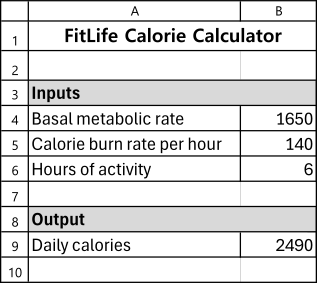
  

  1. Write down the formula used in cell B9, using appropriate grid references.   (1 mark)

    --- 2 WORK AREA LINES (style=lined) ---

  2. Jamal increases his hours of activity to 8 hours per day, while his basal metabolic rate and calorie burn rate remain the same.

    What will be Jamal's new daily calorie requirement?   (1 mark)

    --- 4 WORK AREA LINES (style=lined) ---
Show Answers Only

a.    \(=\text{B4}+ \text{B5} \ ^* \ \text{B6}\)

b.    \(2770\ \text{calories}\)

Show Worked Solution

a.   \(=\text{B4}+ \text{B5} \ ^* \ \text{B6}\)

b.    \(\text{Daily calories}=1650+140\times 8=2770\)

\(\therefore\ \text{Jamal’s new daily calorie requirement is}\ 2770.\)

Filed Under: Applications of Linear Relationships, Applications of Linear Relationships Tagged With: Band 3, smc-6256-50-Spreadsheets, smc-6513-30-Other Linear Applications, smc-6513-50-Spreadsheets, syllabus-2027

Algebra, STD2 EQ-Bank 24

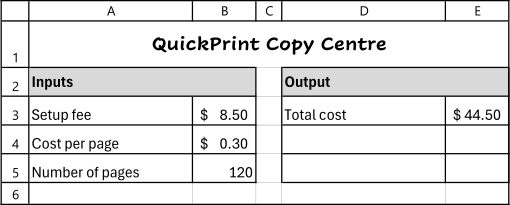
QuickPrint Copy Centre charges for printing services using the formula below.

Total cost = Setup fee + Cost per page \( \times \) Number of pages

A spreadsheet used to calculate the total cost is shown.

  1. Write down the formula used in cell E3, using appropriate grid references.   (1 mark)

    --- 2 WORK AREA LINES (style=lined) ---

  2. QuickPrint increases their cost per page to \$0.42, but keeps the setup fee unchanged. Aisha needs to print 120 pages.

    How much more will Aisha pay compared to the original pricing shown in the spreadsheet?   (2 marks)

    --- 5 WORK AREA LINES (style=lined) ---

Show Answers Only

a.    \(=\text{B3}+ \text{B4} \ ^* \ \text{B5}\)

b.    \($14.40\)

Show Worked Solution

a.   \(=\text{B3}+ \text{B4} \ ^* \ \text{B5}\)
 

b.   \(\text{Original cost from spreadsheet}:\ $44.50\)

\(\text{At increased rate}:\)

\(\text{Total cost}\ =8.50+0.42\times 120=$58.90\)

\(\text{Additional amount}\ =58.90-44.50=$14.40\)

Filed Under: Applications of Linear Relationships, Applications of Linear Relationships Tagged With: Band 3, Band 4, smc-6256-30-Other Linear Applications, smc-6256-50-Spreadsheets, smc-6513-30-Other Linear Applications, smc-6513-50-Spreadsheets, syllabus-2027

Algebra, STD2 EQ-Bank 23

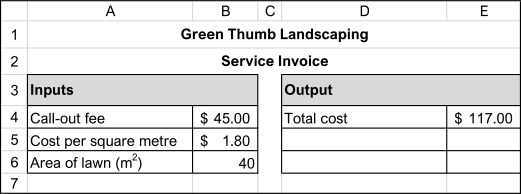
Green Thumb Landscaping charges for their lawn mowing service based on the size of the lawn.

They use the formula below to calculate the cost of each service.

Total cost = Call-out fee + Cost per square metre \( \times \) Area of lawn

The spreadsheet they provide to their clients is included below.

  1. Write down the formula that has been used in cell E4, using appropriate grid references.   (1 mark)

    --- 2 WORK AREA LINES (style=lined) ---

  2. Miguel has a lawn with a different area. The call-out fee and cost per square metre remain the same. When Miguel's lawn area is entered into the spreadsheet, the total cost shown in cell E4 becomes \$153.00.

    What is the area of Miguel's lawn?   (2 marks)

    --- 5 WORK AREA LINES (style=lined) ---

Show Answers Only

a.    \(=\text{B4}+ \text{B5} \ ^* \ \text{B6}\)

b.    \(\text{60 m}^2\)

Show Worked Solution

a.    \(=\text{B4}+ \text{B5} \ ^* \ \text{B6}\)
 

b.     \(153\) \(=45+1.8A\)
  \(108\) \(=1.8A\)
  \(A\) \(=\dfrac{108}{1.8}=60\)

 
\(\therefore\ \text{The area of Miguel’s lawn is 60 m}^2.\)

Filed Under: Applications of Linear Relationships, Applications of Linear Relationships Tagged With: Band 3, Band 4, smc-6256-30-Other Linear Applications, smc-6256-50-Spreadsheets, smc-6513-30-Other Linear Applications, smc-6513-50-Spreadsheets, syllabus-2027

Algebra, STD2 EQ-Bank 27

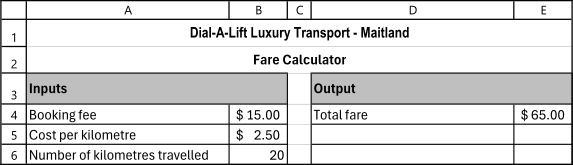
Dial-A-Lift Luxury Transport offers ride services in the local area of Maitland.

They currently use the formula below to calculate the cost of each fare.

   Total fare \(=\) Booking fee \(+\) Cost per kilometre \(\times\) Number of kilometres travelled

A spreadsheet used to calculate the total fare is shown.
 

  1. By using appropriate grid references, write down a formula that could have been used in cell E4.   (2 marks)

    --- 2 WORK AREA LINES (style=lined) ---

  2. A trip with a different number of kilometres travelled is entered, but the booking fee and cost per kilometre remain unchanged. As a result, the value in cell E4 changes to $47.50.
  3. Calculate the value entered in cell B6.   (2 marks)

    --- 5 WORK AREA LINES (style=lined) ---

Show Answers Only

a.    \(=\text{B4}+ \text{B5} \ ^* \ \text{B6}\)

b.    \(\text{Cell B6 value = 13.}\)

Show Worked Solution

a.    \(=\text{B4}+ \text{B5} \ ^* \ \text{B6}\)
 

b.     \(47.5\) \(=15+2.5 n\)
  \(32.5\) \(=2.5n\)
  \(n\) \(=\dfrac{32.5}{2.5}=13\)

 
\(\text{Cell B6 value = 13.}\)

Filed Under: Applications of Linear Relationships, Applications of Linear Relationships Tagged With: Band 4, smc-6256-20-Fuel/Transport, smc-6256-50-Spreadsheets, smc-6513-10-Fuel/Transport, smc-6513-50-Spreadsheets, syllabus-2027

Algebra, STD2 EQ-Bank 25

The following formula can be used to calculate the recommended dosage of a medicine for a child.

   Recommended dosage \(=\) base dosage \(+\) adjustment factor \(\times\) weight of child,

where the recommended dosage and base dosage are in milligrams and the weight of the child is in kilograms.

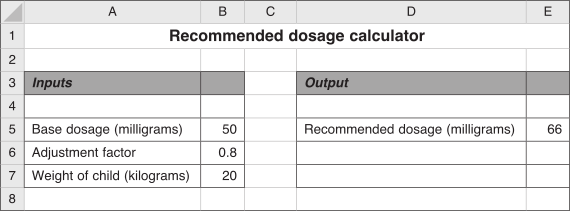
A spreadsheet used to calculate the recommended dosage is shown.
 

  1. By using appropriate grid references, write down a formula that could have been used in cell E5.   (2 marks)

    --- 2 WORK AREA LINES (style=lined) ---

  2. The weight of a different child is entered, but the base dosage and adjustment factor remain unchanged. As a result, the value in cell E5 changes to 70.
  3. Calculate the value entered in cell B7.   (2 marks)

    --- 5 WORK AREA LINES (style=lined) ---

Show Answers Only

a.    \(=\text{B5}+ \text{B6} \ ^* \ \text{B7}\)

b.    \(\text{Cell B7 value = 25.}\)

Show Worked Solution

a.    \(=\text{B5}+ \text{B6} \ ^* \ \text{B7}\)
 

b.    \(\text{Let \(w\) = weight of the child}\)

\(70\) \(=50+0.8 w\)
\(20\) \(=0.8 w\)
\(w\) \(=\dfrac{20}{0.8}=25\)

 
\(\text{Cell B7 value = 25.}\)

Filed Under: Applications of Linear Relationships, Applications of Linear Relationships Tagged With: Band 4, smc-6256-30-Other Linear Applications, smc-6256-50-Spreadsheets, smc-6513-30-Other Linear Applications, smc-6513-50-Spreadsheets, syllabus-2027

Copyright © 2014–2026 SmarterEd.com.au · Log in