SmarterEd

Aussie Maths & Science Teachers: Save your time with SmarterEd

  • Login
  • Get Help
  • About

Calculus, MET1 2024 VCAA 8

Let  \(g: R \rightarrow R, \ g(x)=\sqrt[3]{x-k}+m\),  where  \(k \in R \backslash\{0\}\)  and  \(m \in R\).

Let the point \(P\) be the \(y\)-intercept of the graph of  \(y=g(x)\).

  1. Find the coordinates of \(P\), in terms of \(k\) and \(m\).   (1 mark)

    --- 2 WORK AREA LINES (style=lined) ---

  2. Find the gradient of \(g\) at \(P\), in terms of \(k\).   (2 marks)

    --- 4 WORK AREA LINES (style=lined) ---

  3. Given that the graph of  \(y=g(x)\)  passes through the origin, express \(k\) in terms of \(m\).   (1 mark)

    --- 3 WORK AREA LINES (style=lined) ---

  4. Let the point \(Q\) be a point different from the point \(P\), such that the gradient of \(g\) at points \(P\) and \(Q\) are equal.
  5. Given that the graph of  \(y=g(x)\)  passes through the origin, find the coordinates of \(Q\) in terms of \(m\).   (3 marks)

    --- 7 WORK AREA LINES (style=lined) ---

Show Answers Only

a.    \(\bigg(0, -\sqrt[3]{k}+m\bigg)\)

b.    \(\dfrac{1}{3}(-k)^{-\frac{2}{3}}\)

c.    \(k=m^3\)

d.    \(Q(2m^3,2m)\)

Show Worked Solution

a.   \(g(0)=\sqrt[3]{0-k}+m=-\sqrt[3]{k}+m\)

\(P(0, -\sqrt[3]{k}+m)\)
 

b.   \(g(x)=\sqrt[3]{x-k}+m=(x-k)^{\frac{1}{3}}+m\)

  \(g^{\prime}(x)\) \(=\dfrac{1}{3}(x-k)^{-\frac{2}{3}}\)
  \(g^{\prime}(0)\) \(=\dfrac{1}{3}(0-k)^{-\frac{2}{3}}=\dfrac{1}{3}(-k)^{-\frac{2}{3}} =\dfrac{1}{3}(k)^{-\frac{2}{3}}\)
♦ Mean mark (b) 39%.
c.     \(\text{When }y=0:\)
     \(-\sqrt[3]{k}+m\) \(=0\)  
  \(\sqrt[3]{k}\) \(=m\)  
  \(k\) \(=m^3\)  
♦ Mean mark (c) 47%.
d.     \(g^{\prime}(x)\) \(=g^{\prime}(0)\)
  \(\dfrac{1}{3}(x-k)^{-\frac{2}{3}}\) \(=\dfrac{1}{3(-k)^{\frac{2}{3}}}\)
  \(\dfrac{1}{(x-k)^{\frac{2}{3}}}\) \(=\dfrac{1}{k^{\frac{2}{3}}}\)
  \((x-k)^{\frac{2}{3}}\) \(=k^{\frac{2}{3}}\)
  \((x-k)^2\) \(=k^2\)
  \(x-k\) \(=\pm k\)
  \(x\) \(=0, \ 2k\)
♦♦♦ Mean mark (d) 15%.

\(\text{When }x=2k:\)

\(y=(2k-k)^{\frac{1}{3}}+m=k^{\frac{1}{3}}+m=2m\ \text{(from (c))}\)

\(\therefore\ \text{Coordinates of are}\ Q(2k, 2m)\Rightarrow\ Q(2m^3,2m)\)

Filed Under: Tangents and Normals Tagged With: Band 4, Band 5, Band 6, smc-634-70-Find point of tangency

Calculus, MET1 SM-Bank 3

For the function  `f:R→R,\ \ f(x)= 2e^x + 3x`, determine the coordinates of the point  `P`  at which the tangent to  `f(x)`  is parallel to the line  `y = 5x - 3`.   (3 marks)

--- 5 WORK AREA LINES (style=lined) ---

Show Answers Only

`(0, 2)`

Show Worked Solution

`y = 5x-3\ \ =>\ m=5`

`y` `= 2e^x + 3x`
`(dy)/(dx)` `= 2e^x + 3`

  
`text(Find)\ \ x\ \ text(when)\ \ (dy)/(dx) = 5,`

`5` `= 2e^x + 3`
`2e^x` `= 2`
`e^x` `= 1`
`x` `= 0`

  
`text(When)\ \ x = 0,`

`y` `= 2e^0 + (3 xx 0)=2`

  
`:.P\ \ text{has coordinates (0, 2)}`

Filed Under: Tangents and Normals Tagged With: Band 4, smc-634-20-Log/Exp Function, smc-634-70-Find point of tangency

Calculus, MET2 2016 VCAA 2

Consider the function  `f(x) = -1/3 (x + 2) (x-1)^2.`

  1.  i. Given that  `g^{′}(x) = f (x) and g (0) = 1`,
  2.      show that  `g(x) = -x^4/12 + x^2/2-(2x)/3 + 1`.   (1 mark)

    --- 3 WORK AREA LINES (style=lined) ---

  3. ii. Find the values of `x` for which the graph of  `y = g(x)`  has a stationary point.   (1 mark)

    --- 3 WORK AREA LINES (style=lined) ---

The diagram below shows part of the graph of  `y = g(x)`, the tangent to the graph at  `x = 2`  and a straight line drawn perpendicular to the tangent to the graph at  `x = 2`. The equation of the tangent at the point `A` with coordinates  `(2, g(2))`  is  `y = 3-(4x)/3`.

The tangent cuts the `y`-axis at `B`. The line perpendicular to the tangent cuts the `y`-axis at `C`.


  1.   i. Find the coordinates of `B`.   (1 mark)

    --- 2 WORK AREA LINES (style=lined) ---

  2.  ii. Find the equation of the line that passes through `A` and `C` and, hence, find the coordinates of `C`.   (2 marks)

    --- 5 WORK AREA LINES (style=lined) ---

  3. iii. Find the area of triangle `ABC`.   (2 marks)

    --- 4 WORK AREA LINES (style=lined) ---

  4. The tangent at `D` is parallel to the tangent at `A`. It intersects the line passing through `A` and `C` at `E`.
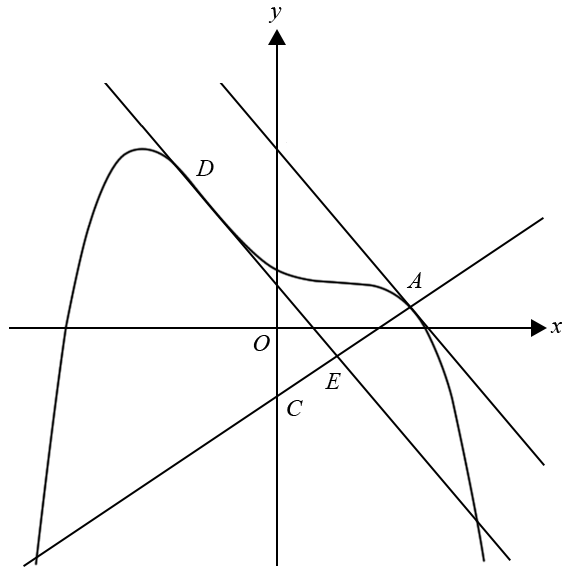


     i. Find the coordinates of `D`.   (2 marks)

    --- 4 WORK AREA LINES (style=lined) ---

  5. ii. Find the length of `AE`.   (3 marks)

    --- 6 WORK AREA LINES (style=lined) ---
Show Answers Only
  1.  i. `text(Proof)\ \ text{(See worked solutions)}`
  2. ii. `x = -2, 1`
  3.   i. `(0, 3)`
  4. ii. `y = 3/4 x-7/6`
  5.      `(0, -7/6)`
  6. iii. `25/6\ text(u²)`
  7. `(-1, 25/12)`
  8. `27/20\ text(u)`
Show Worked Solution
a.i.    `g(x)` `= int f(x)\ dx`
    `=-1/3 int (x + 2) (x-1)^2\ dx`
    `=-1/3int(x^3-3x+2)\ dx`
  `:.g(x)` `= -x^4/12 + x^2/2-(2x)/3 + c`

 
`text(S)text(ince)\ \ g(0) = 1,`

`1` `= 0 + 0-0 + c`
`:. c` `= 1`

  
`:. g(x) = -x^4/12 + x^2/2-(2x)/3 + 1\ \ …\ text(as required)`
 

a.ii.   `text(Stationary point when:)`

`g^{′}(x) = f(x) = 0`

`-1/3(x + 2) (x-1)^2=0`

`:. x = -2, 1`
 

b.i.   

`B\ text(is the)\ y text(-intercept of)\ \ y = 3-4/3 x`

`:. B (0, 3)`
 

b.ii.   `m_text(norm) = 3/4, \ text(passes through)\ \ A(2, 1/3)`

   `text(Equation of normal:)`

`y-1/3` `=3/4(x-2)`
`y` `=3/4 x-7/6`
   

`:. C (0, -7/6)`
 

b.iii.   `text(Area)` `= 1/2 xx text(base) xx text(height)`
    `= 1/2 xx (3 + 7/6) xx 2`
    `= 25/6\ text(u²)`


♦ Mean mark part (c)(i) 43%.
MARKER’S COMMENT: Many students gave an incorrect `y`-value here. Be careful!
c.i.    `text(Solve)\ \ \ g^{′}(x)` `= -4/3\ \ text(for)\ \ x < 0`
  `=> x` `= -1`
  `g(-1)` `=-1/12+1/2+2/3+1`
    `=25/12`

  
`:. D (−1, 25/12)`
 

c.ii.   `text(T) text(angent line at)\ \ D:`

`y-25/12` `=-4/3(x+1)`
`y` `=-4/3x + 3/4`

 
`DE\ \ text(intersects)\ \ AE\ text(at)\ E:`

♦♦ Mean mark 32%.
`-4/3 x + 3/4` `= 3/4 x-7/6`
`25/12 x` `= 23/12`
`x` `=23/25`

 
`:. E (23/25, -143/300)`
 

`:. AE` `= sqrt((2-23/25)^2 + (1/3-(-143/300))^2)`
  `= 27/20\ text(units)`

Filed Under: Coordinate Geometry, Curve Sketching, Tangents and Normals Tagged With: Band 3, Band 4, Band 5, smc-634-10-Polynomial, smc-634-50-Find tangent given curve, smc-634-70-Find point of tangency, smc-724-20-Degree 4, smc-727-10-Equation of line, smc-727-20-Distance

Calculus, MET2 2016 VCAA 10 MC

For the curve  `y = x^2 - 5`, the tangent to the curve will be parallel to the line connecting the positive x-intercept and the y-intercept when `x` is equal to

A.   `sqrt 5`

B.   `5`

C.   `−5`

D.   `sqrt 5/2`

E.   `1/sqrt 5`

Show Answers Only

`D`

Show Worked Solution

`text{Intercepts: (0, −5) and}\ (sqrt 5, 0)`

`text(Gradient between intercepts:)`

`m = (0 – (−5))/(sqrt 5 – 0) = 5/sqrt 5`

`text(Solve:)`

`f prime (x)` `= 5/sqrt 5`
`2x` `= 5/sqrt 5`
`:. x` `=5/(2sqrt5) xx sqrt5/sqrt5`
  `= sqrt 5/2`

 
`=>   D`

Filed Under: Tangents and Normals Tagged With: Band 4, smc-634-10-Polynomial, smc-634-70-Find point of tangency

Calculus, MET1 2015 VCAA 10

The diagram below shows a point, `T`, on a circle. The circle has radius 2 and centre at the point `C` with coordinates `(2, 0)`. The angle `ECT` is `theta`, where  `0 < theta <= pi/2`.
  

met1-2015-vcaa-q10
  

The diagram also shows the tangent to the circle at `T`. This tangent is perpendicular to `CT` and intersects the `x`-axis at point `X` and the `y`-axis at point `Y`.

  1. Find the coordinates of `T` in terms of `theta`.   (1 mark)

    --- 5 WORK AREA LINES (style=lined) ---

  2. Find the gradient of the tangent to the circle at `T` in terms of `theta`.   (1 mark)

    --- 4 WORK AREA LINES (style=lined) ---

  3. The equation of the tangent to the circle at `T` can be expressed as
  4. `qquad cos(theta)x + sin(theta)y = 2 + 2cos(theta)`
  5.  i. Point `B`, with coordinates `(2, b)`, is on the line segment `XY`.
  6.     Find `b` in terms of `theta`.   (1 mark)

    --- 3 WORK AREA LINES (style=lined) ---

  7. ii. Point `D`, with coordinates `(4, d)`, is on the line segment `XY`.
  8.     Find `d` in terms of `theta`.   (1 mark)

    --- 4 WORK AREA LINES (style=lined) ---

  9. Consider the trapezium `CEDB` with parallel sides of length `b` and `d`.
  10. Find the value of `theta` for which the area of the trapezium `CEDB` is a minimum. Also find the minimum value of the area.   (3 marks)

    --- 10 WORK AREA LINES (style=lined) ---

Show Answers Only
  1. `T(2 + 2costheta, 2 sintheta)`
  2. `(-1)/(tan(theta))`
  3.  i. `2/(sintheta)`
  4. ii. `(2-2 costheta)/(sintheta)`
  5. `theta = pi/3`
  6. `A_text(min) = 2sqrt3\ text(u²)`
Show Worked Solution
a.    `cos theta` `= (CM)/(CT)`
    `=(CM)/2`
  `CM` `= 2costheta`
♦♦♦ Part (a) mean mark 20%.
MARKER’S COMMENT: Many students did not include the “+2” in the `x`-coordinate.
`sintheta` `= (TM)/2`
`TM` `= 2sintheta`


`:. T\ text(has coordinates)\ \ (2 + 2costheta, 2 sintheta)`


♦♦♦ Part (b) mean mark 16%.
b.    `m_(CT)` `=(TM)/(CM)`
    `=(2 sin theta)/(2 cos theta)`
    `=tan theta`
     
  `:.m_(XY)` `=-1/tan theta,\ \ \ (CT ⊥ XY)`


c.i.   `text(Substitute)\ \ (2,b)\ \ text(into equation:)`

`2costheta + bsintheta` `= 2 + 2costheta`
`:. b` `= 2/(sintheta)`


c.ii.   `text(Substitute)\ \ (4,d)\ \ text(into equation:)`

♦ Part (c)(ii) mean mark 47%.
`4costheta + dsintheta` `= 2 + 2costheta`
`d sin theta` `=2-cos theta`
`:.d`  `= (2-2 costheta)/(sintheta)`


♦♦♦ Part (d) mean mark 19%.
d.    `text(A)_text(trap)` `= 1/2 xx 2 xx (b + d)`
    `= 2/(sintheta) + (2-2costheta)/(sintheta)`
    `= (4-2costheta)/(sintheta)`


`text(Stationary point when)\ \ (dA)/(d theta)=0`

`(2sin^2theta-costheta(4-2costheta))/(sin^2theta)` `= 0`
`2sin^2theta-4costheta + 2cos^2theta` `= 0`
`2[sin^2theta + cos^2theta]-4costheta` `= 0`
`2-4costheta` `= 0`
`costheta` `= 1/2`
`theta` `= pi/3,\ \ \ \ theta ∈ (0, pi/2)`


`A(pi/3)` `= (4-2(1/2))/(sqrt3/2)`
  `=3 xx 2/sqrt3`
  `= 2sqrt3`


`:. A_text(min) = 2sqrt3\ text(u²)`

Filed Under: Maxima and Minima, Tangents and Normals Tagged With: Band 4, Band 5, Band 6, smc-634-30-Trig Function, smc-634-70-Find point of tangency, smc-641-10-Area

Copyright © 2014–2025 SmarterEd.com.au · Log in