SmarterEd

Aussie Maths & Science Teachers: Save your time with SmarterEd

  • Login
  • Get Help
  • About

Probability, MET2 2023 SM-Bank 4 MC

The probability density function \(f\) of a random variable \(X\) is given by

\(f(x)= \begin{cases}\dfrac{x+1}{20} & 0 \leq x<4 \\ \dfrac{36-5 x}{64} & 4 \leq x \leq 7.2 \\ 0 & \text {elsewhere}\end{cases}\)

The value of \(a\) such that \(\text{Pr}(X \leq a)=\dfrac{5}{8}\) is

  1. \(\dfrac{4(\sqrt{15}-9)}{5}\)
  2. \(\sqrt{26}-1\)
  3. \(\dfrac{36-4 \sqrt{15}}{5}\)
  4. \(\dfrac{4 \sqrt{15}+9}{5}\)
  5. \(\dfrac{4 \sqrt{15}+36}{5}\)
Show Answers Only


Show Worked Solution

\(\text{Using CAS:}\)
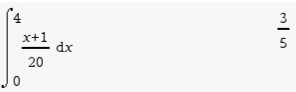
\(\displaystyle \int_{0}^{4}\dfrac{x+1}{20}\,dx =\dfrac{3}{5}<\dfrac{5}{8}\)

\(\therefore\ \text{Pr}(0\leq X<4)+\text{Pr}(4\leq X<a)=\dfrac{5}{8}\)

\(\rightarrow\quad\) \(\dfrac{3}{5}+\displaystyle \int_{4}^{a}\dfrac{36-5x}{64}\,dx\)  \(=\dfrac{5}{8}\)
  \(\displaystyle \int_{4}^{a}\dfrac{36-5x}{64}\,dx\) \(=\dfrac{5}{8}-\dfrac{3}{5}=\dfrac{1}{40}\)
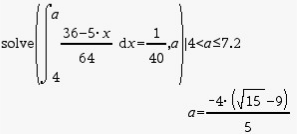
  \(\therefore\ \text{from CAS:}\quad \ a\)

\(=\dfrac{-4\Big(\sqrt{15}-9\Big)}{5}\)


\(=\dfrac{36-4\sqrt{15}}{5}\)

  
\(\text{Using CAS:}\)

  
\(\Rightarrow C\)

Filed Under: Probability density functions Tagged With: Band 4, smc-637-50-Linear PDF

Probability, MET2 2023 VCAA 10 MC

A continuous random variable \(X\) has the following probability density function
 

\(g(x) = \begin {cases}
\dfrac{x-1}{20}         &\ \ 1 \leq x < 6 \\
\\
\dfrac{9-x}{12}         &\ \ 6 \leq x < 9 \\
\\ 0 &\ \ \ \text{elsewhere}
\end{cases}\)
 

The value of \(k\) such that  \(\text{Pr}(X<k)=0.35\)  is

  1. \(\sqrt{14}-1\)
  2. \(\sqrt{14}+1\)
  3. \(\sqrt{15}-1\)
  4. \(\sqrt{15}+1\)
  5. \(1-\sqrt{15}\)
Show Answers Only

\(B\)

Show Worked Solution

\(\displaystyle \int_{1}^{6} \dfrac{x-1}{20}\,dx=0.625>0.35\)

\(\therefore\ k\ \text{lies between 1 and 6 so solve for interval }1\leq x\leq k\)
 

\(\text{Solve for}\ k\ \text{(by CAS)}:\)

\(\displaystyle \int_{1}^{k} \dfrac{x-1}{20}\,dx=0.35\ \ \Rightarrow \ \ k=\sqrt{14}+1\)

\(\Rightarrow B\)

Filed Under: Probability density functions Tagged With: Band 4, smc-637-50-Linear PDF

Probability, MET2 2021 VCAA 4

A teacher coaches their school's table tennis team.

The teacher has an adjustable ball machine that they use to help the players practise.

The speed, measured in metres per second, of the balls shot by the ball machine is a normally distributed random variable `W`.

The teacher sets the ball machine with a mean speed of 10 metres per second and standard deviation of 0.8 metres per second.

  1. Determine  `text(Pr) (W ≥11)`, correct to three decimal places.   (1 mark)

    --- 3 WORK AREA LINES (style=lined) ---

  2. Find the value of `k`, in metres per second, which 80% of ball speeds are below. Give your answer in metres per second, correct to one decimal place.   (1 mark) 

    --- 1 WORK AREA LINES (style=lined) ---

The teacher adjusts the height setting for the ball machine. The machine now shoots balls high above the table tennis table.

Unfortunately, with the new height setting, 8% of balls do not land on the table.

Let  `overset^P`  be the random variable representing the sample proportion of the balls that do not land on the table in random samples of 25 balls.

  1. Find the mean and the standard deviation of  `overset^P`.   (2 marks)

    --- 2 WORK AREA LINES (style=lined) ---

  2. Use the binomial distribution to find  `text(Pr) (overset^P > 0.1)`, correct to three decimal places.   (2 marks) 

    --- 5 WORK AREA LINES (style=lined) ---

The teacher can also adjust the spin setting on the ball machine.

The spin, measured in revolutions per second, is a continuous random variable  `X` with the probability density function
 

       `f(x) = {(x/500, 0 <= x < 20), ({50-x}/{750}, 20 <= x <= 50), (\ 0, text(elsewhere)):}`
 

  1. Find the maximum possible spin applied by the ball machine, in revolutions per second.   (1 mark)

    --- 1 WORK AREA LINES (style=lined) ---

Show Answers Only

  1. `0.106`
  2. `0.8`
  3. `sqrt46/125`
  4. `0.323`
  5. `50 \ text{revolutions per second}`
  6. This content is no longer in the Study Design.
  7. This content is no longer in the Study Design.
  8. This content is no longer in the Study Design.

Show Worked Solution

a.   `W\ ~\ N (10,0.8^2)`

`text{By CAS: norm Cdf} \ (11, ∞, 10, 0.8)`

`text(Pr) (W >= 11) = 0.106`
 

b.    `text(Pr) (W < k) = 0.8 \ \ \ text{By CAS: inv Norm} \ (0.8, 10, 0.8)`
 

c.    `E(overset^P) =  0.08 = 2/25`

♦ Mean mark part (c) 45%.

`text(s.d.) (overset^P) = sqrt{{0.08 xx 0.92}/{25}} = sqrt46/125`
 

d.    `X\ ~\ text(Bi) (25, 0.08)`

♦ Mean mark part (d) 49%.

`text{By CAS: binomCdf} \ (25, 0.08, 3, 25)`

`text(Pr) (overset^P > 0.1)` `= text(Pr) (X > 0.1 xx 25)`
  `= text(Pr) (X > 2.5)`
  `= text(Pr) (X >= 3)`
  `= 0.323`


e.    `text{Maximum spin = 50 revolutions per second}`

♦♦ Mean mark part (e) 21%.


f.    This content is no longer in the Study Design.

g.    This content is no longer in the Study Design.

h.    This content is no longer in the Study Design.

Filed Under: Binomial, Probability density functions Tagged With: Band 4, Band 5, Band 6, smc-637-30-Var(X), smc-637-50-Linear PDF, smc-638-20-binomCdf (CAS), smc-719-10-Single z-score

Probability, MET2 2017 VCAA 3

The time Jennifer spends on her homework each day varies, but she does some homework every day.

The continuous random variable `T`, which models the time, `t,` in minutes, that Jennifer spends each day on her homework, has a probability density function `f`, where


`f(t) = {{:(1/625 (t - 20)),(1/625 (70 - t)),(0):}qquad{:(20 <= t < 45),(45 <= t <= 70),(text(elsewhere)):}:}`


  1. Sketch the graph of `f` on the axes provided below.  (3 marks)

    --- 0 WORK AREA LINES (style=lined) ---


  2. Find  `text(Pr)(25 ≤ T ≤ 55)`.  (2 marks)

    --- 3 WORK AREA LINES (style=lined) ---

  3. Find  `text(Pr)(T ≤ 25 | T ≤ 55)`.  (2 marks)

    --- 5 WORK AREA LINES (style=lined) ---

  4. Find `a` such that  `text(Pr)(T ≥ a) = 0.7`, correct to four decimal places.  (2 marks)

    --- 5 WORK AREA LINES (style=lined) ---

  5. The probability that Jennifer spends more than 50 minutes on her homework on any given day is `8/25`. Assume that the amount of time spent on her homework on any day is independent of the time spent on her homework on any other day.


    1. Find the probability that Jennifer spends more than 50 minutes on her homework on more than three of seven randomly chosen days, correct to four decimal places.  (2 marks)

      --- 3 WORK AREA LINES (style=lined) ---

    2. Find the probability that Jennifer spends more than 50 minutes on her homework on at least two of seven randomly chosen days, given that she spends more than 50 minutes on her homework on at least one of those days, correct to four decimal places.  (2 marks)

      --- 3 WORK AREA LINES (style=lined) ---

Let `p` be the probability that on any given day Jennifer spends more than `d` minutes on her homework.

Let `q` be the probability that on two or three days out of seven randomly chosen days she spends more than `d` minutes on her homework.

  1. Express `q` as a polynomial in terms of `p`.  (2 marks)

    --- 6 WORK AREA LINES (style=lined) ---

    1. Find the maximum value of `q`, correct to four decimal places, and the value of `p` for which this maximum occurs, correct to four decimal places.  (2 marks)

      --- 3 WORK AREA LINES (style=lined) ---

    2. Find the value of `d` for which the maximum found in part g.i. occurs, correct to the nearest minute.  (2 marks)

      --- 5 WORK AREA LINES (style=lined) ---


Show Answers Only

  1.  

  2. `4/5`
  3. `1/41`
  4. `39.3649`
    1. `0.1534`
    2. `0.7626`
  5. `q =7p^2(1-p)^4(2p+3)`
    1. `p = 0.3539quadtext(and)quadq = 0.5665`
    2. `49\ text(min)`

Show Worked Solution

a.   

MARKER’S COMMENT: Many did not draw graph along `t`-axis between 0 and 20 and for  `t>70`.


b.   `text(Pr)(25 <= T <= 55)`

`= int_25^45 1/625 (t – 20)\ dt + int_45^55 1/625 (70 – t)\ dt`

`= 4/5`


c.   `text(Pr)(T ≤ 25 | T ≤ 55)`

`=(text(Pr)(T <= 25))/(text(Pr)( T <= 55))`

`= (int_20^25 1/625(t – 20)\ dt)/(1 – int_55^70 1/625(70 – t)\ dt)`

`= (1/50)/(1 – 9/50)`

`= 1/41`


d.   `text(Pr)(T ≥ a) = 0.7`

♦ Mean mark part (d) 36%.

`=>\ text(Pr)(T <= a) = 0.3`

`text(Solve:)`

`int_20^a 1/625(t – 20)\ dt` `= 0.3quadtext(for)quada ∈ (20, 45)`


`:. a == 39.3649`


e.i.   `text(Let)\ X =\ text(Number of days Jenn studies more than 50 min)`

`X ~\ text(Bi) (7, 8/25)`

`text(Pr)(X >= 4) = 0.1534`


e.ii.    `text(Pr)(X >= 2 | X >= 1)` `= (text(Pr)(X >= 2))/(text(Pr)(X >= 1))`
    `= (0.7113…)/(0.9327…)`
    `= 0.7626\ \ text{(to 4 d.p.)}`


f.   `text(Let)\ Y =\ text(Number of days Jenn spends more than)\ d\ text(min)`

`Y ~\ text(Bi)(7,p)`

♦ Mean mark part (f) 36%.

`q` `= text(Pr)(Y = 2) + text(Pr)(Y = 3)`
  `= ((7),(2))p^2(1 – p)^5 + ((7),(3))p^3(1 – p)^4`
  `= 21p^2(1 – p)^5 + 35p^3(1 – p)^4`
   `=7p^2(1-p)^4[3(1-p)+5p]`
  `=7p^2(1-p)^4(2p+3)`


g.i.   `text(Solve)\ \ q′(p) = 0,`

♦♦ Mean mark part (g)(i) 30%.

`p` `=0.35388…`
  `=0.3539\ \ text{(to 4 d.p.)}`

`:. q_text(max)= 0.5665\ \ text{(to 4 d.p.)}`


g.ii.   `text(Pr)(T > d) = p= 0.35388…`

♦♦♦ Mean mark part (g)(ii) 8%.

  `text(Solve:)`

`int_d^70 (1/625(70 – t))dt` `= 0.35388… quadtext(for)quadd ∈ (45,70)`


`:. d` `=48.967…`
  `=49\ text(mins)`

Filed Under: Binomial, Probability density functions Tagged With: Band 4, Band 5, Band 6, smc-637-40-Conditional probability, smc-637-45-Other probability, smc-637-50-Linear PDF, smc-638-20-binomCdf (CAS), smc-638-50-Conditional

Probability, MET1 2012 VCAA 8b

The probability density function `f` of a random variable `X` is given by
 

`qquad qquad f(x) = {((x + 1)/12, 0 <= x <= 4), (\ \ 0, text{otherwise}):}`
 

Find the value of `b` such that  `text(Pr) (X <= b) = 5/8.`  (3 marks)

Show Answers Only

`3`

Show Worked Solution
`1/12 int_0^b (x + 1)\ dx` `= 5/8`
`[1/2 x^2 + x]_0^b` `= 15/2`
`1/2b^2 + b` `= 15/2`
`b^2 + 2b – 15` `= 0`
`(b + 5) (b – 3)` `= 0`


`:. b = 3,\ \ \ b in (0, 4)`

Filed Under: Probability density functions Tagged With: Band 4, smc-637-45-Other probability, smc-637-50-Linear PDF

Probability, MET2 2007 VCAA 16 MC

If a random variable `X` has probability density function
 

`f(x) = {(x/2, if x in[0,2]), (0,\ \ \ text(otherwise)):}`
 

then  `text(E) (X)`  is equal to

  1. `1/2`
  2. `1`
  3. `4/3`
  4. `2/3`
  5. `2`
Show Answers Only

`C`

Show Worked Solution
`text(E) (X)` `= int_0^2 x (x/2)\ dx`
  `=[x^3/6]_0^2`
  `= 4/3`

 
`=>   C`

Filed Under: Probability density functions Tagged With: Band 4, smc-637-10-E(X), smc-637-50-Linear PDF

Probability, MET1 2006 VCAA 6

The probability density function of a continuous random variable `X` is given by
 

`f(x) = {(x/12,\ \ 1 <= x <= 5), (\ 0,\ \  text(otherwise)):}`
 

  1. Find  `text(Pr) (X < 3)`  (2 marks)

    --- 5 WORK AREA LINES (style=lined) ---

  2. If  `text(Pr) (X >= a) = 5/8`, find the value of `a`.  (2 marks)

    --- 5 WORK AREA LINES (style=lined) ---

Show Answers Only

  1. `1/3`
  2. `sqrt 10`

Show Worked Solution

a.   `text(Pr) (X < 3)`

`= int_1^3 1/12x\ dx`

`= 1/12 [1/2 x^2]_1^3`

`= 1/24 [3^2 – 1^2]`

`= 1/3`


b.   `text(Pr) (X >= a) = 5/8`

♦ Mean mark 47%.

`int_a^5 x/12\ dx` `= 5/8`
`1/24 [x^2]_a^5` `= 5/8`
`(5^2 – a^2)` `= 15`
`a^2` `= 10`
`:. a` `= sqrt 10,\ \ \ a in (1, 5)`

Filed Under: Probability density functions Tagged With: Band 4, Band 5, smc-637-45-Other probability, smc-637-50-Linear PDF

Copyright © 2014–2025 SmarterEd.com.au · Log in