SmarterEd

Aussie Maths & Science Teachers: Save your time with SmarterEd

  • Login
  • Get Help
  • About

Probability, MET1 2024 VCAA 4

Let \(X\) be a binomial random variable where  \(X \sim \operatorname{Bi}\left(4, \dfrac{9}{10}\right)\).

  1. Find the standard deviation of \(X\).   (1 mark)

    --- 4 WORK AREA LINES (style=lined) ---

  2. Find  \(\operatorname{Pr}(X<2)\).   (2 marks)

    --- 8 WORK AREA LINES (style=lined) ---

Show Answers Only

a.    \(\operatorname{sd}(X)=\dfrac{3}{5}\)

b.    \(\dfrac{37}{10\,000}\)

Show Worked Solution

a.     \(\operatorname{sd}(X)\) \(=\sqrt{np(1-p)}\)
    \(=\sqrt{4\times\dfrac{9}{10}\times\dfrac{1}{10}}\)
    \(=\sqrt{\dfrac{36}{100}}\)
    \(=\dfrac{3}{5}\)


b.     \(\operatorname{Pr}(X<2)\) \(=\operatorname{Pr}(X=0)+\operatorname{Pr}(X=1)\)
    \(=\ ^4C _0\left(\dfrac{9}{10}\right)^0\left(\dfrac{1}{10}\right)^4+\ ^4C_1\left(\dfrac{9}{10}\right)^1\left(\dfrac{1}{10}\right)^3\)
    \(= 1 \times \dfrac {1}{10\,000} + 4 \times \dfrac{9}{10} \times \dfrac{1}{1000}\)
    \(=\dfrac{37}{10\,000}\)
Mean mark (b) 51%.

Filed Under: Binomial Tagged With: Band 4, Band 5, smc-638-10-binomial expansion (non-calc), smc-638-32-Find E(X)/var(X) given n p

Probability, MET1 2022 VCAA 4

A card is drawn from a deck of red and blue cards. After verifying the colour, the card is replaced in the deck. This is performed four times.

Each card has a probability of `\frac{1}{2}` of being red and a probability of `\frac{1}{2}` of being blue.

The colour of any drawn card is independent of the colour of any other drawn card.

Let `X` be a random variable describing the number of blue cards drawn from the deck, in any order.

  1. Complete the table below by giving the probability of each outcome.   (2 marks)

     

--- 0 WORK AREA LINES (style=lined) ---

  1. Given that the first card drawn is blue, find the probability that exactly two of the next three cards drawn will be red.  (1 mark)

    --- 2 WORK AREA LINES (style=lined) ---

  2. The deck is changed so that the probability of a card being red is `\frac{2}{3}` and the probability of a card being blue is `\frac{1}{3}`.
  3. Given that the first card drawn is blue, find the probability that exactly two of the next three cards drawn will be red.   (2 marks)

    --- 4 WORK AREA LINES (style=lined) ---

Show Answers Only

a.   Complete table

\begin{array} {|c|c|c|c|c|c|}
\hline x & 0 & 1 & 2 & 3 & 4 \\
\hline {Pr}(X=x) & 1/16 & 4/16 & 6/16 & 4/16 & 1/16 \\
\hline \end{array}

b.    `3/8`

c.    `4/9`

Show Worked Solution

a.   Using binomial distribution where `n=4` and  `p= 1/2`

`text{Pr}(X=1)` `=\ ^4 C_1*(1/2)^1*(1/2)^3 = 4*1/2*1/8` `=4/16`
`text{Pr}(X=3)` `=\ ^4 C_3*(1/2)^3*(1/2)^1= 4*1/8*1/2` `=4/16`
`text{Pr}(X=4)` `=\ ^4 C_4*(1/2)^4*(1/2)^0= 1*1/16*1` `=1/16`

\begin{array} {|c|c|c|c|c|c|}
\hline x & 0 & 1 & 2 & 3 & 4 \\
\hline {Pr}(X=x) & 1/16 & 4/16 & 6/16 & 4/16 & 1/16 \\
\hline \end{array}

b.   Trials are independent of first trial.

Binomial where `n=3, p=1/2`

`text{Pr}(X=2) = \ ^3 C_2*(1/2)^2*(1/2)^1 = 3*1/8 = 3/8`


♦♦ Mean mark (b) 40%.

c.   Trials are independent.

Binomial where `n=3, p=2/3`

`text{Pr}(X=2) = \ ^3 C_2*(2/3)^2*(1/3)^1 = 3*4/9*1/3 = 4/9`


♦ Mean mark 55%.
MARKER’S COMMENT: Many students wrongly treated this question as conditional probability.

Filed Under: Binomial Tagged With: Band 4, Band 5, smc-638-10-binomial expansion (non-calc), smc-638-50-Conditional

Probability, MET2 2020 VCAA 19 MC

Shown below is the graph of `p`, which is the probability function for the number of times, `x`, that a ' 6 ' is rolled on a fair six-sided die in 20 trials.
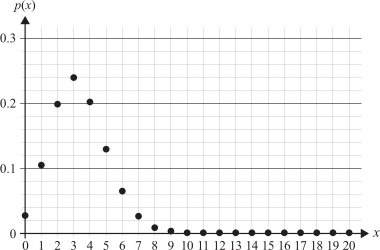


Let `q` be the probability function for the number of times, `w`, that a ' 6 ' is not rolled on a fair six-sided die in 20 trials. `q(w)` is given by

  1. `p(20-w)`
  2. `p(1-(w)/( 20))`
  3. `p((w)/( 20))`
  4. `p(w-20)`
  5. `1-p(w)`
Show Answers Only

`A`

Show Worked Solution

`q∼text(Bi)(20,(5)/(6)),quad p∼text(Bi)(20,(1)/(6))`

♦ Mean mark 45%.

`q(19)=([20],[19])((5)/(6))^(19)((1)/(6))=p(1)=([20],[1])((1)/(6))((5)/(6))^(19)`

`q(18)=([20],[18])((5)/(6))^(18)((1)/(6))^(2)=p(2)=([20],[2])((1)/(6))^(2)((5)/(6))^(18)`

`text(Generally,)`

`g(w)=([20],[w])((5)/(6))^(w)((1)/(6))^(20-w)=p(20-w)=([20],[20-w])((1)/(6))^(20-w)((5)/(6))^(w)`

`q(w)=p(20-w)`

`=>A`

Filed Under: Binomial Tagged With: Band 6, smc-638-10-binomial expansion (non-calc), smc-638-40-Graph

Probability, MET1 2020 VCAA 5

For a certain population the probability of a person being born with the specific gene SPGE1 is `3/5`.

The probability of a person having this gene is independent of any other person in the population having this gene.

  1. In a randomly selected group of four people, what is the probability that three or more people have the SPGE1 gene?  (2 marks)

    --- 5 WORK AREA LINES (style=lined) ---

  2. In a randomly selected group of four people, what is the probability that exactly two people have the SPGE1 gene, given that at least one of those people has the SPGE1 gene? Express your answer in the form  `(a^3)/(b^4 - c^4)`, where, `a, b, c ∈ Z^+`.  (2 marks)

    --- 5 WORK AREA LINES (style=lined) ---

Show Answers Only

  1. `297/625`
  2. `(6^3)/(5^4 – 2^4)`

Show Worked Solution

a.   `text(Let)\ \ X =\ text(number of people with gene)`

`X\ ~\ text(Bi) (4, 3/5)`

`P(X >= 3)` `= P(X = 3) + P(X = 4)`
  `= \ ^4C_3(3/5)^3(2/5) + \ ^4C_4(3/5)^4`
  `= (4 xx 27 xx 2)/625 + 81/625`
  `= 297/625`


b.    `P(X = 2 | X >= 1)` `= (P(X = 2))/(1 – P(X = 0))`
    `= (\ ^4C_2(3/5)^2(2/5)^2)/(1 – (2/5)^4)`
    `= (6 xx (6^2)/(5^4))/((5^4 – 2^4)/(5^4))`
    `= (6^3)/(5^4 – 2^4)`

Filed Under: Binomial Tagged With: Band 4, smc-638-10-binomial expansion (non-calc), smc-638-50-Conditional

Probability, MET1-NHT 2019 VCAA 8

A fair standard die is rolled 50 times. Let `W` be a random variable with binomial distribution that represents the number of times the face with a six on it appears uppermost.

  1. Write down the expression for  `text(Pr)(W = k)`, where  `k in {0, 1, 2, …, 50}`.  (1 mark)

    --- 1 WORK AREA LINES (style=lined) ---

  2. Show that  `(text(Pr)(W = k + 1))/(text(Pr)(W = k)) = (50 - k)/(5(k + 1))`.  (2 marks)

    --- 4 WORK AREA LINES (style=lined) ---

  3. Hence, or otherwise, find the value of `k` for which  `text(Pr)(W = k)`  is the greatest.  (2 marks)

    --- 5 WORK AREA LINES (style=lined) ---

Show Answers Only

  1. `\ ^50 C_k ⋅ (1/6)^k ⋅ (5/6)^(50 – k)`
  2. `text(Proof)\ \ text{(See Worked Solutions)}`
  3. `8`

Show Worked Solution

a.  `text(Pr)(W = k) = \ ^50 C_k ⋅ (1/6)^k ⋅ (5/6)^(50 – k)`


b.   `(text(Pr)(W = k + 1))/(text(Pr)(W = k))` `= (\ ^50C_(k+1) ⋅ (1/6)^(k+1) ⋅ (5/6)^(49 – k))/(\ ^ 50C_k ⋅ (1/6)^k ⋅ (5/6)^(50-k))`
    `= ((50!)/((49 – k)!(k + 1)!) ⋅ (1/6))/((50!)/((50 – k)! k!) ⋅ (5/6))`
    `= ((50 – k)!k!)/(5(49 – k)!(k + 1)!)`
    `= (50 – k)/(5(k + 1))`


c.  `text(Find)\ k\ text(such that)`

`text(Pr)(W = k + 1)` `< text(Pr)(W = k)`
`50 – k` `< 5(k + 1)`
`6k` `> 45`
`k` `> 7 1/2`

 
`=> text(Pr)(W = 8) > text(Pr)(W = 9)`

`=> text(Pr)(W = 9) > text(Pr)(W = 10)\ …`

`:. text(Pr)(W = 8)\ text(is the greatest.)`

Filed Under: Binomial Tagged With: Band 4, Band 5, smc-638-10-binomial expansion (non-calc)

Probability, MET1 2016 VCAA 4

A paddock contains 10 tagged sheep and 20 untagged sheep. Four times each day, one sheep is selected at random from the paddock, placed in an observation area and studied, and then returned to the paddock.

  1. What is the probability that the number of tagged sheep selected on a given day is zero?  (1 mark)

    --- 4 WORK AREA LINES (style=lined) ---

  2. What is the probability that at least one tagged sheep is selected on a given day?  (1 mark)

    --- 4 WORK AREA LINES (style=lined) ---

  3. What is the probability that no tagged sheep are selected on each of six consecutive days?
  4. Express your answer in the form `(a/b)^c`, where `a`, `b` and `c` are positive integers.  (1 mark)

    --- 4 WORK AREA LINES (style=lined) ---

Show Answers Only

  1. `16/81`
  2. `65/81`
  3. `(2/3)^24`

Show Worked Solution

a.   `text(Let)\ \ X =\ text(Number of tagged sheep,)`

`X ~\ text(Bi)(4,1/3)`

`text(Pr)(X = 0)` `= ((4),(0)) xx (1/3)^0 xx (2/3)^4`
  `= 16/81`


b.    `text(Pr)(X >= 1)` `= 1 – text(Pr)(X = 0)`
    `= 1 – 16/81`
    `= 65/81`


c.   `text(Let)\ \ Y =\ text(Days that no tagged sheep selected,)`

`Y ~\ text(Bi)(6,16/81)`

`text(Pr)(Y = 6)` `= ((6),(6)) xx (16/81)^6 xx (65/81)^0`
  `= (16/81)^6 = (2/3)^24`

Filed Under: Binomial Tagged With: Band 4, smc-638-10-binomial expansion (non-calc)

Probability, MET2 2011 VCAA 2*

In a chocolate factory the material for making each chocolate is sent to one of two machines, machine A or machine B.

The time, `X` seconds, taken to produce a chocolate by machine A, is normally distributed with mean 3 and standard deviation 0.8.

The time, `Y` seconds, taken to produce a chocolate by machine B, has the following probability density function
 

`f(y) = {{:(0,y < 0),(y/16,0 <= y <= 4),(0.25e^(−0.5(y-4)),y > 4):}`
 

  1. Find correct to four decimal places

    1. `text(Pr)(3 <= X <= 5)`   (1 mark)

      --- 3 WORK AREA LINES (style=lined) ---

    2. `text(Pr)(3 <= Y <= 5)`   (3 marks)

      --- 3 WORK AREA LINES (style=lined) ---

  2. Find the mean of `Y`, correct to three decimal places.   (3 marks)

    --- 5 WORK AREA LINES (style=lined) ---

  3. It can be shown that  `text(Pr)(Y <= 3) = 9/32`. A random sample of 10 chocolates produced by machine B is chosen. Find the probability, correct to four decimal places, that exactly 4 of these 10 chocolate took 3 or less seconds to produce.   (2 marks)

    --- 5 WORK AREA LINES (style=lined) ---

All of the chocolates produced by machine A and machine B are stored in a large bin. There is an equal number of chocolates from each machine in the bin.

It is found that if a chocolate, produced by either machine, takes longer than 3 seconds to produce then it can easily be identified by its darker colour.

  1. A chocolate is selected at random from the bin. It is found to have taken longer than 3 seconds to produce.
  2. Find, correct to four decimal places, the probability that it was produced by machine A.   (3 marks)

    --- 6 WORK AREA LINES (style=lined) ---

Show Answers Only

a.i.  `0.4938`

a.ii. `0.4155`

b.    `4.333`

c.    `0.1812`

d.    `0.4103`

Show Worked Solution

a.i.   `X ∼\ N(3,0.8^2)`

`text(Pr)(3 <= X <= 5) = 0.4938\ \ text{(4 d.p.)}`


a.ii.    `text(Pr)(3 <= Y <= 5)` `= text(Pr)(3 <= Y <= 4) + (4 < Y <= 5)`
    `= int_3^4 (y/16)dy + int_4^5(1/4 e^(−1/2(y-4)))dy`
    `= 0.4155\ \ text{(4 d.p.)}`


b.    `text(E)(Y)` `= int_0^4 y(y/16)dy + int_4^∞ 0.25ye^(−1/2(y-4))dy`
    `= 4.333\ \ text{(3 d.p.)}`


c.   `text(Solution 1)`

`text(Let)\ \ W = #\ text(chocolates from)\ B\ text(that take less)`

`text(than 3 seconds)`

`W ∼\ text(Bi)(10, 9/32)`

`text(Using CAS: binomPdf)(10, 9/32,4)`

`text(Pr)(W = 4) = 0.1812\ \ text{(4 d.p.)}`
 

`text(Solution 2)`

`text(Pr)(W = 4)`  `=((10),(4)) (9/32)^4 (23/32)^6` 
  `=0.1812`

♦♦♦ Mean mark part (e) 19%.
MARKER’S COMMENT: Students who used tree diagrams were the most successful.


d.   
`text(Pr)(A | L)` `= (text(Pr)(AL))/(text(Pr)(L))`
  `= (0.5 xx 0.5)/(0.5 xx 0.5 + 0.5 xx 23/32)`
  `= 0.4103\ \ text{(4 d.p.)}`

Filed Under: Binomial, Conditional Probability and Set Notation, Normal Distribution, Probability density functions Tagged With: Band 4, Band 5, Band 6, smc-2736-10-Conditional probability, smc-637-10-E(X), smc-637-45-Other probability, smc-637-70-Exp/Log PDF, smc-638-10-binomial expansion (non-calc), smc-638-20-binomCdf (CAS), smc-646-20-Multi-stage events, smc-719-10-Single z-score, smc-719-30-Other z-score intervals

Probability, MET1 2007 VCAA 5

It is known that 50% of the customers who enter a restaurant order a cup of coffee. If four customers enter the restaurant, what is the probability that more than two of these customers order coffee? (Assume that what any customer orders is independent of what any other customer orders.)  (2 marks)

Show Answers Only

`text(Pr)(X > 2) = 5/16`

Show Worked Solution
`text(Pr)(X > 2)` `= text(Pr)(X = 3) + text(Pr)(X = 4)`
  `= ((4),(3))(1/2)^3(1/2) + ((4),(4))(1/2)^4(1/2)^0`
  `= 4 xx 1/16 + 1 xx 1/16` 
♦ Mean mark 41%.
MARKER’S COMMENT: Notation was often poor and confused. Common error: evaluating co-efficients.


`:. text(Pr)(X > 2) = 5/16`


Filed Under: Binomial Tagged With: Band 5, smc-638-10-binomial expansion (non-calc)

Probability, MET1 2011 VCAA 7

A biased coin tossed three times. The probability of a head from a toss of this coin is `p.`

  1. Find, in terms of `p`, the probability of obtaining

    1. three heads from the three tosses  (1 mark)

      --- 2 WORK AREA LINES (style=lined) ---

    2. two heads and a tail from the three tosses.  (1 mark)

      --- 2 WORK AREA LINES (style=lined) ---

  2. If the probability of obtaining three heads equals the probability of obtaining two heads and a tail, find `p`.  (2 marks)

    --- 5 WORK AREA LINES (style=lined) ---

Show Answers Only

    1. `p^3`
    2. `3p^2 (1 – p)`
  1. `0 or 3/4`

Show Worked Solution

a.i.    `text(Pr) (HHH)` `= p xx p xx p`
    `= p^3`


  ii.   `text(Pr) text{(2 Heads and 1 Tail from 3 tosses)}`

♦ Part (a)(ii) mean mark 41%.

`= ((3), (2)) xx p xx p xx (1 – p)`

`= 3 p^2 (1 – p)`


b.   `text(If probabilities are equal:)`

♦ Mean mark 48%.
MARKER’S COMMENT: Many students incorrectly assumed `p` could not be zero.

`p^3` `= 3p^2 – 3p^3`
`4p^3 – 3p^2` `= 0`
`p^2 (4p – 3)` `= 0`

`:. p = 0 or p = 3/4`

Filed Under: Binomial Tagged With: Band 4, Band 5, smc-638-10-binomial expansion (non-calc)

Copyright © 2014–2025 SmarterEd.com.au · Log in