A fair six-sided die is repeatedly rolled. What is the minimum number of rolls required so that the probability of rolling a six at least once is greater than 0.95 ?
- 15
- 16
- 17
- 18
Aussie Maths & Science Teachers: Save your time with SmarterEd
A fair six-sided die is repeatedly rolled. What is the minimum number of rolls required so that the probability of rolling a six at least once is greater than 0.95 ?
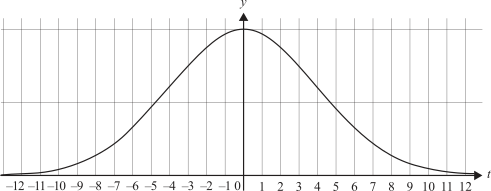
A transport company has detailed records of all its deliveries. The number of minutes a delivery is made before or after its schedule delivery time can be modelled as a normally distributed random variable, `T`, with a mean of zero and a standard deviation of four minutes. A graph of the probability distribution of `T` is shown below. --- 3 WORK AREA LINES (style=lined) --- --- 3 WORK AREA LINES (style=lined) --- --- 5 WORK AREA LINES (style=lined) --- A rival transport company claims that there is a 0.85 probability that each delivery it makes will arrive on time or earlier. Assume that whether each delivery is on time or earlier is independent of other deliveries. --- 3 WORK AREA LINES (style=lined) --- --- 3 WORK AREA LINES (style=lined) --- --- 3 WORK AREA LINES (style=lined) --- --- 5 WORK AREA LINES (style=lined) ---
Hence, or otherwise, find the minimum value of `n` such that there is at least a 0.95 probability that one or more deliveries will not arrive on time or earlier. (1 mark)
The minimum number of times that a fair coin can be tossed so that the probability of obtaining a head on each trial is less than 0.0005 is
A. `8`
B. `9`
C. `10`
D. `11`
E. `12`
Shoddy Ltd produces statues that are classified as Superior or Regular and are entirely made by machines, on a construction line. The quality of any one of Shoddy’s statues is independent of the quality of any of the others on its construction line. The probability that any one of Shoddy’s statues is Regular is 0.8.
Shoddy Ltd wants to ensure that the probability that it produces at least two Superior statues in a day’s production run is at least 0.9.
Calculate the minimum number of statues that Shoddy would need to produce in a day to achieve this aim. (3 marks)
Patricia is a gardener and she owns a garden nursery. She grows and sells basil plants and coriander plants. The heights, in centimetres, of the basil plants that Patricia is selling are distributed normally with a mean of 14 cm and a standard deviation of 4 cm. There are 2000 basil plants in the nursery. --- 5 WORK AREA LINES (style=lined) --- Patricia decides that some of her basil plants are not growing quickly enough, so she plans to move them to a special greenhouse. She will move the basil plants that are less than 9 cm in height. --- 4 WORK AREA LINES (style=lined) --- The heights of the coriander plants, `x` centimetres, follow the probability density function `h(x)`, `h(x) = {(pi/100 sin ((pi x)/50), 0 < x < 50), (\ \ \ \ \ \0, text(otherwise)):}` --- 2 WORK AREA LINES (style=lined) --- Patricia thinks that the smallest 15 per cent of her coriander plants should be given a new type of plant food --- 1 WORK AREA LINES (style=lined) --- Patricia also grows and sells tomato plants that she classifies as either tall or regular. She finds that 20 per cent of her tomato plants are tall. A customer, Jack, selects `n` tomato plants at random. --- 5 WORK AREA LINES (style=lined) ---