SmarterEd

Aussie Maths & Science Teachers: Save your time with SmarterEd

  • Login
  • Get Help
  • About

Algebra, STD2 EQ-Bank 29

The formula below is used to estimate the number of hours you must wait before your blood alcohol content (BAC) will return to zero after consuming alcohol.

\(\text{Number of hours}\ =\dfrac{\text{BAC}}{0.015}\)

The spreadsheet below has been created by Ben so his 21st birthday attendees can monitor their alcohol consumption if they intend to drive, given their BAC reading. 
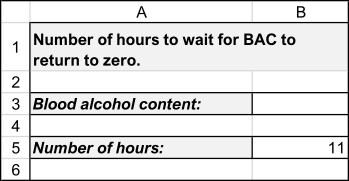
  1. By using appropriate grid references, write down a formula that could appear in cell B5.   (2 marks)

    --- 2 WORK AREA LINES (style=lined) ---

  2. Ben's friend Ryan's reading reflects that he will have to wait 11 hours for his BAC to return to zero. Using the formula, calculate the value Ryan entered into cell B3.   (2 marks)

    --- 5 WORK AREA LINES (style=lined) ---
Show Answers Only

a.    \(=\text{B3}/0.015\)

b.    \(0.165\)

Show Worked Solution

a.    \(=\text{B3}/0.015\)

b.    \(11\) \(=\dfrac{\text{BAC}}{0.015}\)
  \(\text{BAC}\) \(=11\times 0.015=0.165\)

  
\(\text{Ryan entered 0.165 into cell B3.}\)

Filed Under: Applications: BAC, D=SxT and Medication, Applications: BAC, Medicine and d=s x t Tagged With: Band 3, Band 5, smc-6235-10-\(BAC\) formula, smc-6235-60-Spreadsheets, smc-6509-10-BAC, smc-6509-60-Spreadsheets, syllabus-2027

Algebra, STD2 EQ-Bank 28

Fried's formula for determining the medicine dosage for children aged 1 - 2 years is:

\(\text{Dosage}=\dfrac{\text{Age of infant (months)}\  \times \ \text{adult dose}}{150}\)

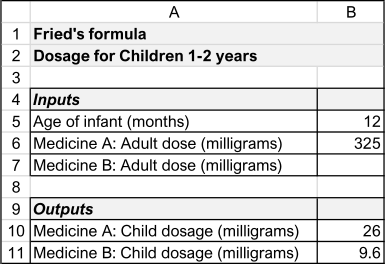
The spreadsheet below is used as a calculator for determining an infant's medicine dosage according to Fried's formula.
 

Amber, a 12 month old child, is being discharged from hospital with two medications. Medicine A has an adult dosage of 325 milligrams and she is to take 26 milligrams. She must also take 9.6 milligrams of Medicine B but the equivalent adult dosage has been left off the spreadsheet.

  1. By using appropriate grid references, write down a formula that could appear in cell B10.   (2 marks)

    --- 1 WORK AREA LINES (style=lined) ---

  2. Calculate the equivalent adult dosage for Medicine B (cell B7) using the information in the spreadsheet.    (2 marks)

    --- 5 WORK AREA LINES (style=lined) ---
Show Answers Only

a.    \(=\text{B5}^*\text{B6}/150\)

b.    \(120 \ \text{milligrams}\)

Show Worked Solution

a.     \(=\text{B5}^*\text{B6}/150\)
 

b.    \(\text{Let} \ A= \text{Adult dose}\)

\(\text{Using given formula:}\)

\(9.6\) \(=\dfrac{12 \times A}{150}\)
\(A\) \(=\dfrac{9.6 \times 150}{12}=120 \ \text{milligrams}\)

Filed Under: Applications: BAC, D=SxT and Medication, Applications: BAC, Medicine and d=s x t Tagged With: Band 4, Band 5, smc-6235-40-Medication Formulas, smc-6235-60-Spreadsheets, smc-6509-30-Medication Formulas, smc-6509-60-Spreadsheets, syllabus-2027

Algebra, STD2 EQ-Bank 12 MC

Young's formula for determining the medicine dosage for children aged 1 - 12 years is:

\(\text{Dosage} = \dfrac{\text{Age of child (years)}\ \times\ \text{Adult dose}}{\text{Age of child (years) } +\  12}\)

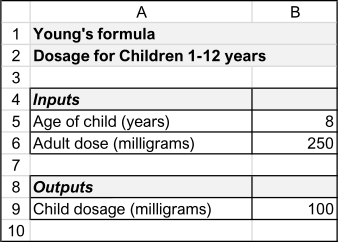
The spreadsheet below is used as a calculator for determining an child's medicine dosage according to Young's formula.


Young's formula for calculating an 8 year old child's dosage has been used in cell B9. Using appropriate cell references, the correct formula to input into cell B9 is:

  1. \(=\text{B5}^*\text{B6}/\text{B5}+12\)
  2. \(=(\text{B5}^*\text{B6})/\text{B5}+12\)
  3. \(=\text{B5}^*\text{B6}/(\text{B6}+12)\)
  4. \(=(\text{B5}^*\text{B6})/(\text{B5}+12)\)
Show Answers Only

\(D\)

Show Worked Solution

\(=(\text{B5}^*\text{B6})/(\text{B5}+12)\)

\(\Rightarrow D\)

Filed Under: Applications: BAC, D=SxT and Medication, Applications: BAC, Medicine and d=s x t Tagged With: Band 5, smc-6235-40-Medication Formulas, smc-6235-60-Spreadsheets, smc-6509-30-Medication Formulas, smc-6509-60-Spreadsheets, syllabus-2027

Algebra, STD2 EQ-Bank 26

Fried's formula for determining the medicine dosage for children aged 1 - 2 years is:

\(\text{Dosage}=\dfrac{\text{Age of infant (months)}\  \times \ \text{adult dose}}{150}\)

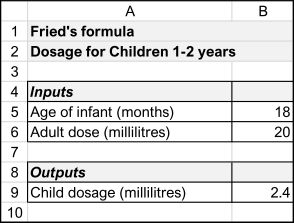
The spreadsheet below is used as a calculator for determining an infant's medicine dosage according to Fried's formula.
 

  1. By using appropriate grid references, write down a formula that could appear in cell B9.   (2 marks)

    --- 1 WORK AREA LINES (style=lined) ---

  2. Another infant requiring the same medicine has been recommended a dosage of 2 millilitres. What is the age of the infant?   (2 marks)

    --- 5 WORK AREA LINES (style=lined) ---
Show Answers Only

a.    \(=\text{B5}^*\text{B6}/150\)

b.    \(15 \ \text{months}\)

Show Worked Solution

a.     \(=\text{B5}^*\text{B6}/150\)
 

b.    \(\text{Let} \ n= \text{age of infant}\)

\(\text{Using given formula:}\)

\(2\) \(=\dfrac{n \times 20}{150}\)
\(n\) \(=\dfrac{2 \times 150}{20}=15 \ \text{months}\)

Filed Under: Applications: BAC, D=SxT and Medication, Applications: BAC, Medicine and d=s x t Tagged With: Band 4, Band 5, smc-6235-40-Medication Formulas, smc-6235-60-Spreadsheets, smc-6509-30-Medication Formulas, smc-6509-60-Spreadsheets, syllabus-2027

Algebra, STD2 EQ-Bank 31

Clark's formula for determining the medicine dosage for children is:

\(\text{Dosage}=\dfrac{\text{weight in kilograms}\  \times \ \text{adult dosage}}{70}\)

The spreadsheet below is used as a calculator for determining a child's medicine dosage according to Clark's formula.
 

  1. By using appropriate grid references, write down a formula that could appear in cell E5.   (2 marks)

    --- 1 WORK AREA LINES (style=lined) ---

  2. Another child requiring the same medicine has been recommended a dosage of 62.5 milligrams. How much does the child weigh?   (2 marks)

    --- 5 WORK AREA LINES (style=lined) ---

Show Answers Only

a.    \(=\text{B6}^*\text{B5}/70\)

b.    \(17.5 \ \text{kilograms}\)

Show Worked Solution

a.    \(=\text{B6}^*\text{B5}/70\)
 

b.    \(\text{Let} \ w= \text{weight of the child.}\)

\(\text{Using given formula:}\)

\(62.5\) \(=\dfrac{w \times 250}{70}\)
\(w\) \(=\dfrac{62.5 \times 70}{250}=17.5 \ \text{kilograms}\)

Filed Under: Applications: BAC, D=SxT and Medication, Applications: BAC, Medicine and d=s x t Tagged With: Band 4, Band 5, smc-6235-40-Medication Formulas, smc-6235-60-Spreadsheets, smc-6509-30-Medication Formulas, smc-6509-60-Spreadsheets, syllabus-2027

Algebra, STD2 EQ-Bank 23

Sharon drinks three glasses of chardonnay over a 180-minute period, each glass containing 1.6 standard drinks.

Sharon weighs 78 kilograms, and her blood alcohol content (BAC) at the end of this period can be calculated using the following formula:

\(\text{BAC}_{\text {female }}=\dfrac{10 N-7.5 H }{5.5 M}\)

where \(N\) = number of standard drinks consumed
\(H\) = the number of hours drinking
\(M\) = the person's mass in kilograms

 
The spreadsheet below can be used to calculate Sharon's \(\text{BAC}\).
 

  1. What value should be input into cell B5.   (1 mark)

    --- 2 WORK AREA LINES (style=lined) ---

  2. Write down the formula that has been used in cell E4, using appropriate grid references.   (2 marks)

    --- 2 WORK AREA LINES (style=lined) ---

Show Answers Only

a.    \(\text{Cell B5 value}=3\)

b.  \(=\left(10^* \text{B4}-7.5^* \text{B5}\right) /(5.5^* \text{B6})\)

Show Worked Solution

a.    \(\text{180 minutes}\ =\ \text{3 hours}\)

\(\therefore \ \text{Cell B5 value}=3\)
 

b.  \(=\left(10^* \text{B4}-7.5^* \text{B5}\right) /(5.5^* \text{B6})\)

Filed Under: Applications: BAC, D=SxT and Medication, Applications: BAC, Medicine and d=s x t Tagged With: Band 3, Band 5, smc-6235-10-\(BAC\) formula, smc-6235-60-Spreadsheets, smc-6509-10-BAC, smc-6509-60-Spreadsheets, syllabus-2027

Copyright © 2014–2026 SmarterEd.com.au · Log in